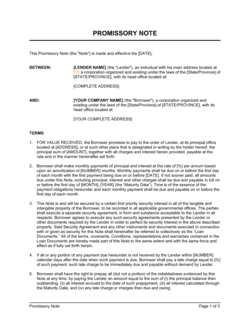
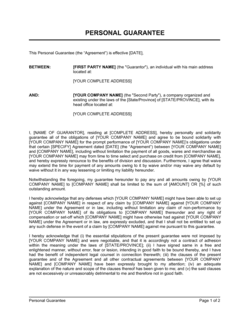
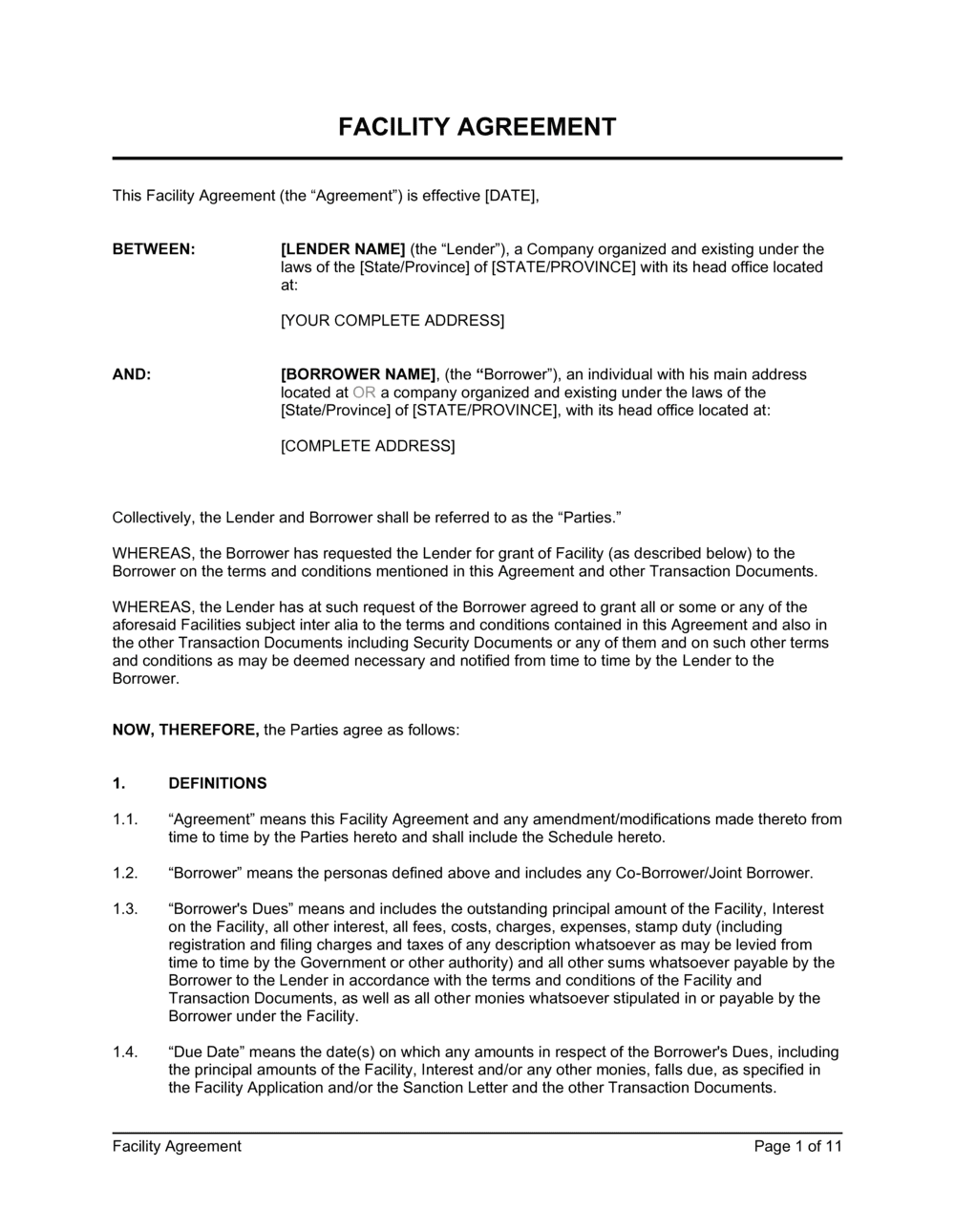
Facility Agreement Template

Free Word download • Edit online • Save & share with Drive • Export to PDF

11 pages30–40 min to fillDifficulty: ComplexSignature requiredLegal review recommended
Learn more ↓
FreeFacility Agreement Template

At a glance

What it is
A Facility Agreement is a legally binding contract between a lender and a borrower that sets out the full terms under which credit is made available — the facility limit, drawdown mechanics, interest rate, repayment schedule, financial covenants, security, and events of default. This free Word download gives businesses and lenders a structured, professionally formatted starting point they can edit online and export as PDF for execution.
When you need it
Use it when a lender is extending a term loan, revolving credit line, or multi-draw facility to a business borrower and both parties need a single governing document that replaces informal letter agreements. It is also required by most corporate legal departments before any material credit arrangement is booked on a balance sheet.
What's inside
Parties and facility limit, purpose of the facility, drawdown conditions, interest rate and margin, repayment and prepayment terms, financial and information covenants, security and guarantee provisions, representations and warranties, events of default, and governing law and jurisdiction.

What is a Facility Agreement?

A Facility Agreement is a legally binding contract between a lender and a borrower that governs the full terms on which credit is made available to a business — covering the maximum committed amount, the mechanics for drawing and repaying funds, the interest rate and margin, financial covenants the borrower must maintain, the security package that backs the lending, and the events that entitle the lender to demand immediate repayment. Unlike a simple promissory note, a facility agreement is a comprehensive lending instrument designed for ongoing or multi-draw credit arrangements where the lender requires enforceable covenants and registered collateral throughout the life of the facility. It is the standard governing document used by banks, private debt funds, and institutional lenders for corporate credit relationships of any material size.

Why You Need This Document

Extending or accepting credit without a formal facility agreement exposes both parties to avoidable risk at every stage of the relationship. For lenders, the absence of a written agreement means no enforceable covenants to detect credit deterioration early, no security registration to establish priority over other creditors, and no acceleration mechanism to demand repayment if the borrower's financial position weakens. For borrowers, an undocumented facility leaves repayment terms, interest rates, and drawdown rights entirely at the lender's discretion — with no contractual protection against unilateral changes. A properly executed facility agreement, with security registered within the statutory window, creates a clear legal framework that protects both parties, satisfies the documentation requirements of auditors and regulators, and provides an enforceable basis for resolving disputes without litigation. This template gives you that framework in a professionally structured Word document you can tailor to your specific transaction and execute with confidence.

Which variant fits your situation?

If your situation is…Use this template
Lending a fixed lump sum repaid over a set scheduleTerm Loan Facility Agreement
Providing a revolving credit line the borrower can draw and repay repeatedlyRevolving Credit Facility Agreement
Funding an acquisition or leveraged buyoutAcquisition Finance Facility Agreement
Providing short-term working capital between cash-flow cyclesWorking Capital Facility Agreement
Lending to an individual rather than a corporate entityPersonal Loan Agreement
A simple one-off loan between two businesses without revolving mechanicsBusiness Loan Agreement
A short-term bridge facility pending a refinancing or asset saleBridge Loan Agreement

Common mistakes to avoid

❌ Referencing LIBOR without a replacement rate fallback

Why it matters: LIBOR was permanently discontinued in June 2023. An agreement that references LIBOR with no fallback rate leaves the interest calculation mechanism void, making the entire interest clause unenforceable.

Fix: Replace all LIBOR references with the appropriate risk-free rate — SOFR for USD, SONIA for GBP, €STR for EUR — and include a fallback provision specifying the calculation method if the reference rate is temporarily unavailable.

❌ Failing to register security within the statutory window

Why it matters: In most jurisdictions, a charge or security interest that is not registered within the required period (21 days in the UK, 30 days in many US states) is void against a liquidator and unsecured creditors, leaving the lender with no priority.

Fix: Build security registration deadlines into a conditions precedent checklist and assign a responsible party — lender's counsel or the borrower's company secretary — with a confirmed completion date before the first drawdown is released.

❌ Setting financial covenants with no headroom

Why it matters: Covenant levels set at or near the borrower's current ratios are breached at the first quarter of underperformance, triggering a technical default even when the borrower is solvent and servicing all payments on time.

Fix: Set covenant levels with at least 15–20% headroom above the borrower's most recent audited ratios and negotiate a waiver or reset mechanism for material business changes.

❌ Omitting a cure period for events of default

Why it matters: An automatic-default clause with no remedy window can accelerate a facility and force insolvency for a borrower experiencing a temporary issue, exposing the lender to accusations of wrongful acceleration.

Fix: Include a grace period of at least 5 business days for payment defaults and 30 days for covenant breaches, with a right for the borrower to remedy before acceleration is triggered.

❌ Using a trade name instead of the borrower's registered entity name

Why it matters: Security registrations, court enforcement, and insolvency claims all require the exact registered legal name. A mismatch — even a single missing word — can invalidate the registration or allow the borrower to dispute the claim.

Fix: Verify the borrower's exact registered name against the relevant company registry before drafting, and include the registration number and jurisdiction in the parties clause.

❌ No cross-default provision

Why it matters: Without cross-default language, a borrower can default on a larger senior facility while continuing to draw on this facility, creating hidden credit exposure the lender cannot act on until an express default under this agreement occurs.

Fix: Include a cross-default clause that triggers an event of default if any other financial indebtedness above a defined threshold is accelerated or unpaid at maturity.

The 10 key clauses, explained

Parties, Facility Type, and Facility Limit

In plain language: Identifies the lender and borrower as legal entities, labels the type of facility (term, revolving, or multi-draw), and states the maximum committed amount.

Sample language
This Facility Agreement is entered into on [DATE] between [LENDER LEGAL NAME] ('Lender') and [BORROWER LEGAL NAME], a [STATE/JURISDICTION] [ENTITY TYPE] ('Borrower'). The Lender agrees to make available to the Borrower a [TYPE] facility in an aggregate principal amount not exceeding [CURRENCY][AMOUNT] ('Facility Limit').

Common mistake: Using a trade name instead of the borrower's registered legal entity. If the borrowing entity name does not match the company's constitutional documents, security registrations and enforcement steps may be challenged.

Purpose

In plain language: Restricts how the borrower may use the drawn funds to a defined purpose — such as working capital, capital expenditure, or a specific acquisition.

Sample language
The Borrower shall apply all amounts borrowed under this Agreement solely for [PERMITTED PURPOSE, e.g., general working capital purposes / acquisition of [TARGET NAME]]. The Lender is not obliged to monitor the application of drawn funds.

Common mistake: Leaving the purpose clause blank or writing 'general corporate purposes' when the facility is earmarked for a specific use. An undefined purpose weakens the lender's ability to call a default if funds are misapplied.

Drawdown Conditions and Mechanics

In plain language: Sets out how the borrower requests funds, the minimum notice period, minimum drawdown amounts, and the conditions that must be satisfied before the lender is obliged to fund.

Sample language
The Borrower may submit a Drawdown Notice to the Lender no later than [X] Business Days prior to the proposed Utilisation Date. Each drawdown shall be in a minimum amount of [CURRENCY][MINIMUM AMOUNT]. The Lender's obligation to fund is conditional upon: (a) no Event of Default subsisting; (b) all Conditions Precedent being satisfied; and (c) the Representations being true and correct.

Common mistake: Failing to list all conditions precedent explicitly. Lenders who fund before receiving board resolutions or executed security documents may lose priority over other creditors.

Interest Rate, Margin, and Payment Dates

In plain language: States whether the rate is fixed or floating, identifies the reference rate, sets the margin above that rate, and specifies when interest must be paid.

Sample language
Interest on each Drawing accrues at a rate per annum equal to [SOFR / SONIA / fixed rate of X]% plus the Margin of [X]% per annum, calculated on a [365/360]-day basis. Interest is payable on the last Business Day of each [monthly / quarterly] Interest Period.

Common mistake: Referencing LIBOR without a replacement rate fallback. LIBOR was discontinued in 2023; agreements that do not include SOFR (US) or SONIA (UK) fallback language create an unresolvable rate calculation dispute.

Repayment and Prepayment

In plain language: Defines the amortisation schedule or bullet repayment date, and states the borrower's right or obligation to prepay early, including any associated fees.

Sample language
The Borrower shall repay the outstanding principal in [equal quarterly instalments of [CURRENCY][AMOUNT] / a single bullet payment on the Maturity Date of [DATE]]. The Borrower may prepay all or part of any Drawing on [X] Business Days' prior written notice, subject to a prepayment fee of [X]% of the amount prepaid if prepayment occurs within [X] months of the first Utilisation Date.

Common mistake: Omitting a prepayment fee provision for fixed-rate facilities. Without one, the lender has no compensation for reinvestment risk when the borrower repays early at a lower rate environment.

Financial Covenants

In plain language: Sets quantitative tests the borrower must meet at each test date — typically covering leverage, interest cover, and minimum liquidity — with the consequence of breach being an event of default.

Sample language
The Borrower shall ensure that, as at each Test Date: (a) the ratio of Total Net Debt to EBITDA shall not exceed [X]:1; (b) the ratio of EBITDA to Net Finance Charges shall not be less than [X]:1; and (c) unrestricted cash and cash equivalents shall not fall below [CURRENCY][AMOUNT].

Common mistake: Setting covenant levels too tight relative to the borrower's historical performance, leaving no headroom. A covenant breach triggers a technical default even when the borrower is fully solvent and servicing debt on time.

Representations and Warranties

In plain language: A set of factual statements by the borrower confirming legal capacity, valid authority, accuracy of financial statements, no undisclosed litigation, and compliance with laws — typically repeated on each drawdown.

Sample language
The Borrower represents and warrants to the Lender on the date of this Agreement and on each Utilisation Date that: (a) it is duly incorporated and validly existing; (b) it has full power and authority to enter into and perform this Agreement; (c) its most recent audited financial statements fairly present its financial position; and (d) no litigation, arbitration, or administrative proceeding is pending or threatened that would have a Material Adverse Effect.

Common mistake: Borrowers signing representations without disclosing known exceptions. An undisclosed matter that later surfaces can be treated as a misrepresentation and trigger an event of default retroactively.

Events of Default and Acceleration

In plain language: Lists the circumstances that entitle the lender to cancel undrawn commitments, demand immediate repayment, and enforce security — including payment default, covenant breach, insolvency, and cross-default.

Sample language
Each of the following constitutes an Event of Default: (a) the Borrower fails to pay any amount due within [X] Business Days of its due date; (b) any Financial Covenant is breached and not remedied within [X] days; (c) the Borrower becomes insolvent or enters any insolvency process; (d) any other Financial Indebtedness of the Borrower exceeding [CURRENCY][THRESHOLD] is accelerated (cross-default). Upon an Event of Default, the Lender may by written notice accelerate all outstanding amounts.

Common mistake: No cure period for covenant breaches. An automatic-default trigger without any remedy window can cause otherwise-solvent borrowers to tip into insolvency unnecessarily, exposing the lender to reputational and legal risk.

Security and Guarantees

In plain language: Identifies the collateral the borrower grants to secure repayment — such as a fixed and floating charge over assets, share pledge, or real property mortgage — and any guarantees from parent entities or principals.

Sample language
As continuing security for its obligations under this Agreement, the Borrower shall, on or before the first Utilisation Date, grant in favour of the Lender: (a) a first-ranking fixed and floating charge over all its assets and undertaking; and (b) a share pledge over [X]% of the issued share capital of [SUBSIDIARY NAME]. [GUARANTOR NAME] shall execute the Guarantee in the form set out in Schedule [X].

Common mistake: Not registering the security interest within the required statutory timeframe. In most jurisdictions, failure to register within 21–30 days of creation renders the security void against a liquidator or other creditors.

Governing Law and Jurisdiction

In plain language: Specifies which country's or state's law governs interpretation and enforcement, and in which courts disputes must be resolved.

Sample language
This Agreement and any non-contractual obligations arising out of or in connection with it are governed by the laws of [GOVERNING LAW JURISDICTION]. Each party irrevocably submits to the [exclusive / non-exclusive] jurisdiction of the courts of [COURT JURISDICTION] to settle any dispute arising out of or in connection with this Agreement.

Common mistake: Selecting a governing law that has no operational nexus to either party. Enforcement courts in some jurisdictions will decline to apply foreign law on commercial lending terms, creating an unenforceable agreement in the very jurisdiction where assets are located.

How to fill it out

  1. 1

    Identify the parties with their full legal names

    Enter the lender's and borrower's registered legal entity names exactly as they appear in their constitutional documents. Include registration numbers, jurisdiction of incorporation, and registered address for each party.

    💡 Cross-reference the borrower's company registry filing before execution — a name mismatch can invalidate security registrations filed in the borrower's name.

  2. 2

    Define the facility type, limit, and currency

    Choose the facility type — term loan, revolving, or multi-draw — and state the maximum committed amount and the currency of denomination. If the facility is multicurrency, list each permitted currency.

    💡 For revolving facilities, also specify the minimum utilisation amount and the clean-down period (the number of days per year the facility must be fully repaid) to prevent permanent reliance on the line.

  3. 3

    Set the interest rate, margin, and reference rate

    Choose a fixed rate or a floating reference rate (SOFR for USD, SONIA for GBP, €STR for EUR) plus a margin. State the interest calculation basis (Actual/365 or Actual/360) and the interest payment dates.

    💡 Include a rate fallback clause specifying what rate applies if the reference rate is unavailable or discontinued — omitting this is one of the most common errors in current facility agreements.

  4. 4

    Complete the drawdown mechanics and conditions precedent

    Specify the notice period for drawdown requests, minimum drawdown amounts, and the full list of conditions precedent the borrower must satisfy before the first utilisation — board resolutions, constitutional documents, executed security, and legal opinions.

    💡 Attach conditions precedent as a numbered Schedule so each item can be checked off and initialled by the lender's legal team on completion.

  5. 5

    Draft the repayment schedule and prepayment terms

    Enter the amortisation table or bullet repayment date, and state any prepayment fee, minimum prepayment amount, and the notice period required. For revolving facilities, confirm whether the commitment reduces permanently on each repayment.

    💡 For term loans, include a cash-sweep provision requiring the borrower to apply a percentage of excess cash flow to accelerated repayment — this protects the lender if profitability exceeds projections.

  6. 6

    Calibrate financial covenants against the borrower's financials

    Set leverage, interest cover, and liquidity covenant levels based on the borrower's last two years of audited accounts and projected financials, with at least 15–20% headroom above current ratios.

    💡 Negotiate a covenant reset mechanism that allows levels to be reset once per year if the borrower's business changes materially — this reduces the risk of technical defaults that benefit neither party.

  7. 7

    Specify the security package and registration obligations

    List every security document to be executed, including the party granting it and the assets covered. Note the jurisdiction-specific registration deadline for each instrument.

    💡 Build a security perfection checklist into the conditions precedent so no registration step is missed in the closing process.

  8. 8

    Confirm governing law and sign before first drawdown

    Choose a governing law with a direct operational connection to at least one party. Both parties must sign before — or simultaneously with — the first drawdown; post-drawdown signature weakens enforceability of representations repeated at utilisation.

    💡 Use a digital execution platform that timestamps signing and stores the fully executed copy with both parties automatically.

Frequently asked questions

What is a facility agreement?

A facility agreement is a legally binding contract between a lender and a borrower that sets out the full terms on which credit is made available — including the maximum amount, drawdown mechanics, interest rate, repayment schedule, financial covenants, security, and events of default. It is the governing document for most commercial lending relationships, replacing informal letter agreements once a facility exceeds a material threshold or requires security.

What is the difference between a facility agreement and a loan agreement?

The terms are often used interchangeably, but a facility agreement typically refers to a more structured arrangement that may permit multiple drawings over time — such as a revolving credit line or multi-draw term facility — rather than a single lump-sum disbursement. A simple loan agreement usually covers a one-time advance with a fixed repayment schedule. Facility agreements also tend to include more detailed covenant and security packages reflecting the ongoing nature of the credit relationship.

What types of facility are covered by this template?

This template can be adapted for a term loan facility (fixed drawings repaid on a schedule), a revolving credit facility (drawn, repaid, and redrawn repeatedly up to the limit), or a multi-draw facility (multiple disbursements during a commitment period with a single repayment date). The drawdown mechanics, repayment, and commitment-fee clauses should be adjusted to match the facility type chosen.

What are financial covenants and why do they matter?

Financial covenants are quantitative tests — such as maximum net debt-to-EBITDA leverage or minimum interest cover — that the borrower must pass at each test date, typically quarterly. They give the lender an early warning of deteriorating credit quality before a payment default occurs. A covenant breach is itself an event of default, giving the lender rights to accelerate or renegotiate terms even if the borrower is still making payments on time.

Is a facility agreement legally required for business lending?

No statute requires a written facility agreement for every loan, but institutional lenders, private debt funds, and most sophisticated private lenders will not advance material credit without one. A written agreement is essential to enforce the security package, rely on representations, and accelerate on a covenant breach. Without it, the lender's claim is limited to the amount advanced with simple interest, and enforcing repayment requires litigation rather than contractual acceleration.

What security is typically included in a facility agreement?

For corporate borrowers, lenders typically require a fixed and floating charge over all assets and undertaking, a share pledge over the borrower's subsidiaries, and sometimes a debenture over specific real property or intellectual property. Parent guarantees or personal guarantees from directors are common for smaller businesses or where the borrower's standalone credit quality is insufficient. The security package must be registered at the relevant company registry within the statutory window to be enforceable against third parties.

What happens when an event of default occurs?

When an event of default occurs, the lender typically has the right to cancel any undrawn commitment, declare all outstanding principal and accrued interest immediately due and payable (acceleration), and enforce any security granted. Most agreements include grace periods — commonly 5 business days for payment defaults and 20–30 days for covenant breaches — before the lender can exercise these rights. The borrower may also seek a waiver or covenant reset from the lender if the breach is technical rather than a sign of genuine credit deterioration.

Do I need a lawyer to complete a facility agreement?

For straightforward bilateral term loans between two domestic parties, a high-quality template reviewed by a finance lawyer is usually sufficient. Legal advice is strongly recommended when the facility involves security registration in multiple jurisdictions, cross-border parties, a leveraged acquisition structure, or complex covenant packages. The cost of a 1–3 hour legal review ($500–$1,500) is small relative to the risk of an unenforceable security interest or an acceleration clause that cannot withstand court scrutiny.

What reference rate should I use now that LIBOR has been discontinued?

For USD facilities, use the Secured Overnight Financing Rate (SOFR), published daily by the New York Federal Reserve. For GBP facilities, use SONIA (Sterling Overnight Index Average), published by the Bank of England. For EUR facilities, use €STR (Euro Short-Term Rate), published by the European Central Bank. Each rate is compounded in arrears over the interest period using a standard compounding convention; the template should specify the compounding method and include a fallback for days when the reference rate is not published.

How this compares to alternatives

vs Loan Agreement

A loan agreement governs a single lump-sum advance disbursed at signing and repaid on a fixed schedule. A facility agreement is broader — it may permit multiple drawings over a commitment period, revolving access, and more detailed covenant and security packages. For a straightforward one-time loan, a loan agreement is simpler; for ongoing credit access, a facility agreement is the appropriate instrument.

vs Line of Credit Agreement

A line of credit agreement is the consumer or small-business equivalent of a revolving facility — it permits flexible drawings up to a limit but typically lacks the detailed financial covenants, security package, and representations block that a facility agreement contains. Facility agreements are used in corporate finance contexts where the lender requires enforceable covenants and registered security; lines of credit suit simpler, unsecured arrangements.

vs Promissory Note

A promissory note is a short-form unconditional promise to repay a fixed sum with interest — typically one to two pages with no covenants, conditions precedent, or security provisions. It is suitable for simple intercompany loans or informal arrangements. A facility agreement is a full-form lending document appropriate when the lender needs ongoing comfort through covenants and security. In some transactions, a promissory note is issued as a standalone drawdown instrument under an overarching facility agreement.

vs Mortgage Agreement

A mortgage agreement is a specific security instrument over real property, creating the lender's charge over land. A facility agreement is the primary lending contract that governs the credit terms and typically requires a mortgage as part of the security package rather than substituting for it. The two documents are used together when property is offered as collateral — the facility agreement governs repayment and covenants while the mortgage agreement creates and registers the security interest.

Industry-specific considerations

Financial Services

Bilateral and syndicated facility agreements are the primary lending instrument; financial covenants reference regulatory capital ratios and liquidity coverage requirements alongside standard leverage tests.

Real Estate and Construction

Development finance facilities include drawdown tranches tied to construction milestones, loan-to-value ratio covenants, and fixed and floating charges over the development site and receivables.

Manufacturing

Working capital revolvers secured against inventory and receivables; borrowing-base mechanics allow available credit to fluctuate with eligible asset values on a monthly calculation.

Technology / SaaS

Venture debt and revenue-based facilities use MRR multiples as the borrowing base and include IP security provisions covering software, patents, and domain names as part of the collateral package.

Jurisdictional notes

United States

US facility agreements are governed by either New York or Delaware law for most commercial transactions. Article 9 of the UCC governs security interests over personal property; a UCC-1 financing statement must be filed with the relevant Secretary of State, typically within 20 days of security creation. SOFR has replaced USD LIBOR as the standard reference rate. State usury laws cap interest rates for certain borrower types — confirm the applicable ceiling before setting the margin.

Canada

Canadian facility agreements are most commonly governed by Ontario or British Columbia law. Personal Property Security Act (PPSA) filings are required to perfect security interests over moveable assets in each province where the borrower carries on business. Quebec's Civil Code creates a distinct security regime — a hypothec replaces the common-law charge and must be published at the Registre des droits personnels et réels mobiliers (RDPRM). CORRA (Canadian Overnight Repo Rate Average) is the replacement for CDOR as the standard floating reference rate.

United Kingdom

English law is the dominant governing law for European and international facility agreements, reflecting the depth of UK finance courts. Charges over UK company assets must be registered at Companies House within 21 days of creation under the Companies Act 2006; failure to register renders the charge void against a liquidator. SONIA has replaced GBP LIBOR. The Loan Market Association (LMA) publishes widely used standard form facility agreements that practitioners adapt; this template follows LMA structural conventions.

European Union

EU facility agreements are typically governed by the law of the member state where the borrower is domiciled — German, French, or Dutch law are common for large corporates. The European Leveraged Finance Association (ELFA) publishes guidance aligned with LMA standards. €STR replaces EURIBOR as the overnight reference rate, though term EURIBOR remains in use for many term facilities. GDPR compliance is relevant where the agreement requires ongoing sharing of financial and management information between parties in different member states.

Template vs lawyer — what fits your deal?

PathBest forCostTime
Use the templateStraightforward bilateral term loans or revolving facilities between domestic parties with simple securityFree2–4 hours
Template + legal reviewFacilities with a security package requiring registration, financial covenants, or cross-border elements$500–$1,500 for a finance lawyer review2–5 days
Custom draftedSyndicated facilities, leveraged acquisitions, multi-jurisdiction security, or regulated lending structures$5,000–$25,000+2–6 weeks

Glossary

Facility Limit
The maximum aggregate principal amount the lender commits to make available to the borrower under the agreement.
Drawdown
A request by the borrower to utilise all or part of the available facility, subject to conditions precedent being satisfied.
Commitment Period
The period during which the borrower may submit drawdown requests; undrawn amounts typically lapse or incur a commitment fee after this period.
Margin
The percentage added to a reference rate (e.g., SOFR or SONIA) to arrive at the total interest rate payable on outstanding drawings.
Financial Covenant
A contractual test — such as minimum interest cover or maximum leverage — that the borrower must satisfy on a regular basis, typically quarterly.
Event of Default
A defined circumstance — such as missed payment, covenant breach, or insolvency — that entitles the lender to accelerate repayment and enforce security.
Acceleration
The lender's right, following an event of default, to declare all outstanding amounts immediately due and payable rather than waiting for the scheduled repayment date.
Representations and Warranties
Factual statements made by the borrower at signing — and often repeated on each drawdown — confirming legal capacity, no litigation, and accuracy of financial statements.
Conditions Precedent
Documents and confirmations the borrower must deliver to the lender before the first drawdown is permitted — typically constitutional documents, board resolutions, and legal opinions.
Security Package
The collateral arrangements supporting the facility — which may include fixed and floating charges over assets, share pledges, or personal guarantees.
Prepayment
Early repayment of all or part of the outstanding facility, which may attract a prepayment fee or require a minimum notice period.
Commitment Fee
A fee charged on the undrawn portion of the facility during the commitment period, compensating the lender for holding capital available.

Part of your Business Operating System

This document is one of 3,000+ business & legal templates included in Business in a Box.

  • Fill-in-the-blanks — ready in minutes
  • 100% customizable Word document
  • Compatible with all office suites
  • Export to PDF and share electronically

Create your document in 3 simple steps.

From template to signed document — all inside one Business Operating System.
1
Download or open template

Access over 3,000+ business and legal templates for any business task, project or initiative.

2
Edit and fill in the blanks with AI

Customize your ready-made business document template and save it in the cloud.

3
Save, Share, Send, Sign

Share your files and folders with your team. Create a space of seamless collaboration.

Save time, save money, and create top-quality documents.

★★★★★

"Fantastic value! I'm not sure how I'd do without it. It's worth its weight in gold and paid back for itself many times."

Managing Director · Mall Farm
Robert Whalley
Managing Director, Mall Farm Proprietary Limited
★★★★★

"I have been using Business in a Box for years. It has been the most useful source of templates I have encountered. I recommend it to anyone."

Business Owner · 4+ years
Dr Michael John Freestone
Business Owner
★★★★★

"It has been a life saver so many times I have lost count. Business in a Box has saved me so much time and as you know, time is money."

Owner · Upstate Web
David G. Moore Jr.
Owner, Upstate Web

Run your business with a system — not scattered tools

Stop downloading documents. Start operating with clarity. Business in a Box gives you the Business Operating System used by over 250,000 companies worldwide to structure, run, and grow their business.

Start free · No credit card required