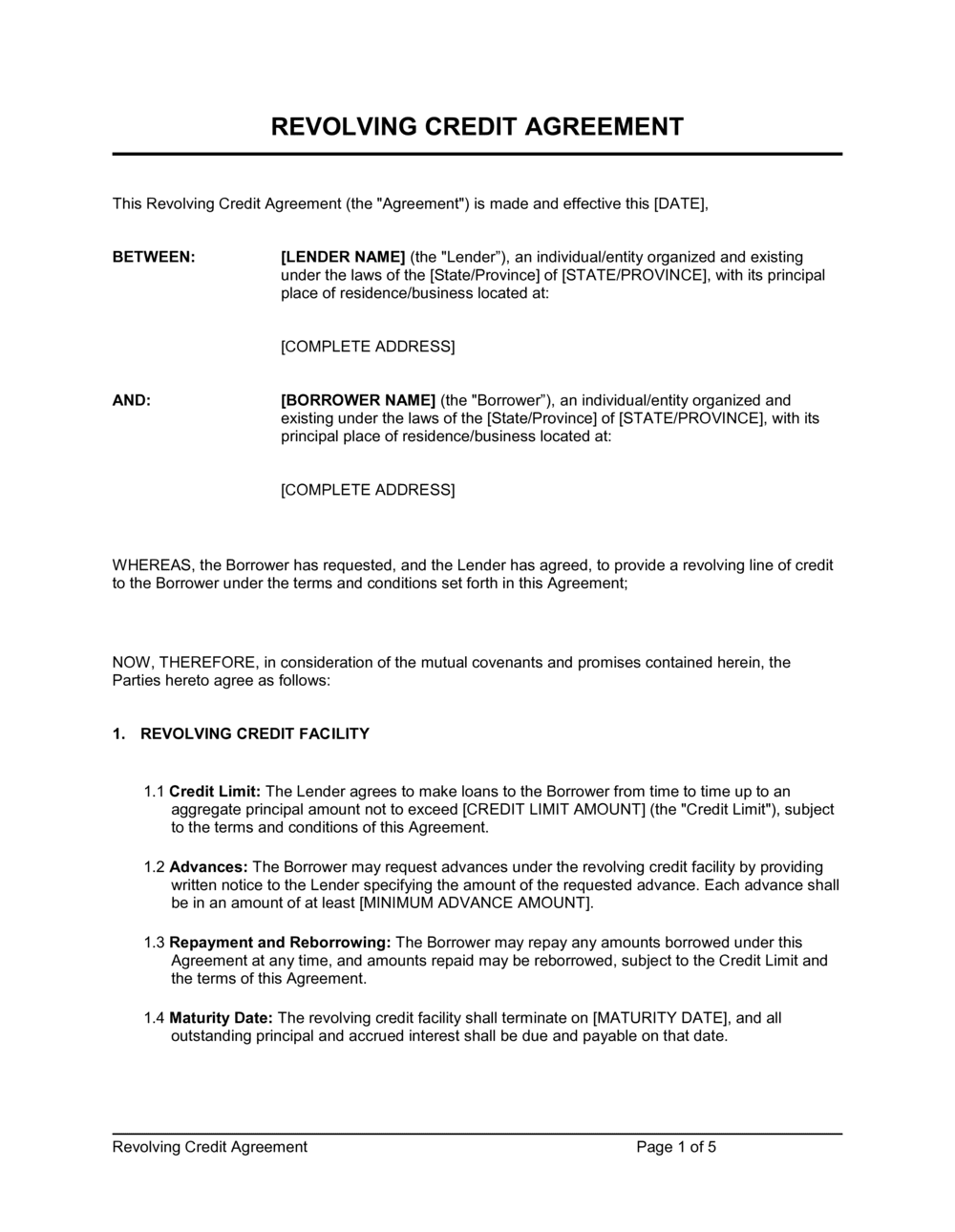
Revolving Credit Agreement Template

Free Word download β€’ Edit online β€’ Save & share with Drive β€’ Export to PDF

5 pagesβ€’25–35 min to fillβ€’Difficulty: Complexβ€’Signature requiredβ€’Legal review recommended
Learn more ↓
FreeRevolving Credit Agreement Template

At a glance

What it is
A Revolving Credit Agreement is a legally binding contract between a lender and a borrower that establishes a renewable credit facility up to a defined maximum β€” the borrower draws funds as needed, repays them, and draws again within the credit limit and term. This free Word download gives you a structured, attorney-reviewed starting point you can edit online and export as PDF for execution between business parties.
When you need it
Use it when a lender β€” a bank, private creditor, or affiliated entity β€” and a business borrower agree to an ongoing, flexible financing arrangement rather than a single fixed-amount loan. It is typically executed at the outset of the credit relationship before any funds are drawn.
What's inside
Credit limit and availability, drawdown request procedure, interest rate and calculation method, repayment and revolving mechanics, fees, financial and operational covenants, events of default, lender remedies, security and collateral references, and governing law.

What is a Revolving Credit Agreement?

A Revolving Credit Agreement is a legally binding contract between a lender and a business borrower that establishes a renewable credit facility up to a defined maximum commitment amount. Unlike a term loan β€” which disburses a fixed sum once and amortizes on a set schedule β€” a revolving facility allows the borrower to draw funds as needed, repay them, and draw again within the credit limit throughout the revolving period. The outstanding balance fluctuates with the borrower's cash needs, and interest accrues only on the drawn amount at any given time. This structure makes revolving credit agreements the standard instrument for working-capital financing, seasonal inventory purchases, and liquidity management across industries from retail to manufacturing to professional services.

Why You Need This Document

Operating a revolving credit facility without a formal written agreement exposes both the lender and borrower to significant risk. Without defined covenants, the lender has no early-warning mechanism before a borrower's financial position deteriorates to the point of non-payment. Without a clear events-of-default and acceleration clause, collecting an overdue balance requires lengthy litigation rather than a contractual remedy. For the borrower, an undocumented facility can be recalled without notice, leaving a working-capital gap at the worst possible time. A properly drafted revolving credit agreement locks in the credit limit, interest rate, repayment mechanics, and cure periods β€” giving both parties a predictable framework and a roadmap for resolving problems before they escalate. This template provides the structure a commercial lender or business borrower needs to document the facility correctly, protect security interests, and comply with applicable law from day one.

Which variant fits your situation?

If your situation is…Use this template
One-time fixed loan rather than a reusable credit lineLoan Agreement
Short-term bridge financing with a single repayment datePromissory Note
Intercompany loan from parent entity to subsidiaryIntercompany Loan Agreement
Line of credit secured by accounts receivable or inventoryAsset-Based Lending Agreement
Personal loan or consumer line of creditPersonal Loan Agreement
Credit extended to a buyer as part of a commercial saleCredit Agreement (Trade Credit)
Syndicated facility with multiple lenders sharing the commitmentSyndicated Credit Facility Agreement

Common mistakes to avoid

❌ No defined maturity date or revolving period end

Why it matters: An open-ended commitment creates an indefinite contingent liability for the lender and removes the borrower's incentive to refinance or repay. Auditors may also require unfavorable balance-sheet treatment.

Fix: Set a specific maturity date β€” typically 12, 24, or 36 months from closing β€” with optional renewal mechanics requiring affirmative lender consent.

❌ Using retired LIBOR as the reference rate

Why it matters: LIBOR was formally discontinued for USD, GBP, EUR, JPY, and CHF by mid-2023. A credit agreement referencing LIBOR has no operative rate mechanism and will fail to accrue interest correctly.

Fix: Replace LIBOR with the applicable successor rate β€” SOFR for USD, SONIA for GBP, EURIBOR for EUR β€” and include a regulatory-compliant fallback rate provision.

❌ Failing to perfect the security interest after execution

Why it matters: Signing a security agreement does not create priority over other creditors. Without UCC or PPSA registration, the lender is unsecured in a bankruptcy and ranks behind perfected secured creditors.

Fix: File a UCC-1 financing statement (US) or PPSA financing statement (Canada) within the prescribed period after execution to perfect and publicize the security interest.

❌ Setting financial covenants without headroom

Why it matters: A covenant set exactly at the borrower's current ratio level triggers a technical default the moment performance dips slightly, forcing expensive waiver negotiations and straining the lending relationship.

Fix: Set covenant thresholds at 15–20% below the borrower's current baseline after reviewing the most recent two years of audited financials, and include a 30-day cure period before acceleration.

❌ No minimum drawdown notice period

Why it matters: Without a required advance notice for draws, lenders face same-day funding demands they cannot operationally accommodate, leading to disputes about whether a draw request was honored in breach.

Fix: Specify a minimum of 2–3 business days' prior written notice for each draw, and require a completed drawdown certificate confirming no existing default.

❌ Omitting a material adverse change definition

Why it matters: An undefined MAC clause is either too broad to enforce or too narrow to capture genuine deterioration β€” courts have invalidated vague MAC provisions as subjective and unenforceable.

Fix: Define Material Adverse Change with specificity: reference thresholds such as a decline exceeding [X]% in revenue, net assets below $[X], or loss of a key license, rather than relying on general language.

The 10 key clauses, explained

Parties, Recitals, and Definitions

In plain language: Identifies the lender and borrower as legal entities, states the purpose of the facility, and defines every capitalized term used throughout the agreement.

Sample language
This Revolving Credit Agreement ('Agreement') is entered into as of [DATE] between [LENDER LEGAL NAME] ('Lender') and [BORROWER LEGAL NAME], a [STATE/PROVINCE] [ENTITY TYPE] ('Borrower'). Capitalized terms not otherwise defined herein have the meanings set forth in Schedule A.

Common mistake: Using informal trade names instead of registered legal entity names β€” the agreement may be unenforceable against the intended party if the entity name does not match public records.

Credit Facility and Commitment

In plain language: States the maximum credit limit, confirms the revolving nature of the facility, and sets the revolving period during which draws and repayments may occur.

Sample language
Subject to the terms hereof, Lender agrees to make revolving advances to Borrower from time to time during the Revolving Period in an aggregate principal amount not to exceed [CREDIT LIMIT] (the 'Commitment'). Borrower may borrow, repay, and reborrow amounts under the Commitment.

Common mistake: Failing to define the revolving period end date. Without a termination date, the lender's commitment is indefinite, creating an open-ended contingent liability on the lender's balance sheet.

Drawdown Procedure

In plain language: Specifies how the borrower requests an advance β€” notice period, minimum advance amount, required certifications, and the lender's funding obligations upon a valid request.

Sample language
Borrower shall deliver a Drawdown Notice to Lender no later than [X] business days prior to the proposed Advance Date, in the form attached as Exhibit [X], specifying the amount requested (minimum $[AMOUNT]) and confirming that no Default exists.

Common mistake: Omitting a minimum notice period for drawdown requests. Without one, the lender cannot operationally plan funding, leading to disputes about whether a draw was timely honored.

Interest Rate, Calculation, and Payment

In plain language: Defines the applicable interest rate, how interest accrues on outstanding drawn balances, the calculation method (actual/360 or actual/365), and when interest payments are due.

Sample language
Outstanding advances shall bear interest at a per-annum rate equal to [REFERENCE RATE] plus [X]% (the 'Applicable Rate'), calculated on the basis of a [360/365]-day year on actual days elapsed. Interest is payable monthly on the [DATE] of each calendar month.

Common mistake: Leaving the reference rate as 'LIBOR' in a template drafted after 2023. LIBOR is retired for most currencies β€” use SOFR (USD), SONIA (GBP), or EURIBOR (EUR) as appropriate.

Repayment and Revolving Mechanics

In plain language: States when principal repayments are due, confirms that repaid amounts become available to reborrow (subject to the credit limit), and sets the final maturity date for full repayment.

Sample language
Principal amounts repaid by Borrower shall be available for re-advance during the Revolving Period, subject to the Commitment. All outstanding principal and accrued interest shall be repaid in full on the Maturity Date of [DATE].

Common mistake: Not specifying whether partial repayments are immediately available to redraw or subject to a re-advance notice period β€” ambiguity here causes operational disputes between treasury and credit teams.

Fees

In plain language: Lists all fees payable under the facility β€” commitment fee on undrawn amounts, arrangement fee, utilization fee if applicable, and any prepayment penalty.

Sample language
Borrower shall pay Lender (a) a Commitment Fee of [X]% per annum on the daily average undrawn Commitment, payable quarterly in arrears; and (b) an Arrangement Fee of $[AMOUNT], payable on the Closing Date.

Common mistake: Omitting the commitment fee entirely in a template to keep it 'simple.' Lenders rely on this fee as compensation for maintaining availability β€” its absence makes the facility economically unviable for many lenders.

Representations, Warranties, and Covenants

In plain language: The borrower confirms key facts (solvency, no pending litigation, accurate financials) at signing and on each draw date, and commits to ongoing financial and operational obligations throughout the term.

Sample language
Borrower represents and warrants that: (a) it is duly organized and in good standing; (b) the execution of this Agreement does not violate any existing obligation; (c) Borrower's most recent financial statements are true and accurate. Borrower covenants to maintain a minimum [RATIO] of [X]:1 measured [QUARTERLY/ANNUALLY].

Common mistake: Using financial covenants from a generic template without calibrating them to the borrower's actual balance sheet. A debt-service coverage ratio set at 1.25x may be immediately breached by a borrower whose current ratio is 1.15x.

Events of Default and Remedies

In plain language: Lists specific triggers β€” payment failure, covenant breach, insolvency, change of control β€” that entitle the lender to suspend draws, accelerate the balance, and enforce security.

Sample language
Each of the following constitutes an Event of Default: (a) failure to pay principal or interest within [X] days of the due date; (b) breach of any financial covenant not cured within [X] days of written notice; (c) commencement of insolvency or bankruptcy proceedings. Upon an Event of Default, Lender may declare all Obligations immediately due and payable.

Common mistake: No cure period for technical or financial covenant defaults. A single missed ratio with no opportunity to remedy can trigger acceleration unnecessarily, destroying an otherwise healthy lending relationship.

Security and Collateral

In plain language: Specifies what assets secure the facility β€” a general security agreement, pledge of receivables, or specific collateral β€” and references any separate security documents executed alongside the agreement.

Sample language
As security for all Obligations, Borrower grants Lender a first-priority security interest in the Collateral described in the General Security Agreement dated [DATE] and executed concurrently herewith.

Common mistake: Describing collateral in the credit agreement without executing and registering a separate security agreement. The reference alone does not perfect the security interest β€” registration under the UCC, PPSA, or equivalent statute is required.

Governing Law, Jurisdiction, and Notices

In plain language: Specifies the jurisdiction whose laws govern the agreement, the courts with exclusive or non-exclusive jurisdiction, and how formal notices between parties must be delivered.

Sample language
This Agreement shall be governed by and construed in accordance with the laws of [STATE/PROVINCE/COUNTRY]. Any dispute shall be subject to the exclusive jurisdiction of the courts of [CITY/JURISDICTION]. Notices shall be in writing and delivered to the addresses set forth in Schedule B.

Common mistake: Choosing a governing law with no meaningful connection to where the borrower operates or holds assets. In an enforcement scenario, a foreign-law judgment may be difficult and expensive to execute against domestic assets.

How to fill it out

  1. 1

    Insert the parties' full legal names and contact details

    Enter both the lender's and borrower's registered legal entity names, entity types, jurisdiction of formation, and principal business addresses. Cross-reference corporate registry records before signing.

    πŸ’‘ For corporate borrowers, confirm the exact entity name matches the signing authority's certificate of incumbency β€” mismatches can void enforcement.

  2. 2

    Define the credit limit and revolving period

    Set the maximum commitment amount in figures and words, and specify the start and end dates of the revolving period β€” the window during which draws and repayments can occur.

    πŸ’‘ Choose a revolving period aligned with the borrower's business cycle; a 12-month auto-renewable term is standard for working-capital facilities.

  3. 3

    Set the interest rate and reference rate

    Choose a fixed or floating rate. For floating, select the current benchmark β€” SOFR for USD, SONIA for GBP, EURIBOR for EUR β€” and specify the spread in basis points. Define the interest calculation basis (actual/360 or actual/365).

    πŸ’‘ Include a fallback rate provision in case the chosen reference rate is discontinued β€” regulators require this for new floating-rate instruments.

  4. 4

    Draft the drawdown procedure and minimum advance amount

    Specify the number of business days' advance notice required for each draw, the minimum draw amount, and the form of the drawdown certificate the borrower must deliver.

    πŸ’‘ A minimum advance of 5–10% of the credit limit prevents excessive administrative burden from small, frequent draws.

  5. 5

    Calibrate financial covenants to the borrower's actual financials

    Review the borrower's most recent audited statements. Set ratios β€” debt-to-EBITDA, current ratio, minimum tangible net worth β€” with headroom of at least 15–20% above the current level to avoid immediate technical default.

    πŸ’‘ Include a cure period of 30–45 days for financial covenant breaches triggered by temporary fluctuations before acceleration is permitted.

  6. 6

    List events of default and include cure periods

    Enumerate payment default (typically 3–5 business days), financial covenant breach (30–45 days), representations breach, insolvency events, and material adverse change. Confirm which defaults are subject to cure.

    πŸ’‘ Distinguish between 'hard' defaults (insolvency, fraud) with no cure period and 'soft' defaults (ratio breach, late filing) with a defined cure window.

  7. 7

    Reference and execute supporting security documents

    If the facility is secured, prepare a separate general security agreement, pledge, or debenture concurrently with the credit agreement. Reference each security document by name and date in the collateral clause.

    πŸ’‘ Register the security interest under the applicable statute β€” UCC Article 9 in the US, PPSA in Canada β€” within the required timeframe to perfect priority.

  8. 8

    Execute and date the agreement before any funds are drawn

    Both authorized signatories must sign before the first advance is made. Attach board or director resolutions authorizing execution. Confirm that any conditions precedent listed in the agreement are satisfied at closing.

    πŸ’‘ Collect a certificate of incumbency confirming the signing officer's authority β€” a lender who funds without this has limited recourse if the borrower disputes authorization.

Frequently asked questions

What is a revolving credit agreement?

A revolving credit agreement is a legally binding contract between a lender and a borrower establishing a flexible credit facility up to a defined maximum. The borrower draws funds as needed, repays them, and draws again within the credit limit and revolving period β€” unlike a term loan, which disburses a fixed amount once. It functions similarly to a corporate credit card but is governed by a formal legal agreement with covenants, interest mechanics, and defined default triggers.

What is the difference between a revolving credit agreement and a term loan agreement?

A term loan disburses a fixed amount on a single date and is repaid on a set schedule β€” repaid principal cannot be redrawn. A revolving credit facility allows the borrower to draw, repay, and redraw repeatedly up to the credit limit throughout the revolving period. Revolving facilities are used for working capital and liquidity management; term loans are used for specific capital investments or acquisitions.

What should a revolving credit agreement include?

At minimum: parties and definitions, the credit limit and commitment, the revolving period and maturity date, drawdown procedure and minimum advance amount, interest rate and calculation method, repayment mechanics, fees (commitment fee, arrangement fee), financial and operational covenants, events of default with cure periods, security and collateral references, and governing law. Missing any of these creates gaps that favor the better-resourced party in a dispute.

Is a revolving credit agreement legally enforceable?

A revolving credit agreement is generally enforceable when properly executed by authorized signatories, supported by valid consideration, and compliant with applicable lending and usury laws in the governing jurisdiction. Consumer credit facilities are subject to additional regulatory requirements β€” Truth in Lending Act (US), Consumer Credit Act (UK) β€” that do not apply to commercial agreements between businesses. Consider consulting a lawyer before execution.

Do I need a lawyer to draft a revolving credit agreement?

For straightforward bilateral facilities between two businesses with familiar terms, a high-quality template reviewed by counsel is often sufficient. Engage a lawyer when the facility exceeds $500,000, involves cross-border parties, requires complex security over regulated assets, or is part of a broader acquisition or restructuring. A 2–4 hour attorney review typically costs $600–$1,500 and is advisable for any facility where default would have material financial consequences.

What is a commitment fee and is it required?

A commitment fee is charged on the undrawn portion of the credit limit β€” typically 0.25–1.00% per annum β€” compensating the lender for maintaining capital availability even when the borrower is not drawing. It is not legally required but is standard market practice for commercial revolving facilities. Omitting it makes the facility less economically attractive for lenders and may signal an uncommitted or informal arrangement.

What events typically trigger a default under a revolving credit agreement?

Common events of default include failure to pay principal or interest within the grace period (typically 3–5 business days), breach of a financial covenant not cured within 30–45 days, a material misrepresentation in borrower certifications, commencement of insolvency proceedings, a change of control without lender consent, and the occurrence of a material adverse change as defined in the agreement. Hard defaults such as insolvency typically carry no cure period and permit immediate acceleration.

How is interest calculated on a revolving credit facility?

Interest accrues only on the outstanding drawn balance β€” not on the full commitment amount. The rate may be fixed or floating; floating rates reference a benchmark such as SOFR (USD) plus a negotiated spread in basis points. Interest is calculated on an actual/360 or actual/365 basis depending on market convention and currency, and is typically payable monthly or quarterly in arrears.

What is the difference between a revolving credit agreement and a line of credit?

The terms are often used interchangeably in practice. A line of credit is the broader commercial concept β€” a pre-approved borrowing limit. A revolving credit agreement is the formal legal document that governs a line of credit, specifying all terms, covenants, and remedies. All revolving credit agreements establish a line of credit, but not every informal line of credit is documented with a revolving credit agreement of this scope.

How this compares to alternatives

vs Loan Agreement

A standard loan agreement disburses a fixed principal amount once; the borrower repays on a set schedule and cannot redraw repaid amounts. A revolving credit agreement allows repeated draws and repayments within the credit limit throughout the revolving period. Use a term loan for a defined capital investment; use a revolving facility for ongoing liquidity management.

vs Promissory Note

A promissory note is a simple, one-page unconditional promise to repay a fixed amount β€” typically with minimal conditions, no covenants, and no drawdown mechanics. A revolving credit agreement is a comprehensive multi-page contract covering availability, covenants, default, and security. Use a promissory note for straightforward informal loans; use a revolving credit agreement when the facility involves ongoing availability and lender protections.

vs Personal Loan Agreement

A personal loan agreement governs a fixed-amount loan between individuals or between an individual and a lender, typically without financial covenants or revolving mechanics. A revolving credit agreement is a commercial instrument for business borrowers with structured availability, fees, and covenants. Consumer credit facilities are also subject to additional regulatory disclosure requirements that do not apply to commercial agreements.

vs Security Agreement

A security agreement is a standalone document granting the lender a security interest over specified collateral β€” it governs the collateral relationship only. A revolving credit agreement governs the entire lending relationship: availability, interest, repayment, covenants, and default. The two documents are typically executed together; the credit agreement references the security agreement for collateral terms.

Industry-specific considerations

Retail and E-commerce

Seasonal inventory financing draws peak before Q4, repaid after holiday sales; availability tied to borrowing-base certificates against eligible inventory.

Manufacturing

Working-capital draws fund raw material purchases; availability formulas often reference accounts receivable and inventory as collateral base.

Professional Services

Receivables-backed revolving lines bridge the gap between invoice issuance and client payment under Net 30–60 terms.

Real Estate and Construction

Construction revolvers fund draw requests tied to project completion milestones; collateral is typically a first mortgage over the project property.

Technology / SaaS

Venture debt revolvers provide liquidity between equity rounds; covenants reference ARR growth, churn thresholds, and minimum cash runway.

Healthcare

Revenue-cycle financing draws against outstanding insurance receivables; eligibility criteria exclude government payer receivables beyond defined aging thresholds.

Jurisdictional notes

United States

Commercial revolving facilities are primarily governed by state contract law and UCC Article 9 for security interests. Usury laws vary by state β€” several states cap interest rates on commercial loans, though many commercial agreements use choice-of-law clauses to select favorable states such as New York or Delaware. Security interests must be perfected by filing a UCC-1 financing statement with the Secretary of State. Since mid-2023, USD floating-rate facilities must reference SOFR rather than USD LIBOR.

Canada

Commercial credit agreements are governed by provincial contract and personal property security law. Security interests are registered under each province's PPSA (Personal Property Security Act) β€” a separate registration is required in each province where the borrower holds assets. Quebec is governed by the Civil Code rather than common law, requiring a hypothec rather than a UCC-style security interest. Interest rate disclosure requirements under the Interest Act apply to written agreements.

United Kingdom

Commercial revolving facilities between businesses are governed by contract law and the Financial Services and Markets Act 2000 where the lender is regulated. Security over company assets is typically taken via a fixed and floating charge registered at Companies House within 21 days of creation. GBP floating-rate facilities should reference SONIA rather than the discontinued GBP LIBOR. Post-Brexit, EU regulatory requirements no longer apply to UK-only facilities, but cross-border EU-UK arrangements may require dual compliance.

European Union

Commercial credit agreements between EU businesses are governed by the law of the member state specified in the governing-law clause, subject to Rome I Regulation on the law applicable to contractual obligations. EUR floating-rate facilities reference EURIBOR or €STR as the benchmark rate. Security perfection requirements vary significantly by member state β€” France, Germany, and the Netherlands each have distinct registration and formality requirements. Cross-border facilities may trigger regulatory oversight under the EU Capital Requirements Regulation if extended by a regulated credit institution.

Template vs lawyer β€” what fits your deal?

PathBest forCostTime
Use the templateStraightforward bilateral revolving facilities up to $250,000 between two domestic business entities with familiar termsFree1–2 hours to complete
Template + legal reviewFacilities between $250,000 and $1,000,000, cross-province arrangements, or deals requiring collateral registration$600–$1,500 for attorney review2–5 business days
Custom draftedFacilities above $1,000,000, syndicated arrangements, cross-border lending, regulated collateral, or facilities tied to an acquisition or restructuring$3,000–$15,000+2–6 weeks

Glossary

Credit Limit (Commitment Amount)
The maximum outstanding principal balance the lender agrees to make available to the borrower at any one time under the revolving facility.
Drawdown (Advance)
A formal request by the borrower to access funds under the credit facility, subject to conditions precedent and availability.
Availability
The amount the borrower can draw at any given time, calculated as the credit limit minus the outstanding principal balance.
Revolving Period
The defined term during which the borrower may draw, repay, and redraw funds; the facility converts to a term loan or terminates at the end of this period.
Interest Rate (Applicable Rate)
The per-annum rate charged on outstanding drawn balances, which may be fixed, variable (e.g., prime + spread), or based on a reference rate such as SOFR.
Commitment Fee
A fee charged on the undrawn portion of the credit facility, compensating the lender for keeping capital available even when not drawn.
Financial Covenant
A contractual obligation requiring the borrower to maintain specified financial ratios β€” such as debt-to-EBITDA or minimum liquidity β€” measured at regular intervals.
Event of Default
A defined trigger β€” such as missed payment, covenant breach, or insolvency β€” that entitles the lender to accelerate the outstanding balance and exercise remedies.
Acceleration
The lender's right, upon an event of default, to declare the entire outstanding balance immediately due and payable rather than on the scheduled repayment dates.
SOFR (Secured Overnight Financing Rate)
The benchmark interest rate that replaced USD LIBOR as the standard reference rate for US dollar-denominated floating-rate credit facilities.
Conditions Precedent
Requirements the borrower must satisfy before the lender is obligated to fund an advance β€” such as providing updated financials or certifying no existing default.
Security Interest
A lender's legal claim over specified collateral β€” accounts receivable, inventory, equipment, or a general business charge β€” that secures the borrower's obligations under the facility.

Part of your Business Operating System

This document is one of 3,000+ business & legal templates included in Business in a Box.

  • Fill-in-the-blanks β€” ready in minutes
  • 100% customizable Word document
  • Compatible with all office suites
  • Export to PDF and share electronically

Create your document in 3 simple steps.

From template to signed document β€” all inside one Business Operating System.
1
Download or open template

Access over 3,000+ business and legal templates for any business task, project or initiative.

2
Edit and fill in the blanks with AI

Customize your ready-made business document template and save it in the cloud.

3
Save, Share, Send, Sign

Share your files and folders with your team. Create a space of seamless collaboration.

Save time, save money, and create top-quality documents.

β˜…β˜…β˜…β˜…β˜…

"Fantastic value! I'm not sure how I'd do without it. It's worth its weight in gold and paid back for itself many times."

Managing Director Β· Mall Farm
Robert Whalley
Managing Director, Mall Farm Proprietary Limited
β˜…β˜…β˜…β˜…β˜…

"I have been using Business in a Box for years. It has been the most useful source of templates I have encountered. I recommend it to anyone."

Business Owner Β· 4+ years
Dr Michael John Freestone
Business Owner
β˜…β˜…β˜…β˜…β˜…

"It has been a life saver so many times I have lost count. Business in a Box has saved me so much time and as you know, time is money."

Owner Β· Upstate Web
David G. Moore Jr.
Owner, Upstate Web

Run your business with a system β€” not scattered tools

Stop downloading documents. Start operating with clarity. Business in a Box gives you the Business Operating System used by over 250,000 companies worldwide to structure, run, and grow their business.

Start freeΒ Β·Β No credit card required