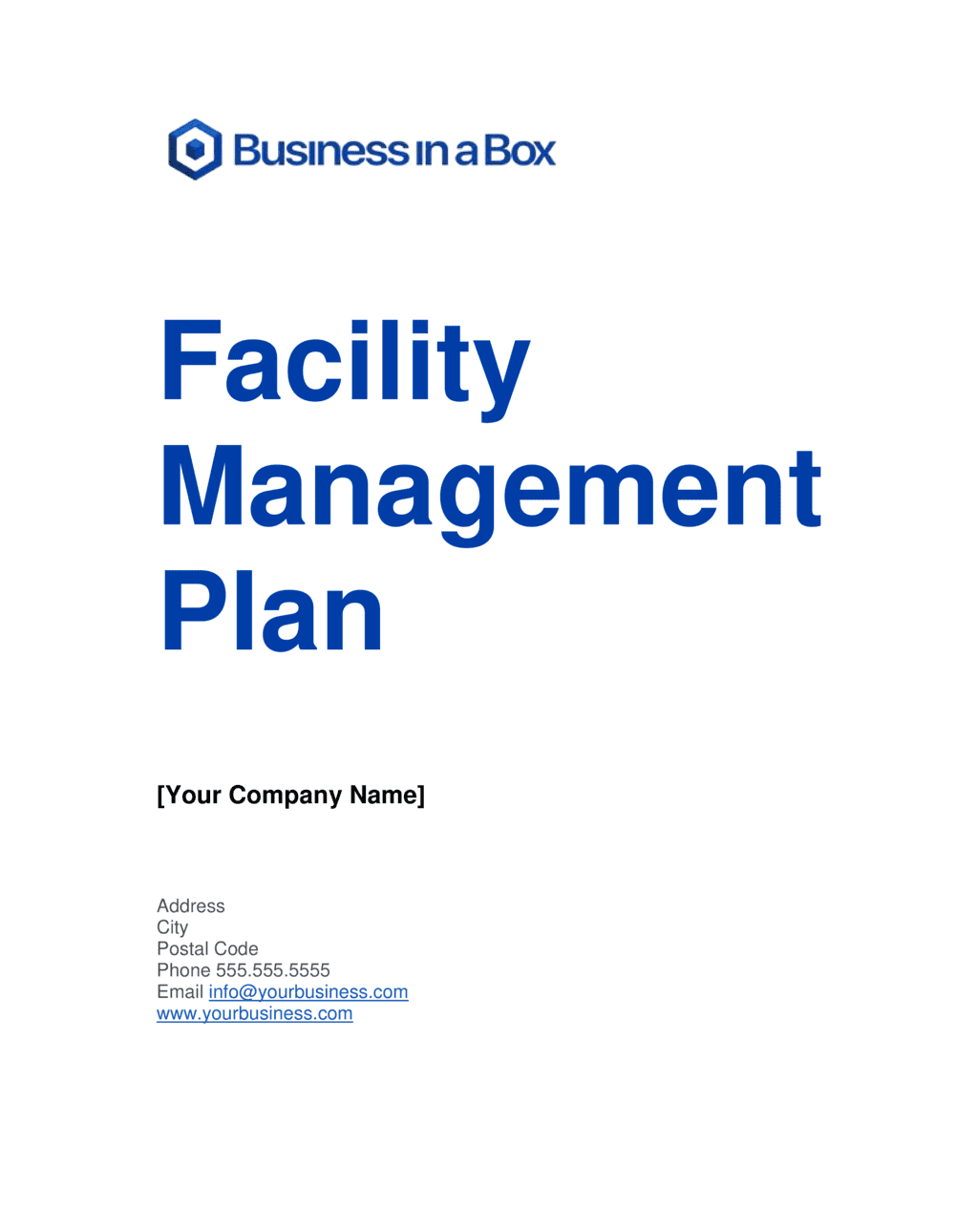
Facility Management Plan Template

Free Word download β€’ Edit online β€’ Save & share with Drive β€’ Export to PDF

15 pagesβ€’30–40 min to fillβ€’Difficulty: Complex
Learn more ↓
FreeFacility Management Plan Template

At a glance

What it is
A Facility Management Plan is a structured operational document that defines how an organization manages its physical spaces, assets, maintenance schedules, safety protocols, and vendor relationships. This free Word download gives you a ready-to-edit framework covering every dimension of facility operations β€” from preventive maintenance calendars to emergency response procedures β€” that you can export as PDF and share with your operations team, property management partners, or leadership.
When you need it
Use it when taking over a new facility, building out an operations team from scratch, preparing for a regulatory inspection, or standardizing inconsistent maintenance practices across multiple locations. It is also the baseline document required before most facility audits and ISO 41001 certifications.
What's inside
Facility overview and asset register, maintenance schedule (preventive and corrective), space utilization plan, health and safety protocols, vendor and contractor management procedures, emergency response plan, sustainability and energy management targets, and performance metrics with review cycles.

What is a Facility Management Plan?

A Facility Management Plan is a structured operational document that defines how an organization manages its physical spaces, building systems, assets, maintenance schedules, safety protocols, and vendor relationships in a single coordinated framework. It establishes who is responsible for each operational function, how maintenance tasks are prioritized and tracked, what standards vendors are held to, and how the facility's performance is measured over time. Rather than a one-time project document, it functions as a living operational policy that governs every aspect of how a building or campus runs day to day.

Why You Need This Document

Without a documented facility management plan, maintenance happens reactively β€” equipment fails before anyone services it, vendor response times go unchallenged because no SLA was recorded, and safety inspection deadlines are missed because permit dates lived only in someone's inbox. The consequences are concrete: unplanned HVAC failures can cost three to five times more than a scheduled service, compliance lapses can trigger fines or suspension of operating licenses, and inconsistent emergency procedures put occupants at risk when seconds matter. A formal plan closes these gaps by making responsibilities explicit, scheduling maintenance before failures occur, and giving your team a single reference document they can act on β€” rather than institutional knowledge that walks out the door when a key person leaves.

Which variant fits your situation?

If your situation is…Use this template
Managing a single commercial office or coworking spaceOffice Facilities Management Plan
Overseeing a warehouse, distribution center, or manufacturing plantIndustrial Facility Management Plan
Managing a school, university, or public institution facilityEducational Facility Management Plan
Operating a healthcare clinic or hospital buildingHealthcare Facility Management Plan
Tracking only preventive and corrective maintenance schedulesMaintenance Schedule Template
Documenting emergency and business continuity procedures onlyEmergency Response Plan
Planning facility handover at the end of a construction projectFacility Handover Plan

Common mistakes to avoid

❌ No defined scope boundary

Why it matters: When the plan does not explicitly state which areas and assets are covered, maintenance gaps appear at the edges β€” shared spaces, parking structures, and external plant go unserviced.

Fix: Add a one-paragraph scope statement and a simple floor-plan diagram marking covered areas clearly before distributing the plan.

❌ Maintenance schedules based on habit rather than specifications

Why it matters: Over-servicing wastes budget; under-servicing voids equipment warranties and accelerates asset deterioration β€” both outcomes cost more than getting the frequency right.

Fix: Pull manufacturer service intervals for every major asset in the register and use those as the scheduling baseline, adjusted only where local codes require a shorter interval.

❌ Vendor SLAs stored only in the vendor contract, not in the plan

Why it matters: The operations team managing day-to-day vendor performance rarely has the contract open. Without SLA commitments visible in the plan, poor performance goes unchallenged.

Fix: Copy the key SLA metrics β€” response time, resolution time, and escalation contact β€” directly into the vendor section of this plan.

❌ Emergency procedures written without site-specific locations

Why it matters: A generic evacuation procedure fails in a real emergency when staff cannot find the gas shut-off or the nearest exit because the plan says 'utility room' instead of 'B1 Level, north corridor, beside elevator bank.'

Fix: Walk the building with the plan in hand and replace every generic location reference with an exact physical description or grid reference from the floor plan.

❌ No baseline data for energy or maintenance KPIs

Why it matters: Setting a 15% energy reduction target without a measured baseline makes it impossible to report actual progress β€” or to prove to stakeholders that the investment in efficiency measures was worthwhile.

Fix: Pull 12 months of utility bills before completing the sustainability section and enter the annual kWh and water consumption figures as your documented baseline.

❌ Plan never reviewed after initial publication

Why it matters: Facilities change β€” assets age, vendors are replaced, headcount shifts, and regulations are updated. A plan that reflects conditions from two years ago creates false confidence and real compliance risk.

Fix: Schedule the annual review date on the day the plan is published, assign a named owner for the review, and add a version-history table to the document to track changes over time.

The 10 key sections, explained

Facility overview and scope

Asset register and condition assessment

Preventive maintenance schedule

Corrective maintenance and work order process

Space utilization and allocation plan

Health, safety, and compliance

Vendor and contractor management

Emergency response and business continuity

Sustainability and energy management

Performance metrics and review cycle

How to fill it out

  1. 1

    Complete the facility overview and define the scope

    Enter the facility's legal address, total square footage, building type, number of floors, and approximate occupant count. Explicitly list which buildings, areas, or assets are included and excluded from the plan.

    πŸ’‘ If you manage multiple facilities, create one plan per site rather than combining them β€” mixed-site plans are nearly impossible to hand off to a site-specific manager.

  2. 2

    Build or import the asset register

    List every major building system and piece of equipment with a unique asset ID, installation year, current condition (Good / Fair / Poor), last service date, and estimated replacement year. If you have an existing CMMS, export the asset list directly.

    πŸ’‘ Assign condition ratings using a 1–5 scale rather than verbal labels β€” numbers are easier to track over time and support budget modeling.

  3. 3

    Set preventive maintenance frequencies from manufacturer specs

    For each asset, look up the manufacturer's recommended service interval and cross-reference it with any applicable local codes. Build a calendar showing daily, weekly, monthly, quarterly, and annual tasks.

    πŸ’‘ Color-code the calendar by trade (electrical, HVAC, plumbing, general) so work can be batched by vendor visit and reduce call-out costs.

  4. 4

    Define work order priority tiers and response targets

    Create at least three priority levels (life-safety, operations-critical, and routine), specify target response and resolution times for each, and document the escalation path when targets are missed.

    πŸ’‘ Post the priority matrix in every maintenance team workspace so it becomes the default triage tool, not something staff have to look up in the plan.

  5. 5

    Map space allocation and record utilization data

    Walk each floor and document current departmental allocations in square feet. If utilization sensors or badge data are available, capture the current utilization rate. Note any under-utilized or over-capacity areas.

    πŸ’‘ A simple heat map of occupancy by floor and time of day communicates utilization findings to leadership faster than a table of numbers.

  6. 6

    Enter all vendor details and SLA commitments

    List every contracted service provider with their scope, contract end date, SLA response targets, and a primary and backup contact. Cross-reference each SLA against the work order priority tiers to confirm alignment.

    πŸ’‘ Set calendar reminders 90 days before each vendor contract expires so renewal negotiations start early, not under pressure.

  7. 7

    Document emergency procedures with location-specific detail

    Record the exact physical locations of utility shut-offs, fire extinguishers, AED units, and evacuation assembly points. Include emergency contacts with 24-hour phone numbers.

    πŸ’‘ Walk the emergency procedures with your team after completing this section β€” what is obvious to you on paper may not be obvious to a new employee in an actual emergency.

  8. 8

    Set KPIs and schedule the annual review

    Choose four to six measurable KPIs from the performance metrics section, enter current baseline values, and set targets for the next 12 months. Immediately block the annual review date on the facilities calendar.

    πŸ’‘ Review KPI actuals quarterly against targets β€” annual-only reviews miss drift early enough to correct it within the plan year.

Frequently asked questions

What is a facility management plan?

A facility management plan is a formal operational document that defines how an organization manages its physical spaces, building systems, assets, maintenance schedules, safety requirements, and vendor relationships. It serves as the primary reference document for everyone responsible for keeping a facility safe, functional, and cost-efficient β€” from the facilities manager to contracted service providers.

What should a facility management plan include?

A complete plan covers ten core areas: facility overview and scope, asset register with condition ratings, preventive maintenance schedule, corrective maintenance and work order process, space utilization and allocation, health and safety compliance, vendor and contractor management, emergency response procedures, sustainability and energy management targets, and performance KPIs with a defined review cycle. Plans for larger or more complex facilities may add separate annexes for each building or site.

Who is responsible for a facility management plan?

Responsibility typically sits with the facility manager or director of operations. In smaller organizations, an office manager, HR director, or property manager may own the document. For multi-site organizations, a corporate real estate or facilities team often owns the master framework while individual site managers maintain site-specific versions.

How often should a facility management plan be updated?

At minimum, the plan should be fully reviewed annually. Interim updates are warranted whenever a major asset is added or decommissioned, a key vendor contract changes, there is a significant shift in occupancy or space layout, or a safety incident reveals a gap in documented procedures. Treating the plan as a living document β€” rather than a one-time project β€” is what distinguishes effective facility management from reactive maintenance.

What is the difference between a facility management plan and a maintenance schedule?

A maintenance schedule is a single section within the broader facility management plan. The plan encompasses the full operational scope β€” including space management, vendor relationships, safety compliance, emergency procedures, and performance reporting β€” while the maintenance schedule specifically addresses when and how each asset or system is inspected and serviced. A standalone maintenance schedule is a useful tool, but it does not replace the wider operational governance that a full plan provides.

Does a facility management plan need to be certified or audited?

Certification is not legally required in most jurisdictions, but organizations seeking ISO 41001 certification β€” the international standard for facility management systems β€” must demonstrate a documented plan that meets the standard's requirements. Many regulated industries, including healthcare and education, are subject to government or accreditation-body audits that will request a facility management plan as evidence of compliant operations.

How do I choose the right KPIs for a facility management plan?

Focus on four to six metrics that directly reflect the plan's objectives. Common choices include planned maintenance completion rate (target 90–95%), mean time to repair, work order backlog count, energy cost per square foot, space utilization rate, and vendor SLA compliance percentage. Avoid tracking more KPIs than the team can act on β€” a shorter list reviewed quarterly drives more improvement than a long list reviewed annually.

Can a small business use a facility management plan?

Yes. Even a single-office business benefits from a simplified facility plan that documents the maintenance schedule for HVAC and fire safety equipment, lists vendor contacts and contract terms, and records emergency shut-off locations. The scale of the document should match the complexity of the facility β€” a 10-person office needs a 5-page plan, not a 50-page enterprise framework. This template scales down as easily as it scales up.

What software tools support facility management plan execution?

A computerized maintenance management system (CMMS) β€” such as Fiix, Limble, or IBM Maximo β€” is the most common tool for tracking work orders, asset histories, and preventive maintenance schedules documented in the plan. For smaller facilities, a shared spreadsheet or a project management tool like Asana or Monday.com can handle the operational tracking. The plan itself is format-agnostic β€” it defines the policy; the software executes it.

How this compares to alternatives

vs Maintenance schedule

A maintenance schedule is a task-and-frequency calendar covering when each asset is serviced. A facility management plan contains the maintenance schedule as one section but also governs space utilization, vendor management, emergency response, safety compliance, and performance reporting. Use the maintenance schedule for day-to-day technician work; use the plan for operational governance and stakeholder reporting.

vs Emergency response plan

An emergency response plan focuses exclusively on crisis scenarios β€” evacuation routes, utility shut-offs, emergency contacts, and business continuity steps. A facility management plan embeds a condensed version of emergency procedures within a broader operational framework. Organizations managing high-risk facilities should maintain both documents, with the emergency response plan providing the detailed drill scripts.

vs Property management agreement

A property management agreement is a legal contract between a property owner and a management company defining fees, scope, and obligations. A facility management plan is an internal operational document that defines how facility services are delivered regardless of who owns the property. The agreement determines who does the managing; the plan defines how it is done.

vs Business continuity plan

A business continuity plan addresses how an organization maintains critical operations during any major disruption β€” not just facility failures. A facility management plan focuses specifically on the physical building environment. For organizations where facility access is the primary operational risk, the two documents overlap significantly in their emergency sections and should cross-reference each other.

Industry-specific considerations

Commercial real estate

Multi-tenant buildings require separate space allocation records per tenant, SLA commitments aligned to lease obligations, and documented landlord compliance with building codes.

Healthcare

Infection control requirements, medical gas system maintenance, Joint Commission or CMS accreditation readiness, and strict equipment calibration documentation drive plan complexity.

Manufacturing

Production-line asset maintenance is tied directly to output capacity β€” unplanned downtime has an immediate revenue cost, making preventive maintenance scheduling the highest-priority section.

Education

School facilities must meet state safety inspection standards, ADA accessibility requirements, and scheduled deep-cleaning protocols, with the plan often submitted as part of accreditation documentation.

Template vs pro β€” what fits your needs?

PathBest forCostTime
Use the templateSingle-site operations managers, office managers, and small facility teams building a plan for the first timeFree4–8 hours to complete
Template + professional reviewMulti-site organizations, regulated facilities (healthcare, education), or teams preparing for an ISO 41001 or accreditation audit$500–$2,000 for a facilities consultant review1–2 weeks
Custom draftedLarge commercial portfolios, mission-critical facilities (data centers, hospitals), or organizations implementing an enterprise CMMS alongside the plan$3,000–$15,000 for a facilities management consultancy engagement4–12 weeks

Glossary

Preventive Maintenance
Scheduled, routine inspections and servicing performed on equipment and building systems to prevent failures before they occur.
Corrective Maintenance
Unplanned repair work carried out after a system or piece of equipment has failed or been found defective during an inspection.
Asset Register
A comprehensive inventory of all physical assets within a facility β€” including HVAC units, elevators, and electrical systems β€” with condition ratings and service histories.
Space Utilization Rate
The percentage of available floor space actively used for productive purposes, measured against total leasable or owned square footage.
CMMS (Computerized Maintenance Management System)
Software used to schedule, track, and record maintenance work orders, asset histories, and vendor activity within a facility.
Hard Services
Facility services tied to the physical building structure β€” HVAC, electrical, plumbing, fire suppression, and structural maintenance.
Soft Services
Non-structural facility services such as cleaning, landscaping, security, pest control, and reception that support occupant experience.
SLA (Service Level Agreement)
A contractual commitment between a facility operator and a vendor or tenant defining expected response times, service quality standards, and remedies for non-performance.
Total Cost of Occupancy
All costs associated with occupying a facility β€” rent or mortgage, utilities, maintenance, insurance, and capital improvements β€” expressed as a total annual or per-square-foot figure.
ISO 41001
The international standard for facility management systems, specifying requirements for organizations that need to demonstrate effective and efficient delivery of facility services.

Part of your Business Operating System

This document is one of 3,000+ business & legal templates included in Business in a Box.

  • Fill-in-the-blanks β€” ready in minutes
  • 100% customizable Word document
  • Compatible with all office suites
  • Export to PDF and share electronically

Create your document in 3 simple steps.

From template to signed document β€” all inside one Business Operating System.
1
Download or open template

Access over 3,000+ business and legal templates for any business task, project or initiative.

2
Edit and fill in the blanks with AI

Customize your ready-made business document template and save it in the cloud.

3
Save, Share, Send, Sign

Share your files and folders with your team. Create a space of seamless collaboration.

Save time, save money, and create top-quality documents.

β˜…β˜…β˜…β˜…β˜…

"Fantastic value! I'm not sure how I'd do without it. It's worth its weight in gold and paid back for itself many times."

Managing Director Β· Mall Farm
Robert Whalley
Managing Director, Mall Farm Proprietary Limited
β˜…β˜…β˜…β˜…β˜…

"I have been using Business in a Box for years. It has been the most useful source of templates I have encountered. I recommend it to anyone."

Business Owner Β· 4+ years
Dr Michael John Freestone
Business Owner
β˜…β˜…β˜…β˜…β˜…

"It has been a life saver so many times I have lost count. Business in a Box has saved me so much time and as you know, time is money."

Owner Β· Upstate Web
David G. Moore Jr.
Owner, Upstate Web

Run your business with a system β€” not scattered tools

Stop downloading documents. Start operating with clarity. Business in a Box gives you the Business Operating System used by over 250,000 companies worldwide to structure, run, and grow their business.

Start freeΒ Β·Β No credit card required