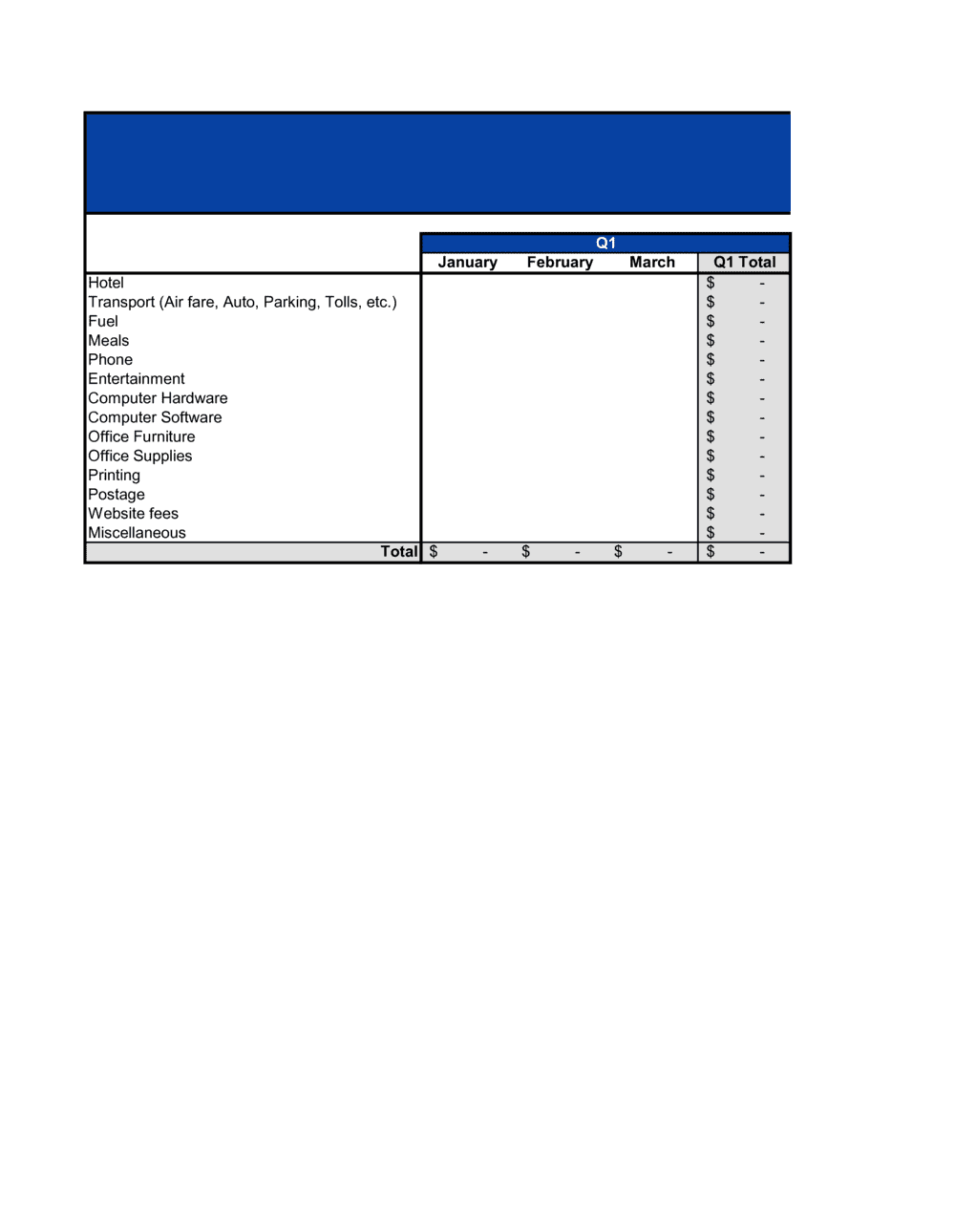
Expense Statement_Monthly - Quarterly - Yearly Template

Free Excel download β€’ Edit online β€’ Save & share with Drive β€’ Export to PDF

3 pagesβ€’25–30 min to fillβ€’Difficulty: Complexβ€’Signature requiredβ€’Legal review recommended
Learn more ↓
FreeXLSExpense Statement_Monthly - Quarterly - Yearly Template

At a glance

What it is
An Expense Statement (Monthly, Quarterly, Yearly) is a formal business document used to record, categorize, and certify all expenditures incurred over a defined reporting period. This free Word download gives you a structured, policy-ready template you can edit online, customize to your reporting cycle, and export as PDF for submission, approval, and audit purposes.
When you need it
Use it at the close of each reporting period β€” monthly, quarterly, or annually β€” to compile employee or departmental spending, support reimbursement requests, and satisfy internal controls and tax documentation requirements.
What's inside
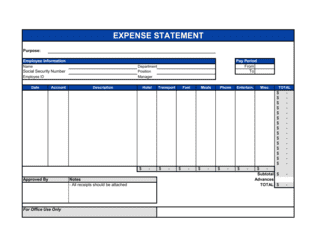
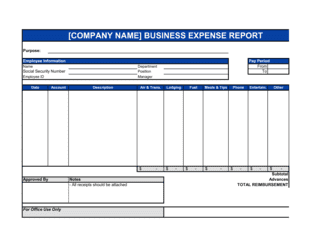
Submitter and approver identification, reporting period and department, categorized expense line items with dates and amounts, receipt references, tax and reimbursement calculations, certification and signature block, and an approval workflow section for management sign-off.

What is an Expense Statement?

An Expense Statement is a formal business document that records, categorizes, and certifies all expenditures incurred over a defined reporting period β€” monthly, quarterly, or annually. It captures each expense by date, vendor, category, and business purpose; calculates the total amount due for reimbursement; and routes through a documented approval workflow before payment is processed. Unlike a single-trip expense report, the period-based expense statement aligns with accounting close cycles and produces the categorized, signed, and approved records that support both internal financial controls and external tax substantiation requirements.

Why You Need This Document

Operating without a formal expense statement process creates compounding problems across finance, tax, and compliance simultaneously. Without itemized, signed statements, the IRS and equivalent tax authorities may reclassify reimbursements as taxable wages β€” triggering payroll tax liability, penalties, and amended returns. Internal controls fail when expenses are approved informally: duplicate payments, personal charges mixed with business costs, and self-approved reimbursements are among the most common findings in financial audits, and all three are preventable with a correctly structured statement and approval workflow. At period-end close, finance teams that lack standardized expense statements spend hours reconstructing transactions from receipts and emails instead of moving directly to reconciliation. The Business in a Box Expense Statement template β€” available for monthly, quarterly, and yearly reporting cycles β€” gives your organization a consistent, policy-aligned format that satisfies IRS accountable-plan requirements, supports VAT reclaim in EU jurisdictions, and creates the seven-year audit trail your business needs before it ever faces an examination.

Which variant fits your situation?

If your situation is…Use this template
Tracking expenses for a single calendar monthMonthly Expense Statement
Consolidating three months of spending for a quarterly reviewQuarterly Expense Statement
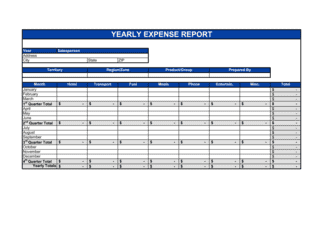
Preparing a full-year expenditure summary for tax filingYearly Expense Statement
Requesting reimbursement for a specific business tripEmployee Expense Report
Tracking petty cash disbursements and replenishmentsPetty Cash Log
Submitting departmental budget vs. actual variance for executive reviewBudget vs. Actual Report
Documenting project-specific costs for client billing or grant reportingProject Expense Report

Common mistakes to avoid

❌ Combining multiple receipts on a single expense line

Why it matters: Bundling transactions prevents reviewers from verifying individual amounts against receipts and breaks the one-to-one audit trail required by tax authorities.

Fix: Create a separate line item for every transaction, regardless of how small. The statement's category subtotals already provide the rollup view reviewers need.

❌ Submitting without a signed certification

Why it matters: An unsigned expense statement provides no documented representation from the employee, voiding the company's accountable-plan defense with the IRS and equivalent tax bodies.

Fix: Require a dated submitter signature β€” physical or authenticated digital β€” on every statement before it enters the approval workflow.

❌ Claiming corporate card charges as out-of-pocket reimbursements

Why it matters: When corporate card charges and personal out-of-pocket amounts are not separated, the company risks reimbursing the employee twice β€” once directly and once through the card payment.

Fix: Add a dedicated column or section that flags each line item as corporate card or personal payment, then calculate the net reimbursable amount at the bottom of the statement.

❌ Using vague business purpose descriptions

Why it matters: Descriptions like 'client meeting' or 'business travel' do not meet IRS substantiation requirements for meals and entertainment, potentially converting a deductible expense into a taxable benefit.

Fix: Record the full business purpose for each item: who was present, the company they represent, and the business topic discussed or the trip's specific objective.

❌ Self-approving expense submissions

Why it matters: Self-approval is a segregation-of-duties failure that every financial audit flags as a material internal controls weakness, regardless of the dollar amounts involved.

Fix: Require at least one independent reviewer β€” a direct manager or finance designate β€” whose signature is separate from the submitter's for every statement.

❌ Filing statements more than 60 days after period-end

Why it matters: Late submissions disrupt period-end close, prevent accurate financial reporting, and β€” for IRS accountable plans β€” may trigger the requirement to treat reimbursements as taxable wages.

Fix: Set and enforce a written submission deadline of 30 days after period-end, with automatic escalation to the employee's manager after 45 days.

The 10 key clauses, explained

Submitter and Period Identification

In plain language: Identifies the employee or department submitting the statement, the reporting period covered, and the date of submission.

Sample language
Submitted by: [EMPLOYEE NAME] | Department: [DEPARTMENT] | Reporting Period: [START DATE] to [END DATE] | Submission Date: [DATE]

Common mistake: Leaving the reporting period vague or entering only a month name without a year β€” this creates filing ambiguity and breaks the audit trail, especially when reviewing multiple periods simultaneously.

Expense Line Items by Category

In plain language: A row-by-row record of each expense, including date incurred, vendor, category (travel, meals, supplies, etc.), business purpose, and amount.

Sample language
[DATE] | [VENDOR NAME] | Category: [TRAVEL / MEALS / SUPPLIES / OTHER] | Purpose: [BUSINESS PURPOSE] | Amount: $[X.XX]

Common mistake: Grouping multiple transactions on a single line to save space. Each expense must appear individually so reviewers can cross-reference receipts and auditors can trace amounts to source documents.

Receipt and Documentation Reference

In plain language: Links each line item to supporting documentation β€” a receipt number, attached scan, or system reference β€” confirming the expense occurred and was paid.

Sample language
Receipt Ref: [RECEIPT ID / ATTACHED SCAN #] | Payment Method: [CORPORATE CARD / PERSONAL CARD / CASH]

Common mistake: Submitting the statement without attaching receipts for amounts above the company threshold, then following up with receipts separately. Unmatched receipts consistently delay reimbursement cycles.

Expense Subtotals by Category

In plain language: Summarizes total spending within each expense category for the reporting period, enabling budget-to-actual comparison and identifying categories that require closer review.

Sample language
Travel: $[X.XX] | Meals & Entertainment: $[X.XX] | Office Supplies: $[X.XX] | Other: $[X.XX] | Period Subtotal: $[X.XX]

Common mistake: Reporting a single total without breaking it out by category. Auditors and tax preparers need category-level detail to apply correct deductibility rules β€” meals are typically 50% deductible while supplies are 100%.

Tax-Deductibility Classification

In plain language: Flags each category or line item as fully deductible, partially deductible (e.g., 50% for meals), or non-deductible, ensuring the financial records support accurate tax reporting.

Sample language
Deductibility: [100% / 50% / 0%] | Tax Code Reference: [IRS Publication 463 / Local Equivalent] | Deductible Amount: $[X.XX]

Common mistake: Applying 100% deductibility to meal and entertainment expenses without noting the 50% limitation. This overstates deductions and creates a correctable error that triggers scrutiny on subsequent returns.

Reimbursement Calculation

In plain language: States the total amount being claimed for reimbursement, distinguishing between company-paid expenses (e.g., corporate card charges) and out-of-pocket amounts owed to the employee.

Sample language
Total Expenses Incurred: $[X.XX] | Less: Company Card Charges: ($[X.XX]) | Net Reimbursement Due to Employee: $[X.XX]

Common mistake: Claiming the full statement total as reimbursable when some items were charged to a corporate card. This results in double payment β€” the employee is reimbursed for an amount the company already paid directly.

Policy Compliance Certification

In plain language: A declaration by the submitter that all listed expenses are accurate, business-related, comply with company expense policy, and are supported by documentation.

Sample language
I certify that the expenses listed above are accurate, were incurred for legitimate business purposes, comply with [COMPANY NAME] Expense Policy effective [DATE], and are supported by receipts or documentation as required.

Common mistake: Omitting the certification block entirely and treating the statement as a simple form. Without a signed certification, the company has no documented representation from the employee β€” undermining both internal controls and IRS substantiation requirements.

Submitter Signature and Date

In plain language: The employee's dated signature confirming the accuracy of the submission and their acceptance of policy terms.

Sample language
Submitter Signature: _________________________ | Printed Name: [EMPLOYEE NAME] | Date: [DATE]

Common mistake: Submitting unsigned statements electronically without a digital signature or authenticated approval β€” unsigned submissions lack the certification weight required for accountable-plan compliance.

Manager Approval Block

In plain language: The reviewing manager's signature confirming they have verified the business purpose, policy compliance, and accuracy of each listed expense.

Sample language
Approved by: [MANAGER NAME] | Title: [TITLE] | Signature: _________________________ | Date: [DATE] | Notes: [ANY CONDITIONS OR EXCEPTIONS]

Common mistake: Having the same person submit and approve their own expense statement. Self-approval is a significant internal controls failure flagged in virtually every financial audit, regardless of the amount involved.

Finance Department Sign-Off and GL Coding

In plain language: Finance's confirmation that the statement has been reviewed, correctly coded to general ledger accounts, and cleared for payment processing.

Sample language
Finance Review: [REVIEWER NAME] | GL Accounts Coded: [YES / PARTIAL] | Payment Method: [ACH / CHECK / PAYROLL] | Scheduled Payment Date: [DATE] | Finance Signature: _________________________

Common mistake: Processing payment before finance completes GL coding. Payments made before coding result in expenses landing in a suspense account, requiring a manual journal entry to correct β€” adding hours of reconciliation work at period-end close.

How to fill it out

  1. 1

    Select the reporting period and complete the header

    Choose monthly, quarterly, or yearly as your reporting cycle. Enter the exact start and end dates, the submitter's full name, department, and cost center. The period must match the period used in your accounting system.

    πŸ’‘ Using ISO date format (YYYY-MM-DD) in the header eliminates ambiguity when statements from multiple regions are consolidated.

  2. 2

    Enter each expense as a separate line item

    List every expense individually with the date incurred, vendor name, expense category, a brief but specific business purpose, and the exact amount in the statement currency. Do not combine multiple receipts on one line.

    πŸ’‘ Write the business purpose in terms an auditor unfamiliar with the project would understand β€” 'client dinner with [COMPANY] team ahead of contract renewal' beats 'business meal'.

  3. 3

    Attach or reference supporting documentation

    For each line item, note the receipt ID, attach a scan, or reference the document in your expense management system. Flag any missing receipts and document the reason β€” lost receipt declarations may be required for amounts above policy limits.

    πŸ’‘ Organize attachments in the same order as the line items on the statement. Reviewers who have to hunt for receipts take longer to approve, slowing your reimbursement.

  4. 4

    Subtotal by expense category

    Total spending within each category β€” travel, meals, supplies, software, etc. β€” and enter the subtotals in the summary row. Verify that the sum of category subtotals equals the gross total before applying deductions.

    πŸ’‘ If your company uses budget codes, map each category subtotal to its budget line now. Doing this after approval delays the GL coding step.

  5. 5

    Apply tax-deductibility classifications

    Flag each category with its applicable deductibility percentage β€” 100% for most business expenses, 50% for meals and entertainment in the US and Canada, 0% for personal or policy-excluded items. Calculate the deductible total for the period.

    πŸ’‘ Check the current IRS Publication 463 (US) or CRA IT-518 (Canada) for the latest meal and entertainment deductibility rules β€” rates have changed multiple times in recent years.

  6. 6

    Calculate the net reimbursement amount

    Subtract any corporate card charges or prepaid amounts from the gross total to arrive at the net amount owed to the employee. State both figures clearly so finance can process only the out-of-pocket portion.

    πŸ’‘ If your company operates an accountable plan, confirm the net reimbursement amount does not include any personal expenses β€” even a small personal item mixed into a reimbursable claim can disqualify the entire plan for that period.

  7. 7

    Sign the certification block and route for approval

    The submitter signs and dates the policy compliance certification before routing to the direct manager. The manager reviews for business purpose and policy compliance, then forwards to finance for GL coding and payment scheduling.

    πŸ’‘ Set a submission deadline β€” typically 30 days after period-end β€” in writing and distribute it to all submitters at the start of each period. Late submissions are the single biggest cause of delayed period-end close.

  8. 8

    File the completed statement and documentation

    Once finance signs off, store the fully executed statement with all attachments in your document management system, organized by employee and reporting period. Retain for the period required by applicable tax law β€” seven years in the US and Canada.

    πŸ’‘ Name your archived files with a consistent convention such as [EMPLOYEE-ID]_[YYYY-QQ or YYYY-MM]_ExpenseStatement.pdf to make retrieval fast during audits.

Frequently asked questions

What is an expense statement?

An expense statement is a formal document that records all business expenditures incurred over a defined reporting period β€” monthly, quarterly, or annually. It itemizes each cost by date, vendor, category, and business purpose, calculates the total amount due for reimbursement, and includes a certification and approval workflow. It serves as the primary record for reimbursement processing, budget management, and tax substantiation.

What is the difference between an expense statement and an expense report?

The terms are often used interchangeably, but an expense report typically refers to a single-event or single-trip submission β€” a specific conference or business trip. An expense statement covers a defined accounting period (month, quarter, or year) and consolidates all expenses incurred during that period across multiple events or projects. Statements are the period- based accounting record; reports are the transaction-based submission.

Does an expense statement need to be signed?

Yes. A signed certification by the submitter is required for the statement to function as a valid internal control and to satisfy IRS accountable-plan requirements in the US. Most jurisdictions require equivalent documentary evidence. Without a signed declaration of accuracy and business purpose, reimbursements may be treated as taxable income rather than tax-exempt reimbursements.

How long should I retain expense statements?

In the US, the IRS generally requires business expense records to be retained for three years from the date the return is filed, but seven years is the widely recommended standard to cover amended returns and fraud investigations. In Canada, the CRA requires six years of retention. In the UK, HMRC requires six years. Many businesses standardize on seven years globally to meet the most conservative requirement across jurisdictions.

What expenses are typically non-reimbursable on a business expense statement?

Non-reimbursable items typically include personal meals not tied to a business meeting, commuting costs between home and a regular workplace, expenses exceeding policy dollar limits, alcohol above a stated per-person threshold, fines and penalties, personal entertainment, and costs incurred by a spouse or family member. The company's written expense policy defines the full list β€” the expense statement should reference that policy version in its certification block.

What is an accountable plan and why does it matter for expense statements?

An accountable plan is an IRS-approved reimbursement arrangement under which qualifying expense reimbursements are excluded from the employee's taxable income and are not subject to payroll taxes. To qualify, the plan requires that expenses have a business connection, employees substantiate amounts and purposes with documentation, and employees return any excess advances within a reasonable period. A properly executed expense statement with itemized line items, receipts, business purposes, and signed certification provides the substantiation the plan requires.

Can I use one expense statement template for monthly, quarterly, and yearly reporting?

Yes. The Business in a Box template is structured to accommodate all three reporting cycles β€” simply enter the appropriate period start and end dates in the header. Monthly statements are most common for active employees and high-volume spenders; quarterly and yearly statements suit business owners, executives, or situations where expenses are infrequent. The underlying line-item and approval structure applies equally across all three cycles.

What happens if an employee loses a receipt?

Most expense policies allow a lost receipt declaration β€” a signed written statement from the employee describing the expense, the vendor, the business purpose, and the amount, along with a confirmation that the original receipt is not recoverable. Many companies set a dollar threshold (e.g., $25) below which receipts are not required. Above that threshold, a lost receipt declaration should be attached in place of the original and noted on the expense line item. Consult your local tax authority guidance for what constitutes acceptable substantiation when original receipts are unavailable.

Are meal and entertainment expenses fully deductible on a business expense statement?

No. In the US, the Tax Cuts and Jobs Act of 2017 reduced the meal deduction to 50% of the cost for most business meals and eliminated the deduction for entertainment expenses entirely. In Canada, meals and entertainment are generally limited to 50% deductibility under the Income Tax Act. The UK allows deductions for staff entertaining but restricts client entertainment. Expense statements should flag each meal and entertainment line at the applicable deductibility rate to ensure accurate tax reporting.

How this compares to alternatives

vs Employee Expense Report

An employee expense report covers a single event or trip and is submitted immediately after the expense is incurred. An expense statement aggregates all expenses across a full reporting period β€” month, quarter, or year β€” and aligns with accounting close cycles. Use an expense report for trip-by-trip reimbursement; use an expense statement for period-end accounting consolidation.

vs Budget vs. Actual Report

A budget vs. actual report compares planned spending to realized spending by category, focusing on variance analysis and financial forecasting. An expense statement is a transactional record of individual expenditures with supporting documentation and approval signatures. The expense statement feeds the data that the budget vs. actual report analyzes.

vs Invoice

An invoice is a payment request issued by a vendor to a buyer for goods or services delivered. An expense statement is an internal document used by employees or departments to claim reimbursement for costs already paid. Invoices flow from external parties into accounts payable; expense statements flow from internal parties into the reimbursement and GL coding workflow.

vs Petty Cash Log

A petty cash log records small cash disbursements from a fixed fund in real time, typically managed by a designated custodian. An expense statement is a formal periodic document signed by the submitter and approved through a defined workflow. Petty cash logs cover incidental, low-value transactions; expense statements cover the full range of business expenditures across a reporting period.

Industry-specific considerations

Professional Services

Client-billable expenses tracked separately from internal costs, with matter or engagement codes on each line item for direct pass-through billing.

Construction and Real Estate

Project-coded expense lines linking field labor, materials, and subcontractor costs to specific job numbers for cost-to-completion reporting.

Healthcare

Strict separation of patient-care costs from administrative expenses, with compliance review required for any meals or travel involving referral sources under anti-kickback rules.

Technology / SaaS

Software subscriptions, cloud infrastructure costs, and remote-work stipends categorized alongside traditional travel and meals for quarterly board reporting.

Retail / E-commerce

Buyer travel, trade show costs, and product samples tracked quarterly against merchandise budgets, with vendor co-op reimbursement offsets noted on the statement.

Financial Services

Regulatory examination costs, licensing fees, and compliance-related travel categorized separately, with enhanced documentation standards to satisfy FINRA or FCA audit requirements.

Jurisdictional notes

United States

The IRS requires expense substantiation under Section 274, including the amount, date, place, and business purpose of each expense. Meals are deductible at 50% and entertainment is generally non-deductible since the Tax Cuts and Jobs Act of 2017. Reimbursements under a qualifying accountable plan are excluded from the employee's W-2 income. Records must be retained for at least three years from the filing date, with seven years recommended.

Canada

The CRA requires employees claiming business expenses to obtain a signed T2200 (Declaration of Conditions of Employment) from their employer. Meals and entertainment are generally limited to 50% deductibility under the Income Tax Act (s. 67.1). Employer reimbursements made under a properly documented accountable arrangement are not considered employment income. Quebec has parallel rules under the Taxation Act, and French-language documentation may be required for provincially regulated employers.

United Kingdom

HMRC requires that expense reimbursements be wholly, exclusively, and necessarily incurred in the performance of the employee's duties to qualify as non-taxable under the Income Tax (Earnings and Pensions) Act 2003. Employers using a dispensation arrangement (now replaced by exemptions under ITEPA 2016) must maintain adequate records. Client entertainment is not deductible for corporation tax. Records should be retained for six years from the end of the relevant tax year.

European Union

Expense deductibility and substantiation requirements vary significantly by member state β€” Germany requires receipts for all amounts above €150; France limits meal deductions and requires proof of business purpose. VAT reclaim on business expenses is available in most member states but requires VAT-compliant invoices rather than simple receipts. GDPR applies to personal data recorded on expense statements, including employee names, travel itineraries, and contact details of clients mentioned in business purpose fields.

Template vs lawyer β€” what fits your deal?

PathBest forCostTime
Use the templateSmall businesses, individual employees, and teams with straightforward expense categories and a clear internal policy already in placeFree15–30 minutes per statement
Template + legal reviewCompanies establishing a formal expense policy for the first time, or businesses in regulated industries where accountable-plan compliance is critical$200–$600 for an accountant or HR policy review1–3 days
Custom draftedMulti-jurisdiction employers with complex tax treatment, publicly traded companies subject to SOX internal controls, or organizations undergoing a financial audit$1,000–$4,000+ for legal and accounting advisory1–3 weeks

Glossary

Reporting Period
The defined calendar interval β€” monthly, quarterly, or annual β€” covered by the expense statement.
Cost Center
An organizational unit (department, team, or project) to which expenses are allocated for internal accounting purposes.
Reimbursable Expense
A business cost paid out-of-pocket by an employee that the employer is obligated to repay under company policy or an employment agreement.
Non-Reimbursable Expense
A cost that does not qualify for reimbursement under company policy β€” such as personal meals, fines, or expenses exceeding policy limits.
General Ledger Code
A numeric or alphanumeric account identifier used to classify each expense in the company's accounting system.
Substantiation
The documented proof β€” receipts, invoices, or itineraries β€” required by tax authorities and internal policy to support each expense claim.
Accountable Plan
An IRS-approved expense reimbursement arrangement under which reimbursements are excluded from the employee's taxable income, provided the expenses are business-related and properly documented.
Per Diem
A fixed daily allowance for meals, lodging, or incidental expenses, used in lieu of itemized receipts when traveling on business.
Accrual Basis
An accounting method that records expenses when they are incurred, not when cash is paid β€” affecting which period an expense appears in on the statement.
Audit Trail
The sequential, unbroken chain of documentation β€” statements, receipts, approvals, and general ledger entries β€” that allows an expense to be traced from payment back to business purpose.
Approval Workflow
The defined sequence of reviewers β€” direct manager, finance, and executive β€” who must sign off on an expense statement before reimbursement is processed.

Part of your Business Operating System

This document is one of 3,000+ business & legal templates included in Business in a Box.

  • Fill-in-the-blanks β€” ready in minutes
  • 100% customizable Word document
  • Compatible with all office suites
  • Export to PDF and share electronically

Create your document in 3 simple steps.

From template to signed document β€” all inside one Business Operating System.
1
Download or open template

Access over 3,000+ business and legal templates for any business task, project or initiative.

2
Edit and fill in the blanks with AI

Customize your ready-made business document template and save it in the cloud.

3
Save, Share, Send, Sign

Share your files and folders with your team. Create a space of seamless collaboration.

Save time, save money, and create top-quality documents.

β˜…β˜…β˜…β˜…β˜…

"Fantastic value! I'm not sure how I'd do without it. It's worth its weight in gold and paid back for itself many times."

Managing Director Β· Mall Farm
Robert Whalley
Managing Director, Mall Farm Proprietary Limited
β˜…β˜…β˜…β˜…β˜…

"I have been using Business in a Box for years. It has been the most useful source of templates I have encountered. I recommend it to anyone."

Business Owner Β· 4+ years
Dr Michael John Freestone
Business Owner
β˜…β˜…β˜…β˜…β˜…

"It has been a life saver so many times I have lost count. Business in a Box has saved me so much time and as you know, time is money."

Owner Β· Upstate Web
David G. Moore Jr.
Owner, Upstate Web

Run your business with a system β€” not scattered tools

Stop downloading documents. Start operating with clarity. Business in a Box gives you the Business Operating System used by over 250,000 companies worldwide to structure, run, and grow their business.

Start freeΒ Β·Β No credit card required