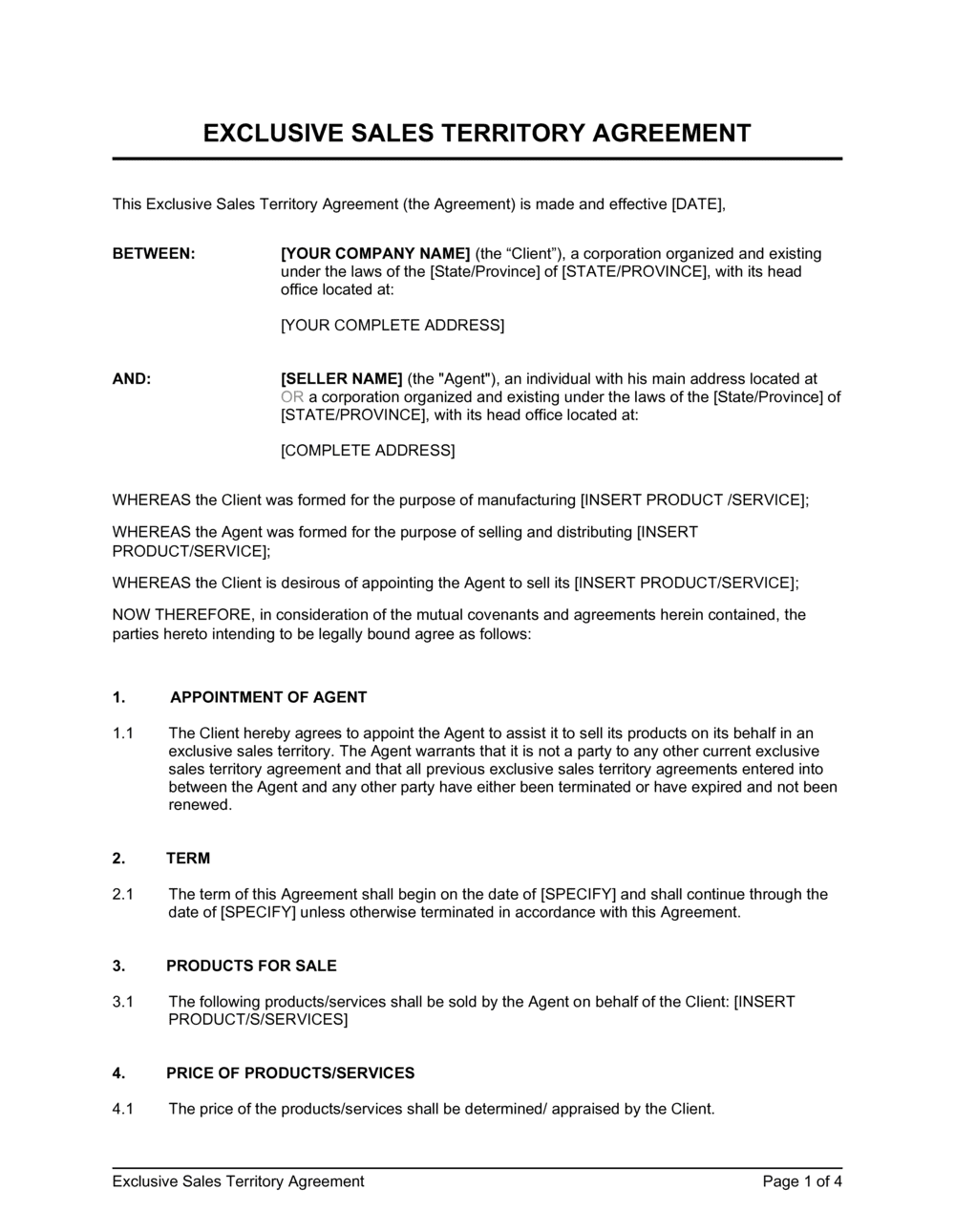
Exclusive Sales Territory Agreement Template

Free Word download • Edit online • Save & share with Drive • Export to PDF

4 pages25–35 min to fillDifficulty: ComplexSignature requiredLegal review recommended
Learn more ↓
FreeExclusive Sales Territory Agreement Template

At a glance

What it is
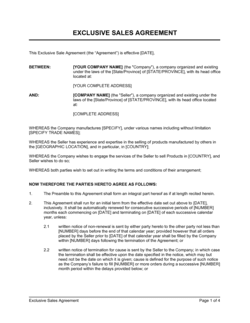
An Exclusive Sales Territory Agreement is a legally binding contract between a supplier or manufacturer and a sales representative, distributor, or dealer that grants the representative the sole right to sell specified products or services within a defined geographic territory. This free Word download gives you a structured, attorney-reviewed starting point covering territory boundaries, exclusivity conditions, performance quotas, IP use, and termination — ready to edit online and export as PDF.
When you need it
Use it when granting a sales rep, dealer, or distributor the exclusive right to operate in a specific region, and when you need enforceable performance obligations and clear remedies if those obligations are not met. It is also appropriate when expanding into new markets through third-party sales channels where territorial conflicts would otherwise arise.
What's inside
Territory definition and exclusivity grant, products covered, performance quotas and minimum purchase requirements, pricing and payment terms, IP and trademark use, confidentiality obligations, term and renewal conditions, termination rights with and without cause, and governing law.

What is an Exclusive Sales Territory Agreement?

An Exclusive Sales Territory Agreement is a legally binding contract between a supplier or manufacturer and a sales representative, distributor, or dealer that grants the representative the sole right to sell specified products within a clearly defined geographic region. During the agreement's term, the supplier is contractually prohibited from appointing competing representatives in that territory and, in most versions, from selling directly to customers there. In exchange for this protected market position, the representative typically accepts minimum sales quotas and performance obligations that must be met to retain the exclusive right. When properly drafted, the agreement balances the representative's need for territorial security with the supplier's need for accountability and the ability to reassign underperforming regions.

Why You Need This Document

Operating a channel sales relationship without an exclusive territory agreement exposes both sides to avoidable disputes and financial losses. Without written boundaries, two representatives may simultaneously pursue the same customer, triggering commission conflicts the supplier has no contractual basis to resolve. Without documented carve-outs, a supplier who continues selling directly to an existing account faces a commission claim from the representative on every transaction in the territory. Without a quota-and-remedy clause, a supplier is unable to exit an underperforming territorial relationship without risking a wrongful-termination claim. And without a post-termination customer-list transfer obligation, a departing representative takes the entire market intelligence built over the relationship and may redirect it to a competitor within days. This template closes all four of those gaps with enforceable, field-tested clause language — giving both parties a clear, written framework before the first sales call is made.

Which variant fits your situation?

If your situation is…Use this template
Appointing a distributor who buys and resells inventory in a defined regionExclusive Distribution Agreement
Engaging a sales agent who earns commission without taking title to goodsSales Representative Agreement
Granting a dealer the right to sell products alongside non-competing brandsNon-Exclusive Sales Territory Agreement
Licensing a brand or product formula rather than selling physical goodsLicense Agreement
Establishing a full franchise relationship with operational standards and feesFranchise Agreement
Setting up a reseller relationship with no geographic restrictionReseller Agreement
Appointing a dealer for a single product line with co-marketing obligationsDealer Agreement

Common mistakes to avoid

❌ Vague territory boundaries

Why it matters: A territory described as 'the Midwest' or 'the East Coast' has no legal precision. Overlapping interpretations lead to channel conflict, commission disputes, and litigation before the first year is complete.

Fix: Attach a signed map exhibit or a written list of specific states, counties, or ZIP codes as Exhibit A, and have both parties initial the exhibit at execution.

❌ No quota consequences

Why it matters: A performance quota with no stated remedy for a miss is unenforceable in practice. The supplier has no contractual basis to reassign the territory to a better-performing partner.

Fix: State explicitly that missing the quota for two consecutive periods entitles the supplier to convert to non-exclusive status or terminate with 30 days' notice — and include a cure period if you want to give the representative a chance to recover.

❌ Omitting carve-outs for existing house accounts

Why it matters: Without named carve-outs, the representative may claim commission on every sale in the territory, including accounts the supplier was already managing directly — creating an immediate and retroactive financial dispute.

Fix: List all existing direct accounts in the territory as a named carve-out schedule before signing, and include a process for adding new carve-outs by written amendment.

❌ No post-termination customer-list transfer obligation

Why it matters: A representative who retains all customer contact data after termination can redirect accounts to a competing supplier within days. The supplier loses the market intelligence built over the entire relationship.

Fix: Include an explicit clause requiring the representative to transfer all customer account information, contracts, and sales history to the supplier within 10 business days of termination, regardless of the reason for ending the agreement.

❌ Auto-renewal with no performance condition attached

Why it matters: An agreement that renews automatically regardless of quota attainment removes the supplier's practical leverage to exit an underperforming territory relationship without triggering a breach claim.

Fix: Tie auto-renewal to quota attainment: the agreement renews only if the representative has met the minimum for the most recent full performance period, or include a right not to renew upon notice.

❌ One-sided or missing confidentiality clause

Why it matters: A clause that only protects the supplier's pricing and product data leaves the representative's customer lists, market research, and competitive intelligence unprotected — creating friction and making the agreement appear commercially unreasonable.

Fix: Draft confidentiality obligations that run in both directions, covering each party's proprietary business information, and specify a survival period of at least two years post-termination.

The 10 key clauses, explained

Territory Definition

In plain language: Describes the exact geographic scope of the representative's exclusive rights — by country, state, region, county, or a custom map exhibit attached to the agreement.

Sample language
Supplier hereby grants Representative the exclusive right to market and sell the Products within the territory described in Exhibit A (the 'Territory'). Territory is defined as [GEOGRAPHIC DESCRIPTION — e.g., the states of [STATE 1] and [STATE 2] / the country of [COUNTRY]].

Common mistake: Using vague descriptors like 'the Southeast region' without attaching a map or list of specific states and counties. Overlapping territories are the leading cause of channel conflict litigation.

Exclusivity Grant and Carve-Outs

In plain language: Confirms that the supplier will not appoint another representative in the territory and will not sell directly to customers there — except for any named accounts specifically carved out.

Sample language
During the Term, Supplier shall not appoint any other sales representative, distributor, or dealer for the Products within the Territory, and shall not sell the Products directly to customers within the Territory, except to the following existing accounts: [LIST OF CARVED-OUT ACCOUNTS].

Common mistake: No carve-out clause for the supplier's existing house accounts. Without one, the representative may claim commission on sales the supplier was already making directly, creating immediate financial disputes.

Products Covered

In plain language: Lists the specific products or product lines covered by the exclusive rights, and clarifies whether future products are automatically included or require a separate amendment.

Sample language
The exclusivity granted herein applies solely to the products listed in Exhibit B (the 'Products'). Any new or modified product lines introduced by Supplier after the Effective Date shall be excluded from this Agreement unless added by written amendment signed by both parties.

Common mistake: Including all current and future products without restriction. This locks the supplier out of launching new lines through different channels in the territory, even if the representative has no capacity or expertise for those lines.

Performance Quotas and Minimum Purchase Requirements

In plain language: Sets the minimum sales volume, units, or revenue the representative must achieve within each performance period to retain exclusive status in the territory.

Sample language
Representative shall achieve minimum net sales of $[AMOUNT] per [QUARTER / YEAR] within the Territory (the 'Quota'). Failure to meet the Quota for [TWO] consecutive periods shall entitle Supplier, at its option, to convert the Territory to non-exclusive status or terminate this Agreement with [30] days' written notice.

Common mistake: Setting quotas without defining the remedy for a miss. A quota with no consequence is unenforceable in practice and removes the supplier's leverage to reassign underperforming territories.

Pricing, Payment Terms, and Margins

In plain language: States the price at which the supplier sells to the representative (or the commission rate for agent arrangements), payment terms, and the process for price changes.

Sample language
Supplier shall sell Products to Representative at the prices set out in the current price schedule (Exhibit C), subject to change upon [60] days' written notice. Payment terms: net [30] days from invoice date. Representative's suggested retail pricing is set out in Exhibit C and may not be altered without Supplier's prior written consent.

Common mistake: No minimum advance notice for price changes. Without notice protection, the representative may have committed to customer prices that become unprofitable when the supplier raises costs mid-contract.

Intellectual Property and Trademark Use

In plain language: Grants the representative a limited, non-transferable license to use the supplier's trademarks and marketing materials solely to promote the products in the territory, and sets quality-control requirements.

Sample language
Supplier grants Representative a limited, non-exclusive, non-transferable license to use Supplier's trademarks, trade names, and marketing materials solely in connection with the sale of Products within the Territory. Representative shall comply with Supplier's brand guidelines as updated from time to time and shall not modify, sublicense, or register any Supplier mark.

Common mistake: No quality-control provision tied to trademark use. Under US trademark law, a licensor who fails to exercise quality control over a licensee's use of its marks risks losing trademark rights through 'naked licensing.'

Confidentiality

In plain language: Prohibits both parties from disclosing the other's proprietary information — pricing, customer lists, product formulas, and business strategies — during and after the agreement.

Sample language
Each party agrees to hold the other's Confidential Information in strict confidence and not to disclose or use it except as necessary to perform obligations under this Agreement. 'Confidential Information' means any non-public technical, commercial, or financial information disclosed by either party.

Common mistake: One-sided confidentiality covering only the supplier's information. The representative also shares customer data, market intelligence, and pricing strategies — omitting mutual protection leaves the representative's data exposed.

Term, Renewal, and Performance Review

In plain language: Sets the initial contract duration, the conditions and notice required for renewal, and the schedule for performance reviews that determine whether the representative retains exclusivity.

Sample language
This Agreement shall commence on [START DATE] and continue for an initial term of [ONE YEAR], automatically renewing for successive [ONE-YEAR] periods unless either party provides written notice of non-renewal at least [90] days before the end of the then-current term. Performance against Quota shall be reviewed [quarterly].

Common mistake: Auto-renewal with no performance condition. A territory that auto-renews regardless of quota performance removes the supplier's practical ability to reassign underperforming regions without triggering termination-for-cause disputes.

Termination, Transition, and Post-Termination Obligations

In plain language: Sets out grounds for termination with and without cause, required notice periods, the process for transitioning customers and inventory, and any post-termination restrictions on the representative.

Sample language
Either party may terminate this Agreement for convenience upon [60] days' written notice. Supplier may terminate immediately for cause, including Representative's material breach, insolvency, or failure to meet Quota for [TWO] consecutive periods. Upon termination, Representative shall cease using Supplier's trademarks, transfer all customer account information to Supplier within [10] business days, and return or destroy all Confidential Information.

Common mistake: No customer-list transfer obligation on termination. Without it, departing representatives routinely retain customer data and use it to compete or transition accounts to a new supplier.

Governing Law, Dispute Resolution, and Indemnification

In plain language: Specifies the jurisdiction's law that governs the contract, how disputes are resolved (arbitration, mediation, or court), and which party bears liability for third-party claims arising from each party's conduct.

Sample language
This Agreement is governed by the laws of [STATE / PROVINCE / COUNTRY]. Disputes shall be resolved by binding arbitration under [AAA / JAMS] rules in [CITY], except that either party may seek injunctive relief in a court of competent jurisdiction. Each party shall indemnify the other against third-party claims arising from its own negligence or breach of this Agreement.

Common mistake: Selecting a governing jurisdiction with no meaningful connection to where either party operates. Several US states and EU member states apply local mandatory law regardless of contractual choice, rendering a foreign forum selection practically unenforceable.

How to fill it out

  1. 1

    Identify the parties and the products

    Enter the supplier's and representative's full legal entity names, registered addresses, and entity types. List the exact products covered in Exhibit B — include SKUs or product codes where possible.

    💡 Use the entity name from the corporate registry, not the trade name. Mismatched names on a contract and a corporate filing create enforceability questions.

  2. 2

    Define the territory precisely

    Attach a map or a written list of ZIP codes, counties, states, or countries as Exhibit A. If the territory is a country, name it explicitly; if it is a custom region, attach a boundary map.

    💡 Ambiguous territory definitions are the single largest source of channel partner disputes. When in doubt, be more specific, not less.

  3. 3

    List carve-out accounts explicitly

    Name any existing house accounts or direct customers that are excluded from the representative's exclusive rights. Attach these as a schedule rather than embedding them in the body so they can be updated by amendment.

    💡 Review your CRM for all active accounts in the territory before execution and decide on each one — a carve-out you forgot becomes a commission dispute.

  4. 4

    Set performance quotas with clear consequences

    Enter the minimum sales volume or revenue per performance period and specify exactly what happens on a miss — conversion to non-exclusive, cure period, or termination. Tie quota levels to realistic market-sizing data.

    💡 Set Year 1 quotas at 70–80% of your internal forecast to account for ramp time. Aggressive quotas that are immediately missed create adversarial relationships.

  5. 5

    Complete the pricing and payment terms

    Reference the current price schedule as Exhibit C. State payment terms (e.g., net 30 from invoice date), any early-payment discount, and the minimum advance notice required for price increases.

    💡 A 60-day price-change notice period gives the representative time to honor existing customer quotes without taking a margin hit.

  6. 6

    Fill in term, renewal, and review dates

    Set the start date, initial term (typically 1–2 years), auto-renewal conditions, and the notice-of-non-renewal deadline. Add calendar reminders for renewal windows and quarterly performance reviews.

    💡 90-day non-renewal notice is standard for most territory agreements — shorter windows leave the representative insufficient time to transition inventory and customer relationships.

  7. 7

    Confirm governing law and dispute resolution

    Select the governing jurisdiction — typically the supplier's home state or the representative's operating location — and choose binding arbitration or court. Confirm the choice is lawful in both parties' jurisdictions.

    💡 Avoid selecting a governing law solely for perceived supplier advantage. Courts in jurisdictions with strong distributor-protection statutes (New Jersey, Belgium, Puerto Rico) apply local law regardless of the contract's choice.

  8. 8

    Execute before the representative begins selling

    Both parties must sign before the representative makes any sales calls or takes any orders in the territory. Post-commencement signatures raise fresh-consideration questions that can void restrictive clauses.

    💡 Use a digital signature platform that timestamps execution — this eliminates disputes about which party signed last or whether the agreement was in effect for a specific transaction.

Frequently asked questions

What is an exclusive sales territory agreement?

An exclusive sales territory agreement is a legally binding contract in which a supplier or manufacturer grants a sales representative, distributor, or dealer the sole right to sell specified products within a defined geographic area. No other representative — including the supplier itself, in most cases — may sell those products in that region during the agreement's term. In exchange, the representative typically accepts minimum sales quotas and performance obligations that must be met to retain the exclusive right.

What is the difference between an exclusive and a non-exclusive territory agreement?

An exclusive territory agreement prevents the supplier from appointing additional representatives in the defined region and, in most versions, from selling directly to customers there. A non-exclusive arrangement allows the supplier to appoint multiple representatives in the same area and sell directly alongside them. Exclusive rights typically command higher performance obligations and are better suited to markets where significant up-front investment by the representative is required to develop the territory.

What performance obligations should be included?

At minimum, the agreement should include a minimum purchase or sales volume threshold per quarter or year, the consequence for missing the threshold (conversion to non-exclusive, cure period, or termination), and a quarterly or annual review date. Some agreements also include minimum marketing spend requirements, customer-visit frequency obligations, and reporting requirements such as monthly sales reports by account.

Can a supplier compete with its own exclusive representative?

Not within the defined territory under a properly drafted exclusive agreement — unless specific accounts are carved out in advance. The exclusivity grant typically prevents the supplier from selling directly to customers in the territory and from appointing any other sales channel there. Any existing supplier accounts that should remain direct should be explicitly named as carve-outs in a schedule attached to the agreement before signing.

How long should an exclusive sales territory agreement last?

Initial terms of one to two years are most common, with automatic annual renewal provisions. Shorter initial terms are appropriate when the supplier is testing a new channel partner or entering a new market; longer terms (two to three years) make sense when the representative is making significant up-front investment in market development. Most agreements include a 90-day non-renewal notice requirement to give both parties time to plan the transition.

Is an exclusive territory agreement enforceable if the representative misses quotas?

Enforceability depends on whether the agreement clearly states the consequence for quota failure. If the contract specifies that a miss for two consecutive periods gives the supplier the right to convert to non-exclusive or terminate with notice, courts in most jurisdictions will enforce that provision. Agreements that include quotas but no stated remedy give the supplier far weaker grounds to act. Always include a cure period — typically 30 to 60 days — before the remedy is triggered to reduce the risk of a wrongful-termination claim.

What happens to customer accounts when the agreement is terminated?

The agreement should explicitly require the representative to transfer all customer account information, open orders, and sales history to the supplier within a specified number of business days after termination. Without this obligation, the departing representative retains the data and may redirect accounts to a competing supplier. The supplier should also reserve the right to contact customers directly immediately upon notice of termination to manage the transition.

Do I need a lawyer to draft an exclusive sales territory agreement?

For straightforward domestic appointments with a single territory and standard quota terms, a high-quality template is typically a sound starting point. Engage a lawyer when the territory spans multiple countries, when the representative's exclusivity investment is substantial, when the agreement involves a dealer-protection statute jurisdiction (such as New Jersey or Belgium), or when the commercial terms are heavily negotiated. A 2–3 hour review typically costs $400–$800 and is worthwhile for any arrangement involving significant expected revenue.

What is a carve-out account and why does it matter?

A carve-out account is a specific customer or account that is explicitly excluded from the representative's exclusive territory rights — typically because the supplier has an existing direct relationship with that customer. Without named carve-outs, the representative may claim commission on every sale made to any customer in the territory, including ones the supplier was already serving before the agreement was signed. Listing carve-outs in a signed schedule before execution prevents this dispute from arising.

How this compares to alternatives

vs Distribution Agreement

A distribution agreement governs a distributor who purchases inventory from the supplier, takes title to it, and resells it at their own risk and margin. An exclusive sales territory agreement can cover either a distributor model or a commission-agent model — the critical variable is whether the representative takes title to goods. Use the distribution agreement when the channel partner bears inventory risk; use the territory agreement when you need a broader framework covering exclusivity conditions, quota management, and territory-level performance obligations.

vs Sales Representative Agreement

A sales representative agreement typically covers a commission-based agent who solicits orders on behalf of the supplier without taking title to goods or bearing inventory risk. An exclusive sales territory agreement adds the territorial exclusivity dimension — the right to be the only authorized seller in a defined region — with enforceable performance thresholds attached to that right. Use the sales rep agreement for a straightforward commission arrangement; use the territory agreement when exclusivity is the central commercial negotiating point.

vs Franchise Agreement

A franchise agreement grants territorial rights alongside a full operating system — brand standards, training, fees, supply chain requirements, and ongoing support obligations — creating a regulated relationship under FTC and provincial franchise disclosure laws. An exclusive sales territory agreement is a simpler commercial arrangement focused solely on sales channel exclusivity without the operational system or regulatory disclosure requirements of franchising. If the supplier wants to control how the representative operates its entire business, a franchise structure is appropriate; if the goal is simply protecting a sales region, the territory agreement is the right instrument.

vs Non-Disclosure Agreement

An NDA protects confidential information shared between parties during negotiations or an ongoing relationship but creates no sales rights or territory protections. An exclusive sales territory agreement includes confidentiality provisions as one of several clauses but goes substantially further by establishing the commercial relationship, exclusivity conditions, and performance obligations. Use an NDA to protect information before a deal is finalized; execute the territory agreement once the commercial terms are agreed.

Industry-specific considerations

Manufacturing and Industrial Supply

Territory agreements map to distributor warehouse locations, with quotas tied to volume purchasing rather than end-customer sales — making minimum purchase requirements the dominant enforcement mechanism.

Consumer Goods and Retail

Exclusivity is often granted by metro area or retail channel type (e.g., grocery vs. specialty), and agreements frequently include planogram compliance and minimum shelf-space obligations alongside sales quotas.

Technology and SaaS

Territory is often defined by country or named-account list rather than geography, and performance quotas are measured in ARR or new logos rather than unit volume — requiring careful quota calibration for each market's sales cycle.

Pharmaceuticals and Medical Devices

Regulatory approval status by country or state determines the effective territory boundary, and agreements must account for mandatory product liability indemnification, regulatory reporting obligations, and recall cooperation clauses.

Food and Beverage

Territories align with distribution routes and cold-chain logistics networks, with freshness and shelf-life requirements creating unique minimum-order and frequency obligations not found in durable-goods agreements.

Professional Services and Franchising

Territory protection prevents franchisees or licensed service providers from cannibalizing one another's client base, and agreements typically include non-solicitation of both customers and sub-contractors operating within the territory.

Jurisdictional notes

United States

US territory agreements are primarily governed by state contract law, with no single federal statute regulating exclusive dealing arrangements. New Jersey's Franchise Practices Act and similar statutes in several states can reclassify a territory agreement as a franchise if it meets definitional criteria — triggering disclosure obligations and termination-for-cause requirements. Non-compete and non-solicitation clauses attached to territory agreements face increasing state-level scrutiny, particularly in California, Minnesota, and Oklahoma, where post-term restrictions on independent contractors are largely unenforceable.

Canada

Each Canadian province governs commercial relationships under its own contract and competition law. The Competition Act federally prohibits exclusive dealing arrangements that substantially lessen competition in a market, though most standard bilateral territory agreements fall below the threshold that triggers review. Alberta and Ontario have franchise legislation that can capture territory agreements if the arrangement includes a community of interest and a license to operate under a trademark — requiring disclosure at least 14 days before signing. Quebec agreements must be in French for provincially-regulated commercial relationships.

United Kingdom

Post-Brexit, UK exclusive territory agreements are assessed under the Competition Act 1998 and the retained Vertical Agreements Block Exemption Regulation (VABER), which broadly permits vertical restraints including territorial exclusivity where the supplier's market share does not exceed 30%. Agreements that restrict the representative from responding to unsolicited orders from outside the territory (passive sales restrictions) are not covered by the exemption and risk unenforceability. Commercial agent relationships are governed by the Commercial Agents (Council Directive) Regulations 1993, which mandate compensation on termination regardless of contract terms.

European Union

EU territory agreements are assessed under the Vertical Block Exemption Regulation (VBER) 2022, which permits exclusive territorial restrictions where both parties' market shares remain below 30%. Passive sales restrictions — preventing a distributor from fulfilling unsolicited orders from outside their territory — are hard-core restrictions that void the exemption and expose the agreement to Article 101 TFEU fines. The EU's strong distributor-protection culture in member states such as Belgium, France, and Germany means termination without adequate notice or compensation can trigger statutory damages irrespective of contract terms. All agreements with EU counterparties should be reviewed against both EU-level rules and the relevant member state's mandatory commercial law.

Template vs lawyer — what fits your deal?

PathBest forCostTime
Use the templateDomestic single-territory appointments with standard quota terms and a trusted channel partnerFree30–45 minutes
Template + legal reviewMulti-state or first international territory appointments, or any deal with significant up-front representative investment$400–$8002–5 days
Custom draftedMulti-country distribution networks, dealer-protection statute jurisdictions, or heavily negotiated exclusivity terms with material revenue at stake$2,000–$7,500+2–4 weeks

Glossary

Exclusive Territory
A defined geographic area — by ZIP code, county, state, country, or custom boundary — in which only the appointed representative may sell the specified products.
Minimum Purchase Requirement
A contractual floor on the quantity or value of product the representative must buy or sell within a defined period to maintain exclusivity.
Right of First Refusal
A clause giving the existing representative the option to match any competing offer before the supplier grants rights in an adjacent or expanded territory.
Residual Commission
Commission paid to a sales representative on repeat purchases made by accounts they originally acquired, even after the account is transferred or the rep departs.
Carve-Out
A specific customer, account, or sub-territory explicitly excluded from the representative's exclusive rights, typically because the supplier already has a direct relationship.
Non-Solicitation Clause
A restriction preventing the representative from actively soliciting customers outside their exclusive territory or poaching the supplier's other channel partners.
Termination for Convenience
A right allowing either party to end the agreement without cause by providing a specified advance notice period, typically 30 to 90 days.
Performance Review Period
A defined interval — typically quarterly or annually — at which the supplier evaluates whether the representative has met minimum sales thresholds.
Clawback Provision
A clause requiring the representative to return commissions or fees already paid if a transaction is reversed, a customer churns within a defined period, or a quota is retroactively missed.
Gray Market
The sale of genuine but unauthorized products outside the agreed territory, typically by purchasing in a low-cost market and reselling in the exclusive region.
Right of Audit
A supplier's contractual right to inspect the representative's sales records, inventory counts, and customer accounts to verify compliance with quotas and territory boundaries.

Part of your Business Operating System

This document is one of 3,000+ business & legal templates included in Business in a Box.

  • Fill-in-the-blanks — ready in minutes
  • 100% customizable Word document
  • Compatible with all office suites
  • Export to PDF and share electronically

Create your document in 3 simple steps.

From template to signed document — all inside one Business Operating System.
1
Download or open template

Access over 3,000+ business and legal templates for any business task, project or initiative.

2
Edit and fill in the blanks with AI

Customize your ready-made business document template and save it in the cloud.

3
Save, Share, Send, Sign

Share your files and folders with your team. Create a space of seamless collaboration.

Save time, save money, and create top-quality documents.

★★★★★

"Fantastic value! I'm not sure how I'd do without it. It's worth its weight in gold and paid back for itself many times."

Managing Director · Mall Farm
Robert Whalley
Managing Director, Mall Farm Proprietary Limited
★★★★★

"I have been using Business in a Box for years. It has been the most useful source of templates I have encountered. I recommend it to anyone."

Business Owner · 4+ years
Dr Michael John Freestone
Business Owner
★★★★★

"It has been a life saver so many times I have lost count. Business in a Box has saved me so much time and as you know, time is money."

Owner · Upstate Web
David G. Moore Jr.
Owner, Upstate Web

Run your business with a system — not scattered tools

Stop downloading documents. Start operating with clarity. Business in a Box gives you the Business Operating System used by over 250,000 companies worldwide to structure, run, and grow their business.

Free Forever Plan · No credit card required