Right of First Opportunity Agreement Commercialization Template

Free Word download • Edit online • Save & share with Drive • Export to PDF

4 pages25–30 min to fillDifficulty: ComplexSignature requiredLegal review recommended
Learn more ↓
FreeRight of First Opportunity Agreement Commercialization Template

At a glance

What it is
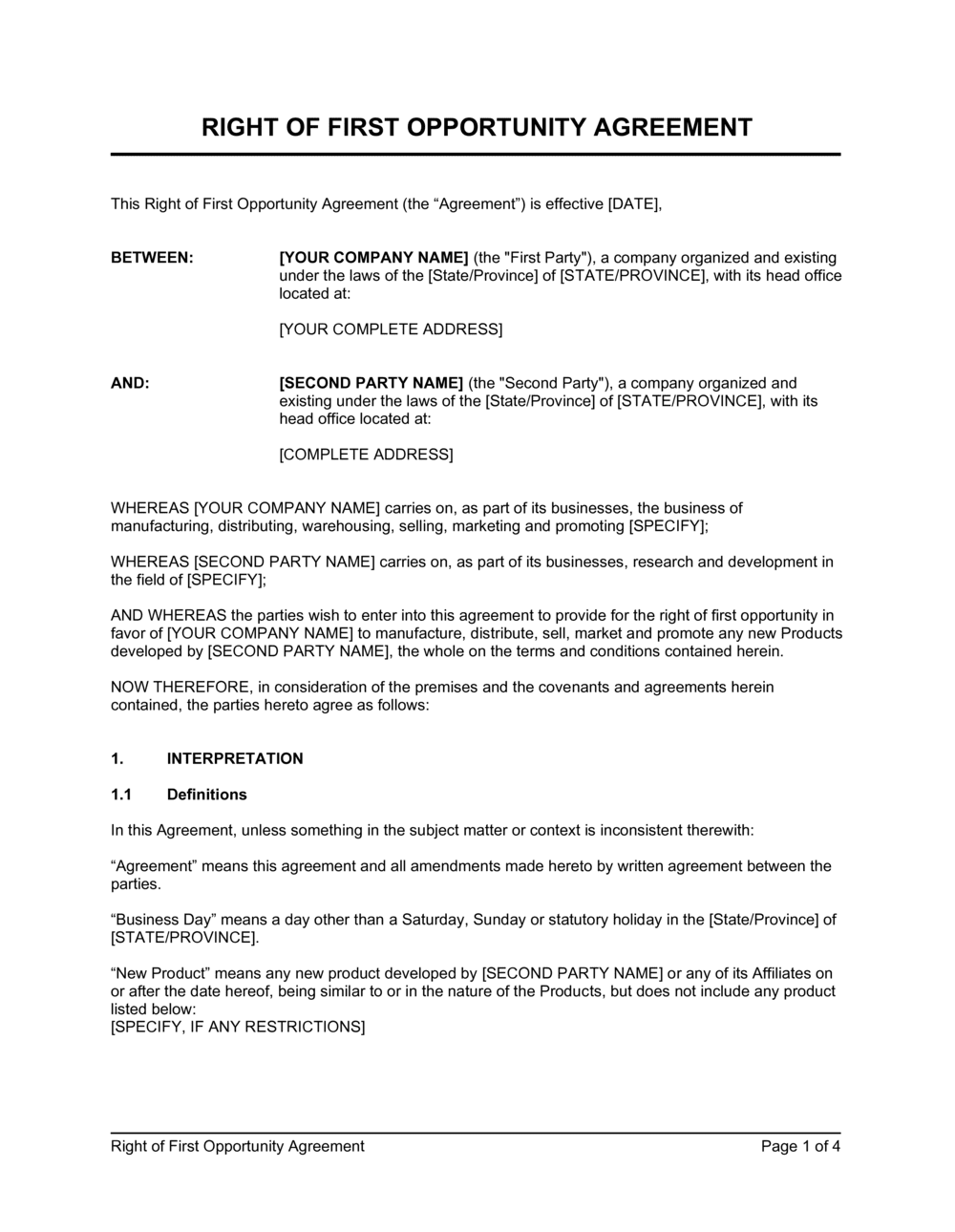
A Right of First Opportunity Agreement (Commercialization) is a legally binding contract that grants one party — the rights holder — the first chance to negotiate a deal to commercialize a technology, product, or IP asset before the owner approaches any third party. This free Word download gives you a structured, attorney-reviewed starting point you can edit online and export as PDF for execution between IP owners, licensors, research institutions, and commercial partners.
When you need it
Use it when a technology owner or innovator wants to give a strategic partner, investor, or licensee a priority window to negotiate commercialization rights before those rights are offered to the open market. It is common in university-industry technology transfer, joint R&D arrangements, and corporate spin-off transactions.
What's inside
Definitions of the commercialization opportunity and IP assets, the notice and offer period mechanics, negotiation window, non-circumvention obligations, exclusivity during negotiation, representations and warranties, termination triggers, and governing law.

What is a Right of First Opportunity Agreement (Commercialization)?

A Right of First Opportunity Agreement (Commercialization) is a legally binding contract that grants one party — typically an investor, corporate partner, or licensee — the first and exclusive right to negotiate commercialization terms for a defined IP asset or technology before the owner approaches any third party. Unlike a right of first refusal, which requires the owner to present an existing third-party offer for matching, a ROFO is triggered proactively: the owner must notify the rights holder and enter a good-faith negotiation window before any external market contact occurs. The agreement governs the notice mechanism, the exclusivity period, the post-lapse rules for third-party dealings, and the confidentiality obligations that protect both sides throughout the process.

This template is a free Word download structured for use in technology transfer, joint R&D commercialization, and corporate IP licensing contexts. It covers all material terms — IP asset definition, offer notice requirements, negotiation period, non-circumvention, representations and warranties, and governing law — in a format suitable for review and execution by both parties and their legal counsel.

Why You Need This Document

Without a formal ROFO agreement, a strategic partner or investor who has contributed resources, funding, or market access to an IP development relationship has no enforceable priority if the owner decides to license or sell that technology to a competitor. The owner can approach the market freely, run a competitive process, and close a deal before the partner even learns the opportunity existed. The commercial and reputational damage from this scenario — particularly in university-industry partnerships and joint venture arrangements — can be severe and irreversible by the time litigation is filed.

A properly drafted ROFO closes this gap by creating a binding obligation to notify and negotiate first, backed by injunctive relief provisions that allow a court to halt a competing transaction before it closes. It also provides a structured framework for the negotiation itself, reducing the risk of bad-faith time-wasting and ensuring that both parties have a clear record of what was offered and when. For IP owners, the ROFO signals commitment to the strategic relationship without locking in specific deal terms prematurely. For rights holders, it provides a contractually enforceable priority that no informal understanding can replicate. This template gives both sides a professionally structured starting point that a lawyer can review and adapt in hours rather than days.

Which variant fits your situation?

If your situation is…Use this template
Granting priority negotiation rights over a specific patent or patent familyRight of First Opportunity Agreement (Commercialization)
Granting a right to match any third-party offer on equal termsRight of First Refusal Agreement
Licensing existing IP for commercial exploitation with defined royaltiesTechnology License Agreement
Jointly developing new IP with shared commercialization rightsJoint Development Agreement
Transferring full ownership of IP to a commercial partnerIP Assignment Agreement
Granting an exclusive option to license before a broader offeringExclusive Option Agreement
Protecting confidential IP details during commercialization negotiationsNon-Disclosure Agreement (NDA)

Common mistakes to avoid

❌ Defining the IP assets too broadly

Why it matters: An overly broad definition — such as 'all IP owned by the company' — can inadvertently encumber unrelated technologies and make future financing or M&A transactions significantly more complex.

Fix: Enumerate specific patent numbers, know-how categories, and fields of use in a Schedule A, and include an explicit carve-out for IP developed outside the scope of the covered relationship.

❌ Omitting the 'no better terms' restriction after the negotiation window lapses

Why it matters: Without this restriction, the IP owner can use the rights holder's negotiation as free market research and then close with a third party on sweeter terms, defeating the entire purpose of the ROFO.

Fix: Add a clause requiring that any third-party deal concluded within 12 months of a lapsed ROFO must not include financial terms materially more favorable than those last proposed in writing to the rights holder.

❌ No good-faith negotiation obligation

Why it matters: A ROFO without a good-faith clause allows one party to run out the clock with no genuine intent to deal, leaving the other side with no practical remedy and a wasted exclusivity period.

Fix: Include an explicit mutual good-faith obligation and a requirement that each party respond to written proposals within a defined number of business days — typically 10 to 15.

❌ Relying on a separate NDA without embedding confidentiality in the ROFO itself

Why it matters: If the standalone NDA expires or is terminated before the commercialization deal closes, sensitive deal terms and IP details become unprotected, creating competitive exposure and potential trade-secret loss.

Fix: Include a self-contained confidentiality clause in the ROFO that survives the agreement's termination and operates independently of any separate NDA.

❌ Excluding injunctive relief from the arbitration clause

Why it matters: If the IP owner secretly deals with a third party in breach of the ROFO, the harm is immediate and irreversible — arbitration timelines of 12 to 24 months cannot undo a closed deal.

Fix: Carve out the right for either party to seek emergency injunctive or interim relief in any court of competent jurisdiction, regardless of the arbitration agreement.

❌ Signing after third-party discussions have already begun

Why it matters: A ROFO signed after the owner has already been in contact with third parties may be unenforceable — courts have found that the trigger event occurred before the right was formally granted.

Fix: Execute the ROFO at the outset of the commercial relationship, before any commercialization activity begins, and include a representation confirming no prior third-party discussions have taken place.

The 9 key clauses, explained

Definitions and scope of IP assets

In plain language: Precisely identifies the technology, patent applications, know-how, and any associated data that the agreement covers, including any field-of-use limitation.

Sample language
'IP Assets' means the inventions described in [PATENT APPLICATION NUMBER(S)], all associated know-how, and the technical data listed in Schedule A, within the field of [FIELD OF USE].

Common mistake: Defining the IP assets too broadly by referencing an entire portfolio rather than specific assets — rights holders may inadvertently claim priority over unrelated technologies the owner never intended to include.

Grant of right of first opportunity

In plain language: States that the IP owner grants the rights holder the first and exclusive opportunity to negotiate commercialization terms before any third party is approached.

Sample language
[OWNER NAME] hereby grants [RIGHTS HOLDER NAME] the exclusive right of first opportunity to negotiate and conclude a commercialization agreement with respect to the IP Assets, on such terms as the parties may agree in writing.

Common mistake: Omitting the word 'exclusive' during the negotiation period — without it, the owner may simultaneously approach third parties while nominally negotiating with the rights holder.

Offer notice and trigger mechanism

In plain language: Sets out when and how the IP owner must notify the rights holder that a commercialization opportunity has arisen, and what information must accompany the notice.

Sample language
Owner shall deliver written notice to Rights Holder ('Offer Notice') promptly and no later than [X] business days before approaching any third party. The Offer Notice shall include a summary of proposed terms, including deal structure, financial terms, and field of use.

Common mistake: Failing to require minimum deal information in the Offer Notice. A bare notice with no proposed terms gives the rights holder nothing to evaluate, effectively converting the ROFO into a meaningless formality.

Negotiation period and exclusivity

In plain language: Defines the window during which the rights holder has the exclusive right to negotiate, and prohibits the owner from approaching third parties during this window.

Sample language
Rights Holder shall have [60] calendar days from receipt of the Offer Notice ('Negotiation Period') to negotiate in good faith and execute a definitive commercialization agreement. During the Negotiation Period, Owner shall not solicit, negotiate with, or disclose the opportunity to any third party.

Common mistake: Setting the negotiation period without specifying a good-faith obligation on both sides. Without it, one party can run out the clock with no real intent to deal, and the other has no remedy.

Failure to reach agreement and third-party dealings

In plain language: Specifies what happens if the parties do not conclude an agreement within the negotiation period — typically, the owner may approach third parties on terms no more favorable than those last offered to the rights holder.

Sample language
If the parties fail to execute a definitive agreement within the Negotiation Period, Owner may negotiate with and license the IP Assets to any third party, provided such third-party transaction is not on financial terms materially more favorable to the third party than those last proposed in writing to Rights Holder.

Common mistake: Omitting the 'no better terms' restriction after the negotiation period lapses. Without it, an owner can use the rights holder's negotiation as free price discovery and then offer a sweeter deal to a preferred third party.

Non-circumvention and confidentiality

In plain language: Prevents the owner from structuring transactions to bypass the ROFO — for example, by transferring the IP to an affiliate that then deals with a third party — and requires both parties to keep deal information confidential.

Sample language
Owner shall not transfer, assign, or otherwise convey the IP Assets to any affiliate or third party for the purpose of circumventing the rights granted herein. All information exchanged during negotiations shall be treated as Confidential Information subject to the NDA dated [DATE] or, absent such NDA, kept strictly confidential for [5] years.

Common mistake: Relying on a standalone NDA and omitting confidentiality from the ROFO itself. If the NDA is terminated or expires before the commercialization deal closes, sensitive deal terms become unprotected.

Representations and warranties

In plain language: Each party confirms that it has authority to enter the agreement, that the IP assets are validly owned or controlled by the owner, and that there are no conflicting agreements that would prevent performance.

Sample language
Owner represents and warrants that: (a) it has full right and authority to grant the ROFO; (b) the IP Assets are free of any conflicting license, lien, or encumbrance that would impair Rights Holder's ability to commercialize them; and (c) no third-party approval is required to perform this Agreement.

Common mistake: No representation that the IP is free of conflicting encumbrances. If an existing exclusive license is already in place, the ROFO may be worthless — the rights holder discovers this only after spending time and money in negotiations.

Term and termination

In plain language: Sets the duration of the ROFO, the conditions under which it terminates early, and the survival of obligations such as confidentiality and non-circumvention after termination.

Sample language
This Agreement shall commence on [EFFECTIVE DATE] and continue for [X] years unless earlier terminated. Either party may terminate upon [30] days' written notice if the other party materially breaches this Agreement and fails to cure within [15] days. Clauses [CONFIDENTIALITY], [NON-CIRCUMVENTION], and [GOVERNING LAW] shall survive termination.

Common mistake: No cure period before termination for breach. Without it, one side can terminate immediately over a technical breach, extinguishing the rights holder's opportunity before a genuine dispute is even resolved.

Governing law and dispute resolution

In plain language: Specifies which jurisdiction's law governs the agreement and how disputes — including injunctive relief for ROFO violations — are handled.

Sample language
This Agreement is governed by the laws of [STATE / PROVINCE / COUNTRY], without regard to conflict-of-law principles. Any dispute shall be resolved by binding arbitration administered by [AAA / ICC / LCIA] in [CITY], except that either party may seek injunctive relief in any court of competent jurisdiction to prevent irreparable harm.

Common mistake: Excluding injunctive relief from the dispute resolution clause. A ROFO violation — where the owner secretly deals with a third party — causes irreparable harm that arbitration timelines cannot remedy; preserving the right to court-ordered injunctions is essential.

How to fill it out

  1. 1

    Identify and describe the IP assets precisely

    List every patent application number, know-how category, and data set covered by the agreement. Attach a Schedule A if the asset list is lengthy. Define any field-of-use limitations clearly.

    💡 Use the same asset descriptions that appear in your patent filings or internal IP registry to avoid definitional mismatches later.

  2. 2

    Name the parties using their full legal entity names

    Enter the IP owner's and rights holder's complete registered legal names, jurisdictions of incorporation, and registered addresses. Confirm that the owner — not an affiliate — actually holds title to the IP assets listed.

    💡 Request a copy of the IP assignment or patent register to confirm ownership before signing. An owner who doesn't actually hold title cannot grant a valid ROFO.

  3. 3

    Set the offer notice requirements and timeline

    Define exactly what information must appear in the Offer Notice — deal structure, proposed financial terms, field of use, and territory — and the number of business days before third-party contact that the notice must be delivered.

    💡 Require at least a term sheet level of detail in the Offer Notice. A vague notice restarts negotiations from zero and wastes the exclusivity window.

  4. 4

    Define the negotiation period and good-faith obligation

    Set a negotiation window of 30 to 90 days depending on deal complexity. State explicitly that both parties must negotiate in good faith and exchange commercially reasonable proposals within the window.

    💡 For complex biotech or deep-tech deals, 90 days is a realistic minimum. For software licensing, 30 to 45 days is generally sufficient.

  5. 5

    Draft the post-lapse third-party dealing restriction

    Specify that if the negotiation period lapses without agreement, the owner may only deal with third parties on terms that are not materially more favorable than those last proposed in writing to the rights holder.

    💡 Define 'materially more favorable' by reference to a specific threshold — for example, financial terms more than 10% better on a net-present-value basis — to make the restriction enforceable rather than subjective.

  6. 6

    Include the non-circumvention and confidentiality provisions

    Confirm the non-circumvention clause covers affiliate transfers and structural workarounds. Embed a confidentiality obligation directly in the agreement, even if a separate NDA exists.

    💡 Cross-reference any existing NDA by date and parties, and state that the ROFO's confidentiality obligation is in addition to — not in lieu of — the NDA.

  7. 7

    Set the term and survival provisions

    Enter the agreement's effective date, duration, and the list of clauses that survive expiration or termination. Ensure confidentiality and non-circumvention always survive.

    💡 Tie the ROFO term to a specific milestone — such as the grant of a key patent or the completion of a clinical trial — rather than a fixed calendar period, so the right remains live while the IP matures.

  8. 8

    Execute before any third-party discussions begin

    Both parties should sign the agreement before any commercialization discussions are held with third parties. Retroactive ROFOs are difficult to enforce and signal poor process to investors and acquirers.

    💡 Use a dated cover email confirming execution and file the signed original alongside the IP asset register so there is no ambiguity about what was covered at the time of signing.

Frequently asked questions

What is a right of first opportunity agreement for commercialization?

A right of first opportunity (ROFO) agreement for commercialization is a contract that requires an IP owner to notify a designated party — the rights holder — and offer them the first chance to negotiate commercialization terms before approaching any third party. Unlike a right of first refusal, a ROFO is triggered before any third-party offer exists: the rights holder negotiates directly from a blank slate rather than matching an existing bid. It is commonly used in university-industry technology transfer, joint R&D arrangements, and corporate spin-out transactions.

What is the difference between a right of first opportunity and a right of first refusal?

A right of first opportunity (ROFO) requires the owner to approach the rights holder first, before any third-party contact, giving them a priority window to negotiate. A right of first refusal (ROFR) requires the owner to present any third-party offer to the rights holder so they can match it on identical terms. A ROFO is generally considered weaker than a ROFR because the rights holder must negotiate terms without knowing what a competitor would offer — but it is also less burdensome on the owner and easier to administer in IP commercialization contexts.

When should I use a right of first opportunity agreement?

Use it when an IP owner wants to give a strategic partner, investor, or licensee a priority negotiation window as part of a broader collaborative relationship — without committing to specific deal terms upfront. Typical situations include university technology transfer offices granting industry sponsors priority licensing rights, startups giving lead investors first commercialization access on jointly developed IP, and corporate R&D departments protecting a partner's priority position before a broader licensing campaign.

Is a right of first opportunity agreement legally enforceable?

A right of first opportunity agreement is generally enforceable when it is in writing, identifies the IP assets with specificity, sets clear notice and negotiation timelines, and includes mutual good-faith obligations. Enforceability depends on jurisdiction and the clarity of the drafting. Courts in common-law jurisdictions have enforced ROFOs as binding contracts where the essential terms are sufficiently definite. Vaguely drafted ROFOs — particularly those lacking defined negotiation periods or clear trigger mechanisms — are more likely to be challenged as unenforceable agreements to agree. Legal review is recommended before execution.

How long should the negotiation period be in a ROFO?

The appropriate length depends on deal complexity. For straightforward software licensing deals, 30 to 45 days is typically sufficient. For biotech, pharmaceutical, or deep-technology commercialization deals involving regulatory pathways and complex financial modeling, 60 to 90 days is more realistic. The key principle is that the period should be long enough for the rights holder to conduct meaningful due diligence and submit a commercially reasonable proposal — not so long that it effectively freezes the owner's commercialization strategy.

Can a right of first opportunity be assigned to a third party?

Whether a ROFO can be assigned depends on the agreement's terms and the applicable jurisdiction. In most cases, ROFO rights are personal to the named rights holder and cannot be assigned without the owner's written consent, because the owner agreed to deal with a specific counterparty. If assignment is a possibility — for example, where a venture fund may want to transfer the right to a portfolio company — include an express assignment provision and approval mechanism in the agreement.

What happens if the IP owner violates the right of first opportunity?

If the owner breaches the ROFO by dealing with a third party without triggering the notice and negotiation process, the rights holder's remedies typically include damages for the lost opportunity and, in some jurisdictions, specific performance or injunctive relief to unwind the third-party transaction. Because IP deals close quickly and are difficult to unwind, the ROFO should include a carve-out from any arbitration clause preserving the right to seek emergency injunctive relief in court. Courts have awarded damages based on the lost value of the commercialization opportunity, though quantifying this is often disputed.

Should a right of first opportunity include a confidentiality clause?

Yes. Confidentiality provisions should be embedded directly in the ROFO, even if a separate NDA already exists between the parties. During the negotiation period, commercially sensitive IP details, financial models, and deal terms are exchanged — if the standalone NDA expires or is terminated before the ROFO deal closes, that information becomes unprotected. The ROFO's confidentiality clause should survive termination of the main agreement for at least five years.

Does a right of first opportunity grant any rights to the IP itself?

No. A ROFO grants only a procedural right — the right to be notified and to negotiate first. It does not grant a license, an option, or any ownership interest in the underlying IP assets. No rights to use, develop, or commercialize the IP are transferred until a separate commercialization agreement is executed following a successful negotiation. This distinction matters for accounting, IP registration, and third-party due diligence purposes.

Do I need a lawyer to draft a right of first opportunity agreement?

For straightforward arrangements between established parties with well-defined IP assets, a high-quality template provides a solid starting point. However, legal review is strongly recommended when the IP assets are high-value or contested, when the parties operate in different jurisdictions, when the commercialization could involve regulatory approvals, or when the ROFO is part of a broader joint development or investment relationship. A 2 to 4 hour review by an IP or commercial lawyer typically costs $600 to $1,500 and substantially reduces the risk of unenforceable clauses.

How this compares to alternatives

vs Right of First Refusal Agreement

A right of first refusal requires the IP owner to present any third-party offer to the rights holder, who can match it on identical terms. A ROFO requires the owner to approach the rights holder before any third-party contact occurs. A ROFR is stronger for the rights holder because negotiation is grounded in a real offer; a ROFO is preferred by IP owners because it does not require surfacing third-party terms.

vs Exclusive Option Agreement

An exclusive option agreement grants the rights holder the right — but not the obligation — to acquire or license the IP on pre-agreed terms within a fixed period, often for a fee. A ROFO does not lock in terms in advance; it only guarantees a first negotiation opportunity. An option is stronger and more certain but typically requires an upfront option payment that a ROFO does not.

vs Technology License Agreement

A technology license agreement transfers defined rights to use, manufacture, or commercialize IP in exchange for royalties or fees — it is the operative commercialization deal. A ROFO is a pre-agreement that governs access to the negotiation process; it does not itself grant any commercialization rights. A ROFO is the precursor; the license agreement is the destination.

vs Non-Disclosure Agreement (NDA)

An NDA protects confidential information exchanged during discussions but creates no commercialization rights or obligations. A ROFO establishes priority negotiation rights and often incorporates or references an NDA for the information exchanged during the negotiation period. Both documents are typically needed together, not as alternatives.

Industry-specific considerations

Life Sciences and Biotech

ROFO commonly granted to pharma company sponsors over university or startup-developed drug candidates, with field-of-use restrictions tied to specific therapeutic areas and regulatory approval milestones.

Technology and SaaS

Software IP ownership clarity is critical — the ROFO must cover source code, algorithms, and training data specifically, and should address open-source component carve-outs.

Manufacturing and Industrial

Used when a manufacturing partner funds process innovation or tooling development and requires priority commercialization rights before the innovator licenses the process to competing manufacturers.

Energy and Clean Technology

Government-funded research institutions often grant ROFOs to commercial partners, with geographic field-of-use restrictions and national interest carve-outs that require specific regulatory compliance language.

Jurisdictional notes

United States

ROFOs are generally enforceable as contracts under US common law when the essential terms are sufficiently definite. State law governs enforceability — courts in New York and Delaware apply a strict definiteness standard and have declined to enforce vague 'agreements to agree.' Bayh-Dole Act considerations apply when the underlying IP was developed with federal funding, requiring specific march-in rights and US manufacturing preferences to be addressed in the commercialization terms.

Canada

Canadian courts recognize ROFOs as binding contracts in commercial contexts, particularly in Ontario and British Columbia. Quebec's civil law tradition may interpret ROFO obligations differently from common-law provinces, and French-language requirements apply to contracts involving Quebec-based entities. IP ownership and licensing under the Canadian Patent Act should be confirmed before granting rights, and provincial securities laws may be triggered if the ROFO is connected to an equity investment.

United Kingdom

English courts enforce ROFOs where the negotiation obligation is clear and the subject matter is sufficiently identified — vague or aspirational ROFOs are treated as unenforceable agreements to negotiate. Post-Brexit, UK IP law diverges from EU frameworks in some respects, particularly regarding exhaustion of rights and database rights. The governing law clause should expressly specify English and Welsh, Scottish, or Northern Irish law, as each is a separate legal system.

European Union

ROFO enforceability varies significantly by member state — German, French, and Dutch contract law each treat priority rights differently, and local courts may apply mandatory provisions that override the chosen governing law. GDPR considerations arise when personal data forms part of the IP assets or is exchanged during the negotiation process. Technology transfer agreements that could affect competition within the EU may also fall within the scope of the EU Technology Transfer Block Exemption Regulation and require careful compliance review.

Template vs lawyer — what fits your deal?

PathBest forCostTime
Use the templateEarly-stage startups and research teams establishing a ROFO with a known partner over clearly defined IP assetsFree30–60 minutes
Template + legal reviewCross-border arrangements, high-value IP, or ROFO embedded in a broader joint development or investment agreement$600–$1,500 (IP or commercial lawyer review)3–7 days
Custom draftedPharmaceutical licensing, complex multi-party IP arrangements, government-funded research, or deals exceeding $5M in potential value$2,500–$8,000+2–4 weeks

Glossary

Right of First Opportunity (ROFO)
A contractual right requiring the IP owner to offer a defined party the first chance to negotiate deal terms before approaching any third party.
Right of First Refusal (ROFR)
A stronger contractual right requiring the owner to present any third-party offer to the rights holder, who may match it on identical terms — distinct from a ROFO, which precedes any third-party contact.
Commercialization
The process of bringing a technology, invention, or IP asset to market through licensing, joint venture, sale, or product development.
IP Asset
Any intellectual property — patents, trade secrets, know-how, software, or data — that is the subject of the commercialization opportunity.
Offer Notice
A written notification from the IP owner to the rights holder that a commercialization opportunity has arisen, triggering the negotiation window.
Negotiation Period
The defined window — typically 30 to 90 days — during which the rights holder has the exclusive right to negotiate terms with the IP owner.
Non-Circumvention
A clause preventing the IP owner from bypassing the rights holder by approaching third parties during or after the negotiation period in bad faith.
Exclusivity Window
The period during active negotiation in which the IP owner agrees not to solicit, negotiate with, or disclose the opportunity to any third party.
Technology Transfer
The formal process by which rights to use, develop, or commercialize a technology are conveyed from the originating party to a commercial partner.
Know-How
Unpatented technical information, data, processes, and expertise that are necessary to practically implement or commercialize a technology.
Field of Use
A defined scope — by industry, application, geography, or product category — within which the commercialization rights are granted or negotiated.

Part of your Business Operating System

This document is one of 3,000+ business & legal templates included in Business in a Box.

  • Fill-in-the-blanks — ready in minutes
  • 100% customizable Word document
  • Compatible with all office suites
  • Export to PDF and share electronically

Create your document in 3 simple steps.

From template to signed document — all inside one Business Operating System.
1
Download or open template

Access over 3,000+ business and legal templates for any business task, project or initiative.

2
Edit and fill in the blanks with AI

Customize your ready-made business document template and save it in the cloud.

3
Save, Share, Send, Sign

Share your files and folders with your team. Create a space of seamless collaboration.

Save time, save money, and create top-quality documents.

★★★★★

"Fantastic value! I'm not sure how I'd do without it. It's worth its weight in gold and paid back for itself many times."

Managing Director · Mall Farm
Robert Whalley
Managing Director, Mall Farm Proprietary Limited
★★★★★

"I have been using Business in a Box for years. It has been the most useful source of templates I have encountered. I recommend it to anyone."

Business Owner · 4+ years
Dr Michael John Freestone
Business Owner
★★★★★

"It has been a life saver so many times I have lost count. Business in a Box has saved me so much time and as you know, time is money."

Owner · Upstate Web
David G. Moore Jr.
Owner, Upstate Web

Run your business with a system — not scattered tools

Stop downloading documents. Start operating with clarity. Business in a Box gives you the Business Operating System used by over 250,000 companies worldwide to structure, run, and grow their business.

Start free · No credit card required