Commitment Letter Template

Free Word download β€’ Edit online β€’ Save & share with Drive β€’ Export to PDF

1 pageβ€’15–20 min to fillβ€’Difficulty: Standard
Learn more ↓
FreeCommitment Letter Template

At a glance

What it is
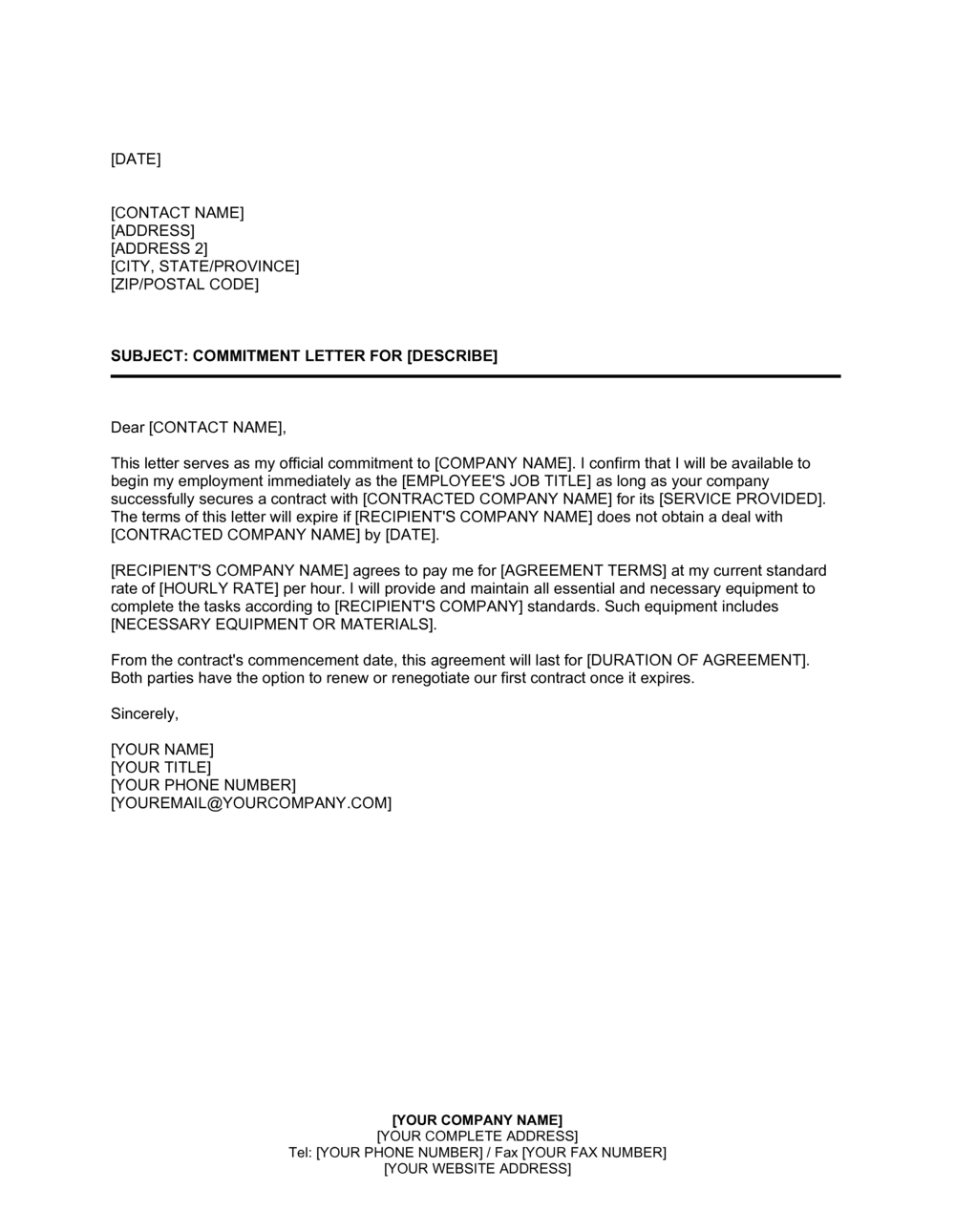
A Commitment Letter is a formal written statement β€” typically issued by a lender, investor, or financial institution β€” confirming intent to provide financing or capital under defined terms and conditions. This free Word download gives you a structured starting point you can edit online and export as PDF to satisfy due-diligence requirements or transaction closing conditions.
When you need it
Use it when a borrower or investee needs written confirmation of financing terms before a deal closes, a property purchase proceeds, or a board approves a transaction. It is commonly required by real estate attorneys, M&A advisors, and corporate legal teams as a condition of moving forward.
What's inside
Parties and transaction summary, financing amount and instrument type, interest rate and repayment terms, conditions precedent to funding, expiration date, and a disclaimer on the non-binding or binding nature of the letter.

What is a Commitment Letter?

A Commitment Letter is a formal written document issued by a lender or investor to a borrower or investee confirming their intent to provide financing or capital under a specific set of terms. It identifies both parties, states the committed amount and instrument type, sets the interest rate and repayment structure, lists the conditions the borrower must satisfy before funds are released, and establishes an expiration date by which the borrower must accept. Unlike a casual term sheet, a commitment letter is issued after initial due diligence and represents a concrete, time-bound statement of financing intent that both parties can rely on to move a transaction forward.

Why You Need This Document

Without a written commitment letter, real estate purchase contracts stall because sellers have no evidence the buyer can close, M&A deals collapse at the due-diligence stage when acquirers cannot demonstrate financing, and borrowers lose credibility with counterparties who need certainty before committing their own resources. A properly drafted commitment letter protects the lender by conditioning the obligation to fund on specific, measurable deliverables β€” and protects the borrower by giving them a concrete document to present to attorneys, sellers, boards, and co-investors. This template gives you a professionally structured starting point that captures every material term, states the binding nature of the letter explicitly, and includes the conditions precedent language that prevents costly closing disputes.

Which variant fits your situation?

If your situation is…Use this template
Confirming a commercial mortgage or real estate acquisition loanMortgage Commitment Letter
Documenting a term loan to a small business borrowerBusiness Loan Commitment Letter
Expressing early interest before full due diligence is completeLetter of Intent
Confirming a revolving credit or working capital facilityCredit Facility Commitment Letter
Formalizing an equity investment term sheet into a commitmentInvestment Term Sheet
Providing proof of funds for a real estate purchase offerProof of Funds Letter
Outlining final loan terms before formal loan agreement is draftedLoan Agreement

Common mistakes to avoid

❌ Leaving the binding-nature clause ambiguous

Why it matters: Courts have treated ambiguous commitment letters as enforceable contracts when both parties proceeded as though the deal was closed, exposing lenders to damages for failure to fund.

Fix: Include an explicit sentence stating whether the letter is binding, non-binding, or binding only as to specific provisions β€” and have the borrower acknowledge the distinction in writing.

❌ Using open-ended conditions precedent

Why it matters: Phrases like 'satisfactory completion of due diligence' give the lender a subjective exit clause that the borrower cannot reliably plan around, creating uncertainty and potential litigation.

Fix: List every condition as a specific, objective deliverable β€” a named document, a minimum financial ratio, or a dated approval β€” so satisfaction is measurable.

❌ Omitting the expiration date and time zone

Why it matters: Without a clear expiration, a commitment can be claimed to remain open indefinitely, obligating the lender long after market conditions or the borrower's creditworthiness has changed.

Fix: Always include a specific expiration date and time with the time zone, and confirm with the borrower that they have enough time to countersign and return the fee before the deadline.

❌ Misidentifying collateral without a prior lien search

Why it matters: Issuing a commitment that promises a first-lien position on collateral already encumbered by a prior lender creates a closing crisis and potential lender liability.

Fix: Run a UCC search, title search, or equivalent before the commitment is issued, and explicitly carve out any permitted prior liens in the collateral clause.

The 8 key clauses, explained

Date, parties, and transaction reference

In plain language: Identifies the issuing lender or investor, the borrower or investee, and a brief description of the transaction being financed.

Sample language
[DATE] | [LENDER NAME] ('Lender') is pleased to confirm its commitment to provide financing to [BORROWER LEGAL NAME] ('Borrower') in connection with [BRIEF TRANSACTION DESCRIPTION].

Common mistake: Using a trade name instead of the lender's registered legal entity name β€” if the commitment is ever disputed, enforcing it against the correct entity becomes unnecessarily complicated.

Financing amount and instrument type

In plain language: States the exact dollar amount committed and whether it is a term loan, revolving facility, mortgage, or equity investment.

Sample language
Lender commits to provide a [TERM LOAN / REVOLVING CREDIT FACILITY / MORTGAGE] in the principal amount of $[AMOUNT] ([WRITTEN AMOUNT] Dollars).

Common mistake: Omitting the instrument type and relying solely on the dollar figure β€” different instruments carry fundamentally different repayment structures and borrower obligations.

Interest rate and fees

In plain language: Specifies the applicable interest rate (fixed or variable, and the index if variable), origination fee, and commitment fee.

Sample language
Interest shall accrue at [X]% per annum ([fixed / variable at [INDEX] + [SPREAD] bps]). An origination fee of [X]% of the committed amount is payable at closing. A commitment fee of $[AMOUNT] is due upon acceptance of this letter.

Common mistake: Leaving the rate as a range ('between 6% and 9%') rather than a fixed figure or a defined index-plus-spread formula β€” ranges invite later disputes about which rate applies.

Repayment terms and maturity

In plain language: Defines the loan term, amortization schedule (if any), and the final maturity date when the outstanding balance is due.

Sample language
The loan shall mature [X] years from the closing date. Principal shall be repaid in [monthly / quarterly] installments of $[AMOUNT], with the remaining balance due in full on [MATURITY DATE].

Common mistake: Describing repayment as 'standard amortization' without specifying the period β€” a 20-year amortization with a 5-year balloon is materially different from a fully amortizing 5-year loan.

Conditions precedent to funding

In plain language: Lists the specific deliverables the borrower must provide or satisfy before the lender is required to fund.

Sample language
This commitment is conditioned upon: (a) satisfactory appraisal of [COLLATERAL]; (b) delivery of [YEAR] and [YEAR] audited financial statements; (c) execution of all definitive loan documents; (d) evidence of [INSURANCE TYPE] insurance naming Lender as additional insured; and (e) [ANY OTHER CONDITIONS].

Common mistake: Using open-ended conditions like 'satisfactory due diligence' without specifying what constitutes satisfaction β€” this gives the lender a subjective exit and creates uncertainty for the borrower.

Collateral and security

In plain language: Identifies the assets the borrower pledges to secure the loan and any lien priority the lender requires.

Sample language
As security for the loan, Borrower shall grant Lender a first-priority [MORTGAGE / SECURITY INTEREST / PLEDGE] over [DESCRIPTION OF COLLATERAL], free and clear of all prior liens except [PERMITTED EXCEPTIONS].

Common mistake: Failing to specify lien priority β€” a second-lien position has significantly less recovery value than a first lien and should be explicitly stated, not assumed.

Expiration and acceptance

In plain language: Sets the deadline for the borrower to accept the commitment in writing and describes how acceptance is communicated.

Sample language
This commitment expires at 5:00 PM [TIMEZONE] on [DATE] unless accepted in writing by Borrower prior to that time. Acceptance is effected by returning a countersigned copy of this letter accompanied by the commitment fee.

Common mistake: Not specifying a time zone on the expiration β€” for multi-jurisdiction transactions, ambiguous expiration times have caused legitimate commitment disputes.

Binding nature and disclaimer

In plain language: States clearly whether the letter is legally binding, non-binding, or binding only as to certain provisions such as exclusivity or confidentiality.

Sample language
This letter reflects Lender's current intent to provide the financing described herein and is [binding / non-binding] on Lender, subject to completion of due diligence and execution of definitive loan documents. [This letter does not constitute a loan agreement or obligate Lender to fund absent satisfaction of all conditions set forth herein.]

Common mistake: Omitting the binding-nature clause entirely β€” courts have held ambiguous commitment letters to be enforceable contracts when both parties behaved as though the deal was done.

How to fill it out

  1. 1

    Enter the lender's and borrower's legal names

    Use each party's full registered legal name β€” not a trade name or DBA. Include the entity type (LLC, corporation, LP) and state or country of formation.

    πŸ’‘ Cross-reference the borrower's name against their most recent bank statement or certificate of good standing before inserting it β€” name mismatches delay closing.

  2. 2

    Describe the transaction in one or two sentences

    Identify what the financing is for β€” acquisition of a specific property, working capital for operations, equipment purchase β€” with enough specificity that both parties can point to the same deal.

    πŸ’‘ If a purchase agreement or term sheet already exists, reference it by date and parties rather than re-describing it in full.

  3. 3

    State the financing amount, instrument, and rate

    Enter the exact committed dollar amount, the type of instrument (term loan, revolver, or mortgage), and a fixed rate or a defined floating-rate formula (e.g., SOFR + 250 bps).

    πŸ’‘ Write out the dollar amount in both numerals and words β€” '$2,500,000 (Two Million Five Hundred Thousand Dollars)' β€” to eliminate transcription disputes.

  4. 4

    Define the repayment schedule and maturity

    Set the loan term, amortization period, payment frequency, and final maturity date. If there is a balloon payment, state the amount explicitly.

    πŸ’‘ Attach a simple amortization table as an exhibit if the schedule is anything other than fully amortizing β€” it removes all ambiguity about payment amounts.

  5. 5

    List all conditions precedent with specificity

    Write out every document, approval, and deliverable the borrower must provide before funding. Number each item and avoid catch-all language like 'other conditions as lender may require.'

    πŸ’‘ Review the list with the borrower before issuing the letter β€” surfacing undisclosed issues early prevents failed closings.

  6. 6

    Identify the collateral and lien position

    Name the specific assets being pledged, describe the required security interest type, and state the lender's required lien priority.

    πŸ’‘ Run a UCC or title search before issuing the commitment to confirm no undisclosed prior liens exist on the intended collateral.

  7. 7

    Set the expiration date and acceptance mechanics

    Choose an expiration date that gives the borrower adequate time to review and return the letter β€” typically 5 to 10 business days β€” and specify the time zone and method of acceptance.

    πŸ’‘ Email countersignature is standard and legally sufficient in most jurisdictions; requiring wet-ink return by courier slows closings without adding legal protection.

Frequently asked questions

What is a commitment letter?

A commitment letter is a formal written statement issued by a lender or investor confirming their intent to provide financing or capital under defined terms. It specifies the amount, instrument type, rate, repayment structure, and conditions the borrower must satisfy before funds are released. It is commonly required in real estate transactions, M&A deals, and commercial lending as evidence that financing is in place.

Is a commitment letter legally binding?

It depends on the language of the letter itself. Some commitment letters are expressly binding on the lender once accepted; others are stated as non-binding expressions of intent, subject to completion of due diligence and execution of definitive documents. Courts have in some cases found ambiguous letters to be enforceable, so the binding-nature clause should always be explicit. Review the specific language carefully before relying on a commitment letter as a firm funding guarantee.

What is the difference between a commitment letter and a term sheet?

A term sheet is typically an earlier, less formal document summarizing the key economic terms of a proposed deal β€” it is almost always non-binding. A commitment letter is issued after initial due diligence and represents a firmer, more detailed confirmation of financing intent. The commitment letter typically incorporates the term sheet's economics and adds conditions precedent, collateral requirements, and expiration mechanics.

What is the difference between a commitment letter and a loan agreement?

A commitment letter confirms intent to lend under stated terms; a loan agreement is the definitive, fully binding contract that governs the actual lending relationship. The commitment letter typically precedes the loan agreement and is often a closing condition in real estate or M&A transactions. Once the loan agreement is executed and funds are disbursed, the commitment letter is superseded.

What are conditions precedent in a commitment letter?

Conditions precedent are specific deliverables or approvals the borrower must satisfy before the lender is obligated to fund. Common examples include delivering audited financial statements, providing a satisfactory property appraisal, obtaining title insurance, and executing all definitive loan documents. Each condition should be described as a specific, objective item β€” vague conditions give the lender an unilateral exit and create closing uncertainty.

How long does a commitment letter remain valid?

A commitment letter is valid until its stated expiration date, which typically ranges from 30 to 90 days depending on deal complexity. Once the expiration passes without the borrower's written acceptance and payment of any required commitment fee, the lender's obligation lapses. Extensions are sometimes granted but should always be confirmed in a separate written amendment to the original letter.

Who issues a commitment letter?

Commitment letters are most commonly issued by banks, credit unions, private lenders, and institutional investors. In real estate transactions, the mortgage lender issues one to satisfy the seller's proof-of-financing requirement. In M&A deals, the acquiring party's financing source issues one to support the buyer's ability to close. Private equity and venture investors may also issue commitment letters when confirming equity contributions.

Does a commitment letter guarantee funding?

Not automatically. Most commitment letters are conditioned on the borrower satisfying all conditions precedent and on no material adverse change occurring before closing. A binding commitment letter does create legal obligations for the lender, but if the borrower fails to meet a stated condition or the lender's credit approval expires, the commitment may lapse. Always read every condition carefully before treating a commitment letter as a funding guarantee.

How this compares to alternatives

vs Letter of Intent

A letter of intent expresses a party's general desire to enter a transaction and outlines preliminary terms β€” it is almost always non-binding. A commitment letter is issued by a financing party after initial due diligence and confirms specific, actionable funding terms. LOIs open negotiations; commitment letters close them.

vs Loan Agreement

A loan agreement is the definitive, fully binding contract governing a lending relationship β€” it is executed at closing and disburses funds. A commitment letter precedes it, confirming intent and conditions before the legal drafting is complete. Once the loan agreement is signed, the commitment letter is superseded.

vs Term Sheet

A term sheet summarizes the proposed economic and structural terms of a deal at an early stage and is typically non-binding. A commitment letter is issued later, incorporates the agreed terms, and adds specific conditions precedent and an expiration deadline. The commitment letter is the financing party's formal step toward closing.

vs Promissory Note

A promissory note is a legally binding promise by the borrower to repay a specific sum under stated terms β€” it is executed at or after closing. A commitment letter is issued before closing to confirm the lender's intent. The note documents an existing debt obligation; the commitment letter anticipates one that has not yet been created.

Industry-specific considerations

Real Estate

Mortgage commitment letters satisfy seller proof-of-financing requirements and are typically required within 10–21 days of a purchase contract execution.

Mergers and Acquisitions

Financing commitment letters from lenders or private equity co-investors are attached to letters of intent and purchase agreements as evidence the buyer can close.

Small Business and SBA Lending

SBA lenders issue commitment letters outlining loan program, amount, and conditions before the formal SBA authorization is issued, giving borrowers an actionable planning document.

Private Equity and Venture Capital

Investors issue commitment letters to confirm equity contributions in fund closings or co-investment rounds, specifying drawdown mechanics and capital call timelines.

Template vs pro β€” what fits your needs?

PathBest forCostTime
Use the templateStandard commercial or real estate financing commitments where terms have already been agreed and conditions are straightforwardFree15–30 minutes
Template + professional reviewLarger transactions, complex conditions precedent, or situations where binding language needs to be calibrated carefully$200–$500 for a brief attorney review1–2 days
Custom draftedInstitutional lenders, cross-border financing, regulated lending environments, or transactions over $5M with multiple parties$1,000–$3,000+3–7 days

Glossary

Commitment Letter
A written statement from a lender or investor confirming their intent to provide financing under specific terms, typically issued before formal loan documents are executed.
Conditions Precedent
Requirements the borrower or investee must satisfy before the lender is obligated to fund β€” such as delivering financial statements, appraisals, or corporate approvals.
Commitment Fee
A fee charged by a lender to hold financing available for a borrower during the commitment period, typically expressed as a percentage of the committed amount.
Expiration Date
The deadline by which the borrower must accept the commitment and satisfy all conditions, after which the lender's obligation lapses.
Term Sheet
A preliminary, often non-binding document summarizing the key economic and structural terms of a proposed financing or investment, which a commitment letter formalizes.
Due Diligence
The process by which a lender or investor investigates a borrower's financial condition, legal standing, and collateral before committing to fund.
Binding vs. Non-Binding Letter
A binding commitment letter creates enforceable obligations on both parties; a non-binding letter confirms intent only and may be withdrawn subject to final diligence or approval.
Closing Conditions
Specific actions or deliverables β€” such as executing loan documents, obtaining insurance, or clearing title β€” that must occur before funds are disbursed.
Drawdown
The act of a borrower requesting and receiving all or part of committed funds under an approved facility.
Collateral
An asset pledged by the borrower to secure repayment of a loan β€” if the borrower defaults, the lender may seize and sell the collateral to recover the debt.

Part of your Business Operating System

This document is one of 3,000+ business & legal templates included in Business in a Box.

  • Fill-in-the-blanks β€” ready in minutes
  • 100% customizable Word document
  • Compatible with all office suites
  • Export to PDF and share electronically

Create your document in 3 simple steps.

From template to signed document β€” all inside one Business Operating System.
1
Download or open template

Access over 3,000+ business and legal templates for any business task, project or initiative.

2
Edit and fill in the blanks with AI

Customize your ready-made business document template and save it in the cloud.

3
Save, Share, Send, Sign

Share your files and folders with your team. Create a space of seamless collaboration.

Save time, save money, and create top-quality documents.

β˜…β˜…β˜…β˜…β˜…

"Fantastic value! I'm not sure how I'd do without it. It's worth its weight in gold and paid back for itself many times."

Managing Director Β· Mall Farm
Robert Whalley
Managing Director, Mall Farm Proprietary Limited
β˜…β˜…β˜…β˜…β˜…

"I have been using Business in a Box for years. It has been the most useful source of templates I have encountered. I recommend it to anyone."

Business Owner Β· 4+ years
Dr Michael John Freestone
Business Owner
β˜…β˜…β˜…β˜…β˜…

"It has been a life saver so many times I have lost count. Business in a Box has saved me so much time and as you know, time is money."

Owner Β· Upstate Web
David G. Moore Jr.
Owner, Upstate Web

Run your business with a system β€” not scattered tools

Stop downloading documents. Start operating with clarity. Business in a Box gives you the Business Operating System used by over 250,000 companies worldwide to structure, run, and grow their business.

Start freeΒ Β·Β No credit card required