- Informed Consent
- An employee's voluntary agreement to participate in the survey after being told how their responses will be collected, stored, and used.
- Anonymity
- A design choice ensuring individual responses cannot be traced back to a specific employee — distinct from confidentiality, which means data is collected but protected.
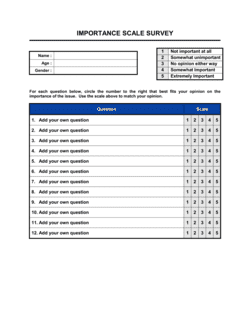
- Likert Scale
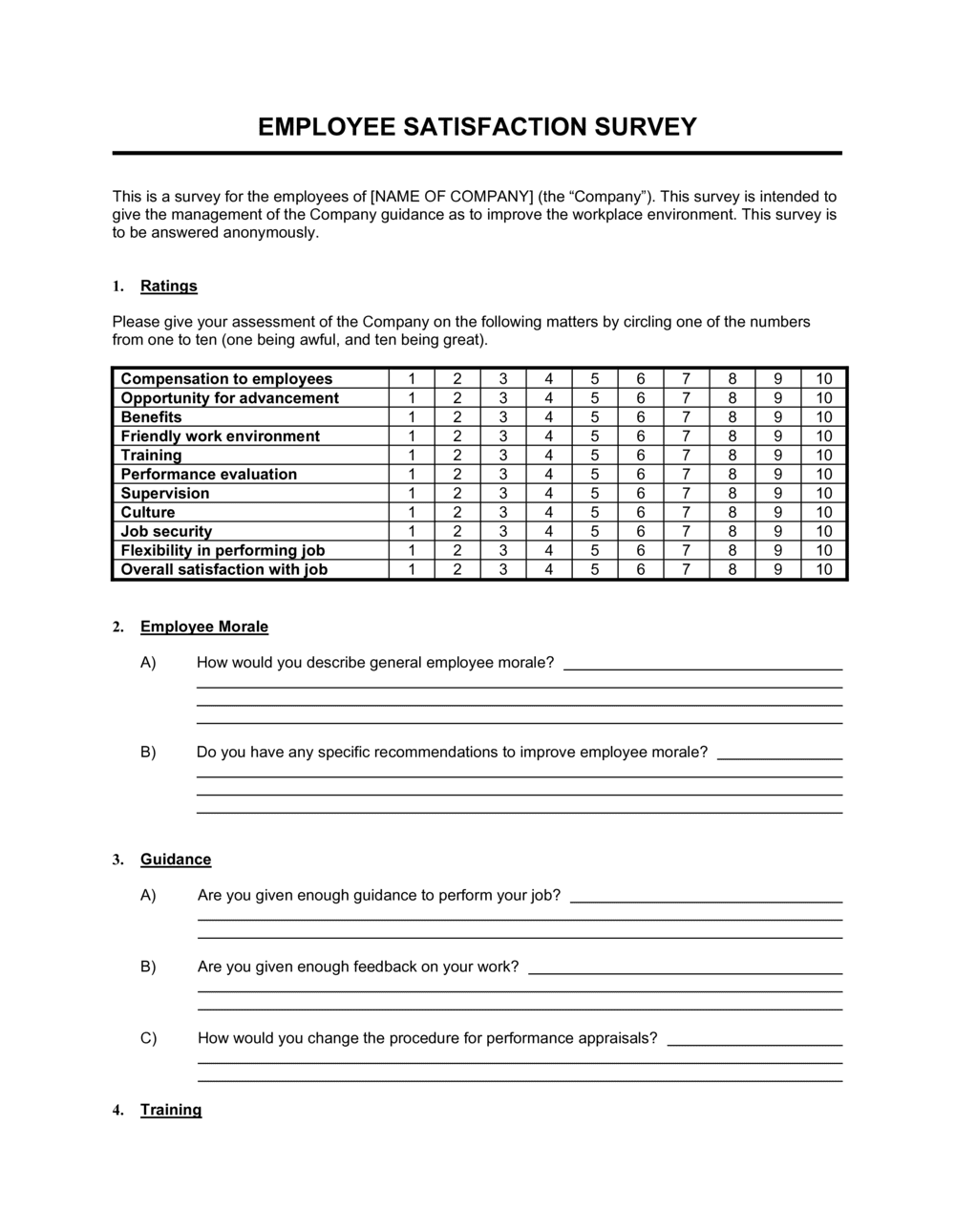
- A five- or seven-point rating scale — typically from Strongly Disagree to Strongly Agree — used to measure attitudes or satisfaction levels numerically.
- Employee Net Promoter Score (eNPS)
- A single-question metric asking employees how likely they are to recommend the company as a place to work, scored from 0 to 10.
- Engagement
- The degree to which employees feel emotionally invested in and motivated by their work and the organization's goals.
- Psychological Safety
- An employee's belief that they can speak up, share concerns, or give honest feedback without fear of retaliation or negative consequences.
- Response Rate
- The percentage of employees who complete the survey out of the total number invited — a rate below 60% limits statistical reliability.
- Benchmark Data
- Industry or sector averages used to compare a company's satisfaction scores against comparable organizations.
- Demographic Segmentation
- The practice of grouping survey results by variables such as department, tenure, or role level to identify patterns that aggregate scores mask.
- Action Planning
- The formal process of translating survey findings into specific, time-bound changes that management commits to implementing.
- Pulse Survey
- A short, frequent survey — typically 5–10 questions deployed monthly or quarterly — used to track sentiment changes between full annual surveys.