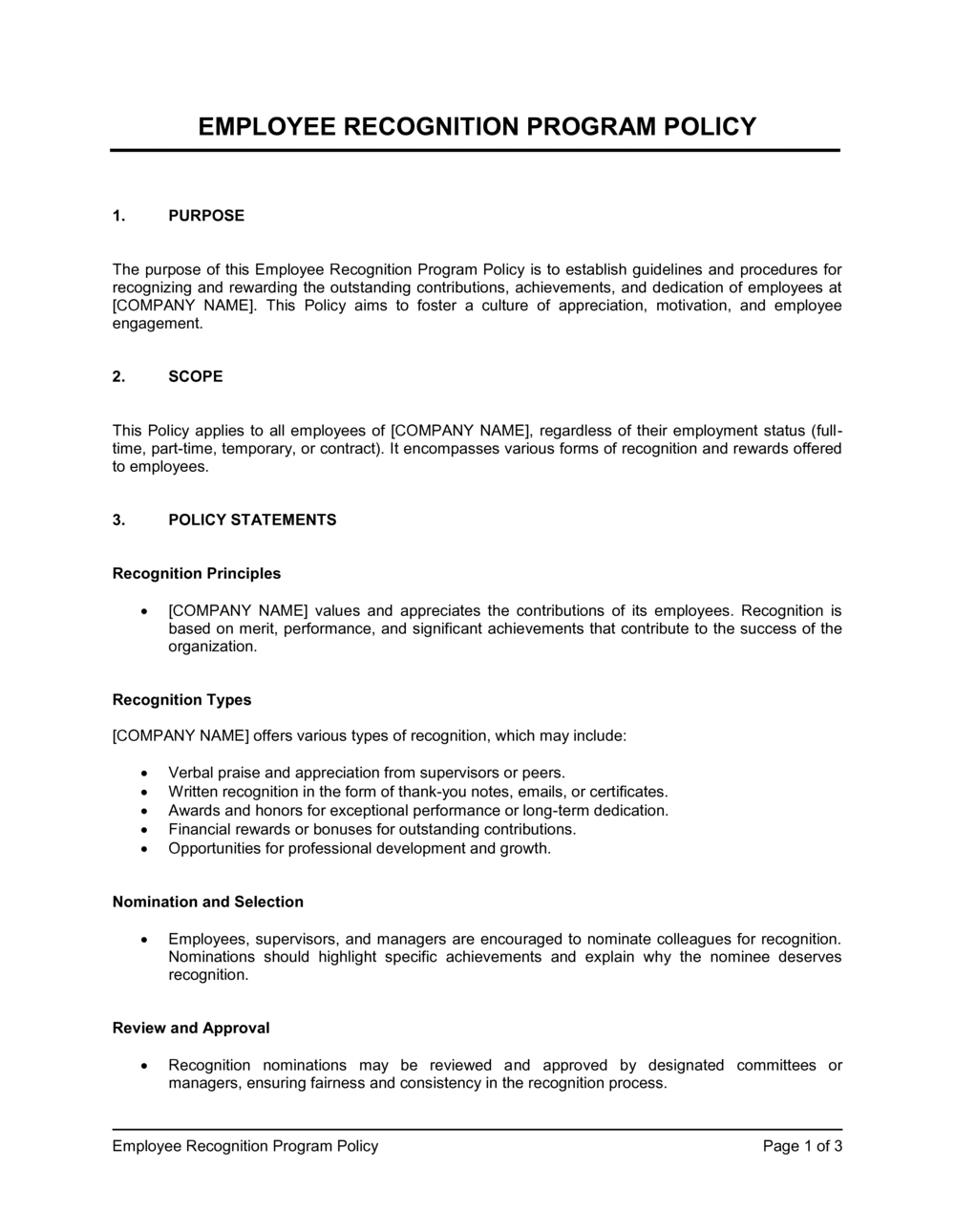
Employee Recognition Program Policy Template

Free Word download β€’ Edit online β€’ Save & share with Drive β€’ Export to PDF

3 pagesβ€’20–25 min to fillβ€’Difficulty: Standard
Learn more ↓
FreeEmployee Recognition Program Policy Template

At a glance

What it is
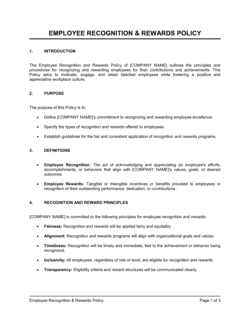
An Employee Recognition Program Policy is an internal HR document that defines how an organization identifies, acknowledges, and rewards employee contributions. This free Word download gives you a structured template covering eligibility, recognition criteria, award types, nomination processes, budget guidelines, and program governance β€” ready to edit online and export as PDF for company-wide rollout.
When you need it
Use it when launching a formal recognition program, standardizing ad-hoc recognition practices across departments, or responding to engagement survey results that flag insufficient employee appreciation. It is also the right document when HR needs a written policy to support budget requests or onboarding communications.
What's inside
Policy purpose and scope, eligibility rules, recognition categories and criteria, nomination and selection process, award types and monetary limits, budget and funding structure, manager responsibilities, communication and announcement procedures, and program review cadence.

What is an Employee Recognition Program Policy?

An Employee Recognition Program Policy is an internal HR document that establishes the formal rules, criteria, processes, and budget governing how an organization acknowledges and rewards employee contributions. It defines who is eligible for recognition, what behaviors and achievements qualify, how nominations are submitted and evaluated, what awards are available at each tier, and how the program is governed and reviewed over time. Unlike informal manager praise or ad-hoc gift-giving, a written recognition policy ensures that every employee β€” regardless of team, location, shift, or seniority β€” has equal access to acknowledgment based on transparent, consistent criteria.

Why You Need This Document

Without a written recognition program policy, acknowledgment concentrates around the most visible employees and most engaged managers, creating the widespread perception that recognition is political rather than merit-based. That perception costs organizations in measurable ways: disengaged employees are significantly more likely to leave voluntarily, and voluntary turnover carries a replacement cost of 50–200% of annual salary per departure. A formal policy gives managers a clear framework to follow, gives HR the documentation needed to justify program budgets to leadership, and gives employees confidence that the program is fair. It also creates the audit trail required to detect and correct demographic gaps in recognition distribution before they become legal or cultural liabilities. This template gives you a complete, customizable starting point you can adapt and deploy in hours β€” not weeks.

Which variant fits your situation?

If your situation is…Use this template
Launching a peer-to-peer recognition program onlyPeer Recognition Program Policy
Recognizing employees specifically tied to performance review outcomesPerformance Incentive Plan
Documenting a length-of-service or tenure award programService Awards Policy
Setting up a sales-specific incentive and recognition planSales Commission and Incentive Plan
Creating a wellness or employee well-being recognition initiativeEmployee Wellness Program Policy
Building a broad-scope HR policies and procedures manualHR Policies and Procedures Manual
Recognizing volunteer or community contributions outside the workplaceCorporate Social Responsibility Policy

Common mistakes to avoid

❌ Launching without defined criteria

Why it matters: When nominators have no clear standard, awards go to visible, senior, or socially connected employees rather than high performers. This quickly creates the perception that recognition is political rather than merit-based.

Fix: Write one specific qualifying behavior example for every award category before the program launches, and include those examples in the nomination form itself.

❌ No departmental budget sub-allocation

Why it matters: A single company-wide pool is consumed by the most active nominators, leaving other departments with nothing to spend in the second half of the year β€” directly reversing the program's motivational intent.

Fix: Divide the total budget by headcount and assign each department a proportional annual allocation with a mid-year rollover limit.

❌ Skipping demographic distribution review

Why it matters: Programs without annual distribution analysis consistently under-recognize remote workers, night-shift staff, and certain demographic groups β€” creating legal exposure and compounding existing inclusion gaps.

Fix: Add a demographic distribution report to the annual review cadence and set a remediation process if any group is recognized at less than 70% of the company average rate.

❌ Making manager participation voluntary

Why it matters: Optional participation produces uneven recognition density across teams. Employees in low-participation teams see the program as irrelevant, which drives disengagement faster than having no program at all.

Fix: Include a minimum nomination expectation in manager job descriptions and review participation data in annual manager effectiveness assessments.

The 9 key sections, explained

Purpose and Scope

Eligibility

Recognition Categories and Criteria

Nomination and Selection Process

Award Types and Monetary Limits

Budget and Funding Structure

Manager Responsibilities

Communication and Announcement Procedures

Program Review and Continuous Improvement

How to fill it out

  1. 1

    Define the program's objective and success metrics

    Write a one-sentence purpose statement that ties the program to a measurable business outcome β€” such as engagement score improvement, voluntary turnover reduction, or values adoption. Add the metric baseline and target in the Purpose section.

    πŸ’‘ Link the program objective to the most recent engagement survey result for maximum budget justification credibility.

  2. 2

    Set eligibility rules for all employment categories

    Specify which employees qualify β€” by employment type, tenure, and role level. State explicitly whether managers and executives are eligible and whether employees on PIPs or under investigation are excluded.

    πŸ’‘ Review your current headcount breakdown before writing eligibility rules; a rule that inadvertently excludes 40% of your workforce will generate immediate pushback.

  3. 3

    Design recognition categories tied to company values

    Create three to six distinct award categories, each linked to a specific company value or performance behavior. Write one concrete example of qualifying behavior for each category to guide nominators.

    πŸ’‘ Fewer, well-defined categories drive higher nomination rates than many overlapping ones β€” start with three and add more only after the first full program cycle.

  4. 4

    Build the nomination form and submission process

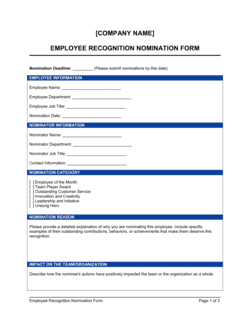
    Define the required fields for a valid nomination β€” recipient name, category, specific behavioral example, and impact statement. Set clear submission deadlines and the review timeline.

    πŸ’‘ A nomination template with a 150-word minimum description forces nominators to provide concrete examples, making committee decisions faster and more defensible.

  5. 5

    Specify award values and taxability thresholds

    Set a dollar cap for each award tier and confirm with payroll which thresholds trigger taxable income reporting. Document this in the policy so employees know what to expect on their pay stub.

    πŸ’‘ Non-cash experiential awards β€” such as an extra day off or a team lunch β€” often have higher perceived value than cash equivalents at the same cost and avoid taxability complexity.

  6. 6

    Allocate the budget by department and award tier

    Divide the total annual budget into sub-pools for spot awards, quarterly awards, and annual awards. Assign each department a proportional allocation based on headcount.

    πŸ’‘ Reserve 10–15% of the total budget as a mid-year top-up pool for departments that exceeded their allocation due to exceptional performance cycles.

  7. 7

    Set manager accountability expectations

    State the minimum nomination frequency expected per manager and include recognition participation as a line item in manager performance evaluations.

    πŸ’‘ Train managers on the nomination form and criteria in a 30-minute session before the program launches β€” managers who complete training submit three times more nominations on average.

  8. 8

    Define the annual review process

    Set a fixed review date each year for HR to analyze participation rates, budget utilization, demographic distribution, and engagement survey data tied to recognition. Document the escalation path for policy updates.

    πŸ’‘ Publish an annual program summary to all employees β€” even a one-page report showing nominations received and awards given builds trust in the program's fairness.

Frequently asked questions

What is an employee recognition program policy?

An employee recognition program policy is an internal HR document that defines the rules, criteria, processes, and budget governing how an organization formally acknowledges and rewards employee contributions. It covers who is eligible, what behaviors or achievements qualify for recognition, how nominations are submitted and reviewed, what awards are available, and how the program is managed over time. Having a written policy ensures recognition is applied consistently across departments rather than left to individual manager discretion.

Why do companies need a formal recognition program policy?

Without a written policy, recognition tends to be ad-hoc, inconsistent, and concentrated among the most visible employees. A formal policy creates equal access to recognition regardless of team, shift, or location, and gives managers clear guidance on when and how to nominate employees. It also provides HR with the documentation needed to justify budget requests and to audit distribution for fairness over time.

What should an employee recognition program policy include?

A complete policy covers purpose and scope, eligibility rules, recognition categories with specific criteria, the nomination and selection process, award types and monetary limits, budget allocation by department and tier, manager responsibilities, communication and announcement procedures, and an annual program review process. Missing any of these creates gaps that lead to inconsistent implementation and employee complaints about fairness.

How do you set a budget for an employee recognition program?

A common starting point is $50–$200 per employee per year, depending on industry and company size. Divide this total into sub-pools for spot awards (small and frequent), quarterly awards (moderate value), and annual awards (highest value). Assign each department a proportional allocation based on headcount, and reserve 10–15% as a mid-year top-up pool. The policy should state clearly who approves budget exceptions and by what process.

Are employee recognition awards taxable?

In most jurisdictions, cash awards and cash-equivalent awards such as gift cards are taxable income to the employee, regardless of the amount. Non-cash awards may qualify for a de minimis exclusion below a certain threshold β€” check current payroll tax guidance for your jurisdiction. The recognition policy should document the taxability treatment of each award type and instruct payroll to include qualifying amounts on the employee's earnings statement to avoid surprises.

How often should employee recognition awards be given?

Effective programs combine high-frequency, low-value recognition β€” such as weekly spot awards or peer shout-outs β€” with less frequent, higher-value awards given quarterly or annually. Recognition that comes more than 30 days after the recognized behavior loses most of its motivational impact. The policy should set maximum timelines for delivering both informal and formal recognition after the triggering event.

How do you measure whether a recognition program is working?

Track four metrics annually: nomination volume by department, award distribution across demographic and tenure groups, budget utilization rate, and the recognition-related items on the annual employee engagement survey. A program that increases recognition survey scores by 5–10 points year-over-year while maintaining equitable distribution across teams is delivering measurable value. Programs with high award volume but flat or declining survey scores typically signal that the criteria or delivery method needs revision.

Can managers receive employee recognition awards?

Yes, but the eligibility rules and nomination process should be defined explicitly in the policy. Many organizations require that manager nominations be reviewed by a committee rather than a single approver to prevent conflicts of interest. Some companies exclude senior executives from the same program as individual contributors and run a separate leadership recognition process instead.

How is an employee recognition program policy different from a performance management policy?

A performance management policy governs the formal cycle of goal-setting, mid-year reviews, annual appraisals, and performance improvement plans β€” it is tied to compensation decisions and role progression. A recognition program policy governs informal and formal acknowledgment of contributions that align with values and behaviors, operating outside the rating cycle. The two should be aligned so that recognition criteria reinforce the same behaviors that drive positive performance reviews, but they are separate documents with separate governance processes.

How this compares to alternatives

vs Performance Incentive Plan

A performance incentive plan ties financial rewards directly to quantitative targets β€” revenue quotas, production output, or KPI thresholds β€” and is governed by compensation policy. An employee recognition program policy covers broader behavioral and values-based acknowledgment that operates outside the formal compensation cycle. Both documents are needed; one does not replace the other.

vs Employee Handbook

An employee handbook summarizes all workplace policies in a single reference document for employees. A recognition program policy is a standalone operational document with the depth needed to govern the program's full process, budget, and governance. The handbook may reference the recognition policy by name and link to it, but does not contain the level of procedural detail required to administer the program.

vs HR Policies and Procedures Manual

An HR policies and procedures manual covers the full range of people operations β€” hiring, onboarding, leave, discipline, and separation β€” at a summary level. The recognition program policy covers a single program in operational depth, including budget allocation, nomination workflows, and review cadence. The manual may include a recognition section that points to this standalone policy.

vs Sales Commission Plan

A sales commission plan is a compensation agreement tied to revenue performance for sales roles, with legally binding payout terms. An employee recognition program policy applies company-wide to non-sales and sales employees alike, covering behaviors and values β€” not revenue metrics β€” and its awards are discretionary rather than contractually obligated.

Industry-specific considerations

Technology / SaaS

Remote-first teams require asynchronous recognition channels such as Slack integrations and virtual award ceremonies to ensure distributed employees are included at the same rate as office-based staff.

Retail / Hospitality

High hourly turnover makes real-time spot awards and shift-level peer recognition critical; programs must accommodate employees without corporate email addresses or intranet access.

Healthcare

Recognition criteria must account for night-shift and weekend workers who are systematically less visible to daytime managers, and award delivery must comply with any union agreement provisions.

Manufacturing

Safety milestone recognition β€” such as team-based awards for days without incidents β€” is a distinct category that requires clear criteria to avoid inadvertent pressure on employees not to report injuries.

Professional Services

Client feedback scores and billable utilization are common recognition triggers; programs must balance individual acknowledgment with team-based rewards to avoid undermining collaboration.

Financial Services

Regulatory environments may restrict certain cash-equivalent award types for licensed employees; compliance and legal teams should review award structures before program launch.

Template vs pro β€” what fits your needs?

PathBest forCostTime
Use the templateHR managers and business owners launching a first formal recognition program for teams under 200 employeesFree2–4 hours to customize and finalize
Template + professional reviewCompanies with over 200 employees, unionized workforces, or programs requiring payroll tax coordination$300–$800 for an HR consultant or employment counsel review3–5 business days
Custom draftedEnterprises with multi-country operations, complex recognition technology integrations, or regulated industries requiring legal sign-off$1,500–$5,000+2–4 weeks

Glossary

Recognition Criteria
The defined behaviors, achievements, or contributions that make an employee eligible to receive recognition under the program.
Nomination Process
The formal procedure by which managers or peers submit a candidate for a recognition award, including required documentation.
Peer-to-Peer Recognition
Recognition initiated by a colleague at the same or similar level, rather than by a manager or supervisor.
Discretionary Award
A recognition given at a manager's or committee's judgment rather than triggered automatically by a defined performance metric.
Non-Monetary Recognition
Acknowledgment that carries no cash or gift-card value β€” such as public praise, preferred parking, or additional time off.
Recognition Committee
A cross-functional group responsible for reviewing nominations, selecting award recipients, and overseeing program governance.
Employee Engagement
The degree to which employees feel motivated, committed, and emotionally invested in their work and the organization's goals.
Spot Award
A small, immediate reward given shortly after a notable behavior or contribution, designed to reinforce the action in real time.
Program Budget Allocation
The total monetary amount approved per fiscal period to fund recognition awards, events, and associated administrative costs.
Values Alignment
The extent to which recognition criteria and award decisions reflect the organization's stated core values and cultural priorities.

Part of your Business Operating System

This document is one of 3,000+ business & legal templates included in Business in a Box.

  • Fill-in-the-blanks β€” ready in minutes
  • 100% customizable Word document
  • Compatible with all office suites
  • Export to PDF and share electronically

Create your document in 3 simple steps.

From template to signed document β€” all inside one Business Operating System.
1
Download or open template

Access over 3,000+ business and legal templates for any business task, project or initiative.

2
Edit and fill in the blanks with AI

Customize your ready-made business document template and save it in the cloud.

3
Save, Share, Send, Sign

Share your files and folders with your team. Create a space of seamless collaboration.

Save time, save money, and create top-quality documents.

β˜…β˜…β˜…β˜…β˜…

"Fantastic value! I'm not sure how I'd do without it. It's worth its weight in gold and paid back for itself many times."

Managing Director Β· Mall Farm
Robert Whalley
Managing Director, Mall Farm Proprietary Limited
β˜…β˜…β˜…β˜…β˜…

"I have been using Business in a Box for years. It has been the most useful source of templates I have encountered. I recommend it to anyone."

Business Owner Β· 4+ years
Dr Michael John Freestone
Business Owner
β˜…β˜…β˜…β˜…β˜…

"It has been a life saver so many times I have lost count. Business in a Box has saved me so much time and as you know, time is money."

Owner Β· Upstate Web
David G. Moore Jr.
Owner, Upstate Web

Run your business with a system β€” not scattered tools

Stop downloading documents. Start operating with clarity. Business in a Box gives you the Business Operating System used by over 250,000 companies worldwide to structure, run, and grow their business.

Start freeΒ Β·Β No credit card required