Employee Rewards Policy Template

Free Word download β€’ Edit online β€’ Save & share with Drive β€’ Export to PDF

3 pagesβ€’20–25 min to fillβ€’Difficulty: Standard
Learn more ↓
FreeEmployee Rewards Policy Template

At a glance

What it is
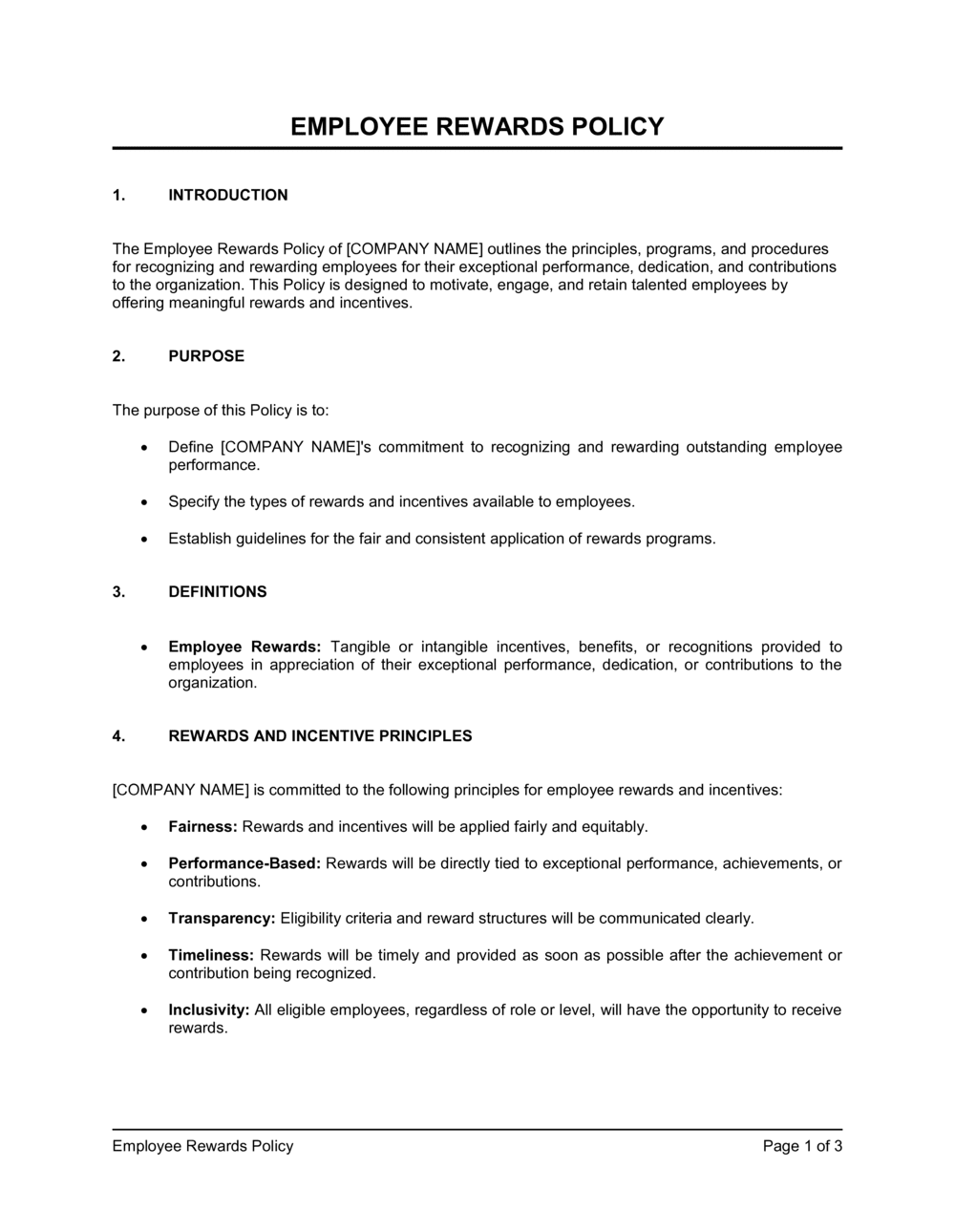
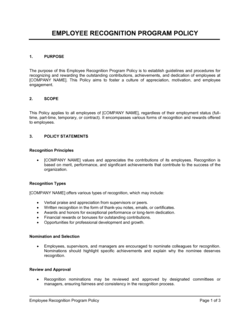
An Employee Rewards Policy is a written operational document that defines how an organization recognizes and rewards employee contributions β€” covering eligible behaviors, reward types, nomination and approval workflows, and budget controls. This free Word download gives you a structured, editable template you can tailor to your company's culture and export as PDF to distribute to managers and staff.
When you need it
Use it when launching or formalizing a recognition program, when managers are applying reward criteria inconsistently, or when rapid headcount growth has made informal ad-hoc recognition unfair or unbudgeted.
What's inside
Policy purpose and scope, eligibility rules, reward categories and types, nomination and approval process, budget and spending limits, tax and payroll treatment guidance, program administration responsibilities, and a review and amendment schedule.

What is an Employee Rewards Policy?

An Employee Rewards Policy is a structured operational document that defines how a company formally recognizes and rewards employee contributions β€” specifying which employees are eligible, what reward types are available at each tier, how nominations are submitted and approved, what budget controls apply, and who owns program administration. Unlike informal recognition or ad-hoc manager discretion, a written rewards policy creates a consistent, transparent framework that applies equitably across departments and levels. It typically covers everything from immediate spot awards for in-the-moment contributions to annual excellence awards for sustained high performance.

Why You Need This Document

Without a documented rewards policy, recognition becomes a function of individual manager personality rather than company standard β€” some employees receive regular acknowledgment while others doing equivalent work receive none, and finance has no mechanism to control what gets spent or by whom. The consequences compound quickly: inconsistent recognition is one of the most frequently cited drivers of voluntary attrition, particularly among high performers who have options. A formal policy eliminates ambiguity about what behaviors are rewarded and by how much, gives managers a framework they can act on without escalating every decision to HR, and creates the audit trail finance needs to track reward spend against budget. This template gives you a complete, editable starting point you can adapt to your company's values, structure, and budget in a single afternoon.

Which variant fits your situation?

If your situation is…Use this template
Recognizing individual performance milestones tied to KPIsPerformance-Based Rewards Policy
Rewarding years of service at defined tenure milestonesEmployee Service Award Policy
Running a peer-to-peer nomination program across the whole companyPeer Recognition Program Policy
Incentivizing sales teams with commissions and bonusesSales Compensation Plan
Recognizing innovation and ideas submitted through an internal programEmployee Suggestion Program Policy
Documenting total compensation including all reward componentsTotal Compensation Statement
Structuring rewards as part of a broader performance management systemPerformance Management Policy

Common mistakes to avoid

❌ No defined budget

Why it matters: Managers either avoid issuing rewards entirely for fear of unknown limits, or spend inconsistently β€” creating the perception that rewards are political rather than merit-based.

Fix: Publish a specific per-head or per-department annual budget in the policy and name the person responsible for tracking it.

❌ Approval thresholds set too high

Why it matters: When a $25 spot award requires VP sign-off, managers stop using the program within weeks. Timeliness is the core driver of recognition effectiveness β€” delayed recognition loses its motivational impact.

Fix: Allow direct managers to approve awards up to at least $100 without escalation. Reserve higher thresholds for larger award categories.

❌ Cash-only reward menu

Why it matters: Employees value recognition differently. A cash payment added to a payslip is easily forgotten. Non-monetary options β€” a public shoutout, a personalized note, an experience β€” often have longer-lasting motivational effects for the same cost.

Fix: Add at least two non-monetary recognition options to the policy, such as a public acknowledgment at a company meeting and an extra day of PTO.

❌ Ignoring tax treatment of rewards

Why it matters: Issuing a gift card without running it through payroll creates a compliance gap β€” the value should typically be reported as income. Employees who receive a surprise tax liability on a reward feel penalized for being recognized.

Fix: Confirm the tax classification of each reward type with your payroll provider before launching, and document the treatment in the policy so HR and managers know the correct process.

The 9 key sections, explained

Policy purpose and objectives

Scope and eligibility

Reward categories and types

Nomination and selection process

Approval authority and spending limits

Budget management and funding

Tax and payroll treatment

Program administration and responsibilities

Policy review and amendment

How to fill it out

  1. 1

    Define the policy purpose and link it to company values

    Write a two- to three-sentence purpose statement that names the specific behaviors you want to reinforce and references your company's stated values. Avoid generic language β€” be precise about what 'exceptional contribution' looks like in your context.

    πŸ’‘ Pull exact language from your existing values framework or culture deck so the policy feels continuous with what employees already know.

  2. 2

    Set eligibility criteria explicitly

    Decide which employee types are covered β€” full-time, part-time, fixed-term β€” and whether a minimum tenure applies. Document the rationale for any exclusions so managers can answer questions consistently.

    πŸ’‘ If you exclude contractors, note it explicitly rather than leaving it ambiguous β€” ambiguity creates more friction than a clear no.

  3. 3

    Define reward categories with dollar amounts or prize descriptions

    List each reward tier by name, value range, and the type of contribution it recognizes. Include at least one non-monetary option alongside any cash or gift-card awards.

    πŸ’‘ Cap spot awards at a value your managers can approve instantly β€” $50–$100 works for most organizations. Anything higher stalls in approval and loses timeliness.

  4. 4

    Build the nomination form or workflow

    Design a simple nomination template β€” name, department, specific contribution (100-word minimum), and values demonstrated. Attach it to the policy as an appendix or link to a digital form.

    πŸ’‘ Requiring a 100-word minimum description forces nominators to be specific, which makes evaluation fairer and recognition more meaningful for recipients.

  5. 5

    Set approval thresholds by dollar amount and role

    Map each reward tier to an approver β€” direct manager, department head, HR director. Ensure managers can approve at least the lowest tier without escalation.

    πŸ’‘ Test the workflow by tracing a $30 spot award through your org chart. If it requires more than two steps, simplify.

  6. 6

    Establish the annual budget and tracking method

    Set a per-head or per-department annual budget. Name the person responsible for tracking spend and the system or spreadsheet they will use. State what happens to unspent budget at year end.

    πŸ’‘ A $200–$400 per employee annual budget is a common starting range for small to mid-size businesses. Publish this number internally β€” transparency reduces the perception that awards are arbitrary.

  7. 7

    Add tax and payroll treatment guidance

    Consult your payroll provider or accountant to confirm how each reward type is classified. Document cash vs. non-cash treatment and the de minimis threshold you will apply.

    πŸ’‘ Include a one-line note on each reward category in the policy itself β€” e.g., 'Gift cards are taxable and will be processed through payroll' β€” so managers don't need to ask HR every time.

  8. 8

    Set the review date and assign an owner

    Name the specific role responsible for annual review, enter the next review date, and decide the communication channel for announcing changes. Attach a version number and effective date to the document.

    πŸ’‘ Calendar a recurring annual reminder at the same time as your compensation review cycle so rewards and pay adjustments stay aligned.

Frequently asked questions

What is an employee rewards policy?

An employee rewards policy is a written document that defines how an organization formally recognizes and rewards employee contributions. It covers which employees are eligible, what types of rewards are available, how nominations are submitted and approved, what budget limits apply, and how the program is administered. The policy replaces informal or inconsistent recognition practices with a structured, equitable system.

Why does a company need a formal rewards policy?

Without a written policy, rewards tend to be distributed inconsistently β€” some managers recognize frequently while others never do, and employees in different departments receive different standards of recognition for equivalent work. A formal policy creates a shared standard, prevents favoritism claims, gives managers a clear framework for acting, and helps finance control reward spending through documented budget limits.

What types of rewards should be included in the policy?

A well-rounded rewards policy typically includes at least three tiers: immediate spot awards for in-the-moment recognition (usually $25–$100 in cash or gift cards), periodic milestone awards for sustained performance (monthly or quarterly), and annual excellence awards for exceptional contributions over a full year. Non-monetary options such as public recognition, extra time off, and preferred parking should appear alongside cash and gift-card rewards.

Are employee rewards taxable?

In most jurisdictions, cash rewards and cash-equivalent rewards β€” including gift cards and prepaid debit cards β€” are treated as taxable supplemental wages and must be processed through payroll with appropriate withholding. Non-cash awards below a de minimis threshold (in the US, generally items of low value given infrequently) may be excluded from taxable income. Consult your payroll provider to confirm the treatment of each reward type before issuing.

How large should an employee rewards budget be?

A common starting range for small to mid-size businesses is $200–$400 per eligible employee per year. This covers a mix of spot awards and periodic recognition events without creating a material payroll cost. Larger organizations with formal engagement programs may budget $500–$1,000 per employee annually. The right number depends on your total compensation strategy, culture goals, and how heavily recognition supplements base pay.

Who should administer the rewards policy?

Administration is typically owned by the HR or People Operations function, which manages the nominations log, processes awards through payroll, tracks budget utilization, and reports program metrics to leadership quarterly. Managers are responsible for submitting nominations on time and communicating recognition to recipients promptly. Assigning administration to a single named role prevents the program from falling through the cracks.

How does an employee rewards policy differ from a bonus policy?

A bonus policy governs scheduled, formula-driven cash payments tied to individual or company performance targets β€” typically paid annually or quarterly. A rewards policy covers a broader range of recognition mechanisms, many of which are discretionary, non-cash, and designed to reinforce day-to-day behaviors rather than annual financial outcomes. The two documents can coexist and should cross-reference each other so employees understand how each program works.

How often should the rewards policy be reviewed?

An annual review aligned to your compensation review cycle is standard. The review should assess whether reward categories and amounts still feel meaningful to employees, whether the budget per head reflects current market norms, and whether the approval workflow is being used as designed. A policy that has not been updated in more than two years is likely referencing outdated tools, dollar amounts, and roles.

Can small businesses with fewer than 20 employees use this policy?

Yes β€” in fact, formalizing rewards early is especially valuable for small businesses where informality can quickly create perceptions of favoritism. Scale the complexity to your size: a small team may only need two reward tiers (a spot award and an annual recognition), a single approver, and a simple shared spreadsheet for tracking. The structure matters more than the number of tiers.

How this compares to alternatives

vs Employee Bonus Policy

A bonus policy governs scheduled, formula-driven cash payments triggered by hitting defined performance targets β€” typically annual or quarterly. A rewards policy covers a broader set of recognition mechanisms, many discretionary and non-cash, that reinforce behaviors throughout the year rather than at a single payout point. Both documents should coexist and cross-reference each other.

vs Performance Review Policy

A performance review policy structures how employee performance is evaluated against goals over a defined period, typically leading to compensation and development decisions. A rewards policy recognizes specific contributions in real time, often between formal review cycles. The two work together β€” rewards reinforce behaviors daily while reviews assess cumulative performance.

vs Sales Compensation Plan

A sales compensation plan is a formula-based document governing commissions, accelerators, and quotas for revenue-generating roles. An employee rewards policy applies company-wide to all employee types and focuses on values-based recognition rather than revenue metrics. Sales teams typically operate under both documents simultaneously.

vs Employee Handbook

An employee handbook is a comprehensive reference document covering all employment policies β€” conduct, benefits, leave, and compliance. A rewards policy is a standalone operational document that sits within the handbook framework but contains the procedural detail β€” nomination forms, approval thresholds, budget allocations β€” that a handbook summary cannot. Linking the standalone policy from the handbook is standard practice.

Industry-specific considerations

Technology / SaaS

Rewards tied to shipping milestones, bug resolution rates, and customer satisfaction scores, with a strong emphasis on non-monetary peer recognition through internal platforms.

Retail / Hospitality

High-turnover environments benefit from frequent low-value spot awards and shift-level recognition to maintain engagement among hourly staff who rarely interact with senior leadership.

Professional Services

Rewards linked to billable utilization, client satisfaction scores, and business development contributions, with careful tax treatment for client-facing entertainment-style awards.

Manufacturing

Safety milestone awards, attendance recognition, and productivity-based spot awards are common, with shift-supervisor approval authority critical to program timeliness on the floor.

Healthcare

Patient experience scores, peer nominations for compassionate care, and attendance awards are central; tax treatment of non-cash awards requires extra diligence given regulated compensation structures.

Nonprofit / Education

Budget constraints make non-monetary recognition β€” public acknowledgment, leadership visibility, flexible scheduling β€” the primary reward currency; monetary awards require board-level budget approval in many organizations.

Template vs pro β€” what fits your needs?

PathBest forCostTime
Use the templateHR managers and small business owners formalizing recognition for teams up to 100 employeesFree2–4 hours
Template + professional reviewOrganizations with complex reward structures, multi-location teams, or union considerations$300–$800 for an HR consultant review3–5 days
Custom draftedEnterprises integrating rewards with HRIS platforms, variable pay schemes, and equity compensation$1,500–$5,000 for a total rewards consultant2–4 weeks

Glossary

Discretionary Reward
A reward given at a manager's judgment for exceptional effort or contribution, rather than being automatically triggered by a fixed metric.
Non-Monetary Recognition
Forms of appreciation that carry no direct cash value β€” such as public acknowledgment, preferred parking, or an extra day off β€” but have measurable impact on engagement.
Nomination Workflow
The defined process by which a manager or peer submits a reward recommendation, including required approvals and documentation steps.
Reward Ceiling
The maximum dollar value of a reward that can be issued under a given category without escalating to senior approval.
Fringe Benefit
A non-wage compensation item β€” such as a gift card, award trip, or merchandise β€” that may have taxable value under applicable payroll rules.
Spot Award
An immediate, low-value reward (typically $25–$250) given in the moment to recognize a specific action or contribution without waiting for a formal review cycle.
Recognition Cadence
The scheduled frequency at which formal recognition events occur β€” such as monthly team shoutouts, quarterly awards, or annual ceremonies.
Equity in Rewards
The principle that reward criteria and amounts are applied consistently across employees regardless of department, seniority level, gender, or background.
Award Budget Allocation
The total funds set aside per department or per head for rewards in a given period, typically expressed as an annual dollar amount per employee.
Taxable Award Threshold
The point at which a reward's value becomes subject to income tax withholding β€” in the US, cash-equivalent awards are taxable from the first dollar.

Part of your Business Operating System

This document is one of 3,000+ business & legal templates included in Business in a Box.

  • Fill-in-the-blanks β€” ready in minutes
  • 100% customizable Word document
  • Compatible with all office suites
  • Export to PDF and share electronically

Create your document in 3 simple steps.

From template to signed document β€” all inside one Business Operating System.
1
Download or open template

Access over 3,000+ business and legal templates for any business task, project or initiative.

2
Edit and fill in the blanks with AI

Customize your ready-made business document template and save it in the cloud.

3
Save, Share, Send, Sign

Share your files and folders with your team. Create a space of seamless collaboration.

Save time, save money, and create top-quality documents.

β˜…β˜…β˜…β˜…β˜…

"Fantastic value! I'm not sure how I'd do without it. It's worth its weight in gold and paid back for itself many times."

Managing Director Β· Mall Farm
Robert Whalley
Managing Director, Mall Farm Proprietary Limited
β˜…β˜…β˜…β˜…β˜…

"I have been using Business in a Box for years. It has been the most useful source of templates I have encountered. I recommend it to anyone."

Business Owner Β· 4+ years
Dr Michael John Freestone
Business Owner
β˜…β˜…β˜…β˜…β˜…

"It has been a life saver so many times I have lost count. Business in a Box has saved me so much time and as you know, time is money."

Owner Β· Upstate Web
David G. Moore Jr.
Owner, Upstate Web

Run your business with a system β€” not scattered tools

Stop downloading documents. Start operating with clarity. Business in a Box gives you the Business Operating System used by over 250,000 companies worldwide to structure, run, and grow their business.

Start freeΒ Β·Β No credit card required