Equity Incentive Plan Template

Free Word download β€’ Edit online β€’ Save & share with Drive β€’ Export to PDF

15 pagesβ€’35–45 min to fillβ€’Difficulty: Complex
Learn more ↓
FreeEquity Incentive Plan Template

At a glance

What it is
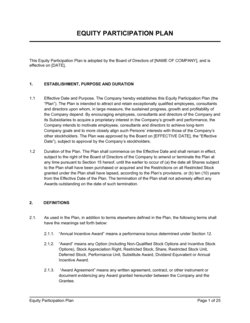
An Equity Incentive Plan is a formal company policy document that authorizes the issuance of stock options, restricted stock units, or other equity awards to employees, directors, and consultants. This free Word download gives you a structured, board-ready starting point covering eligibility, award types, vesting schedules, exercise mechanics, and plan administration β€” ready to edit online and export as PDF.
When you need it
Use it when you are preparing to grant equity to employees for the first time, formalizing an ad hoc equity arrangement, or restructuring compensation to include equity as part of a competitive talent strategy.
What's inside
Plan purpose and authorized share pool, eligibility criteria, types of awards available (ISOs, NSOs, RSUs), vesting schedules and cliff periods, exercise procedures, termination and forfeiture rules, plan administration, and amendment provisions.

What is an Equity Incentive Plan?

An Equity Incentive Plan is a board-approved governing document that authorizes a company to grant equity awards β€” including stock options, restricted stock units, and stock appreciation rights β€” to employees, directors, and consultants. It establishes the total share pool reserved for these awards, defines who is eligible, specifies the types of awards available, and sets the rules for vesting, exercise, forfeiture, and plan administration. Without this plan in place, individual equity grants lack a legal foundation and may be unenforceable or create unintended tax consequences for both the company and recipients.

Why You Need This Document

Handing out equity promises without a formal plan creates serious exposure at exactly the moments that matter most β€” a funding round, an acquisition, or an IRS audit. Investors conducting due diligence expect a properly adopted equity incentive plan with a documented share pool and consistent grant records; missing or informal equity arrangements are among the most common deal-delaying findings in startup M&A. Employees who receive grants without a governing plan document have no clear understanding of their vesting schedule, exercise rights, or what happens when they leave β€” leading to disputes and retention failures. A properly structured equity incentive plan closes these gaps by establishing clear, enforceable terms for every award, protecting the company's cap table integrity, and ensuring ISO grants meet the IRS requirements that give employees favorable tax treatment.

Which variant fits your situation?

If your situation is…Use this template
Granting stock options to US employees with preferential tax treatmentIncentive Stock Option (ISO) Plan
Granting options to contractors, advisors, or non-US employeesNon-Qualified Stock Option (NSO) Plan
Issuing restricted stock that vests on a time or performance scheduleRestricted Stock Unit (RSU) Agreement
Rewarding employees with cash tied to company value, no dilutionPhantom Stock Plan
Granting equity to founders at incorporation with vestingFounder Vesting Agreement
Setting up an employee stock purchase plan at a public companyEmployee Stock Purchase Plan (ESPP)
Structuring a performance-based equity award for executivesPerformance Share Unit (PSU) Agreement

Common mistakes to avoid

❌ Granting options before obtaining a 409A valuation

Why it matters: Options granted at a below-market exercise price trigger immediate income recognition and a 20% penalty tax under IRC Β§409A for the employee β€” plus interest on the underpayment.

Fix: Complete a 409A appraisal before issuing any grants and refresh it after every priced funding round or material company event.

❌ Setting the option pool too small before a fundraise

Why it matters: Investors routinely require a pool top-up as a condition of closing, which dilutes existing shareholders β€” including founders β€” rather than being shared across pre- and post-money.

Fix: Model a pre-money pool refresh scenario at your anticipated next round valuation and size the initial pool to survive at least two years of hiring without an emergency amendment.

❌ Using a 30-day post-termination exercise window

Why it matters: Employees who cannot fund the exercise price in 30 days forfeit vested options they earned. Courts have found some forfeitures unfair, and the talent reputation damage is significant.

Fix: Use a 90-day standard window to preserve ISO status at minimum. Consider offering a 1–5 year extended window as a policy differentiator, with the tax consequence clearly disclosed to departing employees.

❌ Omitting the 10-year plan termination clause

Why it matters: ISO grants made after the 10th anniversary of plan adoption are automatically disqualified, converting ISOs to NSOs retroactively and triggering unexpected ordinary income for employees.

Fix: Include an explicit 10-year sunset clause and set a calendar reminder to seek shareholder approval for a plan restatement before the deadline.

❌ Authorizing ISOs for non-employee consultants

Why it matters: ISO status is available only to W-2 employees under IRC Β§422. An ISO granted to a consultant is automatically treated as an NSO, but if the grant documentation says 'ISO,' it creates tax confusion and potential penalties for both parties.

Fix: Check employment status before every grant. Use NSO documentation for all consultants, advisors, and non-employee directors regardless of what the plan authorizes.

❌ No standard equity grant approval calendar

Why it matters: Ad hoc grant approvals create gaps in documentation, inconsistent grant dates, and potential backdating concerns β€” all of which surface as red flags during acquisition due diligence.

Fix: Establish quarterly grant approval windows and attach a standard board consent template as a plan exhibit so every grant has consistent, timestamped documentation.

The 10 key sections, explained

Purpose and authorization

Share reserve and option pool

Eligibility

Types of awards

Vesting schedule and cliff

Exercise procedures and payment

Termination and forfeiture rules

Change of control and acceleration

Plan administration

Plan amendment and termination

How to fill it out

  1. 1

    Determine the option pool size

    Model your hiring plan for the next 18–24 months and estimate the equity required to attract each role. A typical early-stage pool is 10–15% of fully diluted shares. Run a dilution model to see how the pool interacts with a future funding round before locking in the number.

    πŸ’‘ Investors in seed and Series A rounds often ask founders to top up the option pool before closing β€” model this 'pre-money pool refresh' scenario before setting the initial size.

  2. 2

    Obtain a 409A valuation

    Engage an independent valuation firm to appraise your common stock fair market value before setting any exercise prices. A 409A provides a safe harbor that protects both the company and employees from IRS penalties under IRC Β§409A.

    πŸ’‘ Valuations are valid for 12 months or until a material event (new funding round, acquisition letter of intent). Refresh immediately after raising capital to avoid granting options at a stale, below-market price.

  3. 3

    Choose the award types to authorize

    At minimum, authorize both ISOs and NSOs. Add RSUs if you anticipate granting to executives or if your company is within 2–3 years of a liquidity event where RSU tax treatment becomes more predictable.

    πŸ’‘ RSUs are simpler for late-stage private companies and all public companies because they eliminate the exercise price decision β€” but they create a tax event at vesting even without a liquidity event.

  4. 4

    Set the standard vesting schedule

    Enter a 4-year vesting schedule with a 12-month cliff as the plan default. Individual award agreements can deviate for specific grants β€” performance-based vesting, front-loaded schedules for executives β€” without amending the plan itself.

    πŸ’‘ State the vesting commencement date as the employee's hire date, not the grant date. Grant approval often lags hiring by weeks; backdating vesting to the hire date is standard and prevents employees from losing time in their cliff.

  5. 5

    Define termination and forfeiture windows

    Set the post-termination exercise window at 90 days for standard departures to preserve ISO status, 12 months for death or disability, and immediate forfeiture for termination for cause. Document the definition of 'cause' clearly.

    πŸ’‘ Some companies offer an extended exercise window (1–10 years) as a retention differentiator. This is a plan-level or individual-agreement-level decision β€” note in the plan that the Administrator may extend the window at its discretion.

  6. 6

    Choose a change-of-control acceleration structure

    Select double-trigger acceleration as the default for most employees (vesting accelerates only if the employee is also terminated within 12 months post-acquisition). Reserve single-trigger or enhanced packages for C-suite and founders.

    πŸ’‘ Define 'change of control' precisely β€” include both asset sales and share purchases above a 50% threshold. Ambiguous definitions are litigated at exactly the wrong moment: during an acquisition.

  7. 7

    Designate the plan administrator and approval process

    Name the board or compensation committee as administrator and document the minimum approval requirements β€” quorum, written consent, or meeting resolution. Establish a standard grant approval calendar (e.g., quarterly) to avoid ad hoc approvals.

    πŸ’‘ Attach a standard board consent template for equity grants as an exhibit to the plan. Consistent documentation protects the company during due diligence for a future acquisition or IPO.

  8. 8

    File the plan and obtain board and shareholder approval

    Present the final plan to the board for adoption by written consent or resolution. Shareholder approval is required within 12 months of board adoption for ISO grants to be valid and for public-company listing requirements.

    πŸ’‘ Keep a signed copy of the board consent and shareholder approval in the company's minute book alongside the plan document. Investors and acquirers will request these in due diligence.

Frequently asked questions

What is an equity incentive plan?

An equity incentive plan is a board-approved policy document that authorizes a company to grant stock options, restricted stock units, or other equity awards to employees, directors, and consultants. It defines the total share pool, eligible participants, award types, vesting terms, exercise mechanics, and plan administration rules. It is the governing document that makes every individual equity grant valid and enforceable.

What is the difference between an ISO and an NSO?

An Incentive Stock Option (ISO) is available only to W-2 employees and qualifies for preferential US tax treatment β€” no ordinary income tax at exercise if holding period requirements are met. A Non-Qualified Stock Option (NSO) can be granted to anyone, including consultants and directors, but is taxed as ordinary income at the time of exercise. Most plans authorize both types so the administrator can choose the most appropriate vehicle for each recipient.

What is a standard vesting schedule for equity?

The market standard for startup and private-company equity is a 4-year vesting schedule with a 12-month cliff β€” 25% of the grant vests after one year of service, and the remainder vests monthly over the following 36 months. This structure aligns employee retention with typical funding cycles. Some companies use 3-year schedules for senior executives or front-load vesting to compete for experienced talent.

Do I need a 409A valuation before granting stock options?

Yes, for any private US company granting stock options. A 409A valuation establishes the fair market value of common stock and sets a defensible exercise price. Options granted without a 409A at or above fair market value expose the company and employees to significant penalties under IRC Β§409A β€” including immediate income recognition and a 20% excise tax on the employee. Valuations are typically valid for 12 months or until a material event such as a new funding round.

How large should the option pool be?

Early-stage startups typically reserve 10–15% of fully diluted shares for the equity incentive plan. The right size depends on your hiring plan, competitive benchmarks for each role, and the dilution impact at your next funding round. Investors in seed and Series A rounds frequently require a pool top-up pre-closing, so modeling a future refresh scenario before setting the initial pool size is strongly advised.

What is the difference between an equity incentive plan and an individual stock option agreement?

The equity incentive plan is the master governing document adopted by the board and shareholders that authorizes the overall program and sets the rules. An individual stock option agreement (or award agreement) is issued to each specific participant and sets the terms of their particular grant β€” number of shares, exercise price, grant date, and vesting schedule β€” within the boundaries established by the plan. Both documents are required; neither is sufficient on its own.

What happens to unvested options when an employee leaves?

Unvested options are forfeited upon any termination of service and return to the option pool. Vested options are typically exercisable for 90 days following termination (to preserve ISO status), after which they expire. If an employee is terminated for cause, both vested and unvested options are usually forfeited immediately under standard plan terms. Some companies offer extended post-termination exercise windows β€” up to 10 years β€” as a retention and fairness differentiator.

Does an equity incentive plan require shareholder approval?

For ISO grants to be valid under US tax law, shareholders must approve the plan within 12 months of board adoption. Public companies listed on Nasdaq or NYSE require shareholder approval for all equity compensation plans. Private companies granting only NSOs are not legally required to obtain shareholder approval, but investor term sheets and standard governance practice typically require it in any case.

What is a phantom stock plan and how does it differ from a standard equity incentive plan?

A phantom stock plan pays employees a cash bonus tied to the value of company shares without issuing actual equity. No shares are issued, no dilution occurs, and the recipient never becomes a shareholder. It suits companies that want to share value appreciation with employees but cannot or do not want to issue real equity β€” for example, LLCs, S-corps with shareholder count limits, or businesses with complex cap tables. A standard equity incentive plan issues real shares or rights to purchase real shares and does dilute existing shareholders.

How this compares to alternatives

vs Stock Option Agreement

A stock option agreement is the individual grant document issued to a specific employee under the equity incentive plan. The plan is the master governing policy; the agreement implements a single award within that policy. You need the plan in place before any individual agreement is valid. Both documents are required for every option grant.

vs Phantom Stock Plan

A phantom stock plan delivers cash bonuses tied to share value without issuing real equity β€” no dilution, no cap table entries, no 409A required. An equity incentive plan issues real shares or real options, making recipients actual or potential shareholders. Phantom plans suit LLCs, S-corps, and businesses that want retention incentives without changing ownership structure.

vs Profit Sharing Plan

A profit sharing plan distributes a percentage of annual earnings to employees in cash or retirement contributions based on company profitability. An equity incentive plan grants ownership stakes tied to long-term company value, not annual profits. Equity rewards long tenure and a successful exit; profit sharing rewards current-year performance. Many companies use both in combination.

vs Employee Stock Purchase Plan (ESPP)

An ESPP allows employees to purchase company shares at a discount β€” typically 15% below market price β€” through payroll deductions during an offering period. It is typically used by public companies as a broad-based employee benefit. An equity incentive plan grants awards (options or RSUs) at zero or below-market cost, primarily as a compensation and retention tool for key contributors rather than all employees.

Industry-specific considerations

SaaS / Technology

Option pools sized at 15–20% pre-Series A to compete for engineering talent; RSU transitions as the company approaches a liquidity event.

Biotech / Life Sciences

Extended vesting tied to clinical milestones; performance-based awards linked to regulatory approval events; large pools required to attract credentialed scientific leadership.

Professional Services

Equity used to retain rainmakers and partners; NSO-heavy plans to cover contractors and advisors; buyback provisions tied to partnership buy-in requirements.

Manufacturing

Phantom stock or profit-sharing hybrids common in family-owned manufacturers; RSUs used for plant managers and operations executives ahead of a PE sale or ESOP transition.

Template vs pro β€” what fits your needs?

PathBest forCostTime
Use the templateEarly-stage startups granting equity to fewer than 10 participants in a single jurisdictionFree4–8 hours to complete and obtain board approval
Template + professional reviewCompanies with multiple award types, executive grants, or employees in more than one US state$500–$2,000 for a startup attorney review3–5 business days
Custom draftedPre-IPO companies, multi-jurisdiction programs, complex performance-based awards, or plans requiring shareholder vote$3,000–$15,000+3–6 weeks

Glossary

Equity Incentive Plan
A board-approved policy document authorizing a company to grant equity awards β€” such as stock options or RSUs β€” to employees, directors, and consultants.
Option Pool
The block of shares reserved by the company specifically for issuance under the equity incentive plan, typically expressed as a percentage of fully diluted shares outstanding.
Vesting Schedule
The timeline over which an employee earns the right to exercise or receive equity awards, most commonly four years with a one-year cliff.
Cliff
The minimum period an employee must work before any portion of their equity award vests β€” typically 12 months, after which the first tranche becomes exercisable.
Incentive Stock Option (ISO)
A stock option granted only to employees that qualifies for favorable US federal tax treatment if specific holding period and employment requirements are met.
Non-Qualified Stock Option (NSO)
A stock option that does not meet ISO requirements, taxable as ordinary income at exercise, and grantable to employees, directors, and consultants.
Exercise Price
The fixed price at which an option holder may purchase a share of company stock, typically set at fair market value on the grant date.
409A Valuation
An independent appraisal of a private company's common stock fair market value, required by US tax law to set a defensible exercise price for stock options.
Restricted Stock Unit (RSU)
A promise to deliver company shares to an employee upon satisfaction of vesting conditions, without requiring the employee to pay an exercise price.
Acceleration
A provision that triggers immediate or partial vesting of unvested awards upon a defined event, such as a change of control or involuntary termination.
Dilution
The reduction in existing shareholders' ownership percentage that occurs when new shares are issued under an equity incentive plan.
Fully Diluted Shares
The total share count including all issued shares plus all shares issuable upon exercise of outstanding options, warrants, and convertible instruments.

Part of your Business Operating System

This document is one of 3,000+ business & legal templates included in Business in a Box.

  • Fill-in-the-blanks β€” ready in minutes
  • 100% customizable Word document
  • Compatible with all office suites
  • Export to PDF and share electronically

Create your document in 3 simple steps.

From template to signed document β€” all inside one Business Operating System.
1
Download or open template

Access over 3,000+ business and legal templates for any business task, project or initiative.

2
Edit and fill in the blanks with AI

Customize your ready-made business document template and save it in the cloud.

3
Save, Share, Send, Sign

Share your files and folders with your team. Create a space of seamless collaboration.

Save time, save money, and create top-quality documents.

β˜…β˜…β˜…β˜…β˜…

"Fantastic value! I'm not sure how I'd do without it. It's worth its weight in gold and paid back for itself many times."

Managing Director Β· Mall Farm
Robert Whalley
Managing Director, Mall Farm Proprietary Limited
β˜…β˜…β˜…β˜…β˜…

"I have been using Business in a Box for years. It has been the most useful source of templates I have encountered. I recommend it to anyone."

Business Owner Β· 4+ years
Dr Michael John Freestone
Business Owner
β˜…β˜…β˜…β˜…β˜…

"It has been a life saver so many times I have lost count. Business in a Box has saved me so much time and as you know, time is money."

Owner Β· Upstate Web
David G. Moore Jr.
Owner, Upstate Web

Run your business with a system β€” not scattered tools

Stop downloading documents. Start operating with clarity. Business in a Box gives you the Business Operating System used by over 250,000 companies worldwide to structure, run, and grow their business.

Free Forever PlanΒ Β·Β No credit card required