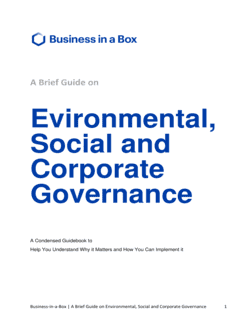
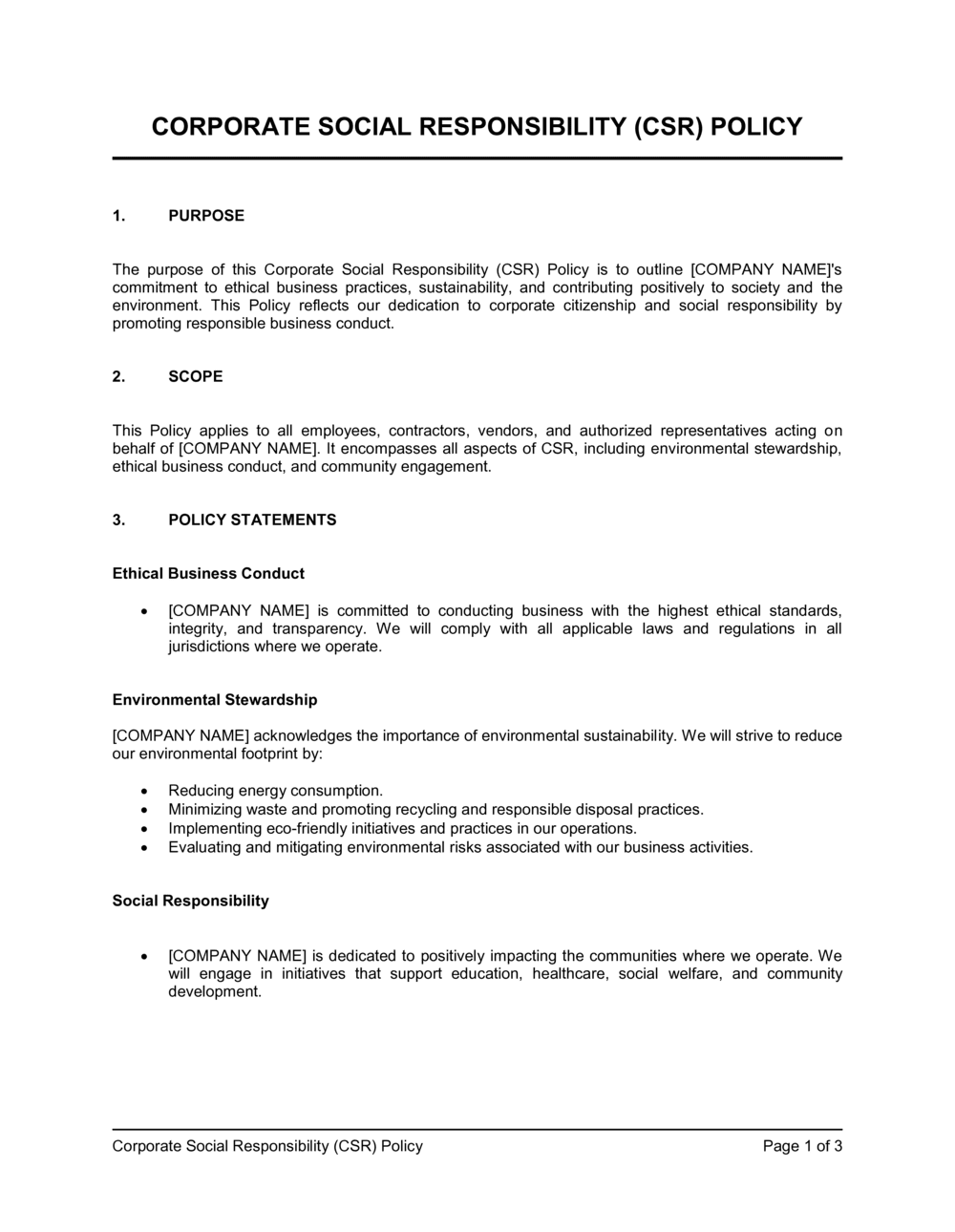
Corporate Social Responsibility Policy Template

Free Word download β€’ Edit online β€’ Save & share with Drive β€’ Export to PDF

3 pagesβ€’20–25 min to fillβ€’Difficulty: Standard
Learn more ↓
FreeCorporate Social Responsibility Policy Template

At a glance

What it is
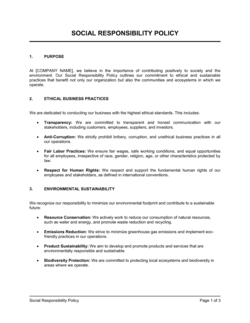
A Corporate Social Responsibility (CSR) Policy is a formal document that defines a company's commitments to environmental stewardship, ethical labor practices, community engagement, and responsible governance. This free Word download gives you a structured, board-ready starting point you can edit online and export as PDF to share with employees, investors, and the public.
When you need it
Use it when formalizing ESG commitments for investors or lenders, responding to customer or partner due-diligence questionnaires, onboarding employees to company values, or preparing a public sustainability disclosure.
What's inside
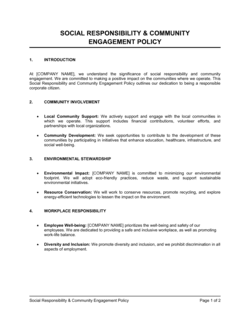
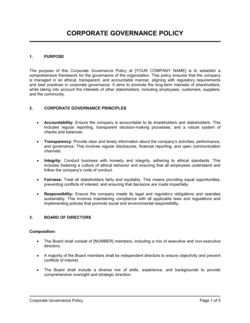
A policy statement and scope, environmental commitments, labor and human rights standards, community investment guidelines, supply chain conduct expectations, governance and ethics principles, reporting obligations, and an implementation and review framework.

What is a Corporate Social Responsibility Policy?

A Corporate Social Responsibility (CSR) Policy is a formal organizational document that sets out a company's voluntary commitments to conducting business in ways that benefit society, protect the environment, and uphold ethical standards beyond what the law requires. It defines specific targets and principles across environmental stewardship, labor and human rights, community investment, supply chain conduct, and corporate governance β€” and establishes how the company will measure, report, and improve its performance over time. Unlike a marketing statement or values page, a properly structured CSR policy assigns ownership, sets measurable targets with baselines and deadlines, references a recognized reporting framework, and specifies a review cycle that keeps commitments current and auditable.

Why You Need This Document

Without a written CSR policy, your company lacks a credible, auditable foundation for the ESG disclosures that investors, corporate buyers, and regulators increasingly require. Institutional investors screen suppliers and portfolio companies against ESG criteria before committing capital; a missing or vague policy is a disqualifying gap in most modern due-diligence processes. Major corporate procurement teams require formal CSR documentation as a condition of vendor approval β€” and a website values page does not satisfy that requirement. Internally, the absence of a policy means environmental and social responsibilities are handled inconsistently across teams, with no named accountable owner and no KPIs to track. A well-structured CSR policy turns values into verifiable commitments, gives employees clear guidance on expected conduct, and provides the documented framework your first annual sustainability report depends on.

Which variant fits your situation?

If your situation is…Use this template
Publicly traded company with mandatory ESG disclosure requirementsESG Reporting Framework
Small business formalizing values for the first timeCorporate Social Responsibility Policy
Company setting out supplier conduct requirementsSupplier Code of Conduct
Organization publishing an annual sustainability reportSustainability Report Template
Business establishing a charitable giving or community investment programCorporate Giving Policy
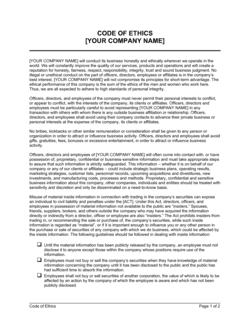
Company documenting internal ethics and anti-corruption standardsCode of Business Conduct and Ethics
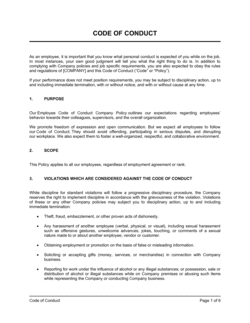
HR team embedding CSR principles into employee conduct expectationsEmployee Code of Conduct

Common mistakes to avoid

❌ Aspirational language with no measurable targets

Why it matters: A policy that says 'we are committed to reducing our environmental impact' with no number, baseline, or deadline cannot be audited, reported on, or held accountable. Investors and rating agencies score it as non-compliant with basic disclosure standards.

Fix: Every commitment should include a metric, a baseline, and a target year. Replace 'we aim to reduce waste' with 'we will reduce landfill waste by 25% against our 2024 baseline by 2027.'

❌ Limiting scope to headquarters operations only

Why it matters: Subsidiaries, overseas offices, and Tier 1 suppliers are where most material ESG risks reside. A policy that excludes them provides false assurance and fails standard supply-chain due-diligence checks.

Fix: Explicitly state that the policy applies to all entities in which the company holds a controlling interest, and extend supply chain obligations to all Tier 1 vendors.

❌ Publishing a supplier code but not referencing it in contracts

Why it matters: A supplier code embedded only in the CSR policy has no contractual force. Suppliers who violate it face no formal consequence, and the company cannot demonstrate enforcement to auditors.

Fix: Incorporate a reference to the supplier code of conduct into every vendor agreement and purchase order template as a binding condition of business.

❌ Assigning CSR ownership to a committee with no named individual

Why it matters: Shared ownership without individual accountability means policy reviews slip, KPIs go unmeasured, and the annual report gets drafted from memory rather than tracked data.

Fix: Name a specific role β€” Chief Sustainability Officer, Operations Director, or equivalent β€” as the sole accountable owner, supported by a cross-functional working group.

❌ Choosing a reporting framework without checking data compatibility

Why it matters: Naming GRI or SASB in the policy and then collecting data in formats that don't match those frameworks' required metrics creates a significant rework burden when the first report is due.

Fix: Download the framework's standard disclosures before finalizing the policy, confirm you can collect each required data point, and list only those KPIs in Schedule A.

❌ No dated review history in the document

Why it matters: Without a record of when the policy was last reviewed and by whom, it is impossible to confirm the policy is current β€” a basic check in any ESG audit or investor questionnaire.

Fix: Add a version table to the cover page recording the review date, approving authority, and summary of material changes for every revision.

The 9 key sections, explained

Policy statement and scope

Environmental commitments

Labor standards and human rights

Community investment and engagement

Supply chain responsibility

Governance and anti-corruption

Reporting and disclosure

Roles, responsibilities, and training

Review and continuous improvement

How to fill it out

  1. 1

    Define the policy scope and governing entity

    Enter the company's full legal name and specify which entities, geographies, and operations the policy covers. If subsidiaries or joint ventures exist, name them explicitly or use inclusive language such as 'all entities in which [COMPANY NAME] holds a majority interest.'

    πŸ’‘ Align the scope definition with your group structure chart so that no operating entity is inadvertently excluded when investors or auditors review the policy.

  2. 2

    Conduct a materiality assessment before setting targets

    Before filling in commitments, identify the two or three ESG topics most relevant to your industry and stakeholders β€” emissions for a manufacturer, labor standards for a retailer, data privacy for a SaaS company. Focus your specific targets on those areas.

    πŸ’‘ A quick survey of your five largest customers and your top institutional investors will reveal which CSR topics they weigh most heavily in due diligence.

  3. 3

    Set measurable environmental targets with a baseline year

    Replace placeholder language with a specific reduction target, a baseline year, and a target year β€” for example, '40% reduction in Scope 1 and 2 emissions by 2030 against a 2023 baseline.' Attach your current emissions inventory in Schedule A.

    πŸ’‘ If you don't have a current emissions inventory, use your energy bills and a standard emissions factor calculator to produce a rough Scope 1 and 2 baseline before finalizing the target.

  4. 4

    Complete the labor standards section against applicable law

    Review the labor standards section against the employment laws of every jurisdiction in which you operate. Replace generic references with any jurisdiction-specific minimums β€” for example, specific minimum wages or mandatory rest periods.

    πŸ’‘ Reference the ILO Core Labour Standards as a universal floor; they provide a credible, internationally recognized baseline that satisfies most investor due-diligence requirements.

  5. 5

    Link supply chain requirements to your vendor contracts

    Once the supply chain responsibility section is finalized, update your standard purchase order terms and vendor agreement templates to reference the CSR policy and any supplier code of conduct as a contractual condition.

    πŸ’‘ Add a single line to your purchase order template β€” 'Supplier acknowledges receipt of and agrees to comply with the [COMPANY NAME] Supplier Code of Conduct' β€” to make the obligation enforceable.

  6. 6

    Assign named owners and training deadlines

    Replace all committee references with named roles (not individual names, which require updates when personnel change). Set a specific onboarding training deadline β€” 30 days is the industry standard β€” and confirm who delivers and tracks completion.

    πŸ’‘ Tie training completion to your existing HR onboarding checklist so CSR awareness training is tracked in the same system as mandatory compliance modules.

  7. 7

    Select a reporting framework and list your KPIs

    Choose GRI Standards, SASB, or the UN SDGs as your primary framework and list the specific KPIs you will track in Schedule A. Align the KPIs to the framework's standard disclosures so your first annual report requires minimal reformatting.

    πŸ’‘ Start with five to eight KPIs rather than attempting to report against every indicator β€” depth on a small set of material metrics is more credible than shallow reporting across 40 indicators.

  8. 8

    Set the review date and obtain board approval

    Enter the next scheduled review date in the policy footer and submit the completed document for board or senior leadership approval. Record the approval date and approving authority on the document cover page.

    πŸ’‘ Schedule the annual review meeting at the same time as your fiscal year-end audit cycle so CSR performance data and policy review happen in one coordinated process.

Frequently asked questions

What is a corporate social responsibility policy?

A corporate social responsibility (CSR) policy is a formal document that defines a company's voluntary commitments to operating in ways that benefit society, the environment, and its stakeholders beyond legal minimums. It typically covers environmental targets, labor standards, community investment, supply chain conduct, and governance principles. It serves both as an internal guide for employee conduct and an external disclosure document for investors, customers, and regulators.

Is a CSR policy legally required?

In most jurisdictions, a CSR policy is voluntary for private companies. However, publicly traded companies in the EU are subject to the Corporate Sustainability Reporting Directive (CSRD), which mandates detailed sustainability disclosures. In the US, the SEC has proposed rules requiring climate-related disclosures for public companies. Many large corporate buyers and institutional investors require suppliers and portfolio companies to have a formal CSR policy as a condition of doing business, making it practically necessary even when not legally mandated.

What is the difference between a CSR policy and an ESG report?

A CSR policy sets out a company's commitments and the framework for how it will behave β€” it is forward-looking and prescriptive. An ESG report documents actual performance against those commitments over a defined period β€” it is backward-looking and evidential. You need the policy first to establish what you are measuring; the report then demonstrates whether you delivered on it.

How specific should environmental targets be in a CSR policy?

Targets should be specific enough to be measurable and auditable. Best practice is to include a metric (e.g., percentage reduction in Scope 1 and 2 emissions), a baseline year, and a target year. Vague language such as "minimize environmental impact" or "reduce where possible" is standard in low-quality policies and is typically scored as non-compliant by major ESG rating agencies. Even a modest but specific target β€” 10% emissions reduction by 2027 β€” is more credible than an unlimited aspiration.

Does a CSR policy need board approval?

Board approval is not legally required for most private companies, but it is strongly recommended. Board sign-off signals that CSR commitments have executive-level accountability and are not simply a marketing exercise. Most institutional investors and major corporate buyers check whether CSR policies are board-approved as part of vendor and portfolio due diligence.

How often should a CSR policy be reviewed?

Annual review is the standard practice, typically aligned with the fiscal year-end to coincide with the collection of annual performance data. In fast-moving regulatory environments β€” particularly for EU-based or EU-selling companies affected by CSRD β€” a mid-year checkpoint is also advisable. The policy should be updated whenever there is a material change in business scope, applicable law, or the company's stated targets.

What reporting framework should I reference in my CSR policy?

The most widely recognized frameworks are GRI Standards (broadly applicable across industries), SASB (industry-specific metrics), the UN Sustainable Development Goals (useful for community and social commitments), and the Task Force on Climate-related Financial Disclosures (TCFD, focused on climate risk). For most small and mid-size businesses, GRI provides the most recognized baseline. Choose one primary framework and align your KPIs to its standard disclosures before finalizing the policy.

Should a CSR policy be made public?

Publishing the CSR policy on your company website is considered best practice and is increasingly expected by institutional investors, procurement teams at large corporations, and consumers. Keeping it internal limits its value as a trust-building and stakeholder-engagement tool. If specific targets or supplier audit results are commercially sensitive, those details can be handled in an internal schedule rather than the public-facing policy document.

What is greenwashing and how does a CSR policy help prevent it?

Greenwashing is the practice of making environmental or social claims that are misleading, unsubstantiated, or disconnected from actual conduct. A well-drafted CSR policy reduces greenwashing risk by anchoring public commitments to specific, measurable targets backed by data. Policies that use only vague aspirational language β€” without baselines, targets, or reporting obligations β€” are both ineffective and increasingly the subject of regulatory scrutiny and consumer litigation in the US, UK, and EU.

How this compares to alternatives

vs Code of Business Conduct and Ethics

A code of ethics governs individual employee behavior β€” conflicts of interest, gifts, anti-bribery, and whistleblowing. A CSR policy governs the company's collective commitments to external stakeholders β€” the environment, communities, and supply chains. Both are needed: the code sets internal conduct standards; the CSR policy sets external responsibility standards. They should be cross-referenced but kept as separate documents.

vs Employee Code of Conduct

An employee code of conduct defines rules for individual workplace behavior β€” attendance, confidentiality, and acceptable use of company assets. A CSR policy operates at the organizational level and addresses how the company as a whole treats society, the environment, and its supply chain. CSR values are often embedded in employee codes as a section, but the full policy requires separate, standalone treatment.

vs Sustainability Report

A sustainability report documents actual ESG performance over a past period, typically one fiscal year, against defined KPIs. A CSR policy sets the commitments and framework that determine what gets measured and reported. The policy comes first and shapes the report; publishing a sustainability report without an underlying policy means there is no defined commitment to measure performance against.

vs Supplier Code of Conduct

A supplier code of conduct is a document directed at external vendors that specifies the labor, environmental, and ethics standards they must meet to do business with the company. A CSR policy is an internal governance document that articulates the company's own commitments. The supplier code is often an appendix or companion document to the CSR policy, and the two should be consistent in scope and standards.

Industry-specific considerations

Manufacturing

Scope 1 and 2 emissions reduction targets, chemical and hazardous waste disposal standards, and Tier 1 and Tier 2 supplier labor audits are the highest-priority sections for manufacturers.

Retail and e-commerce

Supply chain labor standards, sustainable packaging commitments, and product sourcing transparency are central CSR concerns for retailers responding to consumer and investor pressure.

Financial services

Responsible investment criteria, anti-corruption and anti-money-laundering alignment, and diversity and inclusion targets are the primary ESG focus areas for banks, insurers, and asset managers.

Professional services

Pro bono commitments, diversity hiring and pay-equity targets, and carbon-offset programs for business travel are the most material CSR topics for law firms, consultancies, and accounting practices.

Template vs pro β€” what fits your needs?

PathBest forCostTime
Use the templateSmall and mid-size businesses formalizing CSR commitments for the first time or responding to a standard supplier questionnaireFree2–4 hours
Template + professional reviewCompanies preparing for investor ESG due diligence, first public CSR disclosures, or supply chain audit programs$500–$2,000 for a sustainability consultant or ESG advisor review1–2 weeks
Custom draftedPublicly traded companies, CSRD-regulated entities, or businesses pursuing B Corp certification or SBTi-validated emissions targets$3,000–$15,000 for a full ESG strategy and policy engagement4–12 weeks

Glossary

CSR (Corporate Social Responsibility)
A company's voluntary commitment to operate in ways that benefit society and the environment beyond what is legally required.
ESG (Environmental, Social, and Governance)
A framework used by investors and rating agencies to evaluate a company's non-financial performance across three dimensions: environmental impact, social practices, and governance structure.
Materiality Assessment
A process for identifying which CSR topics are significant enough to both the business and its stakeholders to warrant formal measurement and disclosure.
Stakeholder
Any individual or group affected by or with an interest in the company's actions β€” including employees, customers, suppliers, investors, communities, and regulators.
Supply Chain Due Diligence
The process of assessing and monitoring suppliers and subcontractors to ensure they meet the company's labor, environmental, and ethics standards.
Scope 1 / 2 / 3 Emissions
A greenhouse gas accounting classification: Scope 1 is direct emissions from owned sources, Scope 2 is indirect emissions from purchased energy, and Scope 3 covers all other indirect emissions in the value chain.
GRI (Global Reporting Initiative)
An internationally recognized standards framework that organizations use to report their environmental, social, and governance impacts to stakeholders.
Triple Bottom Line
A business accounting framework that measures performance across three dimensions β€” people, planet, and profit β€” rather than financial profit alone.
Greenwashing
The practice of making misleading or unsubstantiated environmental claims, creating a gap between stated CSR commitments and actual conduct.
B Corp Certification
A third-party certification awarded by B Lab to companies that meet verified standards of social and environmental performance, accountability, and transparency.

Part of your Business Operating System

This document is one of 3,000+ business & legal templates included in Business in a Box.

  • Fill-in-the-blanks β€” ready in minutes
  • 100% customizable Word document
  • Compatible with all office suites
  • Export to PDF and share electronically

Create your document in 3 simple steps.

From template to signed document β€” all inside one Business Operating System.
1
Download or open template

Access over 3,000+ business and legal templates for any business task, project or initiative.

2
Edit and fill in the blanks with AI

Customize your ready-made business document template and save it in the cloud.

3
Save, Share, Send, Sign

Share your files and folders with your team. Create a space of seamless collaboration.

Save time, save money, and create top-quality documents.

β˜…β˜…β˜…β˜…β˜…

"Fantastic value! I'm not sure how I'd do without it. It's worth its weight in gold and paid back for itself many times."

Managing Director Β· Mall Farm
Robert Whalley
Managing Director, Mall Farm Proprietary Limited
β˜…β˜…β˜…β˜…β˜…

"I have been using Business in a Box for years. It has been the most useful source of templates I have encountered. I recommend it to anyone."

Business Owner Β· 4+ years
Dr Michael John Freestone
Business Owner
β˜…β˜…β˜…β˜…β˜…

"It has been a life saver so many times I have lost count. Business in a Box has saved me so much time and as you know, time is money."

Owner Β· Upstate Web
David G. Moore Jr.
Owner, Upstate Web

Run your business with a system β€” not scattered tools

Stop downloading documents. Start operating with clarity. Business in a Box gives you the Business Operating System used by over 250,000 companies worldwide to structure, run, and grow their business.

Free Forever PlanΒ Β·Β No credit card required