Sales Commission Plan Template

Free Word download β€’ Edit online β€’ Save & share with Drive β€’ Export to PDF

13 pagesβ€’30–40 min to fillβ€’Difficulty: Complex
Learn more ↓
FreeSales Commission Plan Template

At a glance

What it is
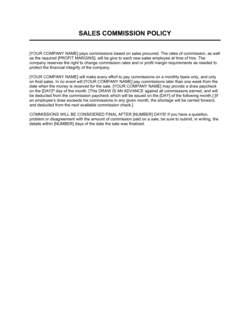
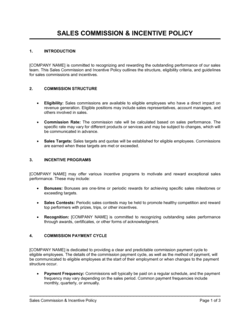
A Sales Commission Plan is a written policy document that defines how salespeople earn variable compensation β€” which deals count, at what rate, when payouts occur, and what happens at quota thresholds. This free Word download gives you a structured, editable template you can tailor to your rep tiers, product mix, and fiscal year, then share with the sales team as the authoritative source of compensation rules.
When you need it
Use it when onboarding your first commissioned sales rep, redesigning compensation ahead of a new fiscal year, or replacing ad hoc deal-by-deal promises with a consistent, documented policy that reduces disputes.
What's inside
Plan purpose and eligibility rules, quota structure and territory definitions, base commission rates with accelerator and decelerator tiers, clawback and adjustment provisions, payout timing and approval workflow, and a signature block for rep acknowledgment.

What is a Sales Commission Plan?

A Sales Commission Plan is a written policy document that defines every material rule governing how salespeople earn variable compensation β€” which revenue counts, at what commission rate, how quota attainment tiers activate accelerators or decelerators, when payouts are made, and under what conditions earned commission can be adjusted or recovered. Unlike a verbal arrangement or a line in an offer letter, a formal commission plan covers the full mechanics of the pay structure for an entire plan year, is distributed to every eligible rep before the year begins, and is signed by both the rep and a company representative as the authoritative record of agreed compensation terms.

Why You Need This Document

Operating without a written commission plan is one of the most common sources of sales-team disputes and avoidable turnover. When accelerator thresholds, split credit rules, and clawback terms exist only in memory or email threads, every strong quarter generates a pay dispute and every departing rep becomes a potential wage claim. In several US states, unpaid or miscalculated commissions trigger liability under sales commission protection statutes β€” and the absence of a signed plan document makes the company's position nearly impossible to defend. A clearly written, signed commission plan eliminates ambiguity on the rules that matter most to your reps, lets finance model commission expense accurately, and gives your sales team the certainty they need to prospect and close without second-guessing whether the deal they are about to discount will actually pay out the way they expect.

Which variant fits your situation?

If your situation is…Use this template
Paying reps a flat percentage of every dollar closedStraight Commission Plan
Splitting commission between base salary and variable payBase Plus Commission Plan
Rewarding team performance equally regardless of individual deal sizeTeam Commission Plan
Compensating sales managers based on their team's total quota attainmentSales Manager Override Commission Plan
Incentivizing recurring revenue growth with renewal and expansion creditsSaaS / Subscription Commission Plan
Paying channel partners or resellers a referral or resale marginChannel Partner Commission Agreement
Running a time-limited contest or SPIF for a product pushSales SPIF / Incentive Program Plan

Common mistakes to avoid

❌ Leaving renewal and upsell credit undefined

Why it matters: When the plan does not specify whether the original rep or the account manager owns expansion revenue, both will claim it β€” and both will have a reasonable argument.

Fix: Define credit rules for every deal type: new business, expansion, renewal, and reactivation. Assign ownership explicitly to a role, not a person.

❌ Using retroactive accelerator rates without modeling the cost

Why it matters: A retroactive accelerator that lifts the rate on all closed revenue once a rep hits 100% can triple a rep's payout in a strong quarter β€” creating a budget overrun finance did not anticipate.

Fix: Model the maximum payout under the retroactive structure before publishing the plan. If the number is unsustainable, switch to a marginal accelerator applied only above the threshold.

❌ No fixed clawback window

Why it matters: An open-ended clawback β€” 'at any time a customer cancels' β€” creates permanent pay uncertainty and causes reps to discount aggressively to lock in customers who will never churn.

Fix: Set a specific window of 90 or 180 days, start it at the paid date (not the close date), and carve out cancellations caused by product or service failures.

❌ Distributing the plan verbally or via email without a signed acknowledgment

Why it matters: A rep who disputes a deduction will claim they never received, read, or agreed to the clawback or accelerator terms β€” and without a signature, HR cannot contradict them.

Fix: Require a signed acknowledgment before the rep's first commission-eligible day under the new plan. Electronic signatures are sufficient and auditable.

❌ Setting company-wide quota without accounting for territory differences

Why it matters: A rep in a saturated territory with a small TAM cannot hit the same dollar quota as a rep in an underpenetrated market β€” causing the harder-territory rep to leave within two quarters.

Fix: Build quotas from a bottom-up territory model: number of target accounts Γ— win rate Γ— ACV = addressable quota. Adjust for rep tenure and ramp stage.

❌ Omitting the plan modification clause

Why it matters: Without a modification provision, changing quotas or rates mid-year may constitute a unilateral change to compensation β€” exposing the company to claims for the higher earnings a rep expected under the original plan.

Fix: Include a clause reserving the right to modify the plan with 30 days' written notice, and state that continued employment constitutes acceptance of the revised terms.

The 9 key sections, explained

Plan purpose and effective date

Eligibility and covered roles

Quota structure and territory definitions

Commissionable revenue and deal eligibility

Base commission rates and tier structure

Clawback and adjustment provisions

Draw against commission and ramp terms

Payout timing and approval workflow

Plan modification and acknowledgment

How to fill it out

  1. 1

    Define the plan period and supersession language

    Enter the exact start and end dates of the plan year and confirm this plan replaces all prior commission arrangements. Store the prior plan in your HR system before issuing the new one.

    πŸ’‘ Distribute the plan at least two weeks before the plan year starts so reps can ask questions before they begin selling under the new terms.

  2. 2

    List eligible roles by exact job title

    Copy job titles verbatim from your HR system. If a manager override plan exists, explicitly exclude manager roles here and reference the separate document by name.

    πŸ’‘ Run the eligible-role list by HR to catch any mismatches between current job titles and what your HRIS records β€” title drift is common in fast-growing teams.

  3. 3

    Assign individual quotas and define territories

    Enter each rep's annual or quarterly quota and attach a Schedule A defining their territory by geography, named accounts, vertical, or market segment. Note the approval process for mid-year territory changes.

    πŸ’‘ Benchmark quotas at 4–6Γ— OTE for field sales and 3–4Γ— OTE for inside sales β€” higher multiples signal unachievable quotas that will drive attrition.

  4. 4

    Define commissionable revenue with explicit exclusions

    List every revenue type that earns commission and every category that does not. Cross-reference your CRM opportunity stages to confirm 'closed-won' is the correct trigger, not 'invoiced' or 'collected'.

    πŸ’‘ When in doubt, add an exclusion rather than leaving it open. It is far easier to add a commission credit later than to claw one back.

  5. 5

    Set commission rates and tier thresholds

    Enter the base rate and each accelerator or decelerator tier. Confirm whether the higher rate applies only to revenue above the threshold (marginal) or to all revenue earned that period (retroactive).

    πŸ’‘ Marginal accelerators are easier to budget and model. Retroactive accelerators are better motivators but create step-change payout spikes that surprise finance.

  6. 6

    Write the clawback terms with a fixed window

    Set a specific clawback window β€” 90 or 180 days is most common β€” and carve out cancellations caused by the company's failure to deliver. State the recovery method (payroll deduction).

    πŸ’‘ Test your clawback clause with three real historical scenarios before finalizing β€” edge cases surface immediately and are easier to address in the draft than in a dispute.

  7. 7

    Confirm payout timing tied to a payroll date

    Name the specific payroll date on which commissions are paid and the approval steps that must be completed first. Attach the commission calculation template so reps can verify their own numbers.

    πŸ’‘ Providing reps with a read-only view of their commission calculations before payout cuts dispute volume by more than half.

  8. 8

    Collect signed acknowledgments before the plan year starts

    Route the plan through DocuSign or Business in a Box eSign to each eligible rep. Store the executed copy alongside their employment agreement in your HR system.

    πŸ’‘ Chase signatures on a five-business-day deadline β€” unsigned plans create ambiguity that protects no one if a dispute arises.

Frequently asked questions

What is a sales commission plan?

A sales commission plan is a written document that defines how salespeople earn variable pay β€” which deals qualify, the commission rate at each quota tier, when payments are made, and the conditions under which commission can be adjusted or clawed back. It replaces informal verbal agreements with a single authoritative policy that both the company and each rep sign before the plan year begins.

What should a sales commission plan include?

At minimum: the plan period and eligibility rules, individual quotas and territory definitions, commissionable revenue types and exclusions, base commission rates with accelerator and decelerator tiers, clawback terms with a defined window, payout timing tied to a specific payroll date, and a signed acknowledgment from each covered rep. Missing any of these creates gaps that disputes will fall into.

What is a typical sales commission rate?

Commission rates vary widely by industry and sales model. SaaS inside sales typically runs 8–12% of annual contract value. Field enterprise sales ranges from 5–10% on larger deals. Retail and transactional sales can run 2–5%. The rate should be set so that a rep hitting 100% of quota earns a total OTE competitive with the market for that role.

What is the difference between a commission plan and an OTE?

OTE (On-Target Earnings) is a single number β€” the total pay a rep earns when they hit exactly 100% of quota. A commission plan is the full document that defines how OTE is structured: what percentage is base salary, what percentage is variable, the quota that triggers the variable component, and the rates at each attainment tier. OTE is the headline; the commission plan is the mechanics behind it.

What is an accelerator in a sales commission plan?

An accelerator is a higher commission rate that applies once a rep exceeds a defined quota threshold β€” for example, 8% on revenue up to 100% of quota and 14% on revenue above 100%. Accelerators reward overperformance and give top reps strong financial incentive to keep closing after they hit plan, rather than sandbagging deals into the next quarter.

What is a clawback clause in a commission plan?

A clawback clause requires a rep to return commission paid on a deal if the customer cancels, fails to pay, or the deal is reversed within a defined window β€” typically 90 to 180 days. Clawbacks protect the company from paying commission on revenue that never materializes and discourage reps from closing deals with customers who are unlikely to pay or retain.

How often should a sales commission plan be updated?

Most companies reset the commission plan annually, aligned to the fiscal year. Quotas are adjusted for market conditions, new product lines, and territory changes. Rates and accelerator thresholds may be held stable for two to three years if the structure is working. Mid-year changes should be rare and always communicated with at least 30 days' notice to avoid trust and retention problems.

Does a sales commission plan need to be a formal document?

Yes. An informal or verbal commission arrangement is a significant legal and operational risk. Without a written plan, disputes over accelerator thresholds, territory credit, and clawback terms become he-said-she-said conversations with no documented resolution path. In several US states, unpaid or disputed commissions can trigger wage-claim liability under sales commission protection laws.

How do I handle commission splits between two reps?

Define split credit rules explicitly in the plan β€” typically as a named percentage assigned to each contributing role (for example, 60% to the field rep and 40% to the SDR who sourced the opportunity). Require CRM documentation of the split before deal close so finance can calculate payouts without adjudicating post-close disputes between reps.

How this compares to alternatives

vs Sales Compensation Agreement

A sales compensation agreement is a bilateral legal contract between employer and rep that creates binding obligations. A commission plan is an internal policy document that sets the mechanics but is typically revised annually. For most sales teams, the employment contract references the commission plan by name rather than embedding all the terms. Use a compensation agreement when you need a multi-year legally binding commitment to a specific rep or executive.

vs Employee Bonus Plan

A bonus plan awards a discretionary or formula-driven lump sum tied to company or individual performance β€” usually paid once or twice a year. A commission plan pays variable compensation tied directly to individual revenue closed, often monthly or quarterly. Bonuses reward broad performance; commissions create a direct line between a rep's specific deals and their pay.

vs Sales Incentive Program (SPIF)

A SPIF is a short-term, product-specific cash incentive layered on top of the base commission plan β€” typically running four to eight weeks to drive focus on a new product or end-of-quarter push. A commission plan governs the full year. SPIFs are tactical and temporary; the commission plan is the structural foundation.

vs Channel Partner Commission Agreement

A channel partner commission agreement governs payments to external resellers, distributors, or referral partners β€” not employees. It requires contract law considerations around payment triggers, territory exclusivity, and audit rights that an internal policy document does not. Use a commission plan for your sales team and a separate channel agreement for external partners.

Industry-specific considerations

SaaS / Technology

Commission is typically paid on annual contract value at close, with separate rates for new business, expansion ARR, and renewals β€” and clawback windows tied to the customer's initial contract term.

Financial Services

Regulatory constraints in several jurisdictions require commission structures to avoid incentivizing unsuitable product recommendations, making documented eligibility rules and compliance sign-off essential.

Manufacturing and Distribution

Reps often carry multi-year accounts with seasonal volume swings, requiring quota-setting models that account for contract renewals and territory-level historical purchase data.

Professional Services

Commission is typically earned on signed project value or retainer fees, with adjustments for utilization shortfalls and provisions crediting the selling rep on follow-on project expansions.

Template vs pro β€” what fits your needs?

PathBest forCostTime
Use the templateSales teams of one to twenty reps with a standard new-business commission structureFree2–4 hours to complete and distribute
Template + professional reviewTeams adding complex accelerator tiers, recoverable draws, or multi-product split credit rules$300–$800 for a sales compensation consultant or HR advisor review3–5 business days
Custom draftedEnterprise sales organizations with 50+ reps, regulated industries, or multi-country compensation structures requiring legal and finance sign-off$2,000–$8,000 for a sales compensation specialist engagement3–6 weeks

Glossary

On-Target Earnings (OTE)
The total compensation a rep earns β€” base salary plus commission β€” when they hit exactly 100% of quota.
Quota
A revenue, unit, or activity target assigned to a rep for a defined period, against which commission attainment is measured.
Accelerator
A higher commission rate that activates once a rep exceeds a quota threshold β€” for example, 12% on revenue above 100% of quota versus 8% below it.
Decelerator
A lower commission rate applied to deals closed below a minimum performance threshold, used to discourage low-value or unprofitable sales.
Clawback
A provision requiring a rep to return previously paid commission if a customer cancels, defaults, or the deal is later disqualified within a defined window.
Draw Against Commission
An advance on expected commission earnings paid during ramp periods β€” either recoverable (must be paid back) or non-recoverable (forgiven if not earned).
Spiff / SPIF
A short-term cash incentive for selling a specific product, reaching a milestone, or closing deals within a promotional period β€” separate from the base commission plan.
Split Credit
An arrangement where commission on a single deal is divided between two or more reps β€” for example, a field rep and an inside rep who collaborated on the close.
Ramp Period
A defined onboarding window β€” typically 30 to 90 days β€” during which a new rep earns a reduced or adjusted quota to allow for training and pipeline building.
Plan Year
The fiscal period β€” usually 12 months β€” for which the commission plan's quotas, rates, and terms apply before the plan is formally reviewed and reset.


Part of your Business Operating System

This document is one of 3,000+ business & legal templates included in Business in a Box.

  • Fill-in-the-blanks β€” ready in minutes
  • 100% customizable Word document
  • Compatible with all office suites
  • Export to PDF and share electronically

Create your document in 3 simple steps.

From template to signed document β€” all inside one Business Operating System.
1
Download or open template

Access over 3,000+ business and legal templates for any business task, project or initiative.

2
Edit and fill in the blanks with AI

Customize your ready-made business document template and save it in the cloud.

3
Save, Share, Send, Sign

Share your files and folders with your team. Create a space of seamless collaboration.

Save time, save money, and create top-quality documents.

β˜…β˜…β˜…β˜…β˜…

"Fantastic value! I'm not sure how I'd do without it. It's worth its weight in gold and paid back for itself many times."

Managing Director Β· Mall Farm
Robert Whalley
Managing Director, Mall Farm Proprietary Limited
β˜…β˜…β˜…β˜…β˜…

"I have been using Business in a Box for years. It has been the most useful source of templates I have encountered. I recommend it to anyone."

Business Owner Β· 4+ years
Dr Michael John Freestone
Business Owner
β˜…β˜…β˜…β˜…β˜…

"It has been a life saver so many times I have lost count. Business in a Box has saved me so much time and as you know, time is money."

Owner Β· Upstate Web
David G. Moore Jr.
Owner, Upstate Web

Run your business with a system β€” not scattered tools

Stop downloading documents. Start operating with clarity. Business in a Box gives you the Business Operating System used by over 250,000 companies worldwide to structure, run, and grow their business.

Free Forever PlanΒ Β·Β No credit card required