Electrician Job Description Template

Free Word download • Edit online • Save & share with Drive • Export to PDF

2 pages20–30 min to fillDifficulty: StandardSignature requiredLegal review recommended
Learn more ↓
FreeElectrician Job Description Template

At a glance

What it is
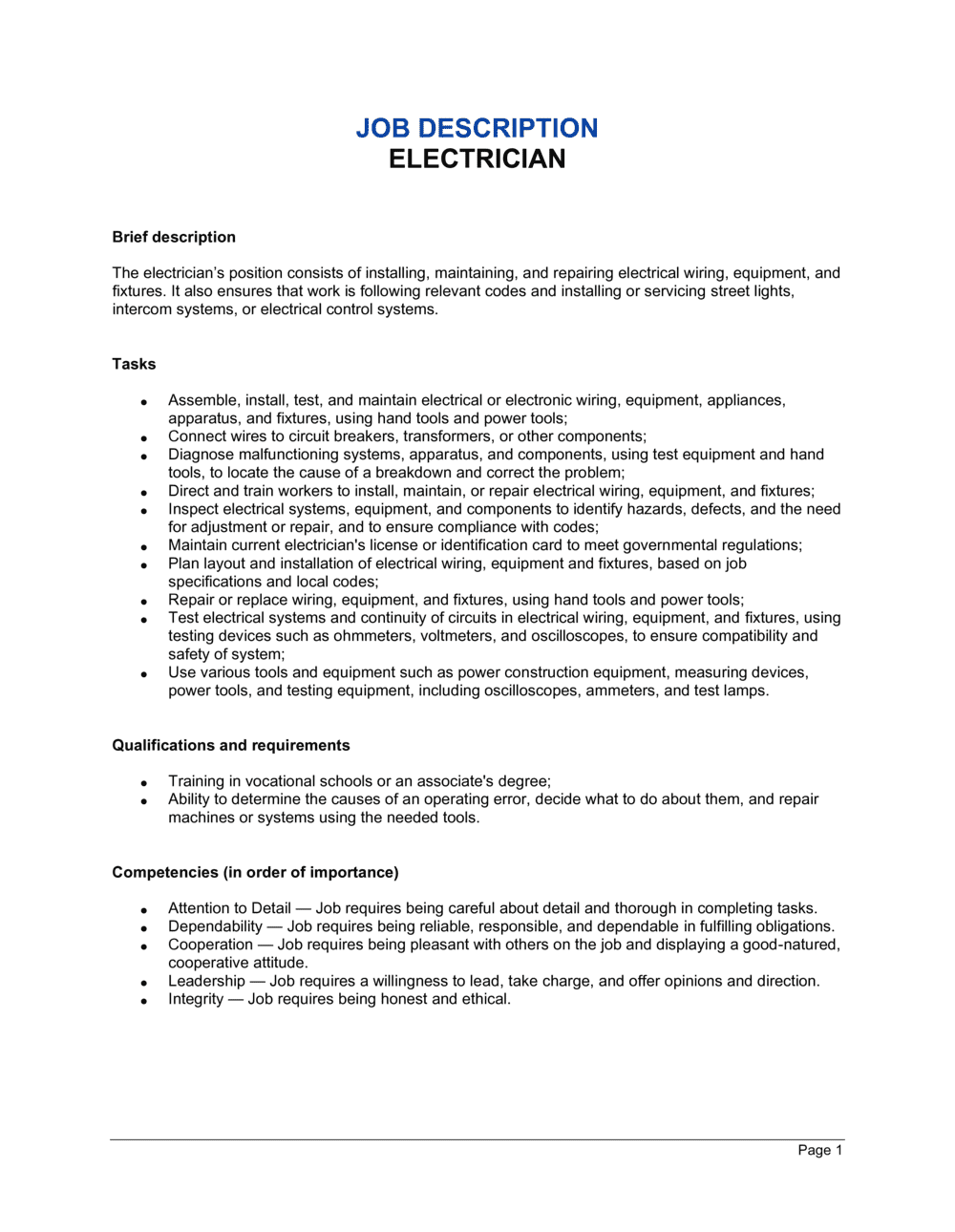
An Electrician Job Description is a structured legal and HR document that defines the duties, qualifications, licensing requirements, reporting structure, working conditions, and compensation expectations for an electrician role. This free Word download gives employers a compliant, editable starting point they can tailor to the specific tier of electrician being hired — apprentice, journeyman, or master — and export as PDF for job postings, offer letters, or employment files.
When you need it
Use it when posting a new electrician vacancy, onboarding a replacement hire, or formalizing existing roles that currently lack written documentation. It is also required by many labor regulators and employment standards bodies as part of a compliant hiring record.
What's inside
Job title and classification, reporting structure, core electrical duties and trade-specific responsibilities, required licenses and certifications, physical and safety requirements, compensation and benefits summary, and an acknowledgment signature block confirming the employee has read and understood the role's expectations.

What is an Electrician Job Description?

An Electrician Job Description is a formal HR and legal document that defines the duties, qualifications, licensing requirements, physical demands, compensation expectations, and reporting structure for an electrician position. It functions as the authoritative written record of what the role requires — used in job postings to attract qualified candidates, attached to employment contracts as a defining schedule, and retained in the employee's personnel file as evidence that role obligations were communicated and acknowledged. The document covers the full spectrum of electrician tiers, from apprentices working under direct supervision to master electricians responsible for permit authority and code compliance sign-off.

Why You Need This Document

Without a written electrician job description, employers face four compounding risks. First, an undocumented role with no FLSA classification creates overtime liability — misclassifying an electrician as exempt from overtime pay exposes the business to Department of Labor audits and back-pay claims covering up to three years of unpaid wages. Second, failing to specify license requirements in writing means the employer has no documented basis to terminate or reassign an employee whose license lapses mid-project, potentially leaving permitted electrical work in the hands of an unlicensed worker. Third, vague duty lists that omit safety obligations weaken the employer's position in OSHA investigations and workers' compensation disputes. Finally, a detailed job description without an at-will disclaimer can be treated as an implied employment contract in several US states, stripping the employer of the flexibility to modify duties or terminate without cause. This template closes all four gaps in under 30 minutes, giving hiring managers a legally sound, jurisdiction-aware starting point for every electrician hire.

Which variant fits your situation?

If your situation is…Use this template
Hiring an entry-level worker enrolled in an apprenticeship programElectrician Apprentice Job Description
Posting for a licensed journeyman electrician for commercial projectsJourneyman Electrician Job Description
Defining a senior role with supervisory and code-compliance responsibilitiesMaster Electrician Job Description
Hiring an in-house maintenance electrician for a manufacturing plantIndustrial Maintenance Electrician Job Description
Engaging an electrician as an independent contractor rather than an employeeIndependent Contractor Agreement
Documenting the full employment relationship beyond just the role descriptionEmployment Contract
Hiring for a temporary or seasonal electrical project with a fixed end dateFixed-Term Employment Contract

Common mistakes to avoid

❌ Misclassifying the electrician as FLSA exempt

Why it matters: Electricians are nearly always non-exempt under the FLSA, entitling them to overtime at 1.5× for hours over 40 per week. Misclassifying them as exempt to avoid overtime triggers Department of Labor audits, back-pay claims, and civil penalties up to $2,381 per violation.

Fix: Confirm FLSA status using the duties test before completing the classification field. When in doubt, classify as non-exempt and consult an employment attorney before publishing the posting.

❌ Omitting the license lapse notification requirement

Why it matters: If an electrician's license lapses and they continue performing permitted electrical work, the employer faces code violations, permit revocations, and potential liability for any installations completed during the lapse.

Fix: Add an explicit clause requiring the employee to notify the company within 24 hours of any license suspension, lapse, or adverse action, and specify that continued employment is contingent on maintaining a valid license.

❌ Using the job description as an implied contract without a disclaimer

Why it matters: Courts in several states have found that detailed, promissory job descriptions without an explicit at-will disclaimer can create implied employment contracts, limiting the employer's ability to terminate or modify duties without legal exposure.

Fix: Include a clear statement in the acknowledgment section that the job description is not a contract of employment and that duties may be modified at the company's discretion.

❌ Inflating physical requirements beyond the actual job demands

Why it matters: Physical requirement thresholds that exceed what the job actually demands can constitute disability discrimination under the ADA if they screen out candidates who could perform the essential functions with reasonable accommodation.

Fix: Conduct or reference a job demands analysis signed off by a site supervisor before finalizing physical requirements. Document the business necessity for every requirement listed.

❌ Omitting prevailing-wage compliance for government-funded projects

Why it matters: Any federally funded construction project in the US is subject to Davis-Bacon Act prevailing-wage requirements. Posting or paying below the applicable wage rate triggers back-pay liability, contract debarment, and potential criminal penalties.

Fix: Check the applicable Davis-Bacon wage determination for the project's county before setting the compensation range. Reference the wage schedule number in the job description for projects where it applies.

❌ Listing a generic reporting line without supervisory detail

Why it matters: Vague authority structures on electrical job sites create OSHA compliance gaps — if no one is clearly designated as responsible for safety oversight, the employer faces shared-employer liability in the event of an injury.

Fix: Name the specific supervisory title (not a person's name) responsible for direct supervision, safety compliance, and performance reviews, and confirm this matches your OSHA 300 log and workers' compensation policy.

The 9 key clauses, explained

Job Title and Classification

In plain language: States the official role title, license tier (apprentice, journeyman, or master), FLSA classification (exempt or non-exempt), and whether the role is full-time, part-time, or contract.

Sample language
Job Title: [JOURNEYMAN / MASTER] Electrician | Department: [ELECTRICAL / MAINTENANCE / FACILITIES] | Classification: Non-Exempt, Full-Time | Reports To: [ELECTRICAL SUPERVISOR / FOREMAN / FACILITIES DIRECTOR]

Common mistake: Omitting the FLSA classification. Electricians are typically non-exempt and entitled to overtime — misclassifying them as exempt to avoid overtime pay triggers Department of Labor penalties and back-pay liability.

Reporting Structure

In plain language: Identifies who the electrician reports to directly, and any positions they supervise, establishing the chain of authority for work assignments, safety compliance, and performance reviews.

Sample language
The [JOB TITLE] reports directly to [FOREMAN / ELECTRICAL SUPERINTENDENT / FACILITIES MANAGER] and is responsible for supervising [NUMBER] apprentices or helpers as assigned.

Common mistake: Leaving the reporting line blank or listing a title that does not exist in the org chart. Ambiguous authority chains create safety and coordination problems on job sites.

Essential Duties and Responsibilities

In plain language: Lists the core electrical tasks the employee must regularly perform — installation, maintenance, troubleshooting, code compliance — in enough detail for performance management and ADA assessments.

Sample language
Install, maintain, and repair electrical wiring, equipment, and fixtures in accordance with [APPLICABLE CODE, e.g., NEC / IEE Wiring Regulations]. Inspect and test electrical systems to ensure compliance with [LOCAL AUTHORITY / STATE / NATIONAL] codes. Read and interpret blueprints, schematics, and technical diagrams to plan and execute electrical installations.

Common mistake: Using generic verbs like 'performs electrical work' without specifying the systems, voltage ranges, or environments involved. Vague duty lists make performance reviews subjective and undermine ADA accommodation analyses.

Qualifications and Experience Requirements

In plain language: Sets out the minimum and preferred education, years of experience, and professional background required to be considered for the role.

Sample language
Minimum [X] years of experience as a licensed electrician in [COMMERCIAL / INDUSTRIAL / RESIDENTIAL] settings. Completion of a [4-year / 5-year] IBEW or equivalent apprenticeship program. High school diploma or GED required; associate degree in electrical technology preferred.

Common mistake: Setting experience thresholds that effectively screen out protected classes without a documented business necessity — for example, requiring 10+ years when 5 suffices. This creates disparate impact exposure under equal employment laws.

Licensing and Certification Requirements

In plain language: Specifies the mandatory trade licenses, safety certifications, and continuing education requirements the employee must hold on their first day and maintain throughout employment.

Sample language
Must hold a valid [STATE / PROVINCIAL] [JOURNEYMAN / MASTER] Electrician License at time of hire. OSHA 10 or OSHA 30 certification required; OSHA 30 preferred. [CPR / First Aid] certification required within [90] days of hire. License must remain current throughout employment.

Common mistake: Not specifying which license tier is required or what happens if a license lapses during employment. A lapsed license can void the employer's permit to operate and expose the business to code-violation liability.

Physical and Environmental Requirements

In plain language: Documents the physical demands of the role — lifting, climbing, standing, confined-space entry, outdoor work — necessary for workers' compensation compliance, ADA accommodation assessments, and accurate job postings.

Sample language
Must be able to lift and carry up to [50] lbs unassisted. Regularly required to climb ladders and work at heights up to [30] feet. Must be able to work in confined spaces, outdoor environments, and exposed to weather conditions. Color vision sufficient to identify wire color codes required.

Common mistake: Overstating physical requirements beyond what the role actually demands. Courts and the EEOC scrutinize inflated requirements as potential disability discrimination if they screen out qualified candidates who could perform the job with reasonable accommodation.

Compensation, Benefits, and Work Schedule

In plain language: States the hourly rate or salary range, overtime eligibility, any shift differential, and the benefits the employee is entitled to, including union benefit fund contributions if applicable.

Sample language
Hourly Rate: $[MIN]–$[MAX] per hour, commensurate with license tier and experience. Overtime at 1.5× for hours worked over 40 per week. Benefits: [HEALTH / DENTAL / VISION / 401(k) / PENSION FUND]. Work Schedule: [STANDARD SHIFT, e.g., Monday–Friday, 7:00 AM–3:30 PM]; shift variations may apply based on project requirements.

Common mistake: Stating a single fixed wage instead of a range when union agreements or prevailing-wage laws require documented wage bands. Posting a rate below the applicable prevailing wage for government-funded projects triggers penalty and disqualification.

Safety Obligations and Compliance

In plain language: Requires the employee to comply with all applicable safety codes, use personal protective equipment, report hazards, and participate in mandatory safety training.

Sample language
Employee must comply with all [COMPANY] safety policies and applicable OSHA / [LOCAL AUTHORITY] regulations at all times. Employee must use required PPE including [INSULATED GLOVES / HARD HAT / SAFETY GLASSES / FLAME-RESISTANT CLOTHING] as specified. Employee must immediately report any electrical hazard, near-miss, or incident to [SUPERVISOR TITLE].

Common mistake: Listing safety obligations only in the employee handbook without referencing them in the job description. If an injury occurs, employers whose job descriptions omit safety obligations face greater difficulty demonstrating the employee had notice of those requirements.

At-Will Statement and Acknowledgment

In plain language: Confirms that the job description is not a contract of employment, states the at-will employment relationship (where applicable), and includes a signature block for the employee to confirm receipt and understanding.

Sample language
This job description does not constitute an employment contract. Employment with [COMPANY NAME] is at-will and may be terminated by either party at any time, with or without cause or notice. I acknowledge receipt of this job description and understand that my duties may be modified at any time. Employee Signature: ___________ Date: ___________ Manager Signature: ___________ Date: ___________

Common mistake: Omitting the disclaimer that the job description is not a contract. Courts in several US states have found that detailed job descriptions without a clear disclaimer can be interpreted as implied employment contracts, limiting the employer's ability to terminate at will.

How to fill it out

  1. 1

    Select the correct license tier and classification

    Identify whether you are hiring an apprentice, journeyman, or master electrician and whether the role is residential, commercial, or industrial. Enter the FLSA classification (almost always non-exempt for hourly electricians) and confirm full-time versus part-time status.

    💡 Check your state's licensing database before posting — some states use different tier names (e.g., 'certified electrician' instead of 'journeyman') and the posting must match the legal terminology.

  2. 2

    Define the reporting structure clearly

    Enter the direct supervisor's exact job title, not a person's name. If the electrician will supervise apprentices or helpers, specify the number and confirm this matches your current org chart.

    💡 Align the reporting line with your workers' compensation and OSHA records — discrepancies between HR documents and field reporting structures create liability gaps in injury investigations.

  3. 3

    Write specific essential duties matched to the work environment

    List 8–12 core tasks using precise, observable language. Specify the voltage ranges worked (e.g., up to 480V three-phase), the types of systems (lighting, HVAC controls, fire alarm integration), and the environments (high-rise commercial, industrial plant, residential).

    💡 Pull actual tasks from your most recent project scopes — duties that reflect real daily work hold up better in performance reviews and unemployment hearings than generic boilerplate.

  4. 4

    Confirm the licensing requirements for your jurisdiction

    Look up the applicable state, provincial, or national license required for the work being performed. Enter the exact license name, issuing authority, and any continuing education requirements. Add a clause requiring the employee to notify the company immediately if their license is suspended or lapsed.

    💡 If your projects cross state lines, list all required licenses — an electrician licensed in Texas working on a federally contracted project in Louisiana needs both states' credentials.

  5. 5

    Document physical requirements accurately

    Enter only the physical demands the role genuinely requires, with specific measurements (lift up to 50 lbs, climb ladders to 30 feet). Review this section against your workers' compensation job demands analysis if one exists.

    💡 Have your site foreman or safety officer review the physical requirements section before publishing — HR-written requirements often understate or overstate what the job actually demands.

  6. 6

    Set compensation within applicable wage laws

    Enter the pay range and confirm it meets or exceeds the applicable federal, state, or prevailing-wage minimum. Note whether the role is covered by a collective bargaining agreement, which sets wage floors and benefit fund contributions.

    💡 For any project funded by federal or state government dollars, cross-reference the Davis-Bacon Act or applicable prevailing-wage schedule before setting the rate — violations trigger back-pay plus penalties.

  7. 7

    Add the at-will disclaimer and obtain signatures

    Include the disclaimer that the job description is not an employment contract. Collect signatures from both the employee and a manager before or on the first day of employment, and file the signed copy in the employee's personnel file.

    💡 Store a PDF copy of the signed job description in the same folder as the signed employment contract — if a dispute arises, having both documents together simplifies your position.

Frequently asked questions

What is an electrician job description?

An electrician job description is a formal document that defines the duties, qualifications, licensing requirements, physical demands, compensation, and reporting structure for an electrician role. It serves as the authoritative record of what the job entails, used in job postings, performance management, ADA accommodation analyses, and as part of the employment file. A signed job description also provides documented evidence that the employee understood their role obligations from day one.

What should an electrician job description include?

At minimum: job title and license tier, FLSA classification, reporting structure, a list of 8–12 essential duties specific to the work environment, required licenses and certifications, physical and environmental requirements, compensation range and overtime eligibility, safety obligations, and an at-will disclaimer with a signature block. Missing the license requirements or FLSA classification are the two most common gaps that create legal exposure.

Do I need a different job description for apprentice, journeyman, and master electricians?

Yes. Each tier has meaningfully different duties, supervision requirements, and licensing prerequisites that must be accurately reflected in the job description. A journeyman job description that is used to hire an apprentice — or vice versa — creates mismatched expectations, performance management problems, and potential permit compliance issues if the actual license tier does not match the permitted work being performed.

Is an electrician job description a legally binding contract?

Not by itself — but it can become one if it contains promissory language and lacks an at-will disclaimer. Courts in multiple US states have found that sufficiently detailed job descriptions without explicit disclaimers create implied contracts. Including the standard disclaimer ("this job description is not a contract of employment") and obtaining a signed acknowledgment prevents this outcome.

What licenses should I require in an electrician job description?

Licensing requirements vary by jurisdiction. In the US, most states require a state-issued journeyman or master electrician license for independent electrical work; specific license names and tiers differ by state. In Canada, provincial certificates of qualification (Red Seal in most provinces) are standard. In the UK, City & Guilds or NVQ Level 3 qualifications combined with an ECS card are typical. Always verify the current licensing requirement with the applicable regulatory authority before finalizing the job description.

Are electricians entitled to overtime pay?

In the US, electricians are almost universally classified as non-exempt under the FLSA, entitling them to overtime pay at 1.5× their regular rate for any hours worked beyond 40 in a workweek. Some electricians employed in highly skilled supervisory roles may qualify for the FLSA's highly compensated employee exemption, but this is uncommon and requires legal review. In Canada and the UK, similar statutory overtime protections apply under provincial employment standards and the Working Time Regulations, respectively.

What physical requirements can I legally include in an electrician job description?

You may include physical requirements that are genuinely necessary to perform the essential functions of the role — lifting limits, ladder climbing, confined-space entry, and color vision for wire identification are common and defensible examples. Under the ADA in the US and equivalent laws in other jurisdictions, you cannot require physical capabilities beyond what the job actually demands. Every physical requirement should be backed by a job demands analysis and documented as a business necessity.

Should I include prevailing-wage rates in an electrician job description?

For any project subject to the Davis-Bacon Act (US federal construction contracts) or a state-level prevailing-wage law, the job description compensation section should reference the applicable wage schedule and classification code. Posting a rate below the prevailing-wage floor exposes the contractor to back-pay liability, contract debarment, and loss of bidding eligibility. Reference the wage determination number in the description and update it each time a new determination is issued.

How does an electrician job description differ from an employment contract?

A job description defines the role — duties, qualifications, and expectations. An employment contract governs the legal relationship — compensation, benefits, termination notice, IP, non-compete, and severance. The job description is typically incorporated by reference into the employment contract or attached as a schedule. Relying on the job description alone leaves the employer without enforceable restrictions on confidentiality, non-solicitation, and termination terms.

How this compares to alternatives

vs Employment Contract

A job description defines the role's duties, qualifications, and expectations. An employment contract governs the full legal relationship — compensation, benefits, IP, non-compete, and termination. The job description is typically attached as a schedule to the employment contract. Using a job description without a supporting employment contract leaves the employer without enforceable restrictive covenants.

vs Independent Contractor Agreement

A job description is used when hiring an electrician as an employee. An independent contractor agreement is used when engaging a licensed electrician as a self-employed subcontractor with no employment entitlements — no overtime, no benefits, no tax withholding. Misclassifying an electrician as a contractor when they function as an employee triggers IRS and DOL penalties.

vs Job Offer Letter

A job offer letter summarizes compensation and start date to trigger candidate acceptance. A job description is the detailed role document covering duties, qualifications, and legal obligations. Both are needed — the offer letter references the job description, which is signed separately on or before the first day.

vs Fixed-Term Employment Contract

A fixed-term contract engages an electrician for a defined project duration with an automatic end date. A standard electrician job description supports an ongoing, indefinite employment relationship. Fixed-term arrangements suit project-specific hires but carry risk of implied renewal if the employee continues working past the contract end date.

Industry-specific considerations

Construction

Project-based staffing with license-tier requirements tied to permit authority, prevailing-wage compliance on public projects, and multi-site reporting structures.

Manufacturing

In-house maintenance electricians working on 480V three-phase industrial equipment, lockout/tagout obligations, and shift-differential compensation structures.

Facilities Management

Commercial property electricians maintaining lighting, emergency systems, and building automation, with mandatory NEC code compliance and inspection coordination.

Utilities and Energy

High-voltage transmission and distribution work requiring additional certifications, NERC CIP compliance for grid-connected facilities, and hazard-pay provisions.

Jurisdictional notes

United States

Licensing requirements are state-specific — California, Texas, and Florida each use different tier names and issuing authorities. Electricians are almost universally non-exempt under the FLSA, entitling them to 1.5× overtime. Federal projects are subject to Davis-Bacon Act prevailing-wage requirements. The FTC's non-compete restrictions and state bans (California, Minnesota) may limit post-employment restrictions even for trade roles.

Canada

Electricians must hold a provincial Certificate of Qualification; most provinces participate in the Red Seal Program, which allows interprovincial recognition. Employment Standards Acts in each province set minimum notice, overtime thresholds (typically after 8 hours/day or 40–44 hours/week depending on province), and termination pay. Quebec-regulated employers must provide the job description in French. IBEW collective agreements govern wages in many commercial and industrial settings.

United Kingdom

Electricians typically hold City & Guilds 2365/2357 qualifications or an NVQ Level 3, combined with an ECS (Electrotechnical Certification Scheme) card. All electrical installation work must comply with BS 7671 (IEE Wiring Regulations). The Working Time Regulations 1998 cap the working week at an average of 48 hours unless the employee opts out. Employers must provide a written statement of employment particulars on or before day one, which the signed job description helps satisfy.

European Union

Licensing and qualification recognition vary significantly by member state — Germany's Meister system, France's BEP/CAP électricité, and Italy's Abilitazione differ in structure and reciprocity. The EU's Professional Qualifications Directive enables cross-border recognition but requires host-state registration. The Transparent and Predictable Working Conditions Directive requires written employment terms within seven days of hire. GDPR applies to any personal data collected as part of the hiring process, including license copies.

Template vs lawyer — what fits your deal?

PathBest forCostTime
Use the templateElectrical contractors and small businesses hiring journeyman or general maintenance electricians in a single US state or Canadian provinceFree20–30 minutes
Template + legal reviewEmployers hiring on prevailing-wage projects, union-covered roles, or multi-state operations where FLSA classification is uncertain$200–$500 for an employment attorney review1–3 days
Custom draftedLarge contractors with 50+ electricians, heavily regulated utility or government contract environments, or operations spanning multiple jurisdictions with differing licensing regimes$800–$2,500+1–2 weeks

Glossary

Journeyman Electrician
A licensed electrician who has completed an apprenticeship and passed a licensing exam, qualified to perform most electrical work under a master electrician's supervision or independently depending on jurisdiction.
Master Electrician
The highest common license tier for electricians, authorizing the holder to design electrical systems, pull permits, and supervise journeymen and apprentices.
Apprentice Electrician
A trainee electrician enrolled in a formal apprenticeship program, working under direct supervision while accumulating the hours required to sit for a journeyman exam.
OSHA
The Occupational Safety and Health Administration — the US federal agency that sets and enforces workplace safety standards, including those governing electrical work.
NFPA 70 / National Electrical Code (NEC)
The US standard for safe installation of electrical wiring and equipment, adopted by most states and referenced in licensing exams and permit inspections.
Essential Duties Clause
The section of a job description that lists the core tasks an employee must be able to perform, used to define the role for performance management and ADA accommodation assessments.
Physical Requirements Section
A clause documenting the physical demands of the role — lifting capacity, climbing, confined-space entry — required for workers' compensation and disability accommodation compliance.
At-Will Employment
Employment that either party may end at any time, for any lawful reason, without advance notice — applicable in most US states but not in Canada, the UK, or the EU.
Trade License
A government-issued credential confirming an electrician has met the education, experience, and examination requirements to perform electrical work legally in a given jurisdiction.
IBEW
The International Brotherhood of Electrical Workers — the primary trade union representing electricians in the US and Canada, whose collective agreements may govern wage rates and working conditions.
Classification (FLSA)
The determination of whether an electrician is classified as exempt or non-exempt under the Fair Labor Standards Act, which determines overtime pay eligibility.

Part of your Business Operating System

This document is one of 3,000+ business & legal templates included in Business in a Box.

  • Fill-in-the-blanks — ready in minutes
  • 100% customizable Word document
  • Compatible with all office suites
  • Export to PDF and share electronically

Create your document in 3 simple steps.

From template to signed document — all inside one Business Operating System.
1
Download or open template

Access over 3,000+ business and legal templates for any business task, project or initiative.

2
Edit and fill in the blanks with AI

Customize your ready-made business document template and save it in the cloud.

3
Save, Share, Send, Sign

Share your files and folders with your team. Create a space of seamless collaboration.

Save time, save money, and create top-quality documents.

★★★★★

"Fantastic value! I'm not sure how I'd do without it. It's worth its weight in gold and paid back for itself many times."

Managing Director · Mall Farm
Robert Whalley
Managing Director, Mall Farm Proprietary Limited
★★★★★

"I have been using Business in a Box for years. It has been the most useful source of templates I have encountered. I recommend it to anyone."

Business Owner · 4+ years
Dr Michael John Freestone
Business Owner
★★★★★

"It has been a life saver so many times I have lost count. Business in a Box has saved me so much time and as you know, time is money."

Owner · Upstate Web
David G. Moore Jr.
Owner, Upstate Web

Run your business with a system — not scattered tools

Stop downloading documents. Start operating with clarity. Business in a Box gives you the Business Operating System used by over 250,000 companies worldwide to structure, run, and grow their business.

Free Forever Plan · No credit card required