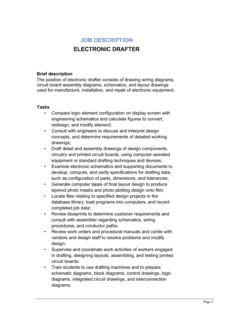
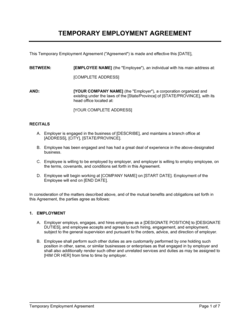
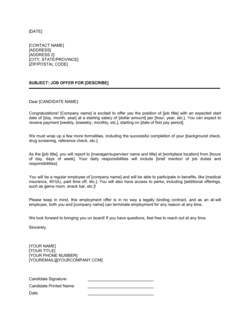
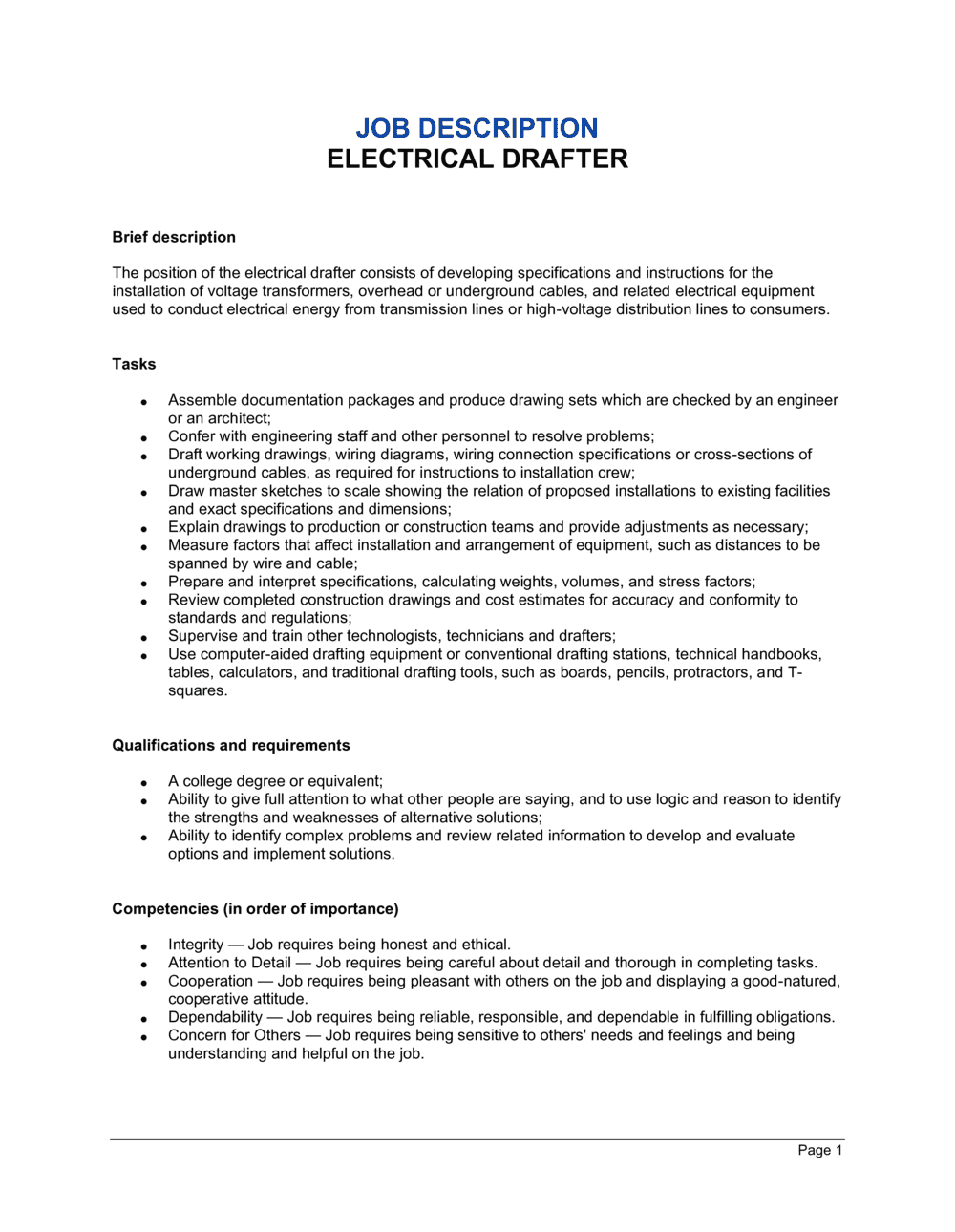
Electrical Drafter Job Description Template

Free Word download • Edit online • Save & share with Drive • Export to PDF

2 pages20–30 min to fillDifficulty: StandardSignature requiredLegal review recommended
Learn more ↓
FreeElectrical Drafter Job Description Template

At a glance

What it is
An Electrical Drafter Job Description is a formal employment document that defines the scope, responsibilities, qualifications, and reporting structure for an electrical drafting role within an engineering, construction, or manufacturing organization. This free Word download gives employers a structured, legally grounded starting point they can edit online and export as PDF for job postings, offer packages, and onboarding records.
When you need it
Use it when hiring or promoting into an electrical drafting position, updating outdated role definitions ahead of a performance cycle, or establishing enforceable duty boundaries before a new hire's first day.
What's inside
Position title and department, reporting structure, core duties and technical responsibilities, required and preferred qualifications, software and CAD tool requirements, physical demands and work environment disclosures, compensation range and classification, and equal employment opportunity statement.

What is an Electrical Drafter Job Description?

An Electrical Drafter Job Description is a formal employment document that defines the duties, qualifications, reporting structure, physical requirements, and compensation terms for an electrical drafting role within an engineering, construction, manufacturing, or utility organization. It establishes the legal and operational baseline for the employment relationship — specifying the essential functions the employee must perform, the technical credentials they must hold, and the conditions under which the work is carried out. When signed by both the employer and the incoming employee, it becomes part of the employment record and supports ADA accommodation analysis, performance management, and, where necessary, termination proceedings.

Why You Need This Document

Hiring an electrical drafter without a clearly documented job description creates compounding legal and operational risk. Without a defined list of essential functions, an employer has no documented baseline for evaluating an ADA accommodation request or defending a performance-based termination — either of which can become costly litigation. Without an explicit FLSA classification and pay range, the employer risks overtime misclassification liability and, in states like Colorado, California, and New York, civil penalties for failing to disclose compensation in job postings. A vague or generic description also attracts mismatched candidates, prolonging the hiring cycle and increasing the risk of a bad fit that becomes an expensive separation. This template gives engineering firms, contractors, and HR teams a legally grounded, field-specific starting point that covers every required clause — from CAD tool requirements and physical demands to EEO language that reflects current federal case law — so the role is defined correctly before the first candidate is screened.

Which variant fits your situation?

If your situation is…Use this template
Hiring a CAD-focused drafter to produce 2D electrical schematicsElectrical Drafter Job Description
Recruiting a senior drafter who also leads a drafting teamElectrical Designer / Lead Drafter Job Description
Engaging a drafter on a fixed project rather than permanent employmentIndependent Contractor Agreement
Filling a temporary or contract-to-hire drafting roleTemporary Employment Contract
Defining a broader electrical engineering role beyond draftingElectrical Engineer Job Description
Onboarding the selected candidate after the position is filledEmployment Contract (At-Will)
Documenting performance expectations for an existing drafterEmployee Performance Review Template

Common mistakes to avoid

❌ Misclassifying the role as FLSA-exempt

Why it matters: Most electrical drafters perform non-managerial, technical production work and do not meet the FLSA administrative or professional exemption tests. Misclassification exposes the employer to up to three years of unpaid overtime plus liquidated damages.

Fix: Apply the DOL's duties test before assigning exempt status — if the drafter primarily executes drawings rather than exercising independent judgment on matters of significance, classify as non-exempt and pay overtime.

❌ Setting degree requirements not justified by the role

Why it matters: Requiring a bachelor's degree for a role that is routinely performed by associate's-degree or certificate holders can constitute disparate-impact discrimination under Title VII and equivalent state laws.

Fix: Use 'Associate's degree or equivalent combination of education and experience' as the minimum, unless you can document why a four-year degree is genuinely necessary.

❌ Omitting the physical demands and work environment clause

Why it matters: Without a documented physical demands baseline, the employer has no reference point for evaluating ADA accommodation requests or defending a fitness-for-duty decision in litigation.

Fix: Complete the physical demands section based on how the role is actually performed, including any site-visit requirements and PPE obligations.

❌ Failing to include a job-description modification clause in the acknowledgment

Why it matters: A job description without explicit language reserving the right to modify duties has been used in litigation as evidence of a contractual commitment to a fixed scope — limiting the employer's ability to adjust the role.

Fix: Include a sentence in the acknowledgment block stating the description is not exhaustive and may be revised at the company's discretion with reasonable notice.

❌ Omitting a pay range in jurisdictions that require one

Why it matters: Colorado, California, New York, and Washington require employers to disclose a salary or hourly range in job postings; non-compliance results in civil penalties and reputational damage.

Fix: Research the pay-transparency requirements in every state where the role will be posted and insert a compliant range before publishing.

❌ Using a generic EEO statement that omits current protected classes

Why it matters: Since Bostock v. Clayton County (2020), sexual orientation and gender identity are federally protected under Title VII. EEO statements that predate this ruling and have not been updated may expose the employer to liability for facially discriminatory job postings.

Fix: Review and update your EEO boilerplate at least annually to incorporate federal case law developments and any new state-level protected characteristics.

The 10 key clauses, explained

Position Title, Department, and FLSA Classification

In plain language: Names the role precisely, places it within the organizational hierarchy, and states whether it is exempt or non-exempt from overtime requirements.

Sample language
Position: Electrical Drafter | Department: [ENGINEERING / DESIGN DEPARTMENT] | Reports To: [LEAD ELECTRICAL ENGINEER / ENGINEERING MANAGER] | FLSA Status: Non-Exempt | Employment Type: [FULL-TIME / PART-TIME]

Common mistake: Classifying an electrical drafter as exempt to avoid overtime liability without meeting the FLSA salary-basis and duties tests — this exposes the employer to back-pay claims and civil penalties.

Position Summary

In plain language: A 2–4 sentence overview of the role's primary function, where it sits in the project workflow, and the level of supervision expected.

Sample language
The Electrical Drafter prepares detailed electrical drawings, schematics, and wiring diagrams from engineering sketches and specifications using [CAD SOFTWARE]. Working under the direction of the [LEAD ENGINEER], this role supports [PROJECT TYPE] projects from design through construction documentation.

Common mistake: Writing a position summary so generic it could describe any technical role — vague summaries make it harder to screen applicants and harder to defend a termination decision based on failure to perform core duties.

Essential Duties and Responsibilities

In plain language: An itemized list of the core tasks the employee must perform, written with enough specificity to support performance management and ADA reasonable-accommodation analysis.

Sample language
Prepare and revise electrical schematics, wiring diagrams, and panel layouts using [AUTOCAD ELECTRICAL / REVIT MEP / OTHER]. Coordinate with engineers to interpret design intent and translate specifications into production-ready drawings. Maintain drawing files and revision logs in accordance with [COMPANY] CAD standards.

Common mistake: Listing every possible task the role might ever perform rather than focusing on essential functions. Overly broad duty lists undermine ADA accommodation analyses and create performance management ambiguity.

Required Qualifications

In plain language: States the minimum education, certification, and experience a candidate must have to be considered — these become the legal baseline for screening decisions.

Sample language
Associate's degree in Electrical Technology, Drafting Technology, or a related field, or equivalent combination of education and experience. Minimum [X] years of experience producing electrical drawings using AutoCAD or AutoCAD Electrical. Demonstrated proficiency with [SPECIFIC STANDARD, e.g., NFPA 79 or NEC] drawing conventions.

Common mistake: Setting education requirements — such as a bachelor's degree — that are not genuinely necessary for the role. Unjustified degree requirements can constitute disparate-impact discrimination under Title VII and equivalent statutes.

Preferred Qualifications

In plain language: Lists additional skills or credentials that are desirable but not required — these inform candidate ranking without becoming a screening barrier.

Sample language
Experience with Revit MEP or EPLAN Electric P8. Familiarity with [INDUSTRY]-specific electrical standards (e.g., IEEE, IEC, or NEC). ASME Y14.5 GD&T knowledge. Prior experience in [INDUSTRY — construction, manufacturing, utilities].

Common mistake: Listing preferred qualifications that are indistinguishable from required ones, effectively raising the bar without the legal scrutiny that required qualifications receive.

Technical Tools and Software Requirements

In plain language: Specifies the CAD platforms, standards, and file formats the employee must be able to use, providing an objective benchmark for skills assessment.

Sample language
Proficiency in AutoCAD Electrical (version [X] or later) required. Working knowledge of [REVIT MEP / EPLAN / MICROSTATION] preferred. Ability to produce drawings in conformance with [COMPANY] layer standards and [ANSI / IEC] symbol libraries.

Common mistake: Naming a specific proprietary software version as a hard requirement when the underlying skill — producing standards-compliant electrical drawings — is what actually matters, unnecessarily filtering qualified candidates.

Physical Demands and Work Environment

In plain language: Discloses the physical requirements and working conditions of the role to support ADA compliance and enable good-faith reasonable-accommodation discussions.

Sample language
Work is performed primarily in an office or design studio environment. Employee is regularly required to sit for extended periods, operate a computer, and review printed drawings. Occasional site visits to [FACILITY / CONSTRUCTION SITE] may require standing, walking on uneven surfaces, and wearing personal protective equipment.

Common mistake: Omitting a physical demands clause entirely. Without it, the employer has no documented baseline for evaluating accommodation requests or defending fitness-for-duty decisions.

Compensation Range and Benefits

In plain language: States the salary band or hourly rate, overtime eligibility, and a reference to the benefits package — increasingly required by pay-transparency laws in several US states.

Sample language
Hourly rate: $[MIN] – $[MAX], commensurate with experience. This position is eligible for overtime pay at 1.5× the regular rate for hours worked in excess of 40 per week. Benefits include [HEALTH / DENTAL / VISION / 401(K)] as described in the Company's standard benefits program.

Common mistake: Omitting compensation information in states with mandatory pay-transparency requirements — Colorado, California, New York, and Washington currently require a salary range in job postings.

Equal Employment Opportunity Statement

In plain language: Affirms the employer's commitment to non-discrimination and, where required, its status as an affirmative action employer.

Sample language
[COMPANY NAME] is an Equal Opportunity Employer. All qualified applicants will receive consideration for employment without regard to race, color, religion, sex, national origin, disability, veteran status, or any other characteristic protected by applicable law.

Common mistake: Using a boilerplate EEO statement that omits protected classes added by recent amendments or state law — for example, failing to include sexual orientation and gender identity, which are protected federally under Bostock v. Clayton County (2020).

Acknowledgment and Signature Block

In plain language: Documents that the employee has received, read, and understood the job description, and acknowledges it may be updated by the employer over time.

Sample language
I acknowledge that I have received and reviewed this job description and understand that it is not an exhaustive list of duties and may be revised at the Company's discretion. Employee Signature: _______________ Date: _______________ | Manager Signature: _______________ Date: _______________

Common mistake: Omitting the employer's right to modify the job description — without this language, courts in some jurisdictions have treated a static job description as a contractual commitment the employer cannot unilaterally change.

How to fill it out

  1. 1

    Enter the position title, department, and reporting line

    Use the exact job title that will appear in the offer letter and payroll system. Specify the department, the direct supervisor's title, and the FLSA classification (exempt or non-exempt).

    💡 Confirm the FLSA classification with your HR or legal team before publishing — misclassification carries 2–3 years of back-pay liability plus penalties.

  2. 2

    Write the position summary in 2–4 sentences

    Describe the role's primary function, its place in the project workflow, and the level of supervision provided. Keep it specific to electrical drafting — not generic engineering support.

    💡 Read the summary aloud as if explaining the role to a candidate in an interview. If it sounds vague, it is.

  3. 3

    List essential duties with enough specificity to support performance management

    Write each duty as an action verb followed by a specific output — 'Prepare and revise electrical schematics using AutoCAD Electrical' rather than 'Assist with drawings.' Limit the list to genuinely essential functions.

    💡 Flag the three to five duties that would account for 80% of the employee's time — those are your essential functions for ADA purposes.

  4. 4

    Set minimum and preferred qualifications separately

    Required qualifications must be genuinely necessary to perform the essential functions. Preferred qualifications are tiebreakers. Keep the two lists clearly labeled and distinct.

    💡 For each required qualification, ask: 'Could the person do the job without this?' If yes, move it to preferred.

  5. 5

    Specify software tools and technical standards

    Name the CAD platforms, file formats, and industry standards (NFPA, NEC, IEC) the role requires. Where a range of tools is acceptable, list the primary tool and note equivalents.

    💡 Avoid locking in a specific software version number — tools update annually and the clause becomes outdated before the hire completes a year.

  6. 6

    Complete the physical demands and work environment section

    Describe the primary work setting, the physical activities regularly required (sitting, keyboard use, site visits), any PPE requirements, and travel expectations.

    💡 Base this on how the role is actually performed today, not an idealized version — courts evaluate accommodation requests against the documented conditions.

  7. 7

    Insert the compensation range and benefits reference

    Enter the salary band or hourly range applicable to this role. Reference the standard benefits program rather than detailing specific plan terms.

    💡 Check whether your state or local jurisdiction requires a pay range in job postings before finalizing this section.

  8. 8

    Obtain signatures before the start date

    Have both the employee and the hiring manager sign the acknowledgment block on or before the first day of employment. File the executed copy in the employee's personnel record.

    💡 A signed job description doubles as documentation that the employee understood their role — this is directly relevant if a performance-based termination is ever challenged.

Frequently asked questions

What does an electrical drafter do?

An electrical drafter produces detailed technical drawings — schematics, wiring diagrams, panel layouts, and single-line diagrams — using CAD software such as AutoCAD Electrical or Revit MEP, working from sketches and specifications provided by electrical engineers. They also maintain drawing files, prepare bills of materials, and update as-built drawings after construction or installation. The role bridges engineering design and physical installation by translating engineering intent into precise, production-ready documentation.

What qualifications should an electrical drafter have?

Most employers require an associate's degree in drafting technology, electrical technology, or a related technical field — or an equivalent combination of certificate training and work experience. Proficiency in AutoCAD Electrical is typically required; experience with Revit MEP, EPLAN, or MicroStation is often preferred. Familiarity with NEC, NFPA 79, IEC, or IEEE drawing standards is expected for roles in construction, manufacturing, or utility environments.

Is an electrical drafter the same as an electrical engineer?

No. Electrical engineers design systems, perform calculations, and take professional responsibility for the design. Electrical drafters translate that design into formal drawings and documentation under the engineer's direction. Drafters typically do not hold a PE (Professional Engineer) license and do not independently approve designs. Some senior drafters carry the title of electrical designer and take on limited design responsibilities, but the two roles remain legally and functionally distinct.

Should an electrical drafter be classified as exempt or non-exempt under the FLSA?

Most electrical drafters should be classified as non-exempt and paid overtime for hours over 40 per week. The FLSA administrative exemption requires that the employee exercise discretion and independent judgment on matters of significance — a standard most drafters who execute drawings under engineering direction do not meet. The learned professional exemption requires an advanced degree, which an associate's credential does not satisfy. Misclassifying a drafter as exempt is one of the most common and costly mistakes in technical-role hiring.

Do I need a separate employment contract if I have a signed job description?

A signed job description documents duties and acknowledgment of role scope, but it is not a substitute for an employment contract. An employment contract covers IP assignment, confidentiality, non-compete and non-solicitation terms, termination notice, severance, and governing law — none of which a job description typically addresses. For any role with access to proprietary designs, client relationships, or trade secrets, a separate employment agreement is strongly recommended.

What CAD software should be specified in an electrical drafter job description?

AutoCAD Electrical is the industry standard for 2D electrical schematic production and should be listed as a required skill for most roles. Revit MEP is increasingly required for building construction and MEP coordination projects. EPLAN Electric P8 is common in industrial and manufacturing environments. Rather than naming a single version number, specify the platform and note that proficiency in equivalent tools may be considered, to avoid filtering out qualified candidates who learned on a slightly different toolset.

Which US states require a pay range in job postings?

As of 2025, Colorado, California, New York, Washington, and several additional states and municipalities require employers to include a salary or hourly range in job postings. Requirements vary — some apply only to employers above a headcount threshold, others to all postings visible to residents of the state. Before publishing an electrical drafter job posting, confirm the requirements in every state where the role will be advertised and insert a compliant pay range.

Can I use the same job description for a contractor and a full-time employee?

No. A job description for an independent contractor must avoid language that establishes employer control over how the work is performed — hours, tools, supervision, and workplace — since those factors are used by the IRS, DOL, and state agencies to determine worker classification. Using a standard employee job description for a contractor relationship increases misclassification risk significantly. Use a separate contractor scope of work tied to an Independent Contractor Agreement instead.

How often should a job description be reviewed and updated?

Review every job description at least annually and whenever the role's duties, reporting structure, or tools change materially. Outdated job descriptions create legal exposure in two directions: they may no longer accurately describe the essential functions used for ADA accommodation analysis, and they may reflect software or standards that are no longer in use. A brief annual review — timed to the performance cycle — keeps the document legally current and operationally accurate.

How this compares to alternatives

vs Electrical Engineer Job Description

An electrical engineer job description covers design responsibility, PE licensure requirements, code compliance ownership, and project engineering duties. An electrical drafter description focuses on CAD production, drawing standards, and execution under engineering supervision. The two roles are often confused but have distinct qualification baselines, FLSA classifications, and compensation bands — conflating them in a single job description creates hiring, pay equity, and classification risk.

vs Employment Contract (At-Will)

A job description defines what the employee does and the qualifications required. An employment contract governs the legal relationship — IP assignment, confidentiality, termination, severance, and governing law. A job description is incorporated by reference into an employment contract but cannot replace it. Any drafter with access to proprietary designs or client data should have both documents executed before their first day.

vs Independent Contractor Agreement

An independent contractor agreement engages a self-employed drafter for a defined project without creating an employment relationship — no benefits, no tax withholding, no overtime. A job description is an employment document and should never be used to define a contractor engagement. Using an employee job description for a contractor arrangement is one of the leading causes of worker misclassification findings by the IRS and DOL.

vs Temporary Employment Contract

A temporary employment contract hires a drafter for a fixed period or project with a defined end date. A standard job description supports ongoing, indefinite employment. For project-based electrical drafting engagements — common in construction — a fixed-term contract paired with this job description provides clearer scope and reduces the risk of implied permanent employment claims when the project concludes.

Industry-specific considerations

Construction and MEP Engineering

Electrical drafters on MEP projects produce coordination drawings across mechanical, electrical, and plumbing systems — requiring BIM coordination skills and Revit MEP alongside AutoCAD.

Manufacturing and Industrial

Manufacturing environments require drafters familiar with NFPA 79 machine electrical standards, panel layout drawings, and tools such as EPLAN Electric P8 for automation-heavy facilities.

Utilities and Energy

Utility-sector drafters produce substation layout drawings, transmission line schematics, and protection relay diagrams to IEEE and NERC standards, often requiring security clearance for critical infrastructure projects.

Engineering and Technical Consulting

Consulting firms need drafters who can move quickly across multiple client project types — commercial, industrial, and infrastructure — and adapt drawing standards to each client's specifications.

Jurisdictional notes

United States

FLSA classification (exempt vs. non-exempt) is the primary federal compliance risk — most electrical drafters qualify as non-exempt. Colorado, California, New York, and Washington require a pay range in job postings. The ADA requires that essential job functions be clearly documented to support accommodation analysis. Since Bostock v. Clayton County (2020), the EEO statement must cover sexual orientation and gender identity.

Canada

Employment standards in each province govern minimum wage, overtime thresholds, and termination notice. Ontario's Pay Transparency Act requires salary range disclosure for publicly advertised roles. Human rights codes in all provinces prohibit discrimination on grounds including disability, sex, and gender identity. Quebec employers must ensure all employment documents used with provincially regulated employees are available in French.

United Kingdom

Job descriptions in the UK should align with the written statement of particulars required under the Employment Rights Act 1996, which must be provided on or before day one. The Equality Act 2010 requires that qualifications be genuinely necessary to avoid indirect discrimination claims. Employers with 250 or more employees are subject to gender pay gap reporting obligations that benefit from clear, consistent role definitions.

European Union

The EU Pay Transparency Directive (2023/970), effective from 2026, requires member states to mandate pay range disclosure in job postings and prohibit salary history inquiries. The EU Transparent and Predictable Working Conditions Directive requires written terms within seven days of hire. GDPR applies to any personal data collected during the recruitment process, including CV screening and application records.

Template vs lawyer — what fits your deal?

PathBest forCostTime
Use the templateHR managers and small business owners posting a standard electrical drafter role in a single stateFree20–30 minutes
Template + legal reviewEmployers hiring in states with pay-transparency laws, multi-state postings, or roles with access to proprietary design IP$150–$400 for an HR attorney or employment law review1–3 days
Custom draftedEngineering firms with unionized workforces, federal contractors with affirmative action obligations, or employers in heavily regulated utility sectors$500–$1,500+1–2 weeks

Glossary

Electrical Drafter
A technical professional who creates detailed electrical drawings, schematics, and wiring diagrams using CAD software under the direction of electrical engineers.
CAD (Computer-Aided Design)
Software used to create precise 2D and 3D technical drawings; AutoCAD and AutoCAD Electrical are the most common tools in electrical drafting.
Single-Line Diagram
A simplified drawing that uses single lines and symbols to represent the components of an electrical power system.
Schematic Drawing
A detailed technical diagram showing the functional relationships between electrical components, including wiring paths and connection points.
Bill of Materials (BOM)
A structured list of all components, materials, and quantities required for an electrical assembly or installation, typically produced alongside drawings.
MEP (Mechanical, Electrical, Plumbing)
The building systems disciplines that are designed and coordinated together on construction projects; electrical drafters frequently support MEP coordination drawings.
As-Built Drawings
Revised drawings produced after construction or installation is complete, reflecting the actual conditions built rather than the original design intent.
FLSA Classification
The US Fair Labor Standards Act category — exempt or non-exempt — that determines whether an employee is entitled to overtime pay for hours worked beyond 40 per week.
Essential Job Functions
The fundamental duties of a position that the employee must be able to perform, with or without reasonable accommodation, as defined by the ADA.
EEO Statement
An Equal Employment Opportunity statement affirming that the employer does not discriminate on the basis of race, sex, disability, age, or other protected characteristics.
Reasonable Accommodation
A modification or adjustment to a job, work environment, or hiring process that enables a qualified person with a disability to perform the essential functions of the role.

Part of your Business Operating System

This document is one of 3,000+ business & legal templates included in Business in a Box.

  • Fill-in-the-blanks — ready in minutes
  • 100% customizable Word document
  • Compatible with all office suites
  • Export to PDF and share electronically

Create your document in 3 simple steps.

From template to signed document — all inside one Business Operating System.
1
Download or open template

Access over 3,000+ business and legal templates for any business task, project or initiative.

2
Edit and fill in the blanks with AI

Customize your ready-made business document template and save it in the cloud.

3
Save, Share, Send, Sign

Share your files and folders with your team. Create a space of seamless collaboration.

Save time, save money, and create top-quality documents.

★★★★★

"Fantastic value! I'm not sure how I'd do without it. It's worth its weight in gold and paid back for itself many times."

Managing Director · Mall Farm
Robert Whalley
Managing Director, Mall Farm Proprietary Limited
★★★★★

"I have been using Business in a Box for years. It has been the most useful source of templates I have encountered. I recommend it to anyone."

Business Owner · 4+ years
Dr Michael John Freestone
Business Owner
★★★★★

"It has been a life saver so many times I have lost count. Business in a Box has saved me so much time and as you know, time is money."

Owner · Upstate Web
David G. Moore Jr.
Owner, Upstate Web

Run your business with a system — not scattered tools

Stop downloading documents. Start operating with clarity. Business in a Box gives you the Business Operating System used by over 250,000 companies worldwide to structure, run, and grow their business.

Free Forever Plan · No credit card required