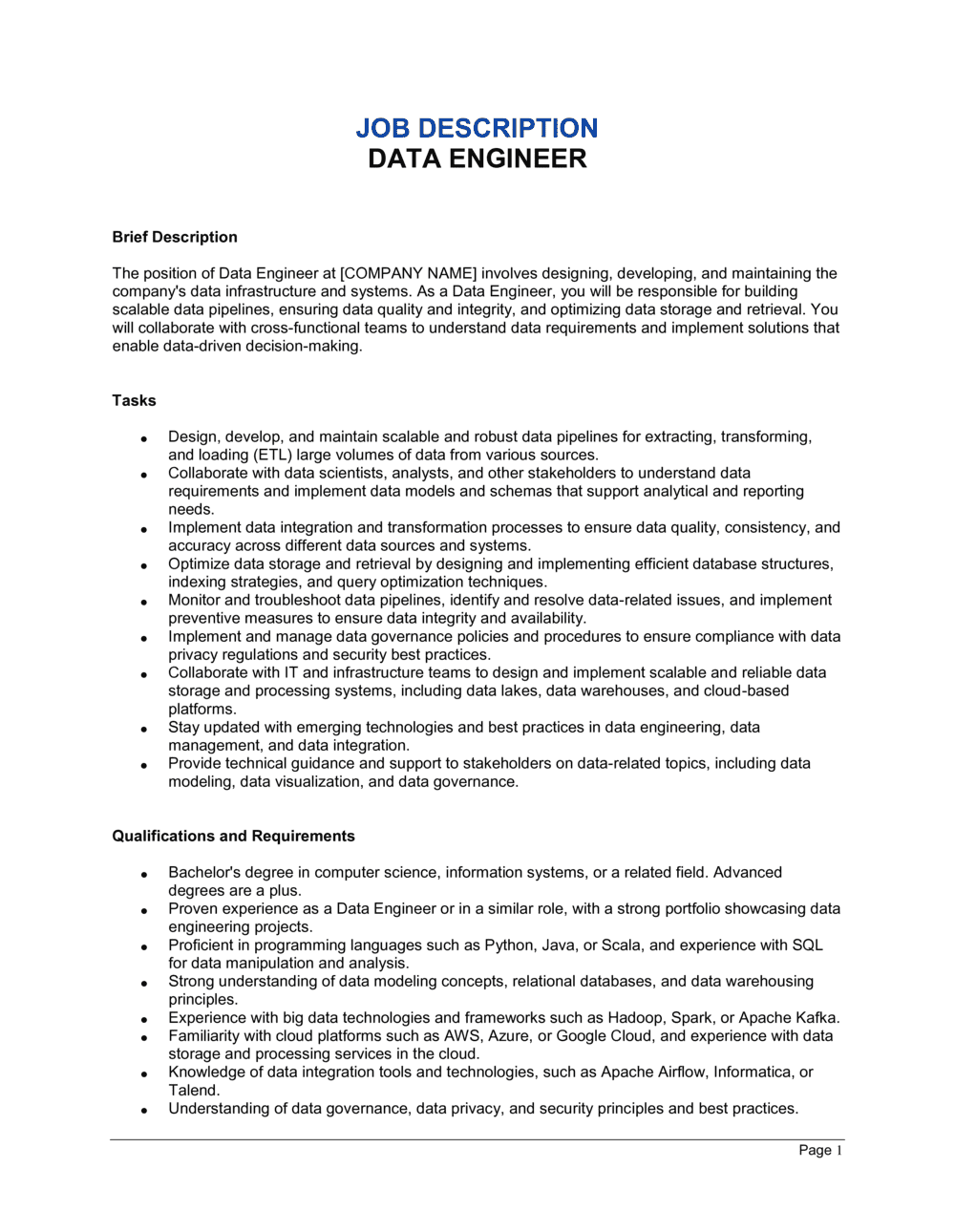
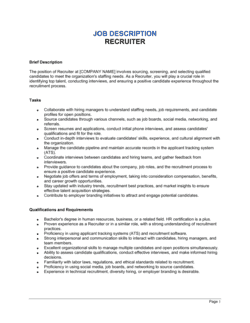
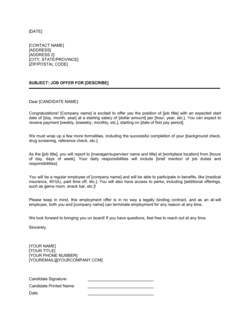
Data Engineer Job Description Template

Free Word download β€’ Edit online β€’ Save & share with Drive β€’ Export to PDF

2 pagesβ€’25–30 min to fillβ€’Difficulty: Standardβ€’Signature requiredβ€’Legal review recommended
Learn more ↓
FreeData Engineer Job Description Template

At a glance

What it is
A Data Engineer Job Description is a binding document that defines the scope of a data engineering role β€” covering core responsibilities, required technical skills, reporting structure, compensation, confidentiality, IP assignment, and at-will or notice-period terms. This free Word download gives you a structured, legally grounded starting point you can edit online and export as PDF for internal approval, job postings, or pre-employment onboarding packets.
When you need it
Use it when opening a new data engineering position, formalizing an existing informal role, or updating an outdated description that no longer matches the employee's actual duties. It is also required when attaching a job description as a schedule to an employment contract or offer letter.
What's inside
Role title and reporting structure, a detailed duties clause covering data pipeline development and maintenance, required and preferred technical qualifications, compensation and classification, confidentiality and IP assignment obligations, and termination terms with governing law.

What is a Data Engineer Job Description?

A Data Engineer Job Description is a formal document that defines the full scope of a data engineering role β€” specifying core duties, required and preferred technical qualifications, compensation and classification, work location and on-call obligations, intellectual property assignment, confidentiality requirements, and at-will or notice-period terms. Unlike a casual job posting, a properly structured data engineer job description functions as a binding schedule to an employment contract, establishing enforceable obligations around data asset ownership, pipeline IP, and confidentiality from the first day of employment. It covers the specific technical stack the engineer will work with β€” ETL pipelines, cloud data warehouses, orchestration tools, and streaming infrastructure β€” alongside the legal terms that protect the company's data assets and competitive position.

Why You Need This Document

Without a formal, signed data engineer job description, four problems materialize quickly. First, IP ownership over pipelines, data models, and proprietary algorithms becomes contested β€” especially for remote engineers working on personal machines. Second, vague or undocumented duties make performance management and termination decisions legally vulnerable, since you lack a baseline against which to measure. Third, omitting a salary range in pay-transparency jurisdictions exposes the company to regulatory fines before the hire even begins. Fourth, confidentiality obligations covering sensitive data infrastructure and customer data have no contractual teeth if they were never set out in writing and signed. A well-drafted, executed data engineer job description closes all four gaps β€” it protects your data assets, grounds your performance management process, and gives every candidate a clear, accurate picture of the role before they accept. This template gives you a legally grounded starting point you can customize for any seniority level and publish or attach to an employment contract in under 30 minutes.

Which variant fits your situation?

If your situation is…Use this template
Hiring a junior or entry-level data engineer with 0–2 years of experienceJunior Data Engineer Job Description
Hiring a senior or staff-level engineer leading data platform architectureSenior Data Engineer Job Description
Engaging a data engineer as an independent contractor rather than an employeeIndependent Contractor Agreement
Attaching role scope to a full employment contract for a permanent hireEmployment Contract (At-Will)
Hiring a data engineer for a fixed-term project or system migrationFixed-Term Employment Contract
Defining a combined data engineer and analyst hybrid roleData Analyst Job Description
Hiring a machine learning engineer whose scope overlaps data infrastructureMachine Learning Engineer Job Description

Common mistakes to avoid

❌ Omitting the salary range in pay-transparency jurisdictions

Why it matters: Colorado, New York, California, and Washington require salary ranges in job postings. Non-compliance triggers regulatory fines up to $10,000 per violation and attracts discrimination claims.

Fix: Add a salary band to the compensation clause before publishing. If the range varies by location, state each applicable band by geography.

❌ Using 'permanent position' or 'long-term role' language

Why it matters: Courts in several US states and Canadian provinces have interpreted such phrases as implied tenure, undermining at-will or fixed-notice-period termination rights.

Fix: Replace tenure-implying language with 'full-time, ongoing role' and include an explicit at-will or notice-period clause in the document.

❌ Requiring years of experience that exceed a technology's age

Why it matters: Requiring '5+ years of dbt experience' when dbt reached mainstream adoption in 2020 is facially unreasonable and exposes the company to age-discrimination and EEO complaints.

Fix: Audit every required qualification against the technology's public release date. Replace year-based requirements with competency-based descriptors where the tool is relatively new.

❌ Restricting IP assignment to work done on company premises

Why it matters: Data engineers frequently work remotely on personal machines. Work product created outside the office falls outside a premises-limited clause, giving the engineer potential ownership claims over pipelines and models.

Fix: Draft IP assignment to cover all work product created 'in connection with Employee's role or using Company resources,' regardless of device or location.

❌ Blending required and preferred qualifications into one list

Why it matters: Undifferentiated qualification lists make screening inconsistent, create implicit bias in hiring decisions, and weaken the company's defense in EEO challenges.

Fix: Use two clearly labeled sections β€” 'Required Qualifications' and 'Preferred Qualifications' β€” with distinct formatting so reviewers apply them as intended.

❌ Failing to specify on-call obligations

Why it matters: Data engineers who discover on-call rotation expectations post-hire report significantly higher dissatisfaction and resign at roughly twice the rate of those who were informed upfront.

Fix: Add a work-schedule clause that states on-call frequency, expected response time, and any associated compensation or time-off-in-lieu arrangement.

The 10 key clauses, explained

Role title, level, and reporting structure

In plain language: States the exact job title, seniority level, and who the data engineer reports to β€” ensuring the role is unambiguous in org charts and performance reviews.

Sample language
[COMPANY NAME] is hiring a [JUNIOR / SENIOR / STAFF] Data Engineer who will report directly to the [VP OF ENGINEERING / HEAD OF DATA / CTO] and collaborate with the [DATA SCIENCE / ANALYTICS / PRODUCT] teams.

Common mistake: Using a generic title like 'Engineer II' without a function-specific label β€” this creates classification ambiguity for payroll, benefits eligibility, and future promotion criteria.

Core duties and responsibilities

In plain language: Enumerates the specific technical and operational tasks the engineer is expected to perform, from pipeline development to on-call incident response.

Sample language
Employee shall design, build, and maintain scalable data pipelines using [TECH STACK]; monitor pipeline health and respond to SLA breaches within [X] hours; collaborate with analysts to model and document data schemas; and contribute to data governance initiatives.

Common mistake: Listing responsibilities so broadly ('other duties as assigned') that performance management becomes impossible β€” every task becomes contestable.

Required technical qualifications

In plain language: Specifies the minimum technical skills, tools, programming languages, and years of experience the candidate must possess to be eligible for the role.

Sample language
Minimum qualifications: [X] years of professional data engineering experience; proficiency in Python and SQL; hands-on experience with [AIRFLOW / DBT / SPARK / KAFKA] and a cloud data warehouse ([SNOWFLAKE / BIGQUERY / REDSHIFT]); Bachelor's degree in Computer Science, Engineering, or a related field, or equivalent experience.

Common mistake: Setting qualifications so high β€” 5+ years of experience for a 3-year-old technology β€” that the posting violates equal employment opportunity standards and eliminates all realistic candidates.

Preferred qualifications and differentiators

In plain language: Lists skills and experiences that are advantageous but not mandatory, giving candidates a clear sense of what distinguishes a strong applicant from a minimally qualified one.

Sample language
Preferred qualifications include experience with streaming data architectures (Kafka, Kinesis), familiarity with ML feature engineering pipelines, and demonstrated contributions to open-source data tooling.

Common mistake: Blurring required and preferred qualifications into a single undifferentiated list β€” this makes screening inconsistent and exposes hiring decisions to bias claims.

Compensation, classification, and benefits

In plain language: States the salary band or hourly rate, FLSA exempt or non-exempt classification, pay frequency, and references to the broader benefits program.

Sample language
Salary range: $[X] to $[X] annually, commensurate with experience. This is a full-time, exempt position paid bi-weekly. Employee is eligible for the Company's standard benefits program, including [HEALTH / DENTAL / VISION / 401(K)], as amended from time to time.

Common mistake: Omitting the salary range in jurisdictions (Colorado, New York, California, Washington) that legally require pay transparency in job postings β€” exposing the company to regulatory fines.

Work location and schedule

In plain language: Defines whether the role is on-site, hybrid, or fully remote, specifies core working hours or time zone requirements, and addresses on-call expectations.

Sample language
This position is [REMOTE / HYBRID β€” X days on-site per week / ON-SITE] at [LOCATION]. Employee is expected to be available during core hours of [X AM–X PM [TIMEZONE]] and to participate in an on-call rotation no more than [X WEEKS] per quarter.

Common mistake: Failing to specify on-call expectations in the job description β€” engineers who discover on-call obligations post-hire are significantly more likely to leave within 12 months.

Intellectual property assignment

In plain language: Assigns to the employer all code, documentation, data models, and other work product created by the employee in connection with the role, including work done on personal devices.

Sample language
All work product, code, data models, algorithms, and documentation developed by Employee in the course of employment, or using Company resources, are the sole property of [COMPANY NAME] and are hereby irrevocably assigned to the Company.

Common mistake: Limiting IP assignment to work performed 'on company premises' β€” data engineers frequently work remotely or on personal machines, placing work product outside the clause's reach.

Confidentiality and data handling obligations

In plain language: Prohibits the employee from disclosing or misusing the company's data assets, architecture, customer data, and trade secrets during and after employment.

Sample language
Employee shall not, during or after employment, disclose or use any Confidential Information β€” including data infrastructure architecture, customer data, proprietary algorithms, and financial data β€” without prior written consent from [COMPANY NAME].

Common mistake: Failing to reference applicable data privacy laws (GDPR, CCPA) in the confidentiality clause for roles that handle personally identifiable information β€” creating compliance gaps.

At-will status or notice-period terms

In plain language: States whether employment is at-will (US default) or governed by a notice period, and confirms that the job description does not create a contract for a specific duration.

Sample language
Employment in this role is at-will, meaning either [COMPANY NAME] or Employee may terminate the relationship at any time, for any lawful reason, with or without notice. Nothing in this job description constitutes a contract of employment for a fixed term.

Common mistake: Using language like 'permanent position' or 'long-term role' in the duties section β€” courts in several jurisdictions have treated such language as implied tenure, undermining at-will status.

Governing law and integration clause

In plain language: Specifies which jurisdiction's law governs the document and confirms that this description supersedes prior informal role definitions or verbal representations.

Sample language
This job description is governed by the laws of [STATE / PROVINCE / COUNTRY]. It constitutes the complete description of the role and supersedes all prior verbal or written representations regarding the position's scope or requirements.

Common mistake: Choosing a governing law based on the company's headquarters when the employee works in a different state or country β€” several jurisdictions apply local employment law regardless of what the document states.

How to fill it out

  1. 1

    Define the role title and seniority level

    Enter the exact job title, seniority band (junior, mid, senior, staff, principal), and the name or title of the direct manager. Confirm the title matches your compensation benchmarking data and org chart.

    πŸ’‘ Standardize titles across your engineering ladder before publishing β€” inconsistent titling inflates salary expectations and complicates future promotion conversations.

  2. 2

    Write specific, measurable core duties

    List 6–10 concrete responsibilities tied to observable outputs: 'design and maintain ETL pipelines processing 500M+ daily events' rather than 'work with data.' Tie each duty to a deliverable or system.

    πŸ’‘ Duties that map directly to your performance review criteria make mid-year and annual reviews faster and less subjective.

  3. 3

    Separate required from preferred qualifications

    Create two distinct lists: minimum qualifications a candidate must have to be considered, and preferred qualifications that distinguish a strong applicant. Be specific about tools, languages, and years of experience.

    πŸ’‘ Keep required qualifications to the genuine minimum β€” each additional requirement cuts your qualified candidate pool by roughly 20–30%.

  4. 4

    Enter the compensation range and classification

    Add the salary band, confirm FLSA exempt or non-exempt classification for US hires, state the pay frequency, and reference the benefits program by category rather than specific plan details.

    πŸ’‘ Check state and local pay transparency laws before publishing β€” Colorado, New York, California, and Washington all require a salary range in job postings as of 2025.

  5. 5

    Specify work location and on-call terms

    State clearly whether the role is remote, hybrid, or on-site. If hybrid, specify days per week. If the role includes on-call rotation, describe frequency and expected response time.

    πŸ’‘ On-call expectations are among the top three reasons data engineers cite for rejecting offers β€” being specific upfront attracts candidates who are comfortable with the requirement.

  6. 6

    Review and tailor the IP assignment clause

    Confirm the IP assignment covers all work product regardless of device or location. For roles involving ML models or proprietary data pipelines, broaden the definition to include training data and derived algorithms.

    πŸ’‘ In California, Labor Code Β§2870 limits employer IP claims to work that relates to the company's business β€” have counsel review the clause for California-based hires.

  7. 7

    Confirm governing law matches the employee's work location

    Set the governing jurisdiction to the state, province, or country where the employee will actually work β€” not where the company is incorporated. Cross-border hires may require jurisdiction-specific addenda.

    πŸ’‘ For fully remote roles where the employee works in a state different from your HQ, consult employment counsel before finalizing the governing law clause.

  8. 8

    Execute before the employee's first day

    Both parties must sign before the start date. Post-start signatures raise a fresh-consideration problem in common-law jurisdictions, potentially voiding IP assignment and confidentiality obligations.

    πŸ’‘ Use Business in a Box eSign to timestamp execution and store the fully-executed copy in BIB Drive for immediate retrieval during audits or disputes.

Frequently asked questions

What is a data engineer job description?

A data engineer job description is a formal document that defines the responsibilities, required technical qualifications, compensation, work conditions, and legal terms for a data engineering role. Beyond serving as a job posting, it functions as a binding schedule to an employment contract, establishing the scope of duties, IP ownership, and confidentiality obligations that govern the employment relationship.

What qualifications should a data engineer job description require?

Minimum qualifications typically include proficiency in Python and SQL, hands-on experience with at least one major orchestration tool (Airflow, Prefect, or Dagster), and experience with a cloud data warehouse such as Snowflake, BigQuery, or Redshift. Years-of-experience requirements should be calibrated to the actual seniority level β€” requiring more years than the relevant technology has existed creates legal and sourcing problems.

Is a job description a legally binding contract?

A job description is not a contract of employment on its own, but it can create binding obligations when incorporated by reference into an employment agreement or offer letter. Clauses covering IP assignment, confidentiality, and at-will status carry legal weight once signed. Courts have also found implied contractual terms in job descriptions that use tenure-implying language like 'permanent role.'

Should a data engineer job description include a salary range?

In many US jurisdictions β€” including Colorado, New York, California, and Washington β€” including a salary range in job postings is legally required as of 2024–2025. Even where not mandated, pay transparency reduces application drop-off and shortens time-to-hire by filtering for candidates whose expectations align with the budget before the first interview.

How does a job description differ from an employment contract?

A job description defines the role's scope, duties, and qualifications β€” the 'what' of the position. An employment contract governs the full legal relationship, including compensation, termination, non-compete, and severance terms. In practice, job descriptions are attached as Schedule A to employment contracts so the duties clause is incorporated by reference and can be updated without amending the main contract.

Are data engineers typically exempt from overtime under the FLSA?

In most cases, yes. Data engineers whose primary duty is applying systems analysis techniques and who earn at least $684 per week typically qualify as exempt under the FLSA computer employee exemption. However, exemption is a fact-specific analysis β€” misclassification exposes employers to significant back-pay liability. Confirm classification with employment counsel before finalizing the job description.

What IP ownership terms should a data engineer job description include?

The IP assignment clause should broadly cover all code, data models, algorithms, documentation, and derived data products created in connection with the role β€” regardless of whether the work was performed on company equipment or personal devices. For roles involving ML pipelines or proprietary data assets, the definition should explicitly include training data and model weights. California employers must comply with Labor Code Β§2870, which limits employer IP claims for off-duty work unrelated to the company's business.

How often should a data engineer job description be updated?

Review the description at least annually and whenever the role's technology stack, reporting structure, or core responsibilities change materially. An outdated description creates performance management gaps β€” if an engineer's actual work diverges from the documented duties, you lose the evidentiary basis for discipline or termination decisions. Have the employee re-acknowledge the updated description with a dated signature when material changes are made.

Do I need a lawyer to finalize a data engineer job description?

For a standard domestic hire in a US state or Canadian province without complex IP requirements, a high-quality template is typically sufficient. Engage employment counsel when the hire involves multi-jurisdiction remote work, sensitive proprietary data or AI-related IP, or a senior-level role where non-compete or enhanced confidentiality terms are critical. A 30–60 minute template review typically costs $150–$400 and is worthwhile for any hire with significant data infrastructure access.

How this compares to alternatives

vs Employment Contract

An employment contract governs the full legal relationship β€” compensation, termination, severance, non-compete, and benefits. A job description defines the role's scope and duties only. The two documents work together: the job description is typically attached as Schedule A to the employment contract and incorporated by reference, so duties can be updated without amending the main agreement.

vs Independent Contractor Agreement

An independent contractor agreement engages a self-employed data engineer for project-based work with no employment entitlements β€” no benefits, no overtime, no tax withholding. A job description is used for employee hires. Misclassifying a data engineer as a contractor when they work under employer control triggers back taxes, penalties, and benefit liability.

vs Offer Letter

An offer letter summarizes the role and compensation to secure acceptance. It is not a comprehensive legal document and lacks standalone IP assignment, confidentiality, and detailed duties clauses. A job description paired with an employment contract provides the legal depth an offer letter alone cannot offer.

vs Data Analyst Job Description

A data analyst job description focuses on querying, visualizing, and interpreting existing data sets. A data engineer job description covers infrastructure-layer responsibilities β€” building and maintaining the pipelines, warehouses, and systems that analysts depend on. The roles occasionally overlap in smaller organizations, but their core technical requirements and IP exposure differ materially.

Industry-specific considerations

SaaS / Technology

Emphasis on cloud-native stack requirements (Snowflake, dbt, Airflow), feature engineering pipelines for ML products, and IP assignment covering proprietary algorithm development.

Financial Services

Enhanced confidentiality clauses covering trading data and client financials, SOX compliance obligations referenced in duties, and strict data access and audit logging requirements.

Healthcare / MedTech

HIPAA compliance obligations incorporated into confidentiality terms, de-identification pipeline responsibilities, and data handling restrictions tied to covered entity agreements.

Retail / E-commerce

Real-time streaming pipeline requirements for inventory and pricing data, PCI-DSS data handling obligations, and cross-functional collaboration with merchandising and demand-planning teams.

Jurisdictional notes

United States

At-will employment is the default in 49 states; avoid tenure-implying language that courts could interpret as implied-term employment. The FLSA computer employee exemption typically covers data engineers earning at least $684/week whose primary duty involves systems analysis β€” confirm classification before finalizing. Colorado, New York, California, and Washington require salary ranges in job postings. California's Labor Code Β§2870 limits IP assignment for off-duty work unrelated to the company's business.

Canada

At-will employment has no equivalent in Canada; replace the at-will clause with a notice-period clause meeting provincial Employment Standards Act minimums. Ontario common-law notice can reach one month per year of service for long-tenured engineers. Quebec requires job documents to be available in French for provincially regulated employers. Confidentiality clauses referencing PIPEDA or provincial privacy legislation (Quebec Law 25) are advisable for roles handling personal data.

United Kingdom

Employers must provide a written statement of employment particulars, including a job description, on or before the employee's first day. Statutory minimum notice is one week per year of service after two years, capped at 12 weeks. Post-employment IP assignment clauses are enforceable but must be clearly drafted to survive challenge under the Patents Act 1977. IR35 rules apply when engaging data engineers through personal service companies.

European Union

The EU Transparent and Predictable Working Conditions Directive requires written employment terms within seven days of hire. GDPR obligations must be incorporated into the confidentiality and data handling clause for any data engineer processing personal data β€” failure to do so creates both employment and regulatory exposure. Post-employment non-compete clauses typically require paid garden leave or financial compensation to be enforceable, with requirements varying by member state.

Template vs lawyer β€” what fits your deal?

PathBest forCostTime
Use the templateStandard domestic data engineering hires in a single US state or Canadian province without complex IP requirementsFree20–30 minutes
Template + legal reviewRemote hires spanning multiple states, roles involving sensitive proprietary data pipelines, or senior engineers with significant data infrastructure access$150–$4001–2 days
Custom draftedAI/ML-heavy roles with contested IP, cross-border hires in regulated industries, or staff-level engineers with access to core data assets and competitive trade secrets$800–$2,500+1–2 weeks

Glossary

Data Pipeline
An automated sequence of steps that ingests, transforms, and loads data from source systems into a destination β€” such as a data warehouse or analytics platform.
ETL / ELT
Extract, Transform, Load (or Extract, Load, Transform) β€” the process of moving and reshaping data from operational systems into analytical stores.
Data Warehouse
A centralized repository optimized for analytical queries, storing structured data from multiple source systems β€” common examples include Snowflake, BigQuery, and Redshift.
Exempt vs. Non-Exempt Classification
A US FLSA distinction determining overtime eligibility; data engineers typically qualify as exempt under the computer employee or highly compensated exemptions if they meet salary and duties tests.
IP Assignment
A clause transferring ownership of code, models, documentation, and other work product created by the employee to the employer during the employment relationship.
At-Will Employment
Employment that either party may end at any time for any lawful reason without advance notice β€” the default standard in most US states.
Data Governance
The set of policies, standards, and processes that define how data is collected, stored, accessed, and used across an organization.
SLA (Service Level Agreement)
A documented commitment to pipeline uptime, latency thresholds, or data freshness targets that the data engineer is responsible for meeting.
Confidential Information
Non-public business information β€” including data architecture, customer data, proprietary algorithms, and financial data β€” that the employee is prohibited from disclosing.
Probationary Period
A defined initial employment period β€” typically 30 to 90 days β€” during which performance is evaluated and termination formalities may be reduced.

Part of your Business Operating System

This document is one of 3,000+ business & legal templates included in Business in a Box.

  • Fill-in-the-blanks β€” ready in minutes
  • 100% customizable Word document
  • Compatible with all office suites
  • Export to PDF and share electronically

Create your document in 3 simple steps.

From template to signed document β€” all inside one Business Operating System.
1
Download or open template

Access over 3,000+ business and legal templates for any business task, project or initiative.

2
Edit and fill in the blanks with AI

Customize your ready-made business document template and save it in the cloud.

3
Save, Share, Send, Sign

Share your files and folders with your team. Create a space of seamless collaboration.

Save time, save money, and create top-quality documents.

β˜…β˜…β˜…β˜…β˜…

"Fantastic value! I'm not sure how I'd do without it. It's worth its weight in gold and paid back for itself many times."

Managing Director Β· Mall Farm
Robert Whalley
Managing Director, Mall Farm Proprietary Limited
β˜…β˜…β˜…β˜…β˜…

"I have been using Business in a Box for years. It has been the most useful source of templates I have encountered. I recommend it to anyone."

Business Owner Β· 4+ years
Dr Michael John Freestone
Business Owner
β˜…β˜…β˜…β˜…β˜…

"It has been a life saver so many times I have lost count. Business in a Box has saved me so much time and as you know, time is money."

Owner Β· Upstate Web
David G. Moore Jr.
Owner, Upstate Web

Run your business with a system β€” not scattered tools

Stop downloading documents. Start operating with clarity. Business in a Box gives you the Business Operating System used by over 250,000 companies worldwide to structure, run, and grow their business.

Start freeΒ Β·Β No credit card required