Electronic Drafter Job Description Template

Free Word download β€’ Edit online β€’ Save & share with Drive β€’ Export to PDF

3 pagesβ€’20–30 min to fillβ€’Difficulty: Standardβ€’Signature requiredβ€’Legal review recommended
Learn more ↓
FreeElectronic Drafter Job Description Template

At a glance

What it is
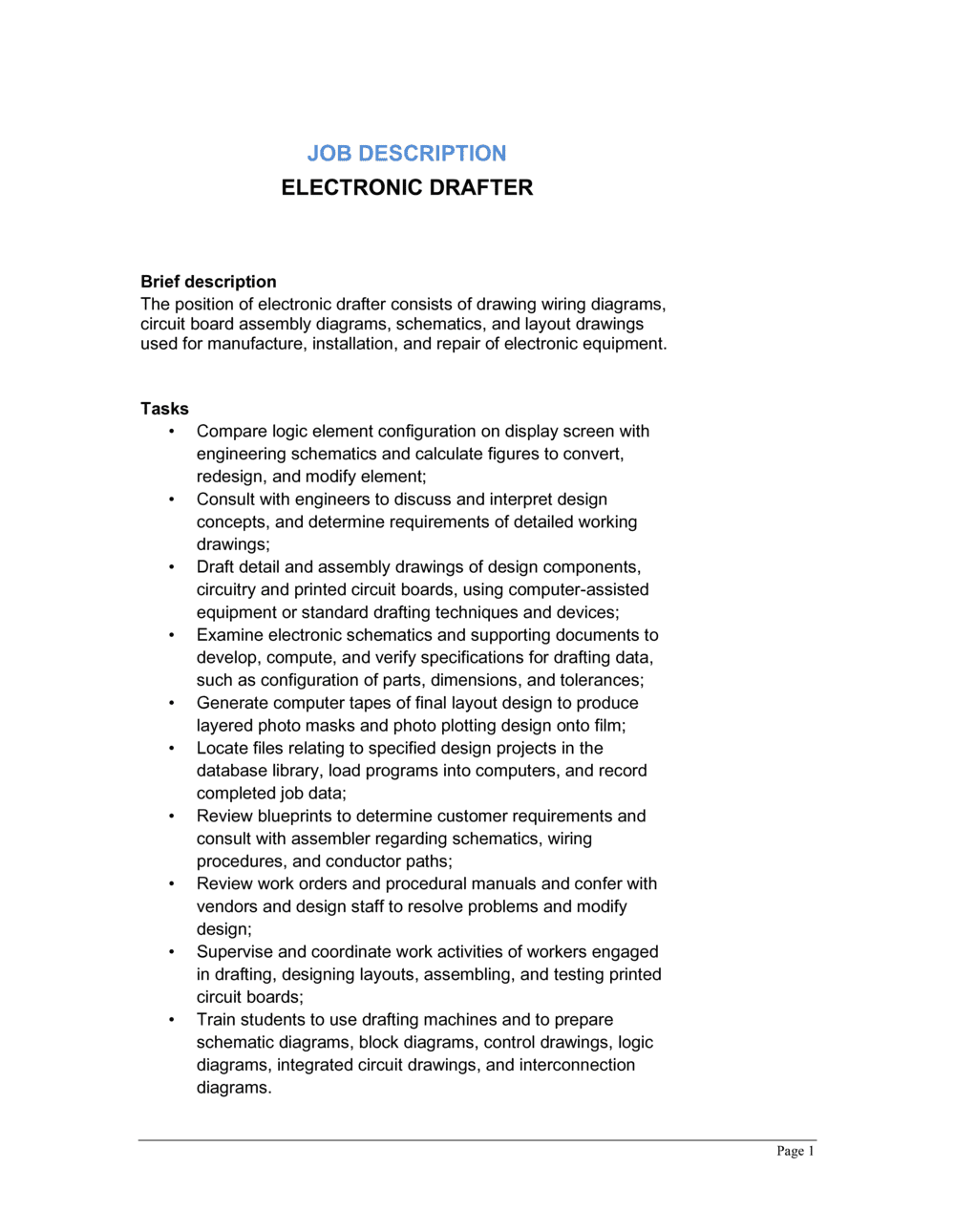
An Electronic Drafter Job Description is a formal employment document that defines the duties, qualifications, reporting structure, compensation, and binding terms of engagement for an electronic drafter role. This free Word download gives employers a structured, legally grounded starting point they can edit online and export as PDF to attach to an offer letter or employment contract.
When you need it
Use it whenever you are recruiting, hiring, or reclassifying an electronic drafter β€” whether for a permanent position, a contract engagement, or a staffing agency placement. It is also essential when updating an existing role following a reorganization or technology change such as a transition to new CAD software.
What's inside
Role summary and reporting structure, core duties and technical responsibilities, required and preferred qualifications, software and equipment proficiencies, compensation and benefits overview, employment type and schedule, confidentiality and IP obligations, and equal opportunity and compliance language.

What is an Electronic Drafter Job Description?

An Electronic Drafter Job Description is a formal employment document that defines the duties, technical qualifications, reporting structure, compensation classification, and binding obligations β€” including confidentiality and IP assignment β€” for an electronic drafter position. It goes beyond a simple job posting: when executed with a dated acknowledgment signature from both the employer and the incoming employee, it creates enforceable obligations regarding work product ownership and proprietary information. Electronic drafters produce the schematics, wiring diagrams, PCB layout drawings, and bills of materials that translate an engineer's design intent into production-ready technical documentation, making this a role with significant IP exposure that warrants a carefully structured document from day one.

Why You Need This Document

Hiring an electronic drafter without a properly structured, signed job description leaves the employer exposed on multiple fronts simultaneously. Without an IP assignment clause, drawings and schematics created by the drafter β€” including work done remotely or on a personal workstation β€” may not legally belong to the company. Without a documented qualifications and duties section, performance management and termination-for-cause decisions become legally vulnerable challenges. Without accurate FLSA classification language, wage-and-hour liability accumulates silently for every overtime hour worked by a misclassified non-exempt employee. In jurisdictions with pay transparency requirements, a job description without a stated salary range can result in posting non-compliance and regulatory penalties. This template gives you a legally grounded, jurisdiction-aware starting point that protects your technical IP, supports defensible employment decisions, and signals to qualified candidates that your organization operates with professional rigor.

Which variant fits your situation?

If your situation is…Use this template
Hiring a drafter focused exclusively on electrical schematics and wiring diagramsElectrical Drafter Job Description
Engaging a drafter on a fixed-term project rather than permanent employmentIndependent Contractor Agreement
Hiring a senior drafter who will also supervise junior staffSenior Drafter Job Description
Filling a mechanical rather than electronic drafting roleMechanical Drafter Job Description
Defining a broad CAD technician role across multiple disciplinesCAD Technician Job Description
Creating a job description for an architectural or structural drafterArchitectural Drafter Job Description
Needing a full employment contract to accompany the job descriptionEmployment Contract

Common mistakes to avoid

❌ Omitting FLSA classification

Why it matters: Without a stated exemption status, employers risk misclassifying a non-exempt drafter as exempt. Misclassification triggers back pay for unpaid overtime β€” potentially covering a multi-year lookback period plus liquidated damages.

Fix: State whether the role is exempt or non-exempt under the FLSA (or provincial/national equivalent) and confirm the classification meets the applicable salary level and duties tests before posting.

❌ No IP assignment clause for remote workers

Why it matters: Drafters working from home or using personal devices may create technical drawings outside the scope of a premises-limited IP clause, leaving ownership of critical design files legally ambiguous.

Fix: Draft the IP assignment to cover all work product created in connection with the company's business, regardless of location, device, or time of day.

❌ Setting qualification requirements that exceed genuine job needs

Why it matters: Requiring a four-year degree for a role that can be performed competently with an associate's degree plus relevant experience can expose the employer to disparate-impact discrimination claims and unnecessarily narrows the applicant pool.

Fix: Audit each qualification requirement against actual role tasks. Where experience can substitute for a credential, say so explicitly β€” for example, 'Associate's degree or equivalent combination of education and 2+ years of CAD experience.'

❌ Using a generic EEO statement that omits locally protected classes

Why it matters: Several states, provinces, and municipalities have expanded protected categories beyond federal minimums β€” including sexual orientation, gender identity, and source of income. An outdated boilerplate statement may not satisfy local posting requirements.

Fix: Review the EEO statement against the protected classes in the state, province, or municipality where the role will be posted and update it accordingly before each new posting.

❌ Signing the job description after the employee's start date

Why it matters: In common-law jurisdictions, an employee who has already started work has provided no new consideration for restrictions signed post-hire β€” making confidentiality and IP assignment clauses potentially unenforceable.

Fix: Present the signed job description at the offer stage, before the first day of work. If a post-start signature is unavoidable, provide documented additional compensation as fresh consideration.

❌ Omitting physical and environmental requirements

Why it matters: Without a documented physical requirements section, the employer lacks a baseline against which to evaluate ADA accommodation requests and may face challenges in workers' compensation proceedings when job-related injuries occur.

Fix: Document all physical demands honestly β€” sustained computer use, occasional facility visits, lifting limits β€” and include standard reasonable-accommodation language.

The 10 key clauses, explained

Role summary and job title

In plain language: Identifies the position by its official title, states the department it sits within, and provides a two-to-three sentence summary of the role's primary purpose.

Sample language
The Electronic Drafter reports to the [ENGINEERING MANAGER / LEAD ENGINEER] within the [DEPARTMENT NAME] and is responsible for producing accurate electronic schematics, wiring diagrams, and related technical documentation in support of [COMPANY NAME]'s product development and manufacturing operations.

Common mistake: Using an informal working title instead of the official payroll title. Discrepancies between the job description and payroll records complicate classification audits and workers' compensation filings.

Core duties and responsibilities

In plain language: Lists the primary tasks the drafter is expected to perform, specific enough to support performance management but flexible enough to accommodate reasonable task changes.

Sample language
Duties include: (a) preparing electronic schematics, PCB layout drawings, and wiring diagrams using [CAD SOFTWARE]; (b) maintaining revision control of all technical drawings in accordance with [COMPANY NAME]'s document management system; (c) collaborating with engineers to interpret design specifications and translate them into production-ready documentation; and (d) preparing and updating bills of materials.

Common mistake: Over-specifying duties to the point where any task change requires a formal contract amendment, or listing duties so broadly that performance management becomes impossible to justify.

Required qualifications and education

In plain language: States the minimum education, certification, and experience thresholds that a candidate must meet to be considered for the role.

Sample language
Candidates must hold an Associate's degree or diploma in Electronics Technology, Drafting Technology, or a related field, or equivalent combination of education and [X] years of directly relevant experience. Certification from the American Design Drafting Association (ADDA) or equivalent is preferred.

Common mistake: Setting qualification thresholds that exceed what is genuinely necessary for the role. Overly restrictive requirements can expose the employer to disparate-impact discrimination claims under Title VII in the US and equivalent statutes in other jurisdictions.

Technical skills and software proficiencies

In plain language: Enumerates the specific CAD platforms, ECAD tools, and technical competencies the drafter must demonstrate.

Sample language
Required proficiencies: [CAD SOFTWARE β€” e.g., AutoCAD, AutoCAD Electrical, or equivalent]; working knowledge of electronic schematic standards (IPC-2581, IPC-7351); familiarity with PCB layout using [ECAD TOOL β€” e.g., Altium Designer, Eagle, or OrCAD]; and ability to read and interpret engineering drawings, GD&T symbols, and industry standards.

Common mistake: Listing every conceivable software tool as 'required' rather than distinguishing must-have proficiencies from preferred ones. Conflating the two narrows the candidate pool unnecessarily and can deter qualified candidates who lack only minor peripheral tools.

Reporting structure and supervision

In plain language: Defines who the drafter reports to directly, any dotted-line reporting relationships, and whether the role involves supervising other drafters or technicians.

Sample language
The Electronic Drafter reports directly to the [TITLE] and may receive day-to-day task direction from [PROJECT LEAD / SENIOR ENGINEER]. This role [does / does not] include supervisory responsibility over junior drafting staff or technicians.

Common mistake: Omitting supervisory scope entirely. If the drafter occasionally supervises others, failing to note it can affect overtime exemption classification under the FLSA and equivalent statutes.

Compensation, classification, and schedule

In plain language: States the base pay range or rate, FLSA exemption status, standard working hours, and any shift or overtime expectations.

Sample language
Compensation: $[MIN] – $[MAX] per [hour / year], [non-exempt / exempt] under the Fair Labor Standards Act. Standard schedule: [X] hours per week, [Monday–Friday / shift schedule]. Overtime may be required during peak project periods in accordance with applicable law.

Common mistake: Omitting the FLSA classification. If the role is non-exempt and overtime expectations are unstated, the employer may face wage-and-hour liability when overtime is required.

Confidentiality and intellectual property assignment

In plain language: Requires the drafter to keep proprietary technical information confidential and assigns all work product β€” drawings, models, schematics β€” created during employment to the employer.

Sample language
All technical drawings, schematics, models, and documentation created by Employee in the course of employment, or relating to [COMPANY NAME]'s products or processes, are the sole property of [COMPANY NAME] and are hereby irrevocably assigned to [COMPANY NAME]. Employee shall not disclose Confidential Information β€” including proprietary design data, customer specifications, and manufacturing processes β€” during or after employment.

Common mistake: No IP assignment clause, or one limited to work performed on company premises. Drafters working remotely or using personal equipment may produce drawings outside the clause's reach if the language isn't drafted broadly.

Physical and environmental requirements

In plain language: Documents the physical demands of the role β€” prolonged computer use, occasional site visits, lifting requirements β€” which supports ADA compliance and workers' compensation accuracy.

Sample language
This role requires prolonged periods of seated computer work (6–8 hours per day). Occasional visits to manufacturing or production facilities may require standing, walking on uneven surfaces, and wearing PPE. Ability to lift up to [X] lbs may be required. Reasonable accommodations will be provided for qualified individuals with disabilities.

Common mistake: Omitting physical requirements entirely. Without this clause, ADA accommodation requests and workers' compensation claims lack a documented baseline, creating liability exposure.

Equal opportunity and compliance statement

In plain language: Confirms the employer's commitment to non-discrimination in hiring and employment, satisfying legal posting requirements in most jurisdictions.

Sample language
[COMPANY NAME] is an equal opportunity employer. All qualified applicants will receive consideration for employment without regard to race, color, religion, sex, national origin, disability, veteran status, age, or any other characteristic protected by applicable law.

Common mistake: Using a generic EEO statement that does not reflect local protected classes. Several states and provinces have added protected categories β€” such as sexual orientation, gender identity, or criminal history β€” that must be included in compliant job postings.

Acknowledgment and signature block

In plain language: Records the employee's agreement that they have read, understood, and accept the job description as a condition of employment, with dated signatures from both parties.

Sample language
By signing below, Employee acknowledges receipt and understanding of this Job Description and agrees to perform the duties described herein as a condition of employment. This document does not constitute a contract of employment for a definite term. Employee Signature: ___________________ Date: ___________ Authorized Employer Representative: ___________________ Date: ___________

Common mistake: Including the job description as part of the offer letter without a separate acknowledgment signature. Without a signed acknowledgment, the employee can later claim they were unaware of specific duties or IP obligations.

How to fill it out

  1. 1

    Enter the employer's legal entity name and department

    Use the company's full registered legal name β€” not a trade name β€” and specify the exact department the drafter will join. These details must match payroll records and any associated employment contract.

    πŸ’‘ Cross-reference your corporate registry filing to confirm the exact legal entity name before the document is signed.

  2. 2

    Define the job title and reporting line

    Enter the official payroll job title and the title of the direct supervisor. If there are dotted-line reporting relationships, document them here to avoid ambiguity during performance reviews.

    πŸ’‘ Align the job title with your compensation benchmarking source β€” mismatches between internal titles and market survey categories distort pay analysis.

  3. 3

    List core duties in order of time allocation

    Write five to eight primary duties, ordered from most to least time-intensive. Use active verbs and include specific deliverables β€” 'prepare PCB layout drawings using Altium Designer' rather than 'handle drafting tasks'.

    πŸ’‘ Duties listed in the job description become the baseline for performance reviews and termination-for-cause justifications β€” specificity protects the employer.

  4. 4

    Set qualification thresholds that match genuine job requirements

    Enter the minimum education, certification, and years-of-experience requirements. Separate required qualifications from preferred ones using distinct headers or labeling.

    πŸ’‘ If a bachelor's degree is not genuinely necessary for competent performance, do not list it as required β€” overly restrictive requirements can trigger disparate-impact claims.

  5. 5

    Specify CAD and ECAD software requirements

    Name the specific software platforms the drafter will use β€” AutoCAD Electrical, Altium Designer, OrCAD, Eagle β€” and distinguish must-have from nice-to-have proficiencies.

    πŸ’‘ Including software version numbers signals to candidates that the role is current and helps filter for relevant experience without a lengthy phone screen.

  6. 6

    Complete the compensation and classification fields

    Enter the salary or hourly pay range, FLSA exemption status (exempt or non-exempt), standard weekly hours, and any shift or overtime expectations.

    πŸ’‘ In states with pay transparency laws β€” Colorado, California, New York, Washington β€” a salary range is legally required in job postings. Include it regardless of jurisdiction to attract stronger candidates.

  7. 7

    Review and tailor the confidentiality and IP assignment clause

    Confirm the clause covers all work product β€” including drawings produced on personal devices or outside standard work hours β€” and that 'Confidential Information' is defined to include design data, customer specifications, and process documentation.

    πŸ’‘ Have legal counsel review the IP clause before use if the drafter will be working with proprietary circuit designs or trade-secret manufacturing processes.

  8. 8

    Obtain signed acknowledgment before the first day of work

    Present the job description to the candidate at the offer stage and collect a dated signature from both the employee and an authorized company representative before the start date.

    πŸ’‘ In common-law jurisdictions, rights-restricting clauses signed after the start date may require fresh consideration to be enforceable β€” execute before day one.

Frequently asked questions

What does an electronic drafter do?

An electronic drafter creates detailed technical drawings, schematics, wiring diagrams, and PCB layout documentation for electronic components and systems. They translate engineers' specifications into precise, production-ready drawings using CAD and ECAD software, maintain revision control of technical files, and prepare bills of materials. The role sits at the intersection of engineering and manufacturing, ensuring that design intent is communicated accurately to fabrication and assembly teams.

What qualifications does an electronic drafter need?

Most employers require an associate's degree or technical diploma in electronics technology, drafting technology, or a related field β€” or an equivalent combination of education and hands-on experience. Proficiency in CAD software such as AutoCAD Electrical and at least one ECAD platform (Altium Designer, Eagle, or OrCAD) is typically required. Certification from the American Design Drafting Association (ADDA) or equivalent strengthens candidacy but is rarely mandatory.

Is an electronic drafter job description a legally binding document?

A job description that includes an acknowledgment and signature block, along with IP assignment and confidentiality clauses, creates enforceable obligations when properly executed by both parties. However, it is not a substitute for a full employment contract β€” it typically does not cover termination notice, severance, or dispute resolution. In most jurisdictions, a signed job description should accompany, not replace, a formal employment agreement.

What software should an electronic drafter know?

The core tools are AutoCAD and AutoCAD Electrical for general and electrical drafting, plus at least one ECAD platform β€” Altium Designer, Eagle (now Fusion 360 Electronics), or OrCAD β€” for schematic capture and PCB layout. Familiarity with document management systems such as SolidWorks PDM or Windchill is increasingly expected. Knowledge of IPC standards for electronic assembly drawings is a strong differentiator.

What is the difference between an electrical drafter and an electronic drafter?

An electrical drafter typically works on power distribution systems, industrial wiring, and high-voltage infrastructure β€” primarily in construction and utilities. An electronic drafter focuses on circuit-level schematics, PCB layouts, and component-level documentation for consumer electronics, instrumentation, or embedded systems. The skills overlap in areas like wiring diagrams, but the software tools, standards, and industry contexts differ significantly.

Do I need a lawyer to prepare an electronic drafter job description?

For a straightforward domestic hire using this template, legal review is not strictly required β€” but it is recommended when the role involves sensitive IP, the drafter will work remotely across state or national lines, or the employer operates in a jurisdiction with complex employment posting requirements. A one-hour review by an employment attorney typically costs $200–$400 and is worthwhile for any role with significant IP or confidentiality exposure.

What pay range should I list for an electronic drafter?

According to US Bureau of Labor Statistics data, electronic drafters earn a median annual wage in the range of $55,000–$70,000, with variation by industry, geography, and seniority. Aerospace, defense, and semiconductor employers typically pay at the higher end. In jurisdictions with pay transparency laws β€” Colorado, California, New York, and Washington β€” including a salary range in the posting is legally required regardless of where candidates are sourced.

Can I use the same job description for a contractor and an employee?

No. An employment-style job description with IP assignment, benefits references, and at-will language should not be used for an independent contractor β€” it reinforces an employment relationship that may trigger worker misclassification liability. For contractors, use a separate Independent Contractor Agreement that defines the scope of services, fee structure, and IP ownership without creating indicia of employment.

How often should an electronic drafter job description be updated?

Review the job description at least annually and whenever there is a significant change in software tools, reporting structure, project scope, or applicable employment law. In practice, the rapid evolution of ECAD software and PCB design standards means technical skills sections often require updates every 12–18 months to remain accurate and competitive in the labor market.

How this compares to alternatives

vs Mechanical drafter job description

A mechanical drafter job description focuses on GD&T, SolidWorks or CATIA proficiency, and structural/assembly drawings. An electronic drafter job description centers on schematic capture, PCB layout, ECAD tools, and IPC standards. Both share similar employment structure and IP clauses, but the technical skills and software requirements are largely non-overlapping. Use the mechanical version for roles supporting product enclosures, hardware assemblies, or structural components.

vs Employment contract

A job description defines the role's duties, qualifications, and technical requirements. An employment contract governs the full legal relationship β€” termination notice, severance, dispute resolution, and non-compete terms. A job description should be attached to or referenced in the employment contract, not used as a substitute for it. For any hire with significant IP or restrictive covenant considerations, both documents are required.

vs Independent contractor agreement

An independent contractor agreement engages a self-employed drafter for project-based deliverables without creating an employment relationship. A job description establishes an employment arrangement with payroll, benefits, and tax-withholding obligations. Using an employment-style job description for a contractor engagement reinforces misclassification risk and can trigger back tax and benefit liability with the IRS or equivalent tax authority.

vs Architectural drafter job description

An architectural drafter job description specifies AutoCAD Architecture or Revit proficiency, building codes, and construction document standards. An electronic drafter job description requires ECAD tools, circuit schematic standards, and PCB layout experience. While the document structure is similar, the technical content, industry standards, and target candidate profiles are entirely distinct β€” use the correct variant to avoid attracting unqualified applicants.

Industry-specific considerations

Aerospace and defense

ITAR compliance obligations and security clearance requirements are frequently embedded in the job description, alongside adherence to MIL-SPEC and AS9100 drawing standards.

Electronics manufacturing

IPC-2581 and IPC-7351 schematic and PCB standards are specified as required competencies, and revision control within PLM systems such as Windchill or Arena is a core duty.

Medical devices

FDA 21 CFR Part 11-compliant document control and ISO 13485 design history file requirements are incorporated into the duties and confidentiality clauses.

Energy and utilities

NFPA 70 (NEC) and IEEE drawing standards apply, and the physical requirements clause typically includes outdoor site visits and PPE obligations at generation or substation facilities.

Jurisdictional notes

United States

FLSA classification (exempt vs. non-exempt) must be accurate β€” electronic drafters are typically non-exempt unless they meet the FLSA's administrative or professional exemption tests. Colorado, California, New York, and Washington require a salary range in job postings. Several states ban salary history inquiries. For roles at defense contractors, ITAR export-control language and security clearance eligibility requirements should be added to the qualifications section.

Canada

Employment Standards Acts in each province govern minimum wages, overtime thresholds, and termination notice β€” the job description must align with the applicable provincial statute. Quebec employers must post job descriptions in French under the Charter of the French Language. IP assignment clauses are enforceable in Canada but must be included in a signed document at or before hire; post-start assignments require fresh consideration.

United Kingdom

Employers must provide a written statement of employment particulars on or before the first day of work under the Employment Rights Act 1996 β€” a signed job description with core terms can satisfy part of this obligation when accompanied by a compliant written statement. The Equality Act 2010 prohibits discriminatory qualification requirements; ensure that educational thresholds are genuinely justified by the role. Working time regulations cap the standard working week at 48 hours unless the employee opts out in writing.

European Union

The EU Pay Transparency Directive (effective 2026) will require employers to disclose salary ranges in job postings across member states. GDPR applies to the processing of candidate personal data collected during the hiring process β€” a compliant privacy notice should accompany any application process. Works council consultation may be required before posting a new role in Germany, France, and the Netherlands. Post-employment non-compete and IP clauses typically require compensating the employee financially to be enforceable.

Template vs lawyer β€” what fits your deal?

PathBest forCostTime
Use the templateSmall businesses and HR teams making a standard domestic electronic drafter hire in a single state or provinceFree20–30 minutes
Template + legal reviewRoles involving sensitive proprietary circuit designs, remote workers across multiple jurisdictions, or employers in states with complex pay transparency or EEO requirements$200–$400 (1-hour employment attorney review)1–3 days
Custom draftedDefense or aerospace employers with ITAR obligations, medical device companies with FDA documentation requirements, or multinational employers hiring across several jurisdictions simultaneously$800–$2,500+1–2 weeks

Glossary

Electronic Drafter
A technical professional who creates detailed drawings, schematics, and diagrams of electronic components and systems using CAD or similar software.
CAD (Computer-Aided Design)
Software used to create precise two- and three-dimensional technical drawings and models, replacing manual drafting in most modern engineering environments.
Schematic Diagram
A standardized drawing that represents the components and interconnections of an electronic circuit using symbolic notation rather than physical layout.
Bill of Materials (BOM)
A structured list of all components, sub-assemblies, and raw materials required to manufacture or assemble an electronic product, often prepared by the drafter.
Redline
Markup annotations added to a technical drawing β€” typically in red β€” to indicate required revisions or corrections before a drawing is finalized.
GD&T (Geometric Dimensioning and Tolerancing)
A system for defining and communicating engineering tolerances on drawings to ensure parts are manufactured within acceptable limits.
ECAD (Electronic Computer-Aided Design)
A specialized subset of CAD software focused on electronic circuit design and PCB layout, including tools such as Altium Designer, Eagle, and OrCAD.
PCB (Printed Circuit Board)
A board that mechanically supports and electrically connects electronic components using conductive tracks, pads, and other features etched onto a substrate.
Revision Control
The process of systematically managing and documenting changes to technical drawings to ensure all stakeholders are working from the current approved version.
IP Assignment
A contractual provision transferring ownership of work product β€” including all drawings and technical documentation created during employment β€” from the employee to the employer.
At-Will Employment
A US employment arrangement in which either the employer or employee may end the relationship at any time for any lawful reason without advance notice.

Part of your Business Operating System

This document is one of 3,000+ business & legal templates included in Business in a Box.

  • Fill-in-the-blanks β€” ready in minutes
  • 100% customizable Word document
  • Compatible with all office suites
  • Export to PDF and share electronically

Create your document in 3 simple steps.

From template to signed document β€” all inside one Business Operating System.
1
Download or open template

Access over 3,000+ business and legal templates for any business task, project or initiative.

2
Edit and fill in the blanks with AI

Customize your ready-made business document template and save it in the cloud.

3
Save, Share, Send, Sign

Share your files and folders with your team. Create a space of seamless collaboration.

Save time, save money, and create top-quality documents.

β˜…β˜…β˜…β˜…β˜…

"Fantastic value! I'm not sure how I'd do without it. It's worth its weight in gold and paid back for itself many times."

Managing Director Β· Mall Farm
Robert Whalley
Managing Director, Mall Farm Proprietary Limited
β˜…β˜…β˜…β˜…β˜…

"I have been using Business in a Box for years. It has been the most useful source of templates I have encountered. I recommend it to anyone."

Business Owner Β· 4+ years
Dr Michael John Freestone
Business Owner
β˜…β˜…β˜…β˜…β˜…

"It has been a life saver so many times I have lost count. Business in a Box has saved me so much time and as you know, time is money."

Owner Β· Upstate Web
David G. Moore Jr.
Owner, Upstate Web

Run your business with a system β€” not scattered tools

Stop downloading documents. Start operating with clarity. Business in a Box gives you the Business Operating System used by over 250,000 companies worldwide to structure, run, and grow their business.

Free Forever PlanΒ Β·Β No credit card required