Dropshipping Agreement Template

Free Word download β€’ Edit online β€’ Save & share with Drive β€’ Export to PDF

4 pagesβ€’25–35 min to fillβ€’Difficulty: Complexβ€’Signature requiredβ€’Legal review recommended
Learn more ↓
FreeDropshipping Agreement Template

At a glance

What it is
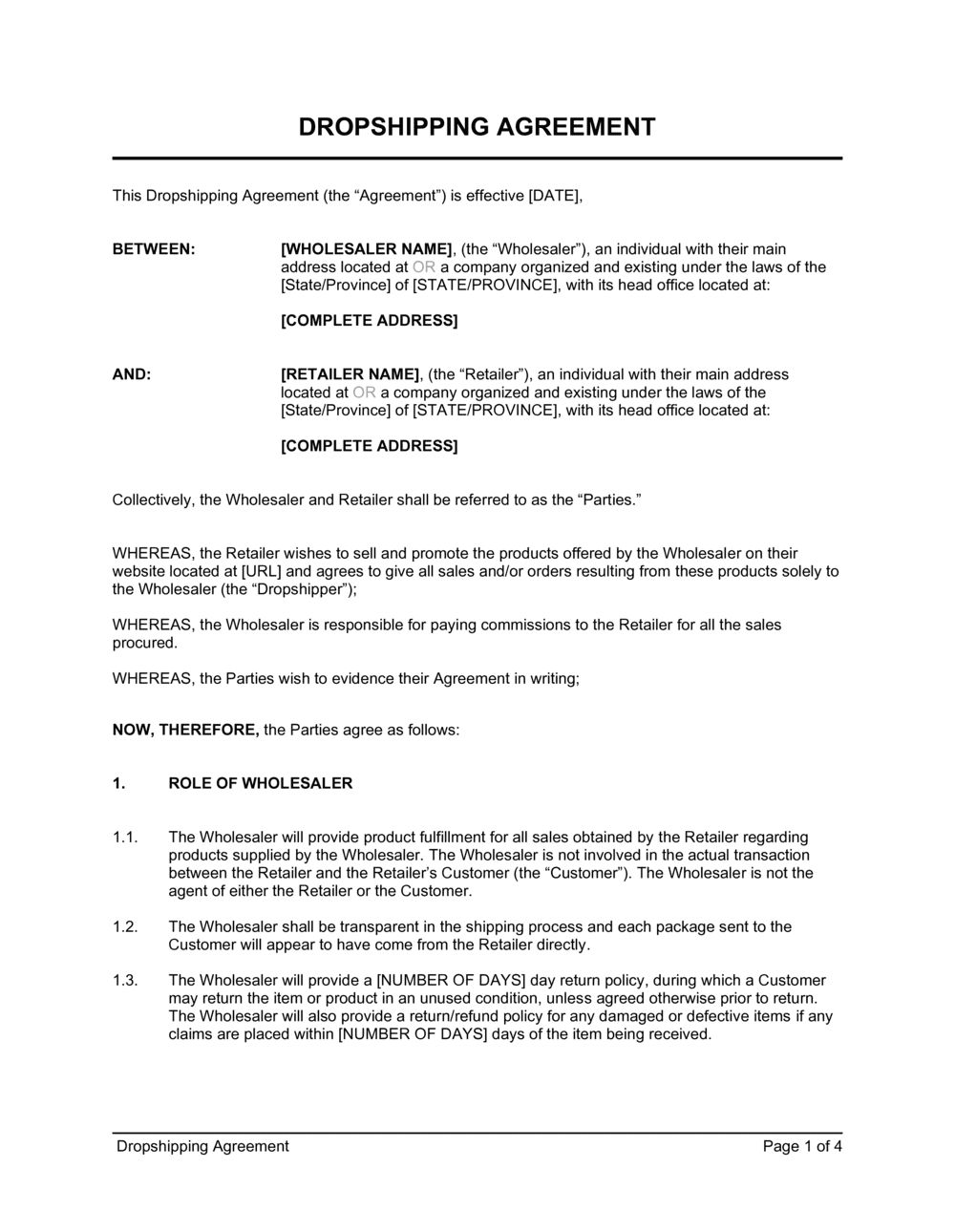
A Dropshipping Agreement is a legally binding contract between an e-commerce retailer and a supplier under which the supplier stores inventory and ships products directly to the retailer's customers on the retailer's behalf. This free Word download covers product catalog rights, wholesale pricing, fulfillment timelines, return handling, branding requirements, chargeback liability, and termination β€” all in a single document you can edit online and export as PDF.
When you need it
Use it before you list any supplier's products for sale β€” whether you are onboarding a new dropship vendor, formalizing an existing arrangement, or expanding an existing catalog relationship to include direct fulfillment. Operating without a signed agreement exposes you to unfulfilled orders, disputed chargebacks, and no contractual remedy when a supplier ships late, ships wrong, or goes dark.
What's inside
Product catalog and SKU authorization, wholesale pricing and payment terms, fulfillment SLAs and tracking obligations, returns and refund procedures, branding and packaging requirements, chargeback and dispute allocation, confidentiality, IP ownership, liability limits, and termination provisions.

What is a Dropshipping Agreement?

A Dropshipping Agreement is a legally binding contract between an e-commerce retailer and a supplier under which the supplier stores inventory and ships products directly to the retailer's customers on the retailer's behalf. It defines which products the retailer is authorized to sell, the wholesale price for each SKU, how quickly orders must be shipped, how returns and refunds are handled, what branding appears on the packaging, and who bears financial responsibility when a chargeback occurs. Unlike a general wholesale contract, a dropshipping agreement is built around the specific operational and liability dynamics of a fulfillment model in which the retailer never touches the physical goods.

Why You Need This Document

Without a signed dropshipping agreement, you are operating on trust alone β€” and trust does not hold up when a supplier misses the holiday shipping window, ships the wrong variant to 200 customers, or quietly starts marketing directly to your buyers using order data you provided. Every day you list a supplier's products without a contract, you are absorbing their fulfillment failures through your payment processor, your customer reviews, and your platform metrics. A chargeback caused by a supplier's non-delivery is still your liability until a contract says otherwise. A supplier who has access to your customer list has no legal obligation not to use it until a contract prohibits it. This template closes those gaps in under an hour β€” establishing enforceable SLAs, chargeback indemnities, data-use restrictions, and a wind-down process that protects you whether the relationship lasts one year or ten.

Which variant fits your situation?

If your situation is…Use this template
Retailer sourcing from an overseas manufacturer who will ship internationallyInternational Dropshipping Agreement
Supplier wants a single master agreement covering multiple retail clientsMaster Vendor Agreement
Retailer purchasing wholesale inventory to fulfill orders themselvesWholesale Agreement
Brand licensing products to a third party for retail sale and fulfillmentProduct Distribution Agreement
Retailer engaging a 3PL warehouse rather than a product supplierWarehousing and Fulfillment Agreement
Short-term or trial arrangement before committing to a full supplier relationshipLetter of Intent (Vendor)
Supplier providing branded private-label products for resalePrivate Label Agreement

Common mistakes to avoid

❌ Operating without a signed agreement

Why it matters: Without a contract, there is no enforceable SLA, no chargeback indemnity, and no data-use restriction β€” leaving the retailer with full liability for every supplier failure.

Fix: Execute a signed dropshipping agreement before listing any products. A signed agreement takes 20 minutes with this template; recovering from an unfulfilled holiday order season takes months.

❌ No Schedule A with itemized SKUs and prices

Why it matters: Treating the product catalog and wholesale pricing as informally agreed means the supplier can change prices or discontinue products with no notice and no contractual remedy for the retailer.

Fix: Attach a signed Schedule A at execution and include a written amendment process for any catalog or pricing changes, with a minimum notice period of 14 days.

❌ Fulfillment SLA with no breach consequence

Why it matters: A supplier who ships late faces no downside if the contract only states an SLA without a penalty, credit, or termination right β€” making the obligation unenforceable in practice.

Fix: Add a breach threshold (e.g., more than 5% of orders late in a calendar month) that triggers a specific remedy β€” an order credit, price reduction, or termination right.

❌ Supplier data-use restriction is omitted

Why it matters: A supplier with access to customer names, addresses, and purchase history can build a direct-to-consumer channel targeting your own customers β€” there is no contractual prohibition without an explicit clause.

Fix: Include a data-use restriction limiting the supplier to using customer data solely for fulfillment, with an obligation to delete all customer data within 90 days of termination.

❌ Chargeback liability assigned entirely to the retailer

Why it matters: Payment processors hold the retailer financially responsible by default. Without a supplier indemnity clause, the retailer absorbs chargebacks caused by supplier non-delivery, wrong items, or late shipment.

Fix: Draft a chargeback liability allocation clause that requires the supplier to reimburse the retailer for chargebacks caused by supplier-side failures, with a 15-day reimbursement deadline and documentation requirement.

❌ No wind-down clause for orders in the pipeline at termination

Why it matters: A supplier who stops fulfilling immediately upon termination notice leaves the retailer holding paid customer orders with no contractual obligation to complete them.

Fix: Include a wind-down clause requiring the supplier to fulfill all orders placed before the effective termination date, regardless of who initiates termination.

The 10 key clauses, explained

Product catalog and SKU authorization

In plain language: Defines exactly which products the retailer is authorized to list and sell, and how catalog changes β€” additions, discontinuations, or price updates β€” are communicated.

Sample language
Supplier grants Retailer a non-exclusive right to market and sell the products listed in Schedule A ('Authorized Products'). Supplier shall provide [14] days' written notice of any SKU discontinuation, price change, or availability restriction.

Common mistake: Failing to attach a Schedule A at signing and treating the catalog as implicitly agreed. Without a signed schedule, disputes over which products are in scope have no documentary anchor.

Wholesale pricing and payment terms

In plain language: States the per-unit wholesale price for each SKU, the invoicing cycle, and the payment due date β€” typically net 15 or net 30 from shipment.

Sample language
Retailer shall pay Supplier the wholesale prices set out in Schedule A. Supplier shall invoice Retailer within [2] business days of shipment. Payment is due [Net 30] from the invoice date. Late payments accrue interest at [1.5]% per month.

Common mistake: Agreeing on pricing verbally without referencing a schedule. Supplier-initiated price increases then become unilateral, with no contractual basis to dispute them.

Fulfillment SLA and tracking obligations

In plain language: Sets the maximum time from order placement to shipment, the required carrier and tracking methods, and the consequences of missing the SLA.

Sample language
Supplier shall ship each order within [1] business day of receiving a confirmed order from Retailer. Supplier shall upload a valid tracking number to Retailer's order management system within [4] hours of shipment. Failure to meet the SLA on more than [5]% of orders in any calendar month constitutes a material breach.

Common mistake: Setting a fulfillment SLA with no defined remedy for breach. Without a consequence β€” such as a credit or termination right β€” the SLA is unenforceable in practice.

Returns, refunds, and RMA procedure

In plain language: Specifies which return reasons the supplier accepts, the RMA process, who pays return shipping, and the refund or replacement timeline.

Sample language
Supplier shall accept returns for defective, damaged, or incorrect items within [30] days of delivery. Retailer shall initiate an RMA request via [SYSTEM / EMAIL]. Supplier shall issue a replacement or full credit within [5] business days of receiving the returned item. Return shipping costs for supplier-error returns are borne by Supplier.

Common mistake: Mirroring the retailer's customer-facing return policy in the supplier agreement without accounting for the additional transit time and RMA lead time β€” resulting in the retailer absorbing refund costs before the supplier has processed the return.

Branding and packaging requirements

In plain language: Defines whether shipments are white-labeled in the retailer's branding, what inserts or branded materials the supplier must include, and what supplier branding is prohibited on the outer packaging.

Sample language
Supplier shall ship all orders using Retailer-supplied packing slips and, where provided, branded outer packaging. Supplier shall not include any reference to Supplier's business name, website, or pricing on any packaging, packing slip, or insert. Retailer grants Supplier a limited license to use Retailer's logo solely for fulfillment purposes.

Common mistake: No branding clause at all. A supplier shipping in their own branded box with their own contact details effectively steals the retailer's customer relationship and enables the customer to buy direct at a lower price.

Chargeback and dispute liability allocation

In plain language: Allocates financial responsibility for chargebacks between retailer and supplier based on the root cause β€” supplier error (wrong item, non-delivery) versus customer fraud or retailer error.

Sample language
Chargebacks arising from Supplier's failure to fulfill an order, shipment of an incorrect or defective item, or delivery outside the confirmed shipping window shall be the financial responsibility of Supplier. Chargebacks arising from customer fraud or Retailer's error shall be borne by Retailer. Supplier shall reimburse Retailer for Supplier-caused chargebacks within [15] days of written notice with supporting documentation.

Common mistake: Assigning all chargeback liability to the retailer by default, which is the payment processor's default position β€” without a supplier indemnity clause, the retailer absorbs losses for supplier failures they cannot control.

Intellectual property license and restrictions

In plain language: Grants each party a limited license to use the other's IP (product images, trademarks, logos) only for the purposes of the agreement, and prohibits any use beyond that scope.

Sample language
Supplier grants Retailer a limited, non-exclusive, revocable license to use Supplier's product images, descriptions, and trademarks solely to market and sell Authorized Products during the term. Retailer grants Supplier a limited license to use Retailer's branding materials solely for order fulfillment. All IP remains the sole property of the granting party.

Common mistake: No restriction on how the retailer uses product images after termination. Former retailers have been found continuing to list products using supplier images after the agreement ends, creating trademark and copyright liability.

Confidentiality and data sharing

In plain language: Restricts both parties from disclosing each other's pricing, customer data, and business processes, and sets rules for how customer order data shared with the supplier may be used.

Sample language
Each party shall keep the other's Confidential Information strictly confidential. Supplier shall use Retailer's customer data β€” including names, addresses, and order details β€” solely to fulfill orders under this Agreement and shall not use such data for marketing, re-targeting, or any other purpose. Supplier shall delete customer data within [90] days of termination.

Common mistake: No restriction on the supplier using customer order data for direct marketing. A supplier with access to the retailer's customer list can use it to launch a competing direct-to-consumer channel.

Liability limitation and indemnification

In plain language: Caps each party's maximum financial exposure and requires the supplier to indemnify the retailer for losses caused by defective products, IP infringement, or regulatory non-compliance.

Sample language
Neither party's aggregate liability shall exceed the total fees paid by Retailer to Supplier in the [12] months preceding the claim. Supplier shall indemnify and hold harmless Retailer from any third-party claims arising from product defects, non-compliance with applicable product safety regulations, or infringement of third-party IP.

Common mistake: Applying the liability cap to the indemnification obligation. Indemnity for third-party product liability claims should typically sit outside the cap β€” a defective product lawsuit can far exceed 12 months of fees.

Term, termination, and wind-down

In plain language: States the initial contract term, renewal conditions, notice required to terminate without cause, and obligations during the wind-down period β€” including fulfilling orders placed before notice.

Sample language
This Agreement commences on [START DATE] and continues for [12] months, renewing automatically for successive [12]-month terms unless either party provides [30] days' written notice of non-renewal. Either party may terminate for convenience on [60] days' written notice. Supplier shall fulfill all orders placed before the effective termination date.

Common mistake: No wind-down clause requiring the supplier to fulfill orders already in the pipeline. A supplier who stops fulfilling immediately upon notice leaves the retailer with paid customer orders it cannot fulfill and no contractual remedy.

How to fill it out

  1. 1

    Identify both parties with their legal entity names

    Enter the retailer's and supplier's full registered legal names, not trade names. Include registered addresses and, where applicable, company registration or tax ID numbers.

    πŸ’‘ Verify the supplier's legal entity name against a public business registry before signing β€” trade names differ from legal names and can create enforcement problems.

  2. 2

    Attach Schedule A with the authorized product catalog

    List every SKU the retailer is authorized to sell, with the wholesale price per unit and any minimum order quantities. Both parties should initial Schedule A separately at signing.

    πŸ’‘ Include a process for how Schedule A gets updated β€” a signed amendment or written email confirmation β€” so price and catalog changes are documented rather than disputed.

  3. 3

    Set the fulfillment SLA and breach threshold

    Specify the maximum hours or business days from order receipt to shipment, the tracking upload deadline, and the monthly SLA breach percentage that triggers a material breach right.

    πŸ’‘ Benchmark the SLA against the supplier's actual current performance before committing β€” an SLA the supplier cannot meet on day one creates immediate breach.

  4. 4

    Define the returns and RMA procedure in detail

    State which return reasons the supplier accepts, the RMA request method, who pays return shipping for each scenario, and the refund or replacement turnaround time.

    πŸ’‘ Map the supplier's return window to your platform's customer return policy and add a buffer β€” if customers have 30 days to return, your supplier agreement needs at least 45.

  5. 5

    Specify branding and packaging requirements

    State whether white-label packaging is required, provide a list of prohibited supplier identifiers on packaging, and attach any brand guidelines as a schedule if needed.

    πŸ’‘ If your supplier ships from overseas, confirm they can reliably source or print your branded materials before inserting this obligation into the contract.

  6. 6

    Allocate chargeback liability by root cause

    Draft the chargeback clause to distinguish between supplier-caused failures (non-delivery, wrong item, late shipment) and retailer-caused or fraud chargebacks. Set a reimbursement timeline and documentation requirement.

    πŸ’‘ Pull 3–6 months of your chargeback history and categorize root causes before negotiating this clause β€” most retailers find supplier errors drive the majority of their chargeback volume.

  7. 7

    Complete the liability cap and indemnification provisions

    Set the aggregate liability cap as a multiple of fees paid β€” 12 months is standard. Confirm that the supplier's product-liability indemnification sits outside the cap or has a higher sub-limit.

    πŸ’‘ Ask the supplier to provide a certificate of product liability insurance naming you as an additional insured β€” this backs up the contractual indemnity with an actual insurance policy.

  8. 8

    Execute before listing any products

    Both parties must sign before the retailer lists the first SKU. Obtain wet or electronic signatures with a timestamp, and store the fully executed copy in a secure document management system.

    πŸ’‘ Use Business in a Box eSign to capture signatures with a legally valid audit trail and automatic copy delivery to both parties.

Frequently asked questions

What is a dropshipping agreement?

A dropshipping agreement is a contract between an e-commerce retailer and a supplier under which the supplier holds inventory and ships products directly to the retailer's customers on the retailer's behalf. It defines which products the retailer may sell, wholesale pricing, fulfillment timelines, return procedures, branding requirements, and how liability for chargebacks and defective products is allocated between the two parties.

Is a dropshipping agreement legally required?

No law mandates a written dropshipping agreement, but operating without one exposes both parties to significant risk. Without a signed contract, there is no enforceable SLA, no chargeback indemnity, no restriction on the supplier using your customer data, and no clear remedy when orders go unfulfilled. Most serious suppliers and all corporate retailers require a signed agreement before activating a dropship relationship.

What should a dropshipping agreement include?

At minimum: the authorized product catalog with wholesale prices, fulfillment SLAs and breach consequences, returns and RMA procedures, branding and packaging requirements, chargeback liability allocation, customer data-use restrictions, IP licenses, a liability cap, indemnification for product defects, and termination with a wind-down period. Missing any of these creates enforceable gaps that typically favor the supplier.

Who is liable for chargebacks in a dropshipping arrangement?

The retailer is the payment processor's liable party by default β€” the processor does not recognize the supplier in the transaction. A well-drafted dropshipping agreement shifts financial responsibility for supplier-caused chargebacks (non-delivery, wrong item, late shipment) back to the supplier through an indemnification clause. The retailer remains responsible for chargebacks caused by customer fraud or retailer-side errors.

Can a supplier ship in my brand's packaging under a dropshipping agreement?

Yes β€” white-label or blind fulfillment is a standard feature of dropshipping arrangements and should be explicitly required in the branding clause. The agreement should prohibit the supplier from including any reference to their own business name, website, or pricing on any packaging, packing slip, or insert. You should also grant the supplier a limited, revocable license to use your brand assets solely for fulfillment purposes.

What fulfillment SLA is reasonable to include in a dropshipping agreement?

The most common standard for domestic dropship fulfillment is shipment within 1 business day of order confirmation, with a tracking number uploaded within 4 hours of shipment. For international suppliers, 2–3 business days is typical. The SLA should include a monthly breach threshold β€” commonly 5% of orders β€” above which the retailer has a termination right or credit entitlement.

How does a dropshipping agreement differ from a wholesale agreement?

A wholesale agreement covers the sale of goods from supplier to retailer in bulk β€” the retailer takes ownership of inventory and handles fulfillment to end customers. A dropshipping agreement never transfers inventory to the retailer; the supplier retains the goods and ships directly to end customers on the retailer's behalf. The key operational difference is who holds inventory and bears the fulfillment obligation.

What data privacy obligations apply to a dropshipping agreement?

When a retailer shares customer names, addresses, and order details with a supplier, that data transfer may trigger obligations under GDPR (EU/UK), PIPEDA (Canada), CCPA (California), or other applicable privacy laws. The agreement should restrict the supplier to using customer data solely for order fulfillment, prohibit secondary use for marketing or re-targeting, and require deletion of customer data within a defined period after termination. For cross-border data transfers to non-adequate countries, Standard Contractual Clauses or equivalent mechanisms may be required.

Do I need a lawyer to draft a dropshipping agreement?

For straightforward domestic dropship arrangements, a high-quality template is typically sufficient. Engage a lawyer when the supplier is based outside your jurisdiction, when the product category carries product-safety or regulatory compliance risk (electronics, food, cosmetics, children's items), when you expect significant order volume, or when the supplier is requiring non-standard exclusivity or IP terms. A 1–2 hour template review costs $300–$600 and is worthwhile for any high-volume supplier relationship.

How this compares to alternatives

vs Wholesale Agreement

A wholesale agreement transfers bulk inventory ownership to the retailer, who then handles storage and fulfillment. A dropshipping agreement keeps inventory with the supplier, who ships directly to end customers. Wholesale gives the retailer more control over fulfillment quality; dropshipping reduces capital tied up in stock but creates dependency on supplier execution.

vs Distribution Agreement

A distribution agreement appoints a distributor to resell products within a territory, typically with exclusivity and minimum purchase commitments. A dropshipping agreement is non-exclusive, requires no inventory purchase, and is activated order-by-order. Distribution is suited to established brands with high sales volumes; dropshipping suits retailers testing new product categories with no upfront commitment.

vs Independent Contractor Agreement

An independent contractor agreement engages an individual or company to perform services. A dropshipping agreement is a product supply and fulfillment contract β€” the supplier is selling goods and shipping them, not performing services. Using a contractor agreement for a dropship relationship creates mismatches in IP, liability, and tax treatment that can create serious compliance issues.

vs Vendor Agreement

A vendor agreement is a broad supply contract covering goods or services without specifying dropship fulfillment mechanics. It typically lacks fulfillment SLAs, chargeback allocation, branding requirements, and customer data-use restrictions that are specific to the dropship model. A dropshipping agreement is the appropriate document when the supplier's primary obligation is direct-to-consumer shipment on the retailer's behalf.

Industry-specific considerations

Consumer Electronics

Product safety certifications (FCC, CE, UL) must be supplier-warranted in the agreement; chargeback rates are high due to DOA and compatibility disputes, making the liability allocation clause critical.

Health and Beauty

FDA labeling compliance, batch lot traceability for recalls, and expiry-date management obligations should all be supplier warranties; return rates are elevated due to sensitivity claims.

Home and Garden

Oversized item shipping SLAs are longer and freight carrier obligations more complex; damage-in-transit claims require clear allocation of liability and documented carrier insurance requirements.

Fashion and Apparel

Size and color variant accuracy is critical β€” wrong-variant shipments are the leading chargeback cause; returns volumes are high, making the RMA procedure and restocking fee terms especially important.

Jurisdictional notes

United States

UCC Article 2 governs the sale of goods between the supplier and retailer, implying warranties of merchantability and fitness unless disclaimed in writing. CCPA and state-level privacy laws regulate customer data shared with the supplier; for California customers, ensure the supplier is operating as a service provider with a compliant data processing addendum. FTC disclosure rules may apply if the retailer markets products without disclosing a third-party fulfillment relationship.

Canada

PIPEDA (and Quebec's Law 25 for Quebec-based parties) governs the transfer of customer personal data to the supplier and requires a written data processing agreement. Provincial consumer protection statutes set implied warranties on goods that cannot be contracted away in B2C transactions. Quebec-based retailers must ensure contracts are available in French. Cross-border data flows to US-based suppliers should address PIPEDA's accountability principle.

United Kingdom

UK GDPR requires a Data Processing Agreement when sharing customer personal data with a supplier acting as a data processor. The Consumer Rights Act 2015 implies statutory guarantees on product quality that the retailer passes to end customers, reinforcing the need for a supplier indemnity for defective goods. For cross-border transfers to non-UK-adequate countries, UK SCCs or the IDTA must be executed alongside the main agreement.

European Union

GDPR requires a Data Processing Agreement (Article 28) whenever a retailer transfers EU customer data to a supplier. For transfers to suppliers outside the EEA, Standard Contractual Clauses must be executed. The EU Product Liability Directive holds importers and distributors liable for defective products, making supplier indemnification and insurance requirements especially important. Member states vary on implied warranty duration β€” two years is the minimum under the EU Sale of Goods Directive.

Template vs lawyer β€” what fits your deal?

PathBest forCostTime
Use the templateDomestic retailer-supplier arrangements with standard product categories and moderate order volumesFree30–45 minutes
Template + legal reviewCross-border supplier relationships, regulated product categories, or arrangements with significant chargeback or product-liability exposure$300–$6002–4 days
Custom draftedHigh-volume supplier relationships, exclusive arrangements, international data transfers requiring SCCs, or products subject to strict regulatory oversight$1,500–$4,000+1–3 weeks

Glossary

Dropshipping
A retail fulfillment model in which the retailer sells products without holding inventory β€” the supplier ships directly to the end customer on the retailer's behalf.
SKU (Stock Keeping Unit)
A unique identifier assigned to each distinct product and variant in a supplier's catalog, used to track inventory and process orders.
Fulfillment SLA
A contractual service-level agreement specifying the maximum time between order receipt and shipment β€” commonly expressed as 'ships within 1 business day of order confirmation.'
Chargeback
A forced reversal of a customer payment initiated by the cardholder's bank, typically due to non-delivery, item not as described, or fraud β€” creating a financial liability for the retailer.
Wholesale Price
The per-unit cost the retailer pays the supplier, set below the retail price to allow the retailer a margin after fulfillment, platform fees, and returns are accounted for.
White-Label Fulfillment
Supplier ships orders in the retailer's branded packaging with no reference to the supplier's name, preserving the retailer's customer relationship.
Return Merchandise Authorization (RMA)
A pre-approved process by which a customer returns a product to the supplier or a returns center, triggering a refund or replacement under the agreed return policy.
Indemnification
A contractual obligation requiring one party to compensate the other for losses, claims, or damages arising from specified events β€” such as a supplier shipping a defective or non-compliant product.
Liability Cap
A contractual ceiling on the maximum damages one party can recover from the other, typically expressed as a multiple of fees paid in the preceding 12 months.
Termination for Convenience
A clause allowing either party to end the agreement without cause by giving written notice of a specified duration β€” commonly 30 to 60 days.
Intellectual Property (IP) License
A limited, revocable permission granted by one party to the other to use trademarks, logos, or product images for a defined purpose β€” such as listing products on the retailer's storefront.
Force Majeure
A clause excusing a party's non-performance when fulfillment is prevented by events outside their control β€” such as natural disasters, port closures, or supply chain disruptions.

Part of your Business Operating System

This document is one of 3,000+ business & legal templates included in Business in a Box.

  • Fill-in-the-blanks β€” ready in minutes
  • 100% customizable Word document
  • Compatible with all office suites
  • Export to PDF and share electronically

Create your document in 3 simple steps.

From template to signed document β€” all inside one Business Operating System.
1
Download or open template

Access over 3,000+ business and legal templates for any business task, project or initiative.

2
Edit and fill in the blanks with AI

Customize your ready-made business document template and save it in the cloud.

3
Save, Share, Send, Sign

Share your files and folders with your team. Create a space of seamless collaboration.

Save time, save money, and create top-quality documents.

β˜…β˜…β˜…β˜…β˜…

"Fantastic value! I'm not sure how I'd do without it. It's worth its weight in gold and paid back for itself many times."

Managing Director Β· Mall Farm
Robert Whalley
Managing Director, Mall Farm Proprietary Limited
β˜…β˜…β˜…β˜…β˜…

"I have been using Business in a Box for years. It has been the most useful source of templates I have encountered. I recommend it to anyone."

Business Owner Β· 4+ years
Dr Michael John Freestone
Business Owner
β˜…β˜…β˜…β˜…β˜…

"It has been a life saver so many times I have lost count. Business in a Box has saved me so much time and as you know, time is money."

Owner Β· Upstate Web
David G. Moore Jr.
Owner, Upstate Web

Run your business with a system β€” not scattered tools

Stop downloading documents. Start operating with clarity. Business in a Box gives you the Business Operating System used by over 250,000 companies worldwide to structure, run, and grow their business.

Start freeΒ Β·Β No credit card required