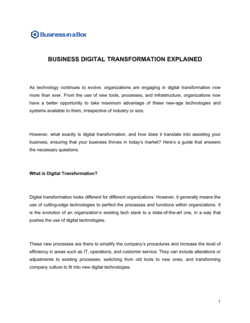
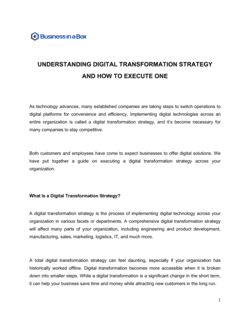
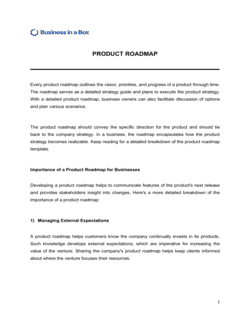
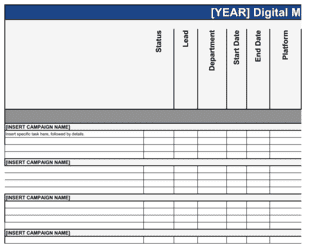
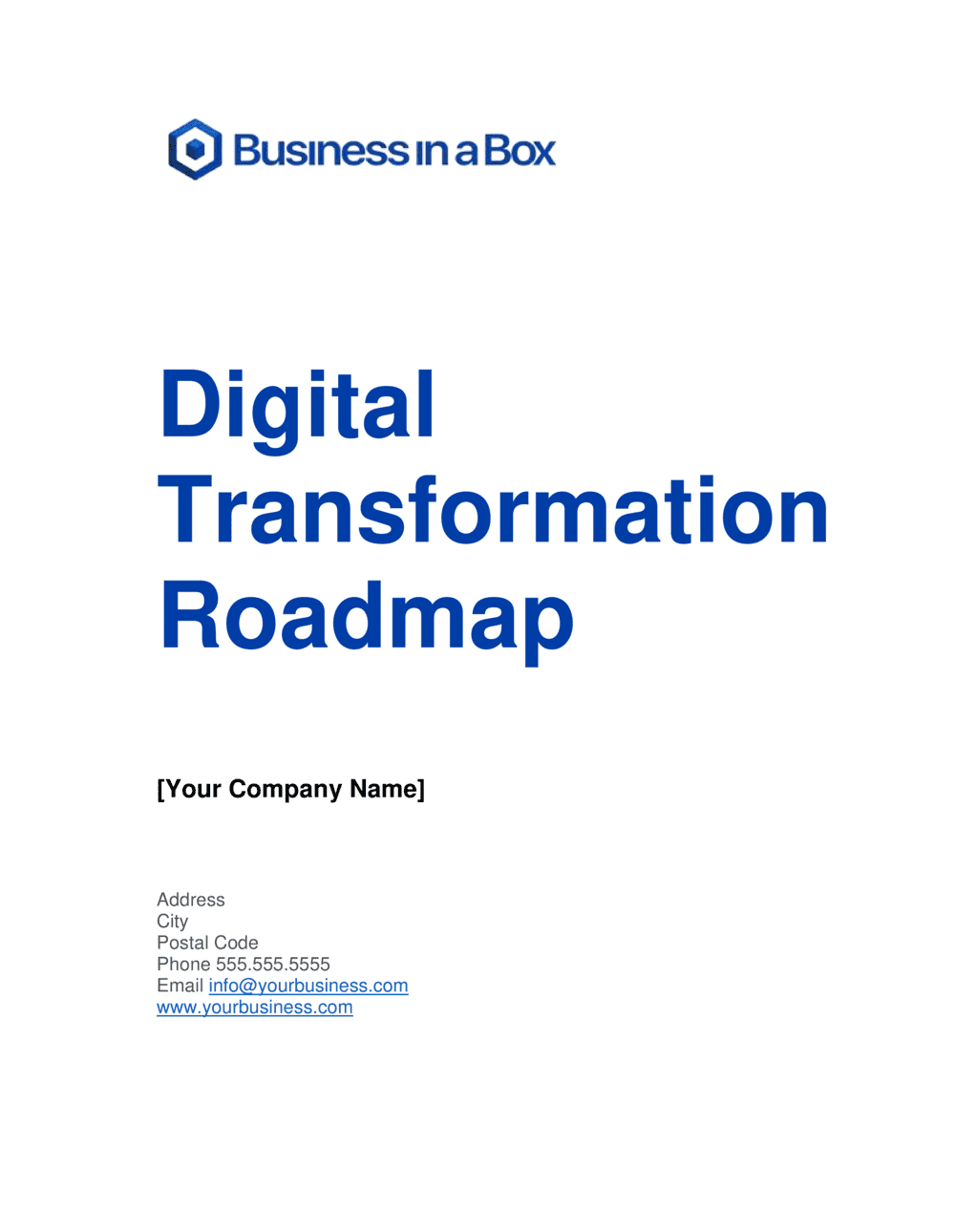
Digital Transformation Roadmap Template

Free Word download • Edit online • Save & share with Drive • Export to PDF

14 pages25–35 min to fillDifficulty: ComplexSignature requiredLegal review recommended
Learn more ↓
FreeDigital Transformation Roadmap Template

At a glance

What it is
A Digital Transformation Roadmap is a formally structured governance document that commits an organization — and its key stakeholders — to a sequenced plan for adopting new technologies, retiring legacy systems, redesigning processes, and building digital capabilities over a defined multi-year horizon. This free Word download gives you a binding, board-ready framework you can edit online and export as PDF to align executives, technology partners, and investment committees around a single authorized plan.
When you need it
Use it when a board, investors, or a technology partner requires a formally approved change program with named accountabilities and milestone commitments. It is also the right document when securing budget authorization for a multi-year transformation initiative that spans multiple departments or vendors.
What's inside
Governance structure and executive sponsorship, current-state assessment, strategic objectives and success metrics, phased initiative plan with milestones, budget allocation and financial controls, technology and vendor selection criteria, risk and change-management protocols, data governance and compliance obligations, and exit or review provisions.

What is a Digital Transformation Roadmap?

A Digital Transformation Roadmap is a formally approved governance document that commits an organization — and its named executive sponsors — to a sequenced, multi-year program of technology adoption, legacy system retirement, process redesign, and digital capability building. It is not a slide deck or a strategy memo: it defines accountable owners, authorizes budget by phase, establishes milestone gate criteria, mandates data governance and compliance obligations, and sets the change-control process that governs every material amendment to the program. For organizations managing significant technology investments, it functions as the single authoritative reference that boards, auditors, investors, and technology partners can rely on.

Why You Need This Document

Without a formally approved roadmap, digital transformation programs consistently encounter the same four failure modes: no single accountable owner to resolve competing priorities, vague objectives that make it impossible to evaluate whether the investment is working, technology deployed without the compliance controls required by GDPR, HIPAA, or sector regulators, and scope creep that quietly consumes budget before the workstreams that deliver real business value are funded. The financial and reputational cost of these failures is concrete — a mid-market transformation program derailed after Phase 1 typically leaves $500K to $2M in sunk costs with no measurable outcome to show boards or investors. This template gives you the governance structure, milestone accountability, and compliance language to prevent all four — in a format your legal team, CFO, and board can sign off on before a single vendor is engaged.

Which variant fits your situation?

If your situation is…Use this template
Comprehensive multi-year enterprise-wide digital overhaulDigital Transformation Roadmap
Cloud migration only, without broader organizational changeIT Project Plan
Single-system ERP or CRM implementationSoftware Implementation Plan
Internal alignment and team-level agile sprint planningIT Strategic Plan
Customer-experience redesign tied to digital channelsCustomer Experience Improvement Plan
Startup or SMB needing a lightweight one-page digital strategyOne-Page Business Plan
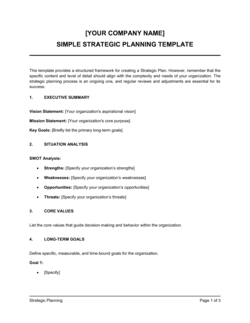
Post-merger technology integration across two entitiesStrategic Planning Template

Common mistakes to avoid

❌ No named individual accountable for delivery

Why it matters: When a transformation is governed by a committee with no single accountable owner, decisions stall, escalations go unresolved, and phases slip indefinitely without consequence.

Fix: Name a single Program Director with explicit authority to make day-to-day decisions within the approved plan, and route all escalations above their authority to a named executive sponsor.

❌ Omitting a quantified current-state baseline

Why it matters: Without a documented starting point, the organization cannot measure ROI, cannot defend budget decisions at milestone gates, and cannot demonstrate transformation value to boards or investors.

Fix: Conduct and document a maturity assessment before finalizing the roadmap — even a two-page summary with a traffic-light rating per system is sufficient to anchor all future measurement.

❌ Setting vague strategic objectives with no KPIs

Why it matters: Objectives like 'modernize our technology' give the steering committee no basis to evaluate success, authorize continued investment, or halt a failing workstream.

Fix: Rewrite every objective as a measurable outcome: metric, target value, and deadline. If a KPI cannot be defined, the objective is not ready to be committed.

❌ Authorizing the full multi-year budget upfront without phase gates

Why it matters: Releasing the entire program budget before Phase 1 is validated removes the financial lever that protects the organization if the strategy needs to change — which it almost always does.

Fix: Authorize budget phase by phase, with each phase release contingent on documented steering committee approval at the preceding milestone gate.

❌ Treating data governance and compliance as a late-phase activity

Why it matters: Retrofitting privacy controls, data classification, and audit trails after systems are live is two to four times more expensive than building them in — and leaves the organization exposed to regulatory liability during the gap.

Fix: Include data governance and compliance requirements in Phase 1 scope, not as a later optimization. Complete privacy-impact assessments before any system handling personal data goes to production.

❌ No formal amendment process

Why it matters: Without a documented change-control process, scope creep accumulates silently — each informal addition is small, but the aggregate erodes budget, timeline, and the original strategic rationale.

Fix: Define a written change-request process with a materiality threshold: changes above the threshold require steering committee approval; changes below it are logged and reported at the next quarterly review.

The 10 key clauses, explained

Parties, Scope, and Executive Sponsorship

In plain language: Identifies the organization(s) bound by the roadmap, defines the scope of the transformation program, and names the executive sponsor accountable for its delivery.

Sample language
This Digital Transformation Roadmap ('Roadmap') is approved and adopted by [ORGANIZATION LEGAL NAME] ('Organization') effective [DATE]. The Roadmap covers [SCOPE DESCRIPTION] and is sponsored by [EXECUTIVE SPONSOR NAME], [TITLE], who holds ultimate accountability for program delivery.

Common mistake: Naming a department rather than a specific executive as sponsor. Without a named individual, accountability dissolves when priorities shift and program funding becomes contested.

Current-State Assessment and Baseline

In plain language: Documents the starting point — existing technology systems, process maturity levels, and capability gaps — against which progress will be measured.

Sample language
As of [DATE], the Organization operates the following core systems: [LIST]. The maturity assessment conducted by [ASSESSOR / METHODOLOGY] on [DATE] identified the following priority gaps: [SUMMARY]. This baseline governs all delta measurements throughout the program.

Common mistake: Omitting the baseline entirely and jumping to future-state objectives. Without a documented starting point, measuring ROI and defending budget decisions at phase gates becomes impossible.

Strategic Objectives and Success Metrics

In plain language: States the business outcomes the transformation is designed to achieve — with quantified, time-bound KPIs that the steering committee will track at each milestone gate.

Sample language
The Roadmap is designed to achieve the following outcomes by [TARGET DATE]: (a) reduce operational cost by [X]%; (b) increase digital revenue channel contribution to [Y]% of total revenue; (c) achieve [SYSTEM/PROCESS] uptime of [Z]% or better.

Common mistake: Setting objectives without measurable KPIs — for example, 'improve customer experience' with no metric attached. Vague objectives make it impossible to declare success or justify continued investment.

Phased Initiative Plan and Milestone Schedule

In plain language: Divides the transformation into discrete phases with named workstreams, start and end dates, deliverables, and milestone gate criteria.

Sample language
Phase 1 ('Foundation'): [START DATE]–[END DATE]. Deliverables: [LIST]. Gate criteria: [CRITERIA]. Phase 2 ('Scale'): commences upon written steering committee approval of Phase 1 gate. Phase 3 ('Optimize'): commences upon approval of Phase 2 gate.

Common mistake: Planning all phases in equal detail upfront. Phases beyond the first 12 months should be directional — over-specifying them creates amendment obligations when scope inevitably evolves.

Budget Allocation and Financial Controls

In plain language: Authorizes the total program budget, allocates spend by phase and workstream, and defines the approval thresholds for expenditure decisions outside the baseline plan.

Sample language
The Organization authorizes a total program budget of $[AMOUNT] for the period [START DATE]–[END DATE], allocated as follows: Phase 1: $[X]; Phase 2: $[X]; Phase 3: $[X]. Unplanned expenditures exceeding [X]% of phase budget require written approval from [APPROVER].

Common mistake: Authorizing a lump-sum total budget without phase-level allocation. This allows early phases to over-spend, leaving insufficient funds for the integration and optimization work that delivers the majority of business value.

Technology and Vendor Governance

In plain language: Establishes selection criteria, due-diligence requirements, and approval authority for all third-party technology platforms and service providers engaged under the program.

Sample language
All technology platforms and vendors with a contract value exceeding $[THRESHOLD] must be approved by the Steering Committee prior to engagement. Selection criteria include: [LIST]. Preferred vendor status does not confer automatic approval for new workstreams.

Common mistake: Allowing initiative owners to procure technology independently without a central approval gate. Fragmented procurement produces integration conflicts and duplicate licensing costs that undermine the transformation's total cost of ownership targets.

Data Governance, Privacy, and Compliance Obligations

In plain language: Specifies how data created, migrated, or processed during the transformation must be handled — including applicable regulatory frameworks, retention schedules, and privacy-by-design requirements.

Sample language
All data migration, integration, and storage activities conducted under this Roadmap must comply with [APPLICABLE REGULATIONS — e.g., GDPR, CCPA, HIPAA]. A data impact assessment must be completed and approved by [DATA OWNER] before any system processing personal data is deployed to production.

Common mistake: Treating data governance as a Phase 3 concern. Retrofitting data classification, lineage, and privacy controls after systems are deployed costs significantly more — and exposes the organization to regulatory liability during the gap period.

Risk Register and Escalation Protocol

In plain language: Requires maintenance of a live risk register and defines the threshold and process for escalating risks to the steering committee or executive sponsor.

Sample language
The Program Manager shall maintain a Risk Register updated no less than [MONTHLY/QUARTERLY]. Risks rated High or Critical using the [METHODOLOGY] matrix must be escalated to the Steering Committee within [X] business days of identification. The Program Manager is authorized to approve mitigations for risks rated Medium or below.

Common mistake: Creating the risk register once at program launch and never updating it. Transformation risks evolve with each phase — a stale risk register provides false assurance and ensures surprises at milestone gates.

Change Management and Stakeholder Communication

In plain language: Commits the organization to a structured change-management approach — communication cadence, training obligations, and the process for managing resistance from affected business units.

Sample language
The Organization shall appoint a Change Management Lead no later than [DATE]. A stakeholder communication plan covering [FREQUENCY, CHANNELS, AUDIENCES] must be approved by the Executive Sponsor within [X] days of Roadmap adoption. All affected roles must complete required training before cutover to any new system.

Common mistake: Treating change management as a communications task rather than a structured workstream with budget and named ownership. Transformation programs that underinvest in change management achieve adoption rates 30–50% lower than planned.

Review, Amendment, and Sunset Provisions

In plain language: Sets the cadence for formal roadmap reviews, the process for approving amendments, and the conditions under which the program may be suspended or terminated.

Sample language
The Roadmap shall be reviewed by the Steering Committee on a [QUARTERLY/SEMI-ANNUAL] basis. Material amendments — defined as changes to scope, budget exceeding [X]%, or timeline shifts exceeding [Y] months — require written approval from [APPROVER(S)]. The program may be suspended by written resolution of [AUTHORITY] in the event of [DEFINED TRIGGER CONDITIONS].

Common mistake: No sunset or termination provision. Without one, a failing transformation program continues consuming resources indefinitely because no one has the documented authority to formally close it.

How to fill it out

  1. 1

    Identify the executive sponsor and steering committee

    Name a single executive sponsor who holds ultimate accountability and constitute a steering committee of no more than seven members covering technology, finance, operations, and the primary affected business units.

    💡 The sponsor must have P&L authority or direct access to the CEO — a sponsor without budget control cannot resolve the resourcing conflicts that every transformation encounters.

  2. 2

    Document the current-state baseline

    List every core system, its vendor, age, support status, and integration dependencies. Summarize the maturity gap assessment findings that justify the transformation scope.

    💡 Use a simple traffic-light rating (red/amber/green) per system so the baseline section is readable by non-technical board members and auditors.

  3. 3

    Set quantified, time-bound strategic objectives

    Write each objective as a measurable outcome with a target value and a deadline — for example, '40% reduction in manual data-entry hours by December 2027.' Limit objectives to five to seven to maintain focus.

    💡 Each objective should map directly to a line in the budget and a workstream in the phased plan — orphaned objectives with no funded workstream are aspirations, not commitments.

  4. 4

    Build the phased initiative plan

    Divide the program into three to five phases. Define Phase 1 in full detail — deliverables, owners, start and end dates, and gate criteria. Define later phases directionally, with gates triggered by steering committee approval rather than fixed calendar dates.

    💡 Phase 1 should deliver a visible, measurable win within 90 days — this builds organizational confidence and protects the program budget in the first board review cycle.

  5. 5

    Allocate budget by phase and workstream

    Break the total authorized budget into phase-level and workstream-level allocations. Define the approval threshold above which unplanned spending requires steering committee sign-off.

    💡 Reserve 10–15% of total program budget as a contingency line — call it explicitly in the document so reviewers understand it is intentional, not a planning gap.

  6. 6

    Complete the data governance and compliance section

    List every applicable regulation (GDPR, CCPA, HIPAA, SOC 2, etc.), name the data owner responsible for each system in scope, and specify that privacy-impact assessments must be completed before production deployment.

    💡 If any system in scope processes personal data of EU residents, flag it explicitly in this section — GDPR obligations attach to the processing activity, not the organization's country of registration.

  7. 7

    Populate the risk register template and escalation thresholds

    Identify the top eight to twelve program risks at launch, rate each by likelihood and impact, assign a mitigation owner, and set the escalation threshold that requires steering committee notification.

    💡 Identify at least one 'vendor lock-in' risk and one 'change fatigue' risk explicitly — these are the two risks most frequently absent from transformation risk registers and most frequently responsible for program failure.

  8. 8

    Obtain signatures before any vendor engagement or budget spend

    Collect signatures from the executive sponsor, CFO or budget authority, and each steering committee member. Date each signature and retain the fully-executed copy before authorizing any procurement or project spend.

    💡 Send for signature via a timestamped eSign platform so the approval record is irrefutable if the program's governance is later challenged.

Frequently asked questions

What is a digital transformation roadmap?

A digital transformation roadmap is a formally approved governance document that commits an organization to a sequenced multi-year plan for adopting new technologies, retiring legacy systems, and redesigning business processes to achieve specific, measurable outcomes. Unlike a strategy slide deck, a roadmap names accountable owners, allocates budget by phase, sets milestone gate criteria, and establishes the amendment process — making it a binding operating commitment rather than an aspiration.

Who needs a digital transformation roadmap?

Any organization embarking on a multi-year technology program that spans more than one department, requires board or investor approval, or involves significant third-party vendors needs a formal roadmap. Chief Information Officers, Chief Executive Officers, IT Directors, and operations leaders use it to secure budget authorization, align executives, and maintain governance accountability across the life of the program.

How is a digital transformation roadmap different from a project plan?

A project plan governs the execution of a single, defined deliverable with a fixed scope, budget, and end date. A digital transformation roadmap governs a multi-year program of interconnected workstreams that evolves as each phase is completed and validated. The roadmap includes strategic objectives, governance structures, budget authorization, risk escalation protocols, and amendment processes that are outside the scope of a typical project plan.

What sections should a digital transformation roadmap include?

A complete roadmap covers executive sponsorship and governance structure, current-state baseline assessment, strategic objectives with quantified KPIs, phased initiative plan with milestone gates, budget allocation and financial controls, technology and vendor governance, data governance and compliance obligations, a risk register and escalation protocol, change management commitments, and review and amendment provisions. Missing any of these creates governance gaps that typically surface at the first budget review.

Does a digital transformation roadmap need to be signed?

Yes, in most organizational contexts. A roadmap that has not been formally approved and signed by the executive sponsor, budget authority, and steering committee members is an advisory document, not a governance commitment. Signatures create accountability, establish the authorized baseline for change-control purposes, and provide the audit trail required by boards, investors, and regulators who may review program governance after the fact.

How long should a digital transformation roadmap cover?

Most enterprise transformation roadmaps cover a three-to-five year horizon, with Phase 1 planned in full detail and later phases defined directionally. Shorter horizons — under 18 months — are typically insufficient to complete the infrastructure, integration, and capability-building work that generates measurable business value. Longer horizons — beyond five years — become unreliable as technology and competitive conditions evolve, and should be treated as a directional vision rather than an operational commitment.

What are the most common reasons digital transformation programs fail?

The four most cited causes are: no single accountable owner (governance diffuses across committees), vague objectives with no measurable KPIs (no basis to evaluate or halt underperformance), underinvestment in change management (technology deployed but not adopted), and failure to lock in data governance before systems go live (compliance exposure and integration debt). A well-structured roadmap addresses all four by design.

Do I need a lawyer or consultant to create a digital transformation roadmap?

For most organizations, a high-quality template provides the structural framework and governance language needed to produce a board-ready document without external help. Engaging a technology consultant adds value when the current-state assessment requires independent technical expertise or when the vendor-selection process involves complex negotiations. Legal review is advisable when the roadmap will be incorporated by reference into vendor contracts, investor agreements, or regulatory submissions.

How should a digital transformation roadmap handle GDPR and data privacy?

The roadmap should explicitly list all applicable data-protection regulations — GDPR, CCPA, HIPAA, or others depending on jurisdiction and industry — and require a privacy-impact assessment before any system handling personal data is deployed to production. Data governance and compliance obligations should appear in Phase 1, not as a later optimization, to avoid the significantly higher cost of retrofitting controls after systems are live.

How this compares to alternatives

vs Strategic Planning Template

A strategic plan sets organization-wide goals, priorities, and resource allocation across all business functions for a 3–5 year horizon. A digital transformation roadmap is a specialized governance document focused specifically on technology and process change, with phase gates, vendor governance, data compliance obligations, and a risk register that a general strategic plan does not include. Organizations typically need both — the strategic plan establishes the why; the roadmap governs the how.

vs IT Project Plan

An IT project plan manages the execution of a single defined system deployment — scope, tasks, timeline, and resource assignments. A digital transformation roadmap governs a multi-year program of interconnected technology initiatives with board-level accountability, budget authorization by phase, and evolving scope. Use a project plan for individual workstreams within the roadmap, not as a substitute for it.

vs Change Management Plan

A change management plan focuses specifically on the people side of transformation — communication, training, resistance management, and adoption tracking. A digital transformation roadmap is the governing document for the entire program, of which change management is one component. The roadmap references and requires a change management plan but does not replace it.

vs Business Continuity Plan

A business continuity plan prepares the organization to operate during and recover from a disruption event. A digital transformation roadmap proactively drives technology change under controlled conditions. The two documents intersect during system cutover phases, where transformation activities create temporary continuity risk — the roadmap should reference the BCP for cutover risk mitigation.

Industry-specific considerations

Financial Services

Core banking platform modernization, open-banking API integration, and compliance with PSD2, SOC 2, and PCI DSS requirements built into Phase 1 data governance obligations.

Healthcare

EHR system migration, telehealth platform rollout, and HIPAA privacy-impact assessments required at every phase gate before any patient-data system goes live.

Manufacturing

Industrial IoT deployment, ERP replacement, and supply-chain digitization sequenced around production schedules to avoid operational disruption during cutover.

Retail / E-commerce

Omnichannel platform unification, customer data platform implementation, and inventory system modernization with CCPA-compliant data handling for customer records.

Professional Services

Knowledge-management system replacement, client-portal digitization, and billable-hour tracking automation with ISO 27001 information-security obligations embedded in vendor governance.

Public Sector

Legacy system decommissioning subject to procurement regulations, mandatory accessibility standards (WCAG 2.1), and data-residency requirements that restrict cloud vendor selection.

Jurisdictional notes

United States

No single federal statute governs digital transformation governance, but sector-specific regulations create compliance obligations that must be embedded in the roadmap: HIPAA for healthcare data, GLBA for financial services, CCPA and state privacy laws for consumer data processing. SOC 2 Type II certification is increasingly required by enterprise customers and should be planned as a milestone within the roadmap's data governance workstream. Organizations receiving federal funding or operating in defense supply chains must also account for NIST Cybersecurity Framework alignment.

Canada

Canada's Personal Information Protection and Electronic Documents Act (PIPEDA) — and its proposed replacement, the Consumer Privacy Protection Act (CPPA) — governs personal data processing and must be addressed in the roadmap's data governance clause. Quebec's Law 25 imposes stricter obligations than federal PIPEDA, including privacy-impact assessments before deploying any technology that processes personal information. Provincial procurement rules apply to public-sector transformation programs and affect vendor selection criteria.

United Kingdom

The UK GDPR and Data Protection Act 2018 require data-protection impact assessments (DPIAs) before deploying high-risk processing systems — a requirement that should be written into the roadmap's phase gate criteria. The National Cyber Security Centre's Cyber Essentials framework is increasingly referenced in public-sector and regulated-industry contracts as a minimum security standard for transformation programs. Financial services firms must also account for FCA operational resilience rules, which set specific requirements for critical system change management.

European Union

GDPR Article 35 mandates Data Protection Impact Assessments before deploying systems that process personal data at scale — this obligation must be embedded in the roadmap's data governance clause and triggered at each relevant phase gate, not at program completion. The EU AI Act (phased in from 2024–2027) introduces mandatory conformity assessments for high-risk AI systems that may be deployed as part of digital transformation initiatives. NIS2 Directive requirements for critical infrastructure sectors impose incident-reporting and supply-chain security obligations relevant to vendor governance clauses.

Template vs lawyer — what fits your deal?

PathBest forCostTime
Use the templateMid-market organizations running internal technology programs with existing governance frameworksFree1–2 weeks to complete with internal stakeholders
Template + legal reviewPrograms involving multiple external vendors, investor reporting obligations, or cross-border data processing$500–$2,000 for a technology lawyer or governance consultant review2–4 weeks
Custom draftedRegulated industries (financial services, healthcare), programs exceeding $5M, or roadmaps incorporated into investor or lender agreements$3,000–$10,000+4–8 weeks

Glossary

Digital Transformation
The process of integrating digital technology into all areas of a business, fundamentally changing how it operates and delivers value to customers.
Initiative Owner
The named individual accountable for delivering a specific workstream or phase of the transformation, with authority to commit resources within the approved budget.
Milestone Gate
A defined checkpoint at which progress against stated deliverables is reviewed before the next phase of work or spending is authorized.
Legacy System
An existing technology platform or application that is outdated, difficult to integrate, or no longer supported by its vendor but still operationally critical.
Change Management
The structured approach to transitioning individuals, teams, and organizations from a current state to a desired future state, including communication, training, and resistance management.
Data Governance
The policies, roles, and processes that ensure data is accurate, secure, consistently defined, and used in compliance with applicable regulations across the organization.
Technology Stack
The combination of software, platforms, databases, and infrastructure components used to build and run an organization's digital capabilities.
KPI (Key Performance Indicator)
A measurable value that demonstrates how effectively a specific objective or workstream is being achieved against a defined target.
Steering Committee
A cross-functional executive group with authority to approve phase gates, resolve escalated risks, and make resourcing decisions for the transformation program.
TCO (Total Cost of Ownership)
The complete financial cost of a technology investment over its lifecycle, including licensing, implementation, training, maintenance, and decommissioning.
Proof of Concept (PoC)
A limited-scope pilot deployment used to validate that a proposed technology or approach will deliver the expected outcome before full-scale rollout.

Part of your Business Operating System

This document is one of 3,000+ business & legal templates included in Business in a Box.

  • Fill-in-the-blanks — ready in minutes
  • 100% customizable Word document
  • Compatible with all office suites
  • Export to PDF and share electronically

Create your document in 3 simple steps.

From template to signed document — all inside one Business Operating System.
1
Download or open template

Access over 3,000+ business and legal templates for any business task, project or initiative.

2
Edit and fill in the blanks with AI

Customize your ready-made business document template and save it in the cloud.

3
Save, Share, Send, Sign

Share your files and folders with your team. Create a space of seamless collaboration.

Save time, save money, and create top-quality documents.

★★★★★

"Fantastic value! I'm not sure how I'd do without it. It's worth its weight in gold and paid back for itself many times."

Managing Director · Mall Farm
Robert Whalley
Managing Director, Mall Farm Proprietary Limited
★★★★★

"I have been using Business in a Box for years. It has been the most useful source of templates I have encountered. I recommend it to anyone."

Business Owner · 4+ years
Dr Michael John Freestone
Business Owner
★★★★★

"It has been a life saver so many times I have lost count. Business in a Box has saved me so much time and as you know, time is money."

Owner · Upstate Web
David G. Moore Jr.
Owner, Upstate Web

Run your business with a system — not scattered tools

Stop downloading documents. Start operating with clarity. Business in a Box gives you the Business Operating System used by over 250,000 companies worldwide to structure, run, and grow their business.

Free Forever Plan · No credit card required