Return of Purchase Order and Demand for Advance Payment Template

Free Word download • Edit online • Save & share with Drive • Export to PDF

1 page20–30 min to fillDifficulty: StandardSignature requiredLegal review recommended
Learn more ↓
FreeReturn of Purchase Order and Demand for Advance Payment Template

At a glance

What it is
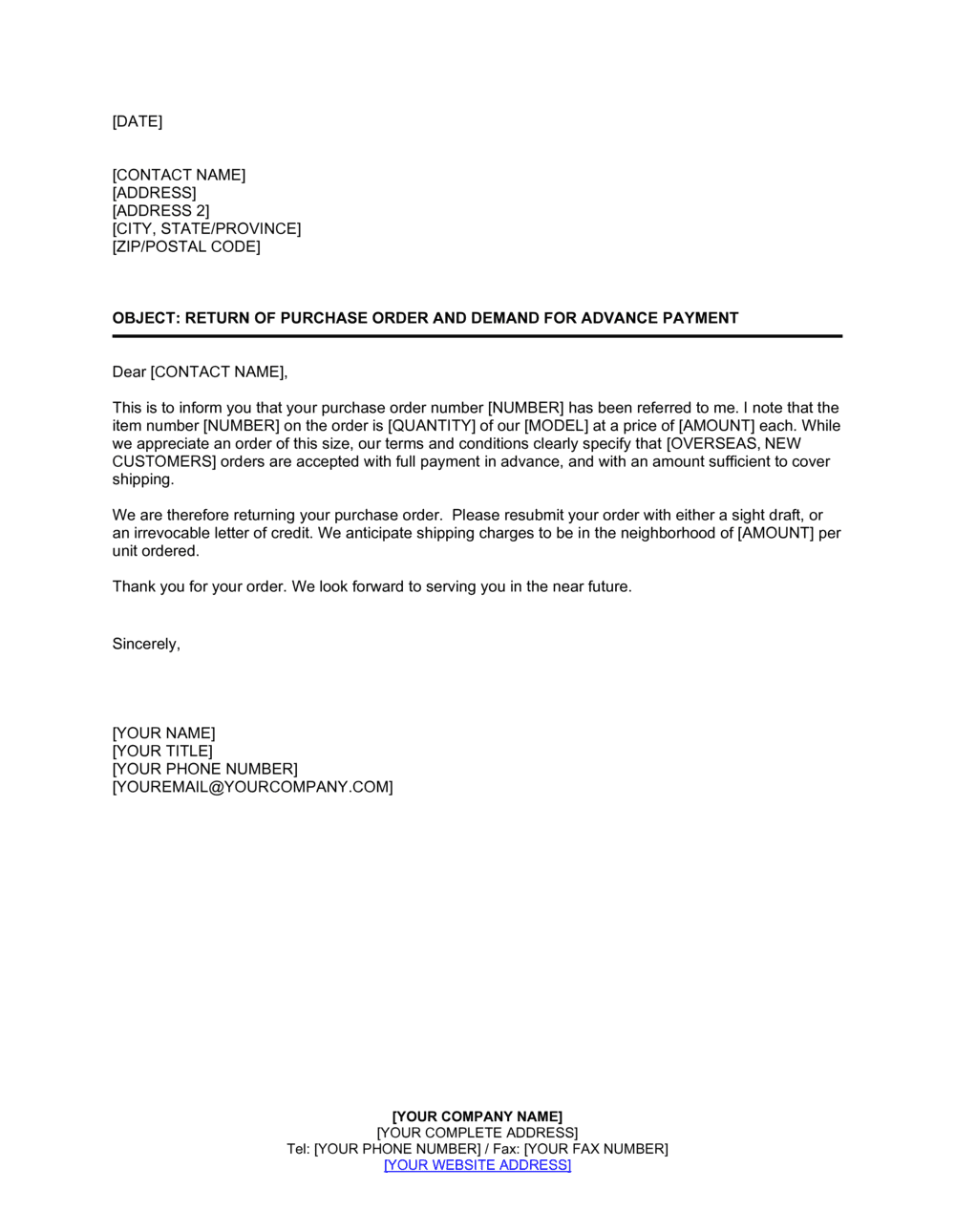
A Return of Purchase Order and Demand for Advance Payment is a formal legal letter a seller sends to a buyer to reject or return an issued purchase order and simultaneously condition future fulfillment on receipt of full or partial payment in advance. This free Word download lets you document the rejection, state your grounds, and set binding advance-payment terms — all in a single professionally formatted document you can edit online and export as PDF.
When you need it
Use it when a buyer submits a purchase order that you cannot or will not fulfill on standard credit terms — typically because the buyer has an overdue balance, a poor payment history, a credit limit breach, or poses an elevated risk of non-payment. It is also appropriate when your own cash-flow or supply-chain constraints require secured funds before production or procurement begins.
What's inside
Seller and buyer identification, reference to the specific purchase order being returned, the stated grounds for rejection, a clear demand for advance payment with the amount and deadline, conditions under which fulfillment will proceed, and signature blocks for both parties.

What is a Return of Purchase Order and Demand for Advance Payment?

A Return of Purchase Order and Demand for Advance Payment is a formal legal letter a seller issues to a buyer that accomplishes two distinct things in a single document: it returns the buyer's submitted purchase order as unaccepted — meaning no fulfillment obligation has been created — and it conditions any future fulfillment of that order on the buyer remitting a specified advance payment by a fixed deadline. The letter documents the grounds for rejection, such as an overdue receivables balance or a credit limit breach, states the exact advance-payment amount and accepted methods, and preserves all of the seller's legal rights against the buyer for prior outstanding amounts. It is not a termination of the business relationship — it is a formal reset of payment terms that gives the buyer a clear path to fulfillment under secured conditions.

Why You Need This Document

Shipping goods against a purchase order from a buyer who has already demonstrated an inability or unwillingness to pay on time is one of the fastest ways for a business to convert a receivables problem into a total loss. Without a written, signed rejection and demand, a seller who simply stops processing orders has no documented basis for their position — leaving them exposed to breach-of-contract claims from the buyer, even when the buyer is the one in arrears. This template creates a contemporaneous record of the rejection, the stated grounds, and the advance-payment demand that is essential evidence in any subsequent collection action, arbitration, or litigation. It also serves as a formal notice that credit terms have been suspended, preventing the buyer from arguing they were unaware of the change in conditions. For sellers who deal in high-volume or high-value orders, having a professionally drafted, consistently applied letter protects both the current transaction and the enforceability of the broader commercial relationship.

Which variant fits your situation?

If your situation is…Use this template
Buyer has an outstanding overdue balance and submits a new POReturn of Purchase Order and Demand for Advance Payment
Rejecting a PO due to pricing or specification errors without a payment demandPurchase Order Rejection Letter
Requesting a deposit on a custom or made-to-order productProforma Invoice
Placing a customer account on credit hold before PO reviewCredit Hold Notice Letter
Demanding full payment of an overdue invoice before further ordersDemand for Payment Letter
Requiring a letter of credit for an international buyerLetter of Credit Request
Suspending an account pending resolution of a payment disputeAccount Suspension Notice

Common mistakes to avoid

❌ Ambiguous purchase order reference

Why it matters: A buyer with multiple active POs can claim the wrong order was returned, delaying resolution and allowing a disputed shipment to proceed. The resulting fulfillment dispute can exceed the original outstanding balance in legal costs.

Fix: Always reference the PO by number, date, and total value, and attach a copy of the original PO as Exhibit A to the letter.

❌ Omitting the unaccepted-status language

Why it matters: Without explicit rejection language, prior course of dealing or partial communications may be used to argue that the PO was implicitly accepted, creating an unintended fulfillment obligation.

Fix: Use the phrase 'returned unaccepted' and add a sentence clarifying that no contract has been formed — do not soften the language with phrases like 'we are unable to process at this time.'

❌ No payment deadline in the advance-payment demand

Why it matters: An open-ended demand gives the buyer no legal obligation to act within any timeframe, effectively stalling your ability to escalate to collections while the buyer delays indefinitely.

Fix: Set a specific calendar date — typically 5 to 10 business days from the letter date — by which advance payment must be received, and state the consequence of non-payment explicitly.

❌ Failing to separate the advance-payment demand from the outstanding-balance demand

Why it matters: Combining both demands in a single paragraph allows the buyer to argue that paying the advance payment satisfies the outstanding balance, or vice versa — creating a setoff dispute that delays both recoveries.

Fix: Address the outstanding balance in a standalone clause that makes clear it is immediately due and payable independent of the buyer's decision about the new order.

❌ Signing below managerial authority

Why it matters: A letter signed by a sales representative or junior AR staff member may be challenged as lacking authority to suspend credit terms or impose binding advance-payment conditions, undermining its enforceability.

Fix: Have the letter executed by a director, controller, VP of Finance, or VP of Sales — someone whose authority to impose payment conditions is documented in your corporate governance records.

❌ No reservation of rights clause

Why it matters: Without a reservation of rights, a court may interpret the demand letter as a settlement offer or a waiver of prior claims, particularly if the buyer responds with a partial payment.

Fix: Include a standard reservation clause affirming all rights and remedies and stating that the letter does not constitute a waiver of any existing claims or obligations.

The 10 key clauses, explained

Parties and reference details

In plain language: Identifies the seller and buyer by legal name and address, and references the specific purchase order being returned by its PO number and date.

Sample language
This letter is issued by [SELLER LEGAL NAME] ('Seller') to [BUYER LEGAL NAME] ('Buyer') regarding Purchase Order No. [PO NUMBER] dated [PO DATE] in the amount of [TOTAL PO VALUE] ('the Order').

Common mistake: Referencing only the PO number without the date and total value. If the buyer has issued multiple orders, an ambiguous reference creates a dispute about which PO is being returned.

Return and rejection of the purchase order

In plain language: Formally states that the seller is returning the purchase order unaccepted and that no binding fulfillment obligation has been created.

Sample language
Seller hereby returns the Order unaccepted. No contract for the supply of goods or services has been formed, and Seller is under no obligation to fulfill the Order on the terms submitted.

Common mistake: Failing to explicitly state that the PO is returned 'unaccepted.' Without this language, partial performance or prior course of dealing may imply acceptance in some jurisdictions.

Stated grounds for rejection

In plain language: Documents the specific reason the seller is declining the PO — overdue balance, credit limit breach, credit terms suspension, or business policy — creating a paper trail for the record.

Sample language
The Order is returned for the following reason(s): [OVERDUE BALANCE OF $[AMOUNT] ON INVOICE(S) [NUMBERS] / BUYER'S OUTSTANDING BALANCE EXCEEDS CREDIT LIMIT OF $[AMOUNT] / CREDIT TERMS SUSPENDED EFFECTIVE [DATE]].

Common mistake: Citing vague reasons such as 'business reasons' or 'internal policy.' A documented, specific ground protects the seller against bad-faith claims and supports any subsequent collection action.

Demand for advance payment

In plain language: Specifies the exact amount the buyer must pay in advance, the payment deadline, and the accepted payment methods before the seller will consider fulfilling the order.

Sample language
Seller will consider fulfilling the Order solely upon receipt of advance payment in the amount of $[AMOUNT] (representing [100% / [X]%] of the Order value), payable by [DATE] via [WIRE TRANSFER / ACH / CERTIFIED CHECK] to the account details set out in Schedule A.

Common mistake: Stating a payment amount without specifying the method and deadline. An open-ended demand gives the buyer no obligation timeline and weakens the seller's position if the matter proceeds to collections.

Conditions for fulfillment

In plain language: Sets out exactly what will happen after advance payment is received — restating the delivery timeline, revised terms, and any conditions that remain subject to final confirmation.

Sample language
Upon confirmed receipt of the advance payment, Seller will reinstate the Order subject to the revised payment terms set out herein. Estimated delivery: [DELIVERY DATE / TIMEFRAME]. All other terms of the original Order remain in effect unless modified in writing.

Common mistake: Promising a specific delivery date without qualifying it as an estimate. If the delivery date is missed, the buyer may claim breach, even when the delay is caused by production or shipping factors outside the seller's control.

Suspension of credit terms

In plain language: Formally notifies the buyer that standard credit terms are suspended for this order and, if applicable, for all future orders until conditions are met.

Sample language
Effective [DATE], Seller hereby suspends [NET [X]] credit terms extended to Buyer. All future orders will be processed on advance-payment terms only until Buyer's account is brought current and Seller, at its sole discretion, reinstates credit terms in writing.

Common mistake: Suspending credit terms only for the current order while leaving the general credit arrangement ambiguous. This allows the buyer to argue that future orders still carry standard terms.

Outstanding balance acknowledgment

In plain language: Restates the amount currently owed by the buyer on prior invoices and confirms that this balance remains due and payable regardless of the outcome of this PO negotiation.

Sample language
For clarity, Buyer's outstanding balance of $[AMOUNT], comprising Invoice(s) [INVOICE NUMBERS] due on [DUE DATE(S)], remains immediately due and payable and is not affected by the return of the Order.

Common mistake: Omitting the outstanding balance clause entirely, which can allow the buyer to argue that returning the PO somehow affects or offsets the prior debt.

Reservation of rights

In plain language: Preserves all of the seller's legal rights and remedies — including the right to pursue collection of the outstanding balance — without waiving any claim by issuing this letter.

Sample language
Seller expressly reserves all rights and remedies available at law or in equity, including the right to pursue collection of any outstanding amounts owed by Buyer. Nothing in this letter shall constitute a waiver of any such rights.

Common mistake: Not including a reservation of rights clause. Without it, a court may interpret a negotiated demand letter as a partial settlement or waiver of prior claims.

Governing law and notices

In plain language: Specifies the jurisdiction whose law governs the letter and how formal notices must be delivered between the parties.

Sample language
This letter is governed by the laws of [STATE / PROVINCE / COUNTRY]. Any notice under this letter must be delivered in writing by [EMAIL WITH READ RECEIPT / COURIER / CERTIFIED MAIL] to the addresses set out above.

Common mistake: Using a governing-law clause that designates a jurisdiction where the buyer has no presence. Enforcing a judgment across borders significantly multiplies cost and time.

Signature and acknowledgment block

In plain language: Provides signature lines for the seller's authorized representative and, where desired, space for the buyer to acknowledge receipt and agree to the advance-payment terms.

Sample language
Issued by: [SELLER AUTHORIZED SIGNATORY NAME], [TITLE], [SELLER LEGAL NAME], dated [DATE]. Acknowledged and agreed: [BUYER AUTHORIZED SIGNATORY NAME], [TITLE], [BUYER LEGAL NAME], dated [DATE].

Common mistake: Leaving the buyer acknowledgment block out entirely. Without it, the buyer can dispute that the letter was received, making it harder to establish the demand timeline in any subsequent legal action.

How to fill it out

  1. 1

    Identify both parties and the specific purchase order

    Enter the seller's and buyer's full legal names and addresses in the parties block. Reference the purchase order by its exact PO number, date, and total dollar value so there is no ambiguity about which order is being returned.

    💡 Pull the PO number directly from the buyer's document rather than relying on email subject lines — discrepancies in PO numbers are a common source of disputes.

  2. 2

    Draft the rejection clause with explicit unaccepted language

    State clearly that the purchase order is returned unaccepted and that no contract has been formed. Avoid any language that could be interpreted as conditional acceptance or partial performance.

    💡 If you have previously supplied the buyer on similar terms, add a sentence clarifying that no course of dealing implies acceptance of this specific order.

  3. 3

    Document the specific grounds for rejection

    List the factual reasons — overdue balance amount, invoice numbers, credit limit figure, or credit suspension date. Attach copies of the relevant invoices or account statements as an exhibit to the letter.

    💡 Specific dollar amounts and invoice references create a contemporaneous record that is far easier to use in a collection action than vague references to payment history.

  4. 4

    Set the advance-payment amount, deadline, and method

    Calculate the advance payment as a percentage of the order value or as a fixed amount. State the exact deadline and list accepted payment methods with full wire or ACH details in Schedule A.

    💡 For high-risk buyers, require 100% advance payment. For buyers with a single overdue invoice, 50% advance plus clearance of the outstanding balance is a reasonable middle position.

  5. 5

    Define conditions for reinstating fulfillment

    Spell out exactly what happens after payment clears — revised delivery timeline, updated terms, and any additional conditions such as a signed credit application or personal guarantee.

    💡 Frame delivery dates as estimates contingent on confirmed cleared funds to avoid a separate breach claim if production timelines shift.

  6. 6

    Restate the outstanding balance separately

    Include an explicit clause confirming that prior invoices remain due regardless of whether the buyer agrees to the advance-payment terms for the new order. This prevents the buyer from conflating the two issues.

    💡 Attach an aging summary of the outstanding balance as Exhibit B — it removes any ambiguity about what is owed and when it became due.

  7. 7

    Add the reservation of rights and governing law clauses

    Include boilerplate reserving all legal remedies and specify the governing jurisdiction. Confirm that the notice provisions (email, courier, or certified mail) align with what your existing supply agreement requires, if one exists.

    💡 Check your original supply agreement or master purchase agreement for a governing-law clause — the letter should match the parent agreement's jurisdiction to avoid a conflict.

  8. 8

    Execute and deliver with a traceable method

    Have the letter signed by an authorized signatory — a director, controller, or VP of sales — before dispatch. Send via email with read receipt and follow up with a physical copy by courier or certified mail to the buyer's accounts-payable contact.

    💡 BCC your legal counsel and accounts-receivable team on the email so there is an internal timestamp on dispatch, independent of the buyer's acknowledgment.

Frequently asked questions

What is a return of purchase order and demand for advance payment?

A return of purchase order and demand for advance payment is a formal legal letter a seller sends to a buyer that does two things simultaneously: it returns the buyer's purchase order unaccepted — meaning no fulfillment obligation exists — and conditions any future fulfillment of that order on receipt of advance payment. It is used when a buyer poses an elevated payment risk, has an overdue balance, or has breached their credit terms.

When should I return a purchase order and demand advance payment?

The most common triggers are an overdue receivables balance from the buyer, a credit limit breach, a history of returned checks or disputed invoices, a recent change in the buyer's financial condition (such as a downgrade in credit score or a public notice of insolvency proceedings), or your own cash-flow requirements for custom or made-to-order production. The letter is appropriate any time you are unwilling to extend additional credit risk on a new order.

Is returning a purchase order legally enforceable?

In most jurisdictions, a purchase order becomes a binding contract only when the seller accepts it — by written confirmation, by shipping the goods, or by beginning performance. Returning a PO before acceptance generally prevents a contract from forming, leaving the seller with no fulfillment obligation. However, if a prior course of dealing or a master supply agreement governs the relationship, specific terms may affect when acceptance is deemed to occur. Consider having a lawyer review the letter if a master agreement is in place.

How much advance payment should I demand?

The amount depends on your risk assessment of the buyer. For a buyer with a single overdue invoice and otherwise clean history, 50% advance payment plus clearance of the outstanding balance is a common middle position. For buyers with chronic late payments, disputed invoices, or a credit limit breach, 100% advance payment is standard. For international buyers or first-time customers, requiring a letter of credit or 100% wire transfer in advance is typical practice in many industries.

Does returning a purchase order waive my right to collect the outstanding balance?

No — returning a purchase order does not affect or discharge any prior debt the buyer owes you. The outstanding balance on prior invoices remains independently due and payable. However, to avoid any argument that the return letter modified or settled prior obligations, the letter must include an explicit clause confirming that the outstanding balance is unaffected and remains immediately due. A reservation of rights clause reinforces this position.

What happens if the buyer ignores the demand for advance payment?

If the buyer fails to remit advance payment by the stated deadline, you are under no obligation to fulfill the order. You may then escalate collection of the outstanding balance through a formal demand letter, a collections agency, or legal action depending on the amount and jurisdiction. The return letter serves as contemporaneous written evidence of your demand and the buyer's non-response, which strengthens your position in any subsequent collection or litigation.

Can I demand advance payment from all customers, or only those in default?

You may generally set your own credit and payment terms for future orders with any customer, including requiring advance payment as a standard condition of sale. However, changing terms mid-relationship for a customer who has an existing master supply agreement may require notice or mutual agreement. Be aware that selectively applying advance-payment requirements in a discriminatory manner may raise issues in jurisdictions with anti-discrimination protections in commercial relationships.

Should the buyer sign the return letter?

Having the buyer acknowledge and sign the letter is strongly recommended but not legally required for the rejection to be effective. A buyer signature confirms receipt, establishes agreement to the advance-payment conditions, and eliminates any dispute about whether the letter was delivered. If the buyer refuses to sign, document delivery through certified mail, courier with proof of delivery, or email with a read receipt.

Do I need a lawyer to send this letter?

For straightforward domestic transactions where the buyer has a clear overdue balance and no master supply agreement governs the relationship, a high-quality template is typically sufficient. Engage a lawyer when the outstanding balance is material (typically above $10,000–$25,000), when a master purchase or supply agreement may affect your right to reject orders, when the buyer is in or approaching insolvency, or when the transaction involves cross-border parties with different governing-law regimes.

How this compares to alternatives

vs Purchase Order Rejection Letter

A standard purchase order rejection letter simply declines a buyer's order — it does not create a path to fulfillment or impose payment conditions. The return of purchase order and demand for advance payment goes further by offering to reinstate the order if the buyer pays upfront. Use the rejection letter when you are declining the order entirely; use this template when you are willing to fulfill under revised terms.

vs Demand for Payment Letter

A demand for payment letter targets an existing overdue invoice with a threat of legal action if unpaid. This template combines a demand for new advance payment with the return of a new purchase order. The two documents address different situations — use the demand for payment letter to collect a past-due balance, and this template when a buyer submits a new order while a balance remains outstanding.

vs Credit Hold Notice Letter

A credit hold notice suspends a buyer's account from processing new orders but does not return a specific PO or impose advance-payment conditions for future fulfillment. This template is more specific and action-oriented — it returns an identified order and sets the exact terms under which the seller will fulfill it, making it the appropriate document once a specific PO has been received.

vs Proforma Invoice

A proforma invoice requests advance payment by issuing a preliminary billing document before delivery, typically used with new customers or custom orders. It does not reject a purchase order or document the grounds for credit suspension. This template is appropriate when the buyer already has a troubled credit history with the seller and a formal record of rejection and demand is needed — the proforma invoice is better suited to routine pre-payment situations.

Industry-specific considerations

Manufacturing

Custom-order manufacturers routinely demand advance payment to cover raw material and tooling costs before production begins, particularly for bespoke or low-volume runs where the seller cannot resell unfinished goods.

Wholesale and Distribution

Distributors use the letter to suspend shipments to retailers or resellers with aging receivables, protecting large inventory positions from buyers who have exceeded credit limits.

Construction and Building Materials

Material suppliers return POs from contractors with overdue balances mid-project, using advance-payment demands to secure payment before releasing additional materials tied to project milestones.

International Trade and Export

Exporters replace standard credit terms with advance payment or letter-of-credit requirements for buyers in high-risk markets or jurisdictions with currency controls, using this letter to formally document the condition before shipment.

Jurisdictional notes

United States

Under UCC Article 2, a seller's acceptance of a purchase order is typically required before a binding sales contract forms. Returning a PO before acceptance is effective as a rejection in most states. However, if prior course of dealing, trade usage, or a master purchase agreement establishes automatic acceptance on receipt, the seller may need additional steps to reject. Some states impose anti-discrimination rules on selectively changing credit terms — consult counsel if you are applying advance-payment requirements to a subset of buyers.

Canada

Contract formation in Canada is governed by common law in all provinces except Quebec, which follows civil law under the Civil Code of Quebec. In common-law provinces, a PO is an offer that requires acceptance by the seller to form a contract — returning it unaccepted is effective. In Quebec, the timing and form of acceptance may be assessed differently. Sellers should confirm that their notice provisions comply with the method specified in any existing supply agreement.

United Kingdom

UK contract law follows offer-and-acceptance principles under the Sale of Goods Act 1979 and common law. A purchase order is an offer from the buyer, and returning it unaccepted prevents contract formation. Sellers should be aware that the UK Late Payment of Commercial Debts (Interest) Act 1998 allows interest and compensation on overdue B2B invoices, which should be referenced in the outstanding-balance clause to maximize recovery. Post-Brexit, cross-border enforcement with EU buyers requires separate legal analysis.

European Union

EU member states follow civil law traditions with varying rules on contract formation and commercial credit. The EU Late Payment Directive (2011/7/EU) establishes statutory interest on overdue B2B invoices across member states, which sellers should reference when stating outstanding balances. Non-compete and credit-suspension clauses may interact with national competition law in certain sectors. For cross-border transactions within the EU, the Rome I Regulation governs which national law applies to the contract, making an explicit governing-law clause essential.

Template vs lawyer — what fits your deal?

PathBest forCostTime
Use the templateSellers handling a straightforward overdue-balance situation with a domestic buyer and no governing master supply agreementFree15–30 minutes
Template + legal reviewOutstanding balances above $10,000 or situations where a master supply or distribution agreement may affect rejection rights$200–$5001–2 days
Custom draftedCross-border transactions, insolvent or near-insolvent buyers, or complex supply chains where the letter may be the first step in litigation$500–$2,000+3–7 days

Glossary

Purchase Order (PO)
A buyer-issued document authorizing the purchase of specific goods or services at agreed prices and quantities — it becomes a binding contract upon seller acceptance.
Advance Payment
Full or partial payment made by the buyer to the seller before goods are shipped or services are rendered.
Credit Terms
The agreed conditions under which a seller extends credit to a buyer, including the payment period (e.g., Net 30) and any applicable discounts or penalties.
Credit Limit
The maximum outstanding balance a seller is willing to carry for a specific buyer before requiring payment or refusing new orders.
Proforma Invoice
A preliminary billing document issued before delivery, often used to request advance payment or confirm pricing and terms before a formal invoice is raised.
Letter of Credit
A bank-issued guarantee that a buyer's payment will be made to a seller on time and in full, commonly used in international trade to reduce counterparty risk.
Accounts Receivable Aging
A report categorizing outstanding invoices by how long they have been unpaid — used to identify high-risk buyers before processing new purchase orders.
Counterparty Risk
The risk that the other party in a commercial transaction will fail to fulfill their payment or performance obligations.
Consideration
Something of value exchanged between parties that makes a contract legally binding — in this context, the seller's commitment to fulfill once advance payment is received.
Force Majeure
A contract clause excusing a party from performance obligations when fulfillment is prevented by extraordinary events outside their control, such as natural disasters or supply-chain disruptions.
Material Breach
A significant failure by one party to perform a contractual obligation that justifies the other party treating the contract as discharged and seeking damages.

Part of your Business Operating System

This document is one of 3,000+ business & legal templates included in Business in a Box.

  • Fill-in-the-blanks — ready in minutes
  • 100% customizable Word document
  • Compatible with all office suites
  • Export to PDF and share electronically

Create your document in 3 simple steps.

From template to signed document — all inside one Business Operating System.
1
Download or open template

Access over 3,000+ business and legal templates for any business task, project or initiative.

2
Edit and fill in the blanks with AI

Customize your ready-made business document template and save it in the cloud.

3
Save, Share, Send, Sign

Share your files and folders with your team. Create a space of seamless collaboration.

Save time, save money, and create top-quality documents.

★★★★★

"Fantastic value! I'm not sure how I'd do without it. It's worth its weight in gold and paid back for itself many times."

Managing Director · Mall Farm
Robert Whalley
Managing Director, Mall Farm Proprietary Limited
★★★★★

"I have been using Business in a Box for years. It has been the most useful source of templates I have encountered. I recommend it to anyone."

Business Owner · 4+ years
Dr Michael John Freestone
Business Owner
★★★★★

"It has been a life saver so many times I have lost count. Business in a Box has saved me so much time and as you know, time is money."

Owner · Upstate Web
David G. Moore Jr.
Owner, Upstate Web

Run your business with a system — not scattered tools

Stop downloading documents. Start operating with clarity. Business in a Box gives you the Business Operating System used by over 250,000 companies worldwide to structure, run, and grow their business.

Start free · No credit card required