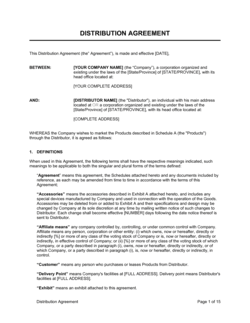
Dealership Agreement Template

Free Word download β€’ Edit online β€’ Save & share with Drive β€’ Export to PDF

13 pagesβ€’30–40 min to fillβ€’Difficulty: Complexβ€’Signature requiredβ€’Legal review recommended
Learn more ↓
FreeDealership Agreement Template

At a glance

What it is
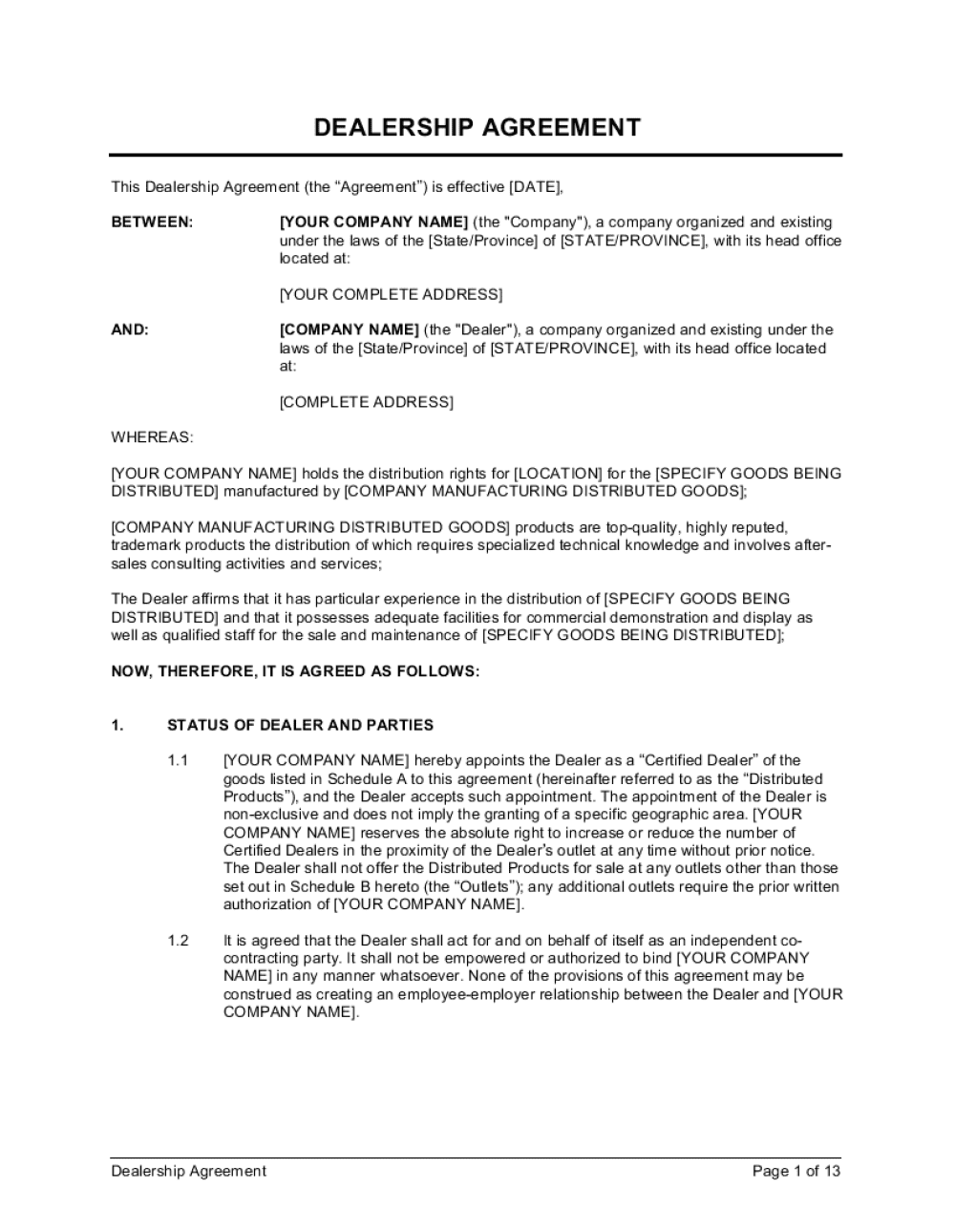
A Dealership Agreement is a legally binding contract between a manufacturer or supplier and an authorized dealer that grants the dealer the right to sell, distribute, and service the supplier's products within a defined territory. This free Word download covers exclusivity rights, pricing and discount structures, marketing obligations, performance targets, IP usage, and termination β€” in a single editable document you can export as PDF and execute on both sides.
When you need it
Use it when appointing a new dealer for a product line, expanding into a new geographic territory, or formalizing an informal distribution relationship where both parties need enforceable obligations in writing. It is equally critical for renewing or replacing an expiring dealer arrangement where territory rights and performance terms need to be reset.
What's inside
Appointment and territory clause, product and pricing schedule, exclusivity terms, performance targets and minimum purchase commitments, marketing and branding obligations, IP license, reporting requirements, termination and post-termination obligations, and governing law.

What is a Dealership Agreement?

A Dealership Agreement is a legally binding contract between a manufacturer or supplier and an authorized dealer that grants the dealer the right to sell, distribute, and service the supplier's products within a precisely defined territory. It establishes the commercial and legal framework for the entire distribution relationship β€” covering territorial exclusivity, wholesale pricing, minimum purchase commitments, marketing obligations, trademark usage, and the conditions under which either party may exit the arrangement. Unlike a simple purchase order or informal reseller relationship, a properly drafted dealership agreement creates enforceable performance obligations on both sides and provides the supplier with meaningful remedies β€” including territory conversion or termination β€” when a dealer underperforms.

Why You Need This Document

Without a written dealership agreement, the rights and obligations of both parties exist only in emails, verbal understandings, and custom β€” and courts fill those gaps with jurisdiction-specific defaults that rarely favor the supplier. A dealer who operates without a formal agreement may claim implied exclusivity, demand compensation for goodwill on exit, or continue using your brand name and trademarks after the relationship ends. Conversely, a supplier who terminates an informal dealer arrangement without documented cause or proper notice faces statutory penalties in more than 20 US states, every Canadian province with dealer-protection legislation, and across the EU. A signed dealership agreement, executed before the dealer begins operating, closes these exposures: it defines the territory with legal precision, ties exclusivity to measurable performance, protects your IP with an explicit reversion clause on termination, and gives both parties a clear, enforceable roadmap from appointment through exit. This template gives you a professionally structured starting point you can adapt in under two hours β€” and that a lawyer can review for jurisdiction-specific refinements in a single session.

Which variant fits your situation?

If your situation is…Use this template
Granting a single dealer sole rights to a territoryExclusive Dealership Agreement
Appointing multiple dealers in the same territoryNon-Exclusive Dealership Agreement
Engaging a distributor who resells to sub-dealers rather than end usersDistribution Agreement
Authorizing a reseller to bundle and add value to a software productValue-Added Reseller (VAR) Agreement
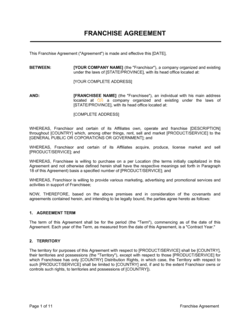
Licensing a brand to an operator who follows a defined business modelFranchise Agreement
Appointing a sales agent who earns commission but does not take title to goodsSales Agency Agreement
Formalizing a one-time product purchase rather than an ongoing deal relationshipPurchase Agreement

Common mistakes to avoid

❌ Vague territory description

Why it matters: Phrases like 'the Pacific Northwest' or 'Central Europe' have no legal precision. When a new dealer is appointed in an adjacent area, the first dealer claims overlap and litigation follows.

Fix: Define territory by specific country, state, province, or postal code list and attach a map exhibit as a schedule to the agreement.

❌ Exclusive territory with no minimum purchase commitment

Why it matters: Without a performance floor, the supplier is contractually locked out of the territory even if the dealer makes no effort to sell, potentially for years.

Fix: Tie every exclusive appointment to quarterly minimum purchase volumes. Include a conversion clause that downgrades the territory to non-exclusive automatically on two consecutive shortfalls.

❌ Prices embedded in the contract body

Why it matters: When wholesale prices change β€” as they do annually for most product lines β€” every price change requires a formal contract amendment, creating administrative burden and often triggering renegotiation of unrelated terms.

Fix: Move all pricing to a separately referenced schedule that the supplier can update on defined notice (typically 30 days) without amending the main agreement.

❌ No post-termination inventory repurchase right

Why it matters: A terminated dealer with significant branded stock can sell it through unauthorized channels, undercut the replacement dealer, and damage the brand in the territory for months.

Fix: Include a right of first refusal entitling the supplier to repurchase all unsold authorized products at the dealer's landed cost within 30 days of termination.

❌ No IP reversion clause on termination

Why it matters: Without explicit reversion language, a terminated dealer may continue using the supplier's trademarks on signage, websites, and social media β€” creating consumer confusion and diluting brand protection.

Fix: Require the dealer to cease all use of the supplier's marks immediately on termination and to update all public-facing materials within a defined period, typically 30 days.

❌ Ignoring mandatory dealer-protection statutes

Why it matters: Many US states, EU member states, and Canadian provinces have dealer-protection or franchise laws that impose minimum notice periods, goodwill compensation, and inventory repurchase obligations regardless of what the contract says β€” breaching them exposes the supplier to statutory penalties.

Fix: Research the mandatory dealer-protection laws in every jurisdiction where a dealer operates before finalizing termination and notice-period clauses. Have local counsel review the agreement for each jurisdiction.

The 10 key clauses, explained

Appointment and authorized territory

In plain language: Identifies the dealer, defines the exact geographic territory, lists the authorized products, and states whether the appointment is exclusive or non-exclusive.

Sample language
[SUPPLIER NAME] hereby appoints [DEALER NAME] as its [exclusive / non-exclusive] authorized dealer for the sale and distribution of the Authorized Products within the territory of [TERRITORY DESCRIPTION] ('Territory'), commencing [START DATE].

Common mistake: Describing the territory vaguely β€” for example, 'the northeastern region' instead of listing specific states or postal codes. Ambiguous territory definitions are the single most litigated clause in dealership disputes.

Product schedule and pricing

In plain language: Lists the specific products the dealer may sell, the wholesale price or discount off SRP, and the mechanism for updating prices with advance notice.

Sample language
The Authorized Products and applicable Dealer Pricing are set out in Schedule A, which may be updated by [SUPPLIER NAME] with no less than [30] days' written notice. Dealer shall not resell Authorized Products below [X]% of the then-current SRP without prior written approval.

Common mistake: Locking specific prices into the contract body instead of a separately updatable schedule. When supplier costs change, the main contract must be amended rather than simply issuing a new schedule.

Exclusivity and non-compete obligations

In plain language: States whether the dealer has exclusive rights in the territory, and whether the dealer must refrain from selling competing products during the term.

Sample language
During the Term, [SUPPLIER NAME] shall not appoint any other dealer for the Authorized Products within the Territory. Dealer agrees not to directly or indirectly market, distribute, or sell any Competing Products [as defined in Schedule B] within the Territory without prior written consent.

Common mistake: Granting exclusivity without a corresponding minimum purchase commitment. An exclusive territory with no performance floor locks the supplier out of the territory regardless of the dealer's effort.

Minimum purchase commitments and performance targets

In plain language: Sets the minimum units or dollar value the dealer must purchase each period and the performance metrics β€” market share, customer satisfaction scores β€” the dealer must meet to retain the appointment.

Sample language
Dealer shall purchase no less than [X UNITS / $X] of Authorized Products per [quarter / year] ('Minimum Commitment'). Failure to meet the Minimum Commitment in any two consecutive periods entitles [SUPPLIER NAME] to convert the appointment from exclusive to non-exclusive upon [30] days' notice.

Common mistake: Setting a single annual commitment with no quarterly checkpoints. A dealer can miss the target for three quarters and catch up in Q4 β€” the supplier has no mechanism to act earlier.

Marketing, branding, and MDF

In plain language: Obligates the dealer to actively promote the supplier's brand within the territory, sets standards for how the supplier's trademarks may be used, and defines any co-op marketing fund available to the dealer.

Sample language
Dealer shall spend no less than [X]% of annual Dealer net revenue on marketing the Authorized Products within the Territory. [SUPPLIER NAME] shall contribute a Marketing Development Fund of up to $[X] per [quarter], reimbursable against approved activities per the MDF Policy in Schedule C.

Common mistake: Omitting brand usage guidelines from the agreement entirely and relying on verbal direction. Unauthorized trademark use by a dealer can weaken the supplier's brand protection in disputes with third parties.

Ordering, delivery, and inventory

In plain language: Sets out the purchase order process, lead times, delivery terms (Incoterms for cross-border deals), minimum stocking requirements, and who bears the risk of loss in transit.

Sample language
Dealer shall submit purchase orders in writing with no less than [X] days' lead time. Delivery terms are [FOB / CIF / DDP] [LOCATION]. Dealer shall maintain a minimum inventory of [X] units of each Authorized Product at all times.

Common mistake: Omitting Incoterms entirely on cross-border arrangements. Without a defined delivery term, risk of loss in transit is disputed by both parties when goods are damaged or delayed in customs.

Intellectual property license

In plain language: Grants the dealer a limited, non-transferable license to use the supplier's trademarks, logos, and marketing materials solely to sell the authorized products, and makes clear that no IP ownership passes to the dealer.

Sample language
[SUPPLIER NAME] grants Dealer a limited, non-exclusive, non-transferable license to use the Marks solely in connection with the marketing and sale of Authorized Products within the Territory during the Term. Dealer acquires no ownership interest in any Mark or other intellectual property of [SUPPLIER NAME].

Common mistake: No IP reversion clause on termination. Without it, a terminated dealer may continue using the supplier's trademarks β€” creating consumer confusion and potentially diluting the brand.

Reporting and audit rights

In plain language: Requires the dealer to submit regular sales reports and gives the supplier the right to audit the dealer's books to verify performance against targets and pricing compliance.

Sample language
Dealer shall provide [SUPPLIER NAME] with monthly sales reports in the format prescribed in Schedule D within [10] business days of month-end. [SUPPLIER NAME] may audit Dealer's relevant records upon [15] days' written notice, no more than once per calendar year.

Common mistake: No audit right at all, or one that requires 90 days' notice. Without a realistic audit mechanism, minimum purchase commitments and pricing compliance are unverifiable.

Term, termination, and consequences

In plain language: States the initial term, renewal conditions, notice periods for termination with and without cause, and what happens to inventory, IP, and customer relationships after termination.

Sample language
This Agreement commences on [START DATE] and continues for [X] year(s) ('Initial Term'), renewing automatically for successive [1]-year periods unless either party gives [90] days' written notice. [SUPPLIER NAME] may terminate immediately for cause including material breach, insolvency, or conviction of a relevant offence. On termination, Dealer shall cease all use of the Marks and [SUPPLIER NAME] may exercise its right of first refusal over remaining inventory at Dealer's landed cost.

Common mistake: No post-termination inventory repurchase right. A terminated dealer sitting on $200,000 of branded inventory can dump it through gray market channels, undercutting the supplier's replacement dealer before they launch.

Governing law and dispute resolution

In plain language: Specifies which jurisdiction's law governs the agreement and how disputes are resolved β€” arbitration, mediation, or litigation β€” and where.

Sample language
This Agreement is governed by the laws of [STATE / PROVINCE / COUNTRY], without regard to its conflict-of-law principles. Any dispute shall be resolved by binding arbitration administered by [AAA / ICC / LCIA] in [CITY], conducted in [LANGUAGE], except that either party may seek injunctive relief in any court of competent jurisdiction.

Common mistake: Choosing a governing law with no connection to where the dealer operates. Several jurisdictions β€” particularly EU member states β€” apply mandatory dealer-protection statutes regardless of any contractual choice of law.

How to fill it out

  1. 1

    Identify parties and define the authorized territory precisely

    Enter both parties' full registered legal names and addresses. Define the territory using specific geographic identifiers β€” country, state, province, or a list of postal codes β€” not directional descriptions like 'the south' or 'the western region.'

    πŸ’‘ Attach a map exhibit if the territory boundary is not a standard administrative division. A visual boundary eliminates ambiguity in later disputes.

  2. 2

    Complete the product and pricing schedule

    List every authorized product by SKU or model number in Schedule A. Enter the wholesale price or discount percentage off SRP for each product and the notice period the supplier must give before changing prices.

    πŸ’‘ Keep pricing in a separate schedule, not the contract body β€” this lets you update prices by issuing a new schedule rather than amending the main agreement.

  3. 3

    Choose exclusivity terms and match them to performance commitments

    Decide whether the appointment is exclusive or non-exclusive. If exclusive, set minimum purchase commitments with quarterly checkpoints and specify what happens β€” non-exclusive conversion or termination β€” if the dealer misses two consecutive periods.

    πŸ’‘ Exclusivity without a performance floor is a commercial trap for the supplier. Every exclusive territory must have a measurable commitment attached.

  4. 4

    Set performance targets and review periods

    Define annual and quarterly minimum purchase volumes or revenue targets. Add at least one quarterly performance review date in the calendar and specify the written notice process if targets are missed.

    πŸ’‘ Express targets in units and dollars. Unit targets catch volume-padding through discounting; dollar targets protect revenue.

  5. 5

    Define marketing obligations and MDF terms

    State the percentage of net revenue the dealer must spend on local marketing. If a Marketing Development Fund applies, define the annual or quarterly cap, the approval process, and the reimbursement timeline.

    πŸ’‘ Require pre-approval for all MDF-funded activities to prevent reimbursement claims for unapproved spend.

  6. 6

    Draft the IP license and brand-use restrictions

    Grant a limited, non-transferable trademark license tied to the term. Attach brand guidelines as an exhibit and include an explicit reversion clause requiring the dealer to stop using all marks immediately on termination.

    πŸ’‘ Include a clause requiring the dealer to update directory listings, website copy, and signage within 30 days of termination to prevent residual brand confusion.

  7. 7

    Complete the term, termination, and inventory provisions

    Set the initial term (typically 1–3 years), automatic renewal conditions, notice periods for termination with and without cause, and the supplier's right of first refusal over remaining inventory on termination.

    πŸ’‘ In jurisdictions with dealer-protection statutes (many US states, EU, Canada), statutory notice minimums may override contractual notice periods β€” confirm before setting the termination clause.

  8. 8

    Select governing law and dispute resolution mechanism

    Choose a governing law that has a real connection to where the dealer operates. Decide between arbitration (confidential, faster for cross-border) and litigation. Specify the seat, language, and institutional rules.

    πŸ’‘ For international deals, institutional arbitration (ICC, LCIA, or AAA-ICDR) is almost always preferable to litigation β€” enforcement of court judgments across borders is far more complex than enforcement of arbitral awards under the New York Convention.

Frequently asked questions

What is a dealership agreement?

A dealership agreement is a contract between a manufacturer or supplier and an authorized dealer that grants the dealer the right to sell, distribute, and service the supplier's products within a defined territory. It sets out pricing, exclusivity, performance targets, marketing obligations, IP usage rights, and the conditions for terminating the relationship. It creates enforceable obligations on both parties and replaces informal understandings as the governing document for the distribution relationship.

What is the difference between a dealership agreement and a distribution agreement?

A dealer typically sells directly to end consumers or businesses within a defined territory and often provides after-sales service. A distributor buys in bulk from the supplier and resells to sub-dealers or retailers rather than end users. Distributors take title to goods and carry inventory risk; agents do not. A distribution agreement governs the wholesale relationship between supplier and distributor, while a dealership agreement governs the retail or end-user-facing relationship. Many supply chains use both.

What should a dealership agreement include?

At minimum: the parties' legal names, an exact territory definition, a list of authorized products and pricing schedule, exclusivity terms, minimum purchase commitments with consequences for non-performance, marketing and branding obligations, a limited trademark license, ordering and delivery terms, reporting and audit rights, term and termination provisions including post-termination inventory and IP obligations, and governing law and dispute resolution. Missing any of these creates gaps courts or arbitrators will fill with jurisdiction-specific defaults.

Can a dealership agreement be terminated early?

Yes, most dealership agreements allow termination for cause β€” such as material breach, insolvency, or failure to meet performance targets β€” on shorter notice or immediately. Termination without cause typically requires a notice period of 30 to 90 days depending on the agreement and the jurisdiction. In many US states, Canada, and the EU, mandatory dealer-protection statutes impose minimum notice periods that override shorter contractual terms, and some require compensation for goodwill on termination regardless of the contract's provisions.

Is exclusivity enforceable in a dealership agreement?

Exclusivity clauses are generally enforceable when the territory is precisely defined and the dealer has corresponding performance obligations. Courts and competition regulators look critically at exclusive arrangements that foreclose competition in a substantial market segment. In the EU, exclusive distribution agreements must comply with the Vertical Block Exemption Regulation. In the US, exclusive dealing arrangements are assessed under antitrust law β€” particularly where the supplier has significant market share. Seek legal advice before granting broad exclusivity in any major market.

What are minimum purchase commitments in a dealership agreement?

Minimum purchase commitments are the contractual floor of orders the dealer must place with the supplier in each period β€” typically expressed as a unit count or dollar value per quarter or year. They protect the supplier from being locked out of an exclusive territory by an underperforming dealer. Consequences for missing commitments typically include conversion of an exclusive territory to non-exclusive, a right of termination for cause, or both. Setting quarterly rather than only annual checkpoints gives the supplier earlier remedies.

Do I need a lawyer to draft a dealership agreement?

For straightforward domestic dealer appointments within a single state or province, a high-quality template is a solid starting point. Engage a lawyer when the deal involves cross-border distribution, exclusive territories in jurisdictions with mandatory dealer-protection statutes, significant product liability exposure, or material IP licensing components. A 2–3 hour legal review typically costs $600–$1,500 and is worthwhile for any appointment covering a territory with meaningful annual revenue.

What happens to unsold inventory when a dealership agreement ends?

Without a specific provision, the dealer retains the inventory and may sell it however they choose β€” including through unauthorized channels. A well-drafted agreement includes a supplier right of first refusal to repurchase unsold authorized products at the dealer's landed cost within a defined window, typically 30 days after termination. Some jurisdictions impose a statutory obligation on suppliers to repurchase inventory on termination without cause, regardless of what the contract says.

What governing law should I choose for an international dealership agreement?

Choose a governing law with a genuine connection to one of the parties or the territory of performance. For international deals, neutral jurisdictions with well-developed commercial law β€” England and Wales, New York, or Singapore β€” are commonly chosen. Be aware that several jurisdictions apply mandatory dealer-protection or franchise statutes regardless of any contractual choice of law, so the chosen law governs the contract's interpretation but may not override local statutory protections for the dealer.

How this compares to alternatives

vs Distribution Agreement

A distribution agreement governs a wholesaler who buys in bulk from the supplier and resells to sub-dealers or retailers rather than end users. A dealership agreement governs a dealer who sells directly to end consumers or businesses and often provides after-sales service. The key distinction is who the dealer's customer is β€” another business in the supply chain or the end user of the product.

vs Sales Agency Agreement

A sales agent solicits orders on behalf of the supplier but never takes title to the goods β€” the supplier contracts directly with the end customer and pays the agent a commission. A dealer buys the products outright, takes title, and carries inventory risk. Agency relationships have significant tax and employment-law implications in the EU and UK that dealer relationships typically do not.

vs Franchise Agreement

A franchise agreement licenses both a brand and a complete business system β€” operating procedures, training, marketing, and quality standards β€” in exchange for ongoing royalties. A dealership agreement licenses only the right to sell specific products in a territory and does not typically impose a full operating system on the dealer. Franchise relationships are also subject to dedicated franchise disclosure laws in the US, Canada, and Australia that dealership agreements are not.

vs Purchase Agreement

A purchase agreement governs a single transaction β€” one buyer purchasing a defined quantity of goods from a seller on agreed terms. A dealership agreement creates an ongoing relationship authorizing repeated purchases, territory exclusivity, and performance obligations over a defined term. Use a purchase agreement for one-off or spot transactions; use a dealership agreement when you need a structured, multi-year distribution relationship.

Industry-specific considerations

Automotive

Franchise dealer networks require detailed facility standards, warranty service obligations, manufacturer-mandated pricing floors, and statutory dealer-protection laws that vary significantly by US state.

Manufacturing

Industrial equipment dealers often carry spare-parts stocking requirements, certified technician obligations, and warranty repair protocols that must be incorporated into the performance and service sections.

Technology / Hardware

Value-added resellers and hardware dealers need clear IP license scope covering demo units and bundled software, plus data-security and customer-privacy obligations tied to product registration and support portals.

Consumer Goods / Retail

Retail dealer agreements must address planogram compliance, seasonal minimum orders, return and markdown allowances, and co-branded promotional materials β€” and must avoid resale price maintenance provisions that breach competition law.

Jurisdictional notes

United States

More than 20 US states have franchise or dealer-protection statutes that impose mandatory notice periods, cause requirements for termination, and inventory repurchase obligations β€” regardless of the contract's terms. Automotive dealers are additionally protected by state franchise laws that severely restrict manufacturer termination rights. Resale price maintenance is a per se antitrust violation under federal law; suggested retail prices must be genuinely non-binding.

Canada

Several Canadian provinces β€” including Ontario, Alberta, and Prince Edward Island β€” have enacted Arthur Wishart Act-style franchise disclosure legislation that may apply to certain dealership arrangements. Common-law good faith obligations in contract performance are more actively enforced in Canada than in most US states. Quebec's Civil Code applies to dealer agreements with Quebec-based dealers and may impose obligations not found in common-law provinces. Minimum notice for termination without cause is assessed against the length and nature of the relationship.

United Kingdom

Post-Brexit, the UK applies its own Vertical Agreements Block Exemption Order (VABEO), which follows EU principles but operates independently. Commercial agents (but not dealers who take title to goods) are protected by the Commercial Agents Regulations 1993, which entitle agents to compensation or indemnity on termination β€” a distinction that makes the dealer vs. agent classification critically important. English courts will generally enforce a chosen governing law clause between commercial parties.

European Union

EU Vertical Block Exemption Regulation (VBER) 2022 governs the legality of exclusivity, non-compete, and territorial restriction clauses in dealer agreements β€” both parties must have market shares below 30% for the block exemption to apply automatically. Several EU member states have mandatory dealer-protection or commercial agent statutes that require goodwill compensation or minimum notice regardless of the contract. GDPR obligations must be addressed where dealer operations involve processing EU consumer personal data.

Template vs lawyer β€” what fits your deal?

PathBest forCostTime
Use the templateDomestic dealer appointments in a single jurisdiction with straightforward territory and standard pricingFree1–2 hours
Template + legal reviewExclusive territory appointments, cross-border deals, or jurisdictions with known dealer-protection statutes$600–$1,5003–5 business days
Custom draftedMulti-territory international dealer networks, automotive or regulated-industry franchised dealers, or agreements with material IP licensing and product liability exposure$3,000–$10,000+2–4 weeks

Glossary

Dealer Territory
The defined geographic area within which the dealer is authorized to sell and distribute the supplier's products.
Exclusivity
A contractual promise by the supplier not to appoint any other dealer within the same territory for the same product line.
Minimum Purchase Commitment
The minimum dollar or unit volume the dealer must order from the supplier in each contract period to retain territory rights.
Suggested Retail Price (SRP)
The price the supplier recommends the dealer charge end customers β€” the dealer is typically free to deviate, subject to local competition law.
Resale Price Maintenance (RPM)
A supplier's attempt to fix the price at which a dealer resells products β€” generally prohibited under competition law in most jurisdictions.
Marketing Development Fund (MDF)
A pool of funds provided or co-funded by the supplier to reimburse the dealer for approved local advertising and promotional activities.
Authorized Products
The specific products or product lines listed in the agreement that the dealer is permitted to sell under the dealership arrangement.
Trademark License
Permission granted by the supplier for the dealer to use the supplier's brand names, logos, and marks solely to market and sell the authorized products.
Gray Market
Products sold through unauthorized channels or imported outside the supplier's official distribution network, often undercutting authorized dealer pricing.
Post-Termination Tail
A defined period after the agreement ends during which certain obligations β€” such as confidentiality, non-solicitation, or stock return rights β€” continue to apply.
Right of First Refusal
A clause giving the supplier the option to repurchase unsold inventory from a dealer at cost before the dealer may sell it to third parties on termination.
Performance Review Period
A scheduled interval β€” typically quarterly or annually β€” at which the supplier assesses whether the dealer has met agreed sales targets and minimum commitments.

Part of your Business Operating System

This document is one of 3,000+ business & legal templates included in Business in a Box.

  • Fill-in-the-blanks β€” ready in minutes
  • 100% customizable Word document
  • Compatible with all office suites
  • Export to PDF and share electronically

Create your document in 3 simple steps.

From template to signed document β€” all inside one Business Operating System.
1
Download or open template

Access over 3,000+ business and legal templates for any business task, project or initiative.

2
Edit and fill in the blanks with AI

Customize your ready-made business document template and save it in the cloud.

3
Save, Share, Send, Sign

Share your files and folders with your team. Create a space of seamless collaboration.

Save time, save money, and create top-quality documents.

β˜…β˜…β˜…β˜…β˜…

"Fantastic value! I'm not sure how I'd do without it. It's worth its weight in gold and paid back for itself many times."

Managing Director Β· Mall Farm
Robert Whalley
Managing Director, Mall Farm Proprietary Limited
β˜…β˜…β˜…β˜…β˜…

"I have been using Business in a Box for years. It has been the most useful source of templates I have encountered. I recommend it to anyone."

Business Owner Β· 4+ years
Dr Michael John Freestone
Business Owner
β˜…β˜…β˜…β˜…β˜…

"It has been a life saver so many times I have lost count. Business in a Box has saved me so much time and as you know, time is money."

Owner Β· Upstate Web
David G. Moore Jr.
Owner, Upstate Web

Run your business with a system β€” not scattered tools

Stop downloading documents. Start operating with clarity. Business in a Box gives you the Business Operating System used by over 250,000 companies worldwide to structure, run, and grow their business.

Free Forever PlanΒ Β·Β No credit card required