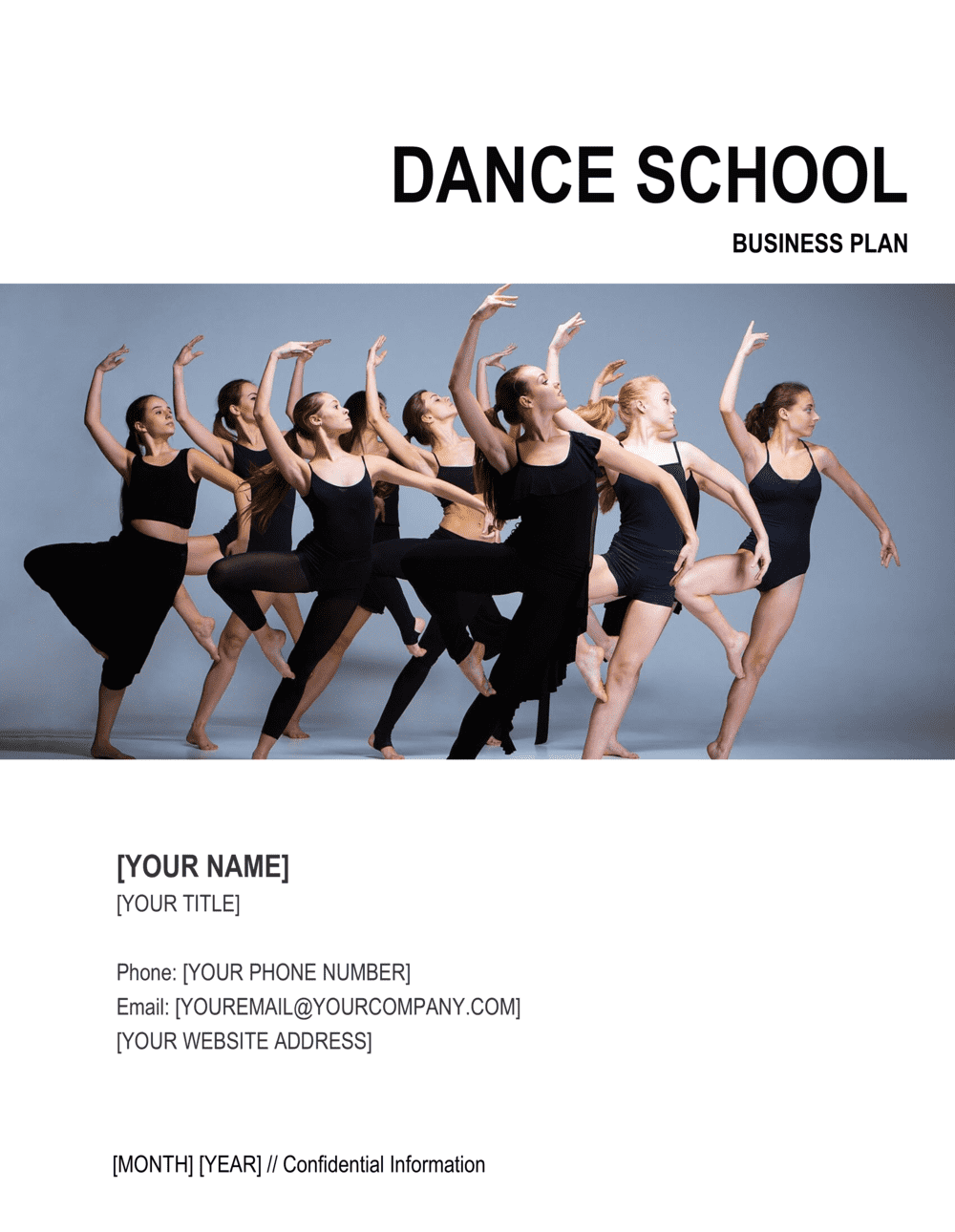
Dance School Business Plan Template

Free Word download β€’ Edit online β€’ Save & share with Drive β€’ Export to PDF

28 pagesβ€’2h 25m – 3h 15m to fillβ€’Difficulty: Expert
Learn more ↓
FreeDance School Business Plan Template

At a glance

What it is
A Dance School Business Plan is a structured document that maps your studio's concept, target student base, class offerings, pricing model, marketing approach, staffing plan, and 3-year financial projections into a single reference document. This free Word download gives you a ready-to-edit framework you can complete online and export as PDF to share with lenders, landlords, or investors.
When you need it
Use it when opening a new dance school, applying for a small business loan or studio lease, seeking an investor or silent partner, or restructuring an existing studio around a defined growth strategy.
What's inside
Executive summary, company overview, market and competitive analysis, class and program offerings, pricing and revenue model, marketing and enrollment strategy, operations and staffing plan, and 3-year financial projections including revenue, expenses, and cash flow.

What is a Dance School Business Plan?

A Dance School Business Plan is a structured operational document that defines every material dimension of running a dance studio: the class offerings and schedule, target student demographics, local competitive landscape, pricing and tuition model, instructor staffing plan, marketing and enrollment strategy, and 3-year financial projections. Unlike a generic business plan template, it accounts for the operational realities specific to a dance studio β€” seasonal enrollment patterns, recital revenue cycles, music licensing obligations, class utilization rates, and trial-class conversion funnels. The result is a document that functions as both an internal roadmap and a credible submission for lenders, landlords, and investors evaluating your studio's financial viability.

Why You Need This Document

Opening a dance school without a written plan is the single most common reason new studios run out of cash before their first recital. Without a documented breakeven enrollment number, owners often sign leases and hire instructors before they know how many students they need to cover fixed costs β€” and by the time they find out, the gap is already a crisis. Lenders and commercial landlords routinely reject applicants who present only an idea and a passion for dance; they require a formal plan with realistic cash flow projections before extending credit or lease terms. A complete dance school business plan forces you to stress-test your tuition rates, model student attrition, and identify how long your capital will last at 50% enrollment β€” turning expensive surprises into solvable planning problems before you spend a dollar on buildout. This template gives you the structure to build that plan in 2–3 weeks instead of starting from a blank page.

Which variant fits your situation?

If your situation is…Use this template
Opening a brand-new standalone dance studioDance School Business Plan
Seeking a bank loan or SBA financing for studio buildoutBank Loan Business Plan
Quick concept validation before committing to a leaseOne-Page Business Plan
Launching a restaurant or cafΓ© with dance eventsRestaurant Business Plan
Running a nonprofit community dance programNonprofit Business Plan
Planning a broader fitness or wellness center with dance classesFitness Center Business Plan
Expanding an existing studio into a second locationBusiness Expansion Plan

Common mistakes to avoid

❌ Projecting enrollment from capacity rather than demand

Why it matters: Assuming classes fill to 80% within the first two months almost always leads to a cash shortfall by Month 3, when real enrollment is still at 30–40%.

Fix: Build a conservative ramp: 30% fill rate in Months 1–2, 55% by Month 4, 75% by Month 8. Model cash flow at each stage to confirm you have enough runway.

❌ Underpricing to compete with rec centers

Why it matters: Rec center programs operate at subsidized overhead. Matching their prices with a private studio's cost structure means you never reach breakeven.

Fix: Price to your own cost structure and differentiate on quality, instructor credentials, or studio environment β€” not on being the cheapest option.

❌ Ignoring music licensing in the cost model

Why it matters: Operating without ASCAP and BMI blanket licenses exposes the studio to copyright infringement claims that can exceed $10,000 per incident.

Fix: Budget for both ASCAP and BMI annual blanket licenses β€” combined cost is typically $400–$700/year for a small studio β€” and include them in Year 1 fixed costs.

❌ Omitting attrition from the financial model

Why it matters: A model that only adds students and never accounts for students leaving overstates revenue by Month 6 and makes the business appear profitable when it is not.

Fix: Apply a monthly attrition rate of 3–5% to your enrolled student count in every month of the projection and model new enrollment needed to offset it.

❌ No owner salary in the expense model

Why it matters: A plan that excludes owner compensation looks profitable on paper but creates a personal cash crisis the moment the owner needs to draw income.

Fix: Include a line item for owner salary from Month 1, even if it starts below market rate. This gives an honest picture of when the business can sustain the owner financially.

❌ Launching with too many dance styles at once

Why it matters: Offering 8 styles at launch spreads marketing budget across too many audiences, dilutes the studio's brand identity, and requires more instructors than early revenue can support.

Fix: Launch with 2–3 core styles that match demonstrable local demand, then add styles in Year 2 based on waitlist and trial class data.

The 9 key sections, explained

Executive Summary

Company Overview

Market and Competitive Analysis

Class and Program Offerings

Pricing and Revenue Model

Marketing and Enrollment Strategy

Operations and Staffing Plan

Management Team

Financial Projections

How to fill it out

  1. 1

    Write the company overview and mission first

    Enter your legal business name, entity type, location, and a one-sentence mission that states what styles you teach, who you serve, and the outcome you create for students.

    πŸ’‘ Locking down the company overview first prevents scope drift β€” every subsequent section should connect back to this foundation.

  2. 2

    Research your local market and competitors

    Identify all dance schools within a 10-mile radius. Note their styles, age ranges, pricing, and Google review sentiment. Then define the gap your studio fills β€” style, age group, price point, or scheduling.

    πŸ’‘ Check local rec center and YMCA schedules too β€” they are often the primary competition for beginner and preschool enrollment.

  3. 3

    Define your class schedule and program offerings

    List every class type, age group, session length, and day/time slot you plan to offer at launch. Calculate total available student slots per week.

    πŸ’‘ Start with 60–70% of your intended long-term schedule. Launching at full capacity before you have demand drives instructor payroll ahead of tuition income.

  4. 4

    Set tuition rates using a cost-first approach

    Calculate your total monthly fixed costs (rent, utilities, insurance, software, music licensing), then determine how many enrolled students at your target monthly rate covers those costs plus a 20% margin.

    πŸ’‘ If your minimum viable enrollment number exceeds what local competitors charge at their break-even, you have a location or cost structure problem β€” not a pricing problem.

  5. 5

    Build the enrollment and marketing funnel

    Choose two to three primary acquisition channels. Estimate the cost per trial class lead, your trial-to-enrollment conversion rate (industry average: 40–60%), and the monthly enrollment volume each channel can realistically generate.

    πŸ’‘ A strong referral program β€” one month free tuition for each new enrolled family referred β€” typically yields the lowest CAC of any channel for dance schools.

  6. 6

    Model staffing costs against projected class fill rates

    Map each class slot to an instructor, their hourly rate, and the number of students needed to make that class profitable. Flag any class that requires 8+ students to break even β€” those are your highest-risk slots.

    πŸ’‘ Pay instructors a per-class flat rate rather than hourly when possible β€” it aligns their incentive with attendance and simplifies payroll.

  7. 7

    Build the three-year financial projection

    Model monthly revenue from each class type based on projected fill rates, add recital and ancillary revenue, subtract all fixed and variable expenses, and calculate net cash flow. Summarize Years 2 and 3 annually.

    πŸ’‘ Include a separate row for owner salary β€” omitting it makes the business look more profitable than it is and produces a cash shortfall the moment you start paying yourself.

  8. 8

    Write the executive summary last

    Pull the strongest data point from each section β€” enrollment target, breakeven number, funding ask, and competitive advantage β€” and compress them into one to two pages.

    πŸ’‘ The executive summary is the only section a busy lender may read in full. If it doesn't include a specific breakeven student count and a clear funding use, add them before sending.

Frequently asked questions

What is a dance school business plan?

A dance school business plan is a structured document that defines your studio's concept, target students, class offerings, pricing model, marketing strategy, staffing plan, and financial projections. It serves as both a strategic operating roadmap and the formal document lenders, landlords, and investors request when evaluating your studio's viability.

Do I need a business plan to open a dance school?

You are not legally required to have one, but any lender, commercial landlord, or investor will ask for it. Beyond capital access, a written plan forces you to calculate your breakeven enrollment number, stress-test your pricing, and map your first-year cash flow β€” decisions that are far cheaper to get wrong on paper than in a live studio.

How many students does a dance school need to break even?

Breakeven depends on your rent, instructor costs, and monthly tuition rate. A small studio with $4,000/month in fixed costs and $80/month average tuition needs 50 enrolled students to cover fixed costs alone. Add variable costs (instructor pay per class, supplies) and most small studios target 60–100 enrolled students for a sustainable first-year operation. Model your own number in the financial projections section.

What financial projections should a dance school business plan include?

At minimum: monthly revenue by class type, monthly fixed and variable expenses, net cash flow, and cumulative cash position for Year 1, plus annual summaries for Years 2 and 3. Also include a breakeven analysis that states the exact enrolled student count needed to cover all costs, and a sensitivity table showing results at 70% of projected enrollment.

How long should a dance school business plan be?

For a bank loan or investor presentation, 15–25 pages plus a financial model appendix is the standard range. For internal planning or a landlord's review, 10–15 pages is typically sufficient. A one-page plan works for early concept validation but is insufficient for any formal capital application.

What makes a dance school business plan different from a general business plan?

A dance school plan requires industry-specific detail that a generic template omits: class utilization rates, trial-to-enrollment conversion benchmarks, recital revenue modeling, music licensing costs, instructor pay structures, and seasonal enrollment patterns. Generic financial assumptions (uniform monthly revenue, no attrition) consistently underestimate the operational complexity of running a studio.

Can I use this template for a dance franchise application?

Yes, with modifications. Most dance franchises provide a required plan format or supplemental questions β€” complete those first, then use this template to build out the financial model, competitive analysis, and operations sections that franchisors expect but rarely template for you.

How do I estimate revenue for a new dance school?

Build from class capacity up: multiply each class's maximum student capacity by a realistic fill rate (30% in Month 1, scaling to 75–80% by Month 10), then multiply by the monthly tuition rate for that class type. Sum across all classes for total monthly tuition revenue, then add recital fees, registration fees, and retail sales as separate line items.

Should I include a marketing budget in my dance school business plan?

Yes β€” and it should be specific. List each acquisition channel, the estimated monthly spend, the expected number of trial class leads it generates, your trial-to-enrollment conversion rate, and the resulting cost per enrolled student. A plan that says 'social media marketing' without a dollar amount or expected return signals to lenders that enrollment growth is hoped for rather than planned.

How this compares to alternatives

vs General Business Plan

A general business plan template provides the structural framework but omits dance-specific metrics such as class utilization rates, recital revenue, music licensing costs, and trial conversion benchmarks. Use this dance school template when your audience understands studio economics; use the general template only if you need to adapt the format to a non-arts audience.

vs One-Page Business Plan

A one-page plan is a rapid alignment tool for testing a concept internally. It lacks the financial depth and competitive analysis that a landlord, bank, or investor requires. Use it to pressure-test your concept before investing the time to build the full dance school plan.

vs Nonprofit Business Plan

A nonprofit plan structures funding around grants, donations, and program fees rather than tuition-based revenue. Use it when your dance school operates as a 501(c)(3) community arts organization. For a for-profit studio β€” even one with community programming β€” the dance school template's revenue model is more appropriate.

vs Marketing Plan

A marketing plan focuses exclusively on student acquisition strategy β€” channels, messaging, budget, and KPIs. A business plan contains a marketing section but also covers operations, financials, and the full competitive context. Build the business plan first; the marketing plan then executes the enrollment strategy section in greater detail.

Industry-specific considerations

Performing Arts Education

Recital revenue, competition team fees, and seasonal enrollment spikes around registration windows require multi-period cash flow modeling distinct from year-round subscription businesses.

Fitness and Wellness

Adult dance fitness programs (Zumba, barre, hip-hop cardio) blend studio and fitness business models, requiring both class utilization metrics and membership retention benchmarks.

Franchise and Multi-Location

Franchise dance concepts require territory analysis, franchisor royalty modeling, and compliance with the franchisor's required financial statement format.

Nonprofit and Community Arts

Community dance academies relying on grant funding must model earned income (tuition) separately from contributed income (grants, donations) and demonstrate a path to earned-income sustainability.

Template vs pro β€” what fits your needs?

PathBest forCostTime
Use the templateDance teachers opening a first studio, sole proprietors applying for a small business loan under $200KFree2–3 weeks (30–50 hours)
Template + professional reviewFirst-time business owners who need a financial model sanity-check before a bank submission or lease negotiation$300–$800 for a small-business advisor or accountant review3–4 weeks
Custom draftedMulti-location studio concepts, franchise territory acquisitions, or raises above $250K from institutional lenders$2,000–$6,000 for a professional business plan writer with arts or franchise experience4–6 weeks

Glossary

Revenue per Student
Total monthly revenue divided by the number of active enrolled students β€” a core unit-economics metric for a dance school.
Class Utilization Rate
The percentage of available class spots filled across all sessions; a rate below 60% typically signals a pricing or scheduling problem.
Enrollment Funnel
The sequence of steps a prospective student takes from first awareness to paid registration, including trials, tours, and follow-up touchpoints.
Trial Class Conversion Rate
The share of students who take a free or discounted trial class and subsequently enroll in a paid program.
Recital Revenue
Income generated from annual or seasonal showcase events, including ticket sales, costume fees, and photography packages.
Drop-in Rate
A per-class fee charged to students who attend without a recurring enrollment commitment β€” typically priced 30–50% above the per-class equivalent of a monthly package.
Studio Overhead
Fixed monthly costs regardless of enrollment: rent, utilities, insurance, music licensing (ASCAP/BMI), and software subscriptions.
Attrition Rate
The percentage of enrolled students who discontinue their classes in a given month or term β€” the inverse of retention rate.
Minimum Viable Enrollment
The number of paying students needed each month to cover all fixed and variable costs and reach break-even.
Multi-Program Household
A family with more than one student enrolled, which increases lifetime value and reduces per-student marketing cost.

Part of your Business Operating System

This document is one of 3,000+ business & legal templates included in Business in a Box.

  • Fill-in-the-blanks β€” ready in minutes
  • 100% customizable Word document
  • Compatible with all office suites
  • Export to PDF and share electronically

Create your document in 3 simple steps.

From template to signed document β€” all inside one Business Operating System.
1
Download or open template

Access over 3,000+ business and legal templates for any business task, project or initiative.

2
Edit and fill in the blanks with AI

Customize your ready-made business document template and save it in the cloud.

3
Save, Share, Send, Sign

Share your files and folders with your team. Create a space of seamless collaboration.

Save time, save money, and create top-quality documents.

β˜…β˜…β˜…β˜…β˜…

"Fantastic value! I'm not sure how I'd do without it. It's worth its weight in gold and paid back for itself many times."

Managing Director Β· Mall Farm
Robert Whalley
Managing Director, Mall Farm Proprietary Limited
β˜…β˜…β˜…β˜…β˜…

"I have been using Business in a Box for years. It has been the most useful source of templates I have encountered. I recommend it to anyone."

Business Owner Β· 4+ years
Dr Michael John Freestone
Business Owner
β˜…β˜…β˜…β˜…β˜…

"It has been a life saver so many times I have lost count. Business in a Box has saved me so much time and as you know, time is money."

Owner Β· Upstate Web
David G. Moore Jr.
Owner, Upstate Web

Run your business with a system β€” not scattered tools

Stop downloading documents. Start operating with clarity. Business in a Box gives you the Business Operating System used by over 250,000 companies worldwide to structure, run, and grow their business.

Start freeΒ Β·Β No credit card required