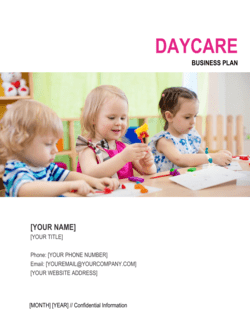
Daycare Business Plan 2 Template

Free Word download β€’ Edit online β€’ Save & share with Drive β€’ Export to PDF

32 pagesβ€’2h 40m – 3h 35m to fillβ€’Difficulty: Expert
Learn more ↓
FreeDaycare Business Plan 2 Template

At a glance

What it is
A Daycare Business Plan is a structured planning document that maps your childcare center's mission, licensing requirements, enrollment capacity, staffing model, curriculum approach, and financial projections into a single investor- and lender-ready file. This free Word download gives you a professionally formatted starting point you can edit online and export as PDF for banks, licensing boards, or investors.
When you need it
Use it when launching a new daycare center or in-home childcare operation, applying for an SBA loan or small business grant, or seeking a state childcare license that requires a formal business plan submission.
What's inside
Executive summary, company overview and legal structure, market and demographic analysis, facility and licensing plan, staffing and staff-to-child ratio model, curriculum and program offerings, marketing and enrollment strategy, and 3-year financial projections including tuition revenue, payroll, and operating expenses.

What is a Daycare Business Plan?

A Daycare Business Plan is a structured operational and financial document that maps every dimension of a licensed childcare operation β€” from facility layout and state licensing requirements to staff-to-child ratios, curriculum framework, enrollment projections, and 3-year financial forecasts. It functions as both an internal roadmap for the owner-operator and a formal submission document for SBA lenders, state licensing agencies, and grant programs. Unlike a generic business plan, a daycare-specific plan is built around the regulatory constraints and revenue mechanics unique to licensed childcare: tuition tiers by age group, subsidy reimbursement rates, ratio-driven staffing costs, and a licensing timeline that determines the actual opening date.

Why You Need This Document

Opening a childcare center without a written business plan means committing to a lease, staff hires, and facility renovation before you have confirmed that the tuition revenue can cover the payroll β€” and payroll in a licensed daycare typically runs 55–70% of total operating expenses. Banks and SBA lenders will not process a loan application without a formal plan that includes at least a market analysis, staffing model, and three-year P&L. State licensing boards in many jurisdictions require a written operational plan as part of the application. Beyond compliance, the act of building the plan forces you to calculate your break-even enrollment before you spend your first dollar on construction β€” turning assumptions about demand, pricing, and capacity into a concrete number you can test against the local market. This template gives you a professionally structured starting point that covers every required section, so you can focus your time on the local research and financial modeling that make the plan credible.

Which variant fits your situation?

If your situation is…Use this template
Opening a licensed daycare center in a commercial facilityDaycare Business Plan
Running a small in-home childcare operationHome Daycare Business Plan
Launching an after-school or enrichment program onlyAfter-School Program Business Plan
Operating a nonprofit community childcare centerNonprofit Business Plan
Seeking a one-page overview for initial planning or board approvalOne-Page Business Plan
Pitching a daycare concept to angel investorsInvestor Business Plan
Planning a preschool or Montessori programPreschool Business Plan

Common mistakes to avoid

❌ Assuming 100% enrollment from opening day

Why it matters: Lenders immediately test enrollment ramp assumptions. A plan that shows full capacity revenue in Month 1 signals inexperience and is rejected as unrealistic.

Fix: Model a 6–12 month ramp-up to 75–85% capacity and ensure your operating reserve covers the cash deficit during that period.

❌ Ignoring state licensing timelines in the opening schedule

Why it matters: Childcare licensing in most states takes 60–120 days after a complete application, excluding inspections. Plans that show an opening date two weeks after lease signing will miss it.

Fix: Contact the state licensing agency before finalizing the plan and build their stated processing time into your milestone schedule.

❌ Understating staffing costs

Why it matters: Payroll typically represents 55–70% of a daycare's operating expenses. Models built on minimum-wage assumptions routinely understate costs by 20–30% and produce a cash-flow gap within the first year.

Fix: Use local job-posting data to set realistic wage rates for lead teachers and assistants, then add a 15% fringe load for taxes and benefits.

❌ Benchmarking tuition against the wrong market

Why it matters: Setting rates based on a national average or a different ZIP code causes either underpricing (cash deficit) or overpricing (enrollment shortfall), both of which sink the plan.

Fix: Call or visit at least three centers within a 3-mile radius and record their current tuition by age group before setting your rates.

❌ Vague curriculum description with no recognized framework

Why it matters: Lenders and licensing bodies expect alignment with a named, evidence-based curriculum. 'Play-based learning' without further detail does not satisfy this standard.

Fix: Name the curriculum framework you will use, cite its developer or standards body, and describe how it maps to your state's early learning standards.

❌ No operating reserve in the use-of-funds schedule

Why it matters: Childcare centers regularly face 30–60 day gaps between enrollment, first tuition payments, and subsidy reimbursements. Without a 3-month operating reserve, cash runs out before break-even.

Fix: Include a dedicated operating reserve line β€” typically 10–15% of total startup funding β€” in your use-of-funds allocation.

The 8 key sections, explained

Executive Summary

Company Overview and Legal Structure

Market and Demographic Analysis

Facility and Licensing Plan

Staffing and Compensation Plan

Curriculum and Program Offerings

Marketing and Enrollment Strategy

Financial Projections

How to fill it out

  1. 1

    Complete the company overview and define your legal structure

    Enter the registered legal name, entity type, state of incorporation, and the physical address of your planned facility. Include your mission statement β€” one sentence identifying who you serve and what distinguishes your program.

    πŸ’‘ Register your LLC or nonprofit before submitting a business plan to any lender or licensing board β€” they verify the entity independently.

  2. 2

    Research local childcare demand with primary data

    Pull census data for your ZIP code to find the count of children under 5 and dual-income households. Call or visit at least three competitors to assess their waitlists and current capacity utilization.

    πŸ’‘ A waitlist of 20 or more children at a nearby center is the clearest signal of unmet local demand β€” document it with a date and source.

  3. 3

    Map your facility dimensions to state licensing requirements

    Confirm your state's minimum indoor square footage per child (typically 35–50 sq ft) and outdoor play area requirements. Sketch a classroom layout showing maximum licensed capacity per room.

    πŸ’‘ Contact your state childcare licensing agency before signing a lease β€” some commercial spaces cannot meet licensing standards regardless of renovation.

  4. 4

    Build the staffing plan by enrollment tier

    Model three staffing scenarios: 50%, 75%, and 100% of licensed capacity. For each, calculate how many staff are required to meet ratio mandates, then multiply by local competitive wage rates.

    πŸ’‘ Add a 15% fringe benefits load on top of gross wages to account for payroll taxes, workers' comp, and any benefits offered.

  5. 5

    Define your curriculum model and age-group programs

    Choose a recognized curriculum framework (Creative Curriculum, HighScope, Reggio-inspired, or Montessori) and describe one paragraph per age group explaining how the program is structured for that developmental stage.

    πŸ’‘ Citing a named curriculum framework increases credibility with licensing reviewers and justifies premium tuition pricing to families.

  6. 6

    Set tuition rates and model the enrollment ramp

    Benchmark tuition against three local competitors by age group. Set your rates, then model a conservative enrollment ramp β€” assume 40% capacity at Month 3, 65% at Month 6, and 85% at Month 12.

    πŸ’‘ Include a line for subsidy reimbursement separately from private-pay tuition β€” subsidy rates are often 15–25% below market rate and affect your blended revenue per child.

  7. 7

    Build the three-year financial model from the bottom up

    Start with enrolled children Γ— tuition rate = monthly revenue. Stack operating expenses β€” payroll, rent, food, supplies, insurance β€” and calculate net income for each month of Year 1 and annually for Years 2–3.

    πŸ’‘ Food costs for a full-day center typically run $8–$15 per child per day β€” include them as a variable cost that scales with enrollment.

  8. 8

    Write the executive summary last

    Condense each section into two to three sentences, leading with your licensed capacity, break-even enrollment, and funding ask. The summary should be readable in under three minutes.

    πŸ’‘ If the executive summary requires more than two pages, cut it β€” most lenders read the summary and the financial projections before deciding whether to read the rest.

Frequently asked questions

What is a daycare business plan?

A daycare business plan is a structured document that outlines the concept, licensing pathway, staffing model, curriculum, enrollment projections, and financial forecasts for a childcare center or in-home daycare operation. It serves as both a strategic roadmap for the owner and a formal submission document for lenders, state licensing agencies, and grant programs.

Do I need a business plan to open a daycare?

Most state licensing agencies do not require a formal business plan as part of the license application, but banks and the SBA require one for any loan request. Beyond financing, a written plan is a practical necessity β€” it forces you to calculate break-even enrollment, model staffing costs against ratio requirements, and confirm that the tuition revenue can cover payroll before you sign a lease.

How long should a daycare business plan be?

A complete daycare business plan typically runs 20–30 pages plus a financial model appendix. An SBA lender expects at least a full market analysis, staffing plan, and three-year pro forma. Shorter one-page summaries are useful for board presentations or initial investor conversations but are insufficient for loan applications.

What financial projections should a daycare business plan include?

At minimum: monthly revenue projections for Year 1 based on enrollment ramp assumptions, a monthly cash flow statement for Year 1, annual P&L for Years 2 and 3, a break-even enrollment calculation, and a startup cost and use-of-funds schedule. Payroll β€” the largest expense β€” should be modeled at 50%, 75%, and 100% enrollment to show lenders your sensitivity to ramp-up risk.

What is break-even enrollment for a daycare?

Break-even enrollment is the number of children you must have enrolled for tuition and subsidy revenue to equal your total monthly operating expenses. Most daycare centers reach break-even at 70–85% of licensed capacity. Calculating this number explicitly tells you how many months of operating reserve you need to survive the ramp-up period.

How do I estimate startup costs for a daycare center?

Typical startup cost categories include facility build-out and renovation, furniture and equipment (cribs, high chairs, play structures), licensing and inspection fees, insurance deposits, initial food and supply inventory, marketing and enrollment deposits, and a 3-month operating reserve. A center serving 30–50 children in a leased commercial space commonly requires $75,000–$200,000 in startup capital depending on the condition of the facility.

What staff-to-child ratios should my daycare business plan reflect?

Ratios vary by state and by the age group of the children. Common requirements in the US are 1 caregiver per 3–4 infants, 1 per 4–6 toddlers, and 1 per 8–12 preschool-age children. Your business plan must reflect your specific state's mandated ratios β€” using national averages without confirming local requirements is one of the most common planning errors in daycare pro formas.

Can I use this template for an in-home daycare?

Yes, with modifications. An in-home daycare plan will have a smaller licensed capacity (typically 6–12 children depending on the state), lower facility costs, and a simpler staffing model β€” often the owner plus one assistant. The financial model, market analysis, and licensing sections still apply and are required by most lenders and some state agencies even for home-based operations.

How long does it take to write a daycare business plan?

Most first-time daycare founders spend 20–40 hours over 2–3 weeks completing a full plan, with most of that time spent on local market research and the financial model. Using a structured template reduces the formatting and organizational work significantly, letting you focus on gathering the local data β€” competitor tuition rates, licensing requirements, and facility cost estimates β€” that makes the plan credible.

How this compares to alternatives

vs General Business Plan

A general business plan covers the same core sections but lacks childcare-specific components β€” staff-to-child ratio modeling, state licensing timelines, subsidy reimbursement rates, and age-group tuition tiers. A daycare business plan adapts the financial model and operational plan to the regulatory and capacity constraints unique to licensed childcare. Use the daycare-specific template for any licensing or lending submission.

vs One-Page Business Plan

A one-page plan is a rapid-alignment tool for early ideation or internal board review. It lacks the financial depth, market analysis, and licensing detail that banks and state agencies require. Use the one-page version to test your concept early, then build this full plan before pursuing financing or submitting a license application.

vs Nonprofit Business Plan

A nonprofit business plan is structured around program impact, grant funding sources, and 501(c)(3) compliance rather than tuition revenue and investor return. If your daycare will operate as a nonprofit community childcare center, the nonprofit plan is more appropriate. For-profit licensed centers β€” including LLCs and S-Corps β€” should use the daycare-specific plan.

vs Financial Projections Template

A standalone financial projections template covers P&L, cash flow, and balance sheet but provides no context β€” no market analysis, staffing plan, or licensing roadmap. Lenders never evaluate a forecast in isolation. The daycare business plan wraps the financial model in the narrative and operational detail that makes the numbers credible.

Industry-specific considerations

Early Childhood Education

Curriculum framework selection, state licensing compliance, NAEYC accreditation planning, and staff credential requirements specific to ECE regulation.

Healthcare / Social Services

Childcare subsidy program participation (CCDF), health and nutrition program enrollment (CACFP), and mandated reporter training compliance for all staff.

Nonprofit and Community Organizations

Grant funding sources (Child Care and Development Block Grant, United Way), sliding-scale fee structures, and 501(c)(3) reporting requirements for childcare-related programs.

Franchise and Multi-Site Operations

Franchise disclosure document alignment, territory enrollment modeling, franchisor-mandated curriculum and branding standards, and multi-site ratio compliance tracking.

Template vs pro β€” what fits your needs?

PathBest forCostTime
Use the templateFirst-time daycare founders applying for SBA loans under $250K or state childcare grantsFree2–3 weeks (20–40 hours)
Template + professional reviewCenters seeking $250K–$500K in financing or applying for NAEYC accreditation requiring formal planning documentation$500–$2,000 for a SCORE mentor session or small business advisor review3–4 weeks
Custom draftedMulti-site childcare operators, franchise territory applications, or nonprofit childcare organizations pursuing federal grants above $500K$2,500–$8,000 for a professional business plan writer with childcare industry experience4–8 weeks

Glossary

Staff-to-Child Ratio
The number of caregiving staff required for each group of children, set by state licensing regulations and varying by the age of the children in care.
Licensed Capacity
The maximum number of children a facility is legally authorized to enroll at one time, as determined by its physical space and state license.
Tuition Revenue
Income generated from weekly or monthly childcare fees paid by families, the primary revenue stream for most daycare operations.
Subsidy Program
Government funding β€” such as CCDF vouchers in the US β€” that pays a portion of childcare fees on behalf of income-eligible families.
Break-Even Enrollment
The minimum number of enrolled children at which total tuition and subsidy revenue equals total operating expenses.
NAEYC Accreditation
Voluntary quality accreditation from the National Association for the Education of Young Children, recognized as a premium quality signal to families and funders.
Child-to-Staff Ratio Compliance
Ongoing adherence to state-mandated ratio requirements during all operating hours, which affects scheduling, part-time staffing, and overtime costs.
Operating Capacity Utilization
The percentage of licensed capacity that is actually enrolled at a given time β€” daycare businesses typically need 75–85% utilization to cover fixed costs.
Infant-Toddler Program
A childcare offering for children aged 6 weeks to 24 months, which typically carries higher tuition rates and stricter ratio requirements than preschool-age care.
Subsidy Reimbursement Rate
The fixed per-child, per-day dollar amount a government subsidy program pays to the provider, which is often below the market private-pay tuition rate.

Part of your Business Operating System

This document is one of 3,000+ business & legal templates included in Business in a Box.

  • Fill-in-the-blanks β€” ready in minutes
  • 100% customizable Word document
  • Compatible with all office suites
  • Export to PDF and share electronically

Create your document in 3 simple steps.

From template to signed document β€” all inside one Business Operating System.
1
Download or open template

Access over 3,000+ business and legal templates for any business task, project or initiative.

2
Edit and fill in the blanks with AI

Customize your ready-made business document template and save it in the cloud.

3
Save, Share, Send, Sign

Share your files and folders with your team. Create a space of seamless collaboration.

Save time, save money, and create top-quality documents.

β˜…β˜…β˜…β˜…β˜…

"Fantastic value! I'm not sure how I'd do without it. It's worth its weight in gold and paid back for itself many times."

Managing Director Β· Mall Farm
Robert Whalley
Managing Director, Mall Farm Proprietary Limited
β˜…β˜…β˜…β˜…β˜…

"I have been using Business in a Box for years. It has been the most useful source of templates I have encountered. I recommend it to anyone."

Business Owner Β· 4+ years
Dr Michael John Freestone
Business Owner
β˜…β˜…β˜…β˜…β˜…

"It has been a life saver so many times I have lost count. Business in a Box has saved me so much time and as you know, time is money."

Owner Β· Upstate Web
David G. Moore Jr.
Owner, Upstate Web

Run your business with a system β€” not scattered tools

Stop downloading documents. Start operating with clarity. Business in a Box gives you the Business Operating System used by over 250,000 companies worldwide to structure, run, and grow their business.

Start freeΒ Β·Β No credit card required