Customer Experience Specialist Job Description Template

Free Word download • Edit online • Save & share with Drive • Export to PDF

2 pages20–30 min to fillDifficulty: StandardSignature requiredLegal review recommended
Learn more ↓
FreeCustomer Experience Specialist Job Description Template

At a glance

What it is
A Customer Experience Specialist Job Description is a binding employment document that formally defines the role, responsibilities, qualifications, reporting structure, and terms of engagement for a CX specialist position. This free Word download gives you a structured, legally grounded template you can edit online, attach to an employment contract, and post to job boards or share with candidates in minutes.
When you need it
Use it when hiring a new customer experience specialist, redefining an existing CX role after a reorganization, or creating a consistent standard across multiple CX hires. It is also required any time you need to establish documented performance expectations before an employment contract is signed.
What's inside
Job title and department, position summary, core duties and responsibilities, required and preferred qualifications, key performance indicators, reporting structure, compensation band, work location and hours, and an acknowledgment signature block for both employer and employee.

What is a Customer Experience Specialist Job Description?

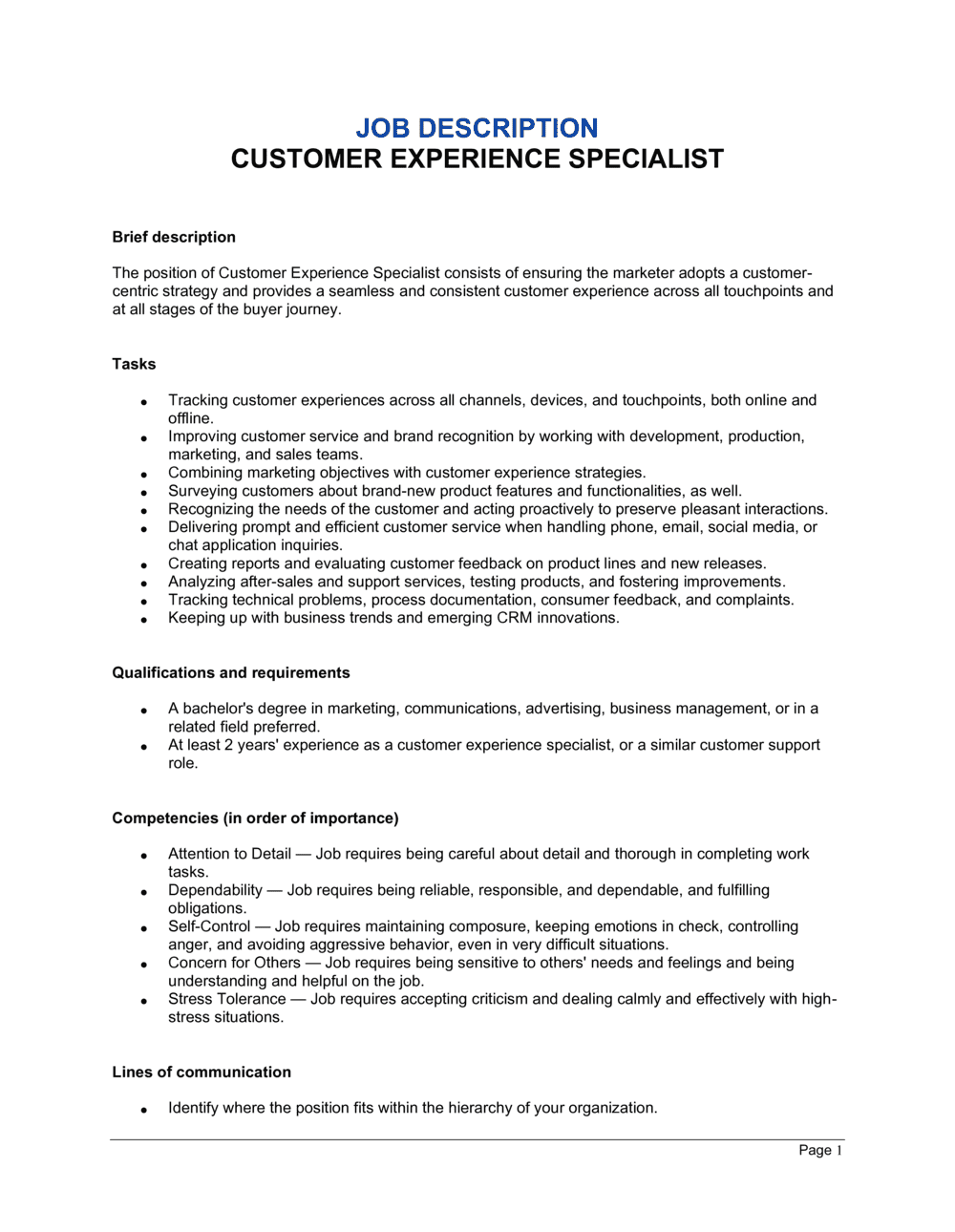
A Customer Experience Specialist Job Description is a formal employment document that defines the full scope of a CX specialist role — including position summary, core duties, required qualifications, key performance indicators, reporting structure, compensation band, and work location terms. It functions as both a recruitment instrument, published to attract qualified candidates, and a legally significant employment record once signed by both parties, establishing the documented performance expectations that govern the employment relationship from day one.

Unlike a general offer letter, a job description goes beyond confirming salary and start date. It creates a written record of exactly what the role requires, what success looks like in measurable terms, and what obligations the specialist accepts — including confidentiality and data-handling responsibilities tied to their daily access to customer PII. When attached as a schedule to the employment contract, it becomes incorporated by reference into the binding agreement.

Why You Need This Document

Without a signed, specific job description, you are left managing a customer-facing role against unwritten expectations — and that gap has real legal and operational consequences. Employers who rely on verbal role definitions or vague email summaries face disciplinary challenges when performance falls short, because courts and employment tribunals routinely ask for documented evidence that the employee understood what was expected of them. In Canada and the UK in particular, a termination for underperformance without a clear written baseline is difficult to defend.

Beyond legal protection, a structured job description reduces time-to-productivity for new CX hires by giving them unambiguous targets — specific FCR rates, CSAT scores, and SLA response windows — rather than leaving them to infer expectations through observation. It also protects the business operationally: a CX specialist who handles customer PII every day without documented confidentiality obligations creates data governance exposure that a single data request or regulatory inquiry can make expensive. This template closes those gaps in under 30 minutes, giving you a document that works from the first job posting through the last performance review.

Which variant fits your situation?

If your situation is…Use this template
Hiring a senior CX lead who manages a team of specialistsCustomer Experience Manager Job Description
Filling an entry-level customer support or service roleCustomer Service Representative Job Description
Hiring for a hybrid CX and sales functionCustomer Success Manager Job Description
Engaging a CX specialist on a project or contract basisIndependent Contractor Agreement
Defining a technical CX analyst role focused on data and reportingCustomer Experience Analyst Job Description
Onboarding a remote or internationally based CX specialistRemote Work Employment Agreement
Formalizing the full employment terms after the job description is acceptedEmployment Contract

Common mistakes to avoid

❌ Omitting numeric KPIs from the job description

Why it matters: Without documented performance targets, the employer has no objective standard for a performance improvement plan or termination for underperformance — creating wrongful dismissal exposure.

Fix: Include at least three quantified KPIs (e.g., FCR rate, CSAT score, tickets per week) in the job description and reference them in the employment contract's performance expectations clause.

❌ Failing to disclose a compensation range in pay-transparency jurisdictions

Why it matters: California, New York, Colorado, Washington, and several Canadian provinces require pay ranges on job postings — omitting them triggers fines and reputational consequences on job platforms.

Fix: Research the pay-transparency laws for every jurisdiction where the posting will be visible and include a compliant salary band before publishing.

❌ Listing 'remote' without specifying permitted work locations

Why it matters: An employee who works from an unexpected state or country creates immediate payroll tax registration, benefits, and workers' compensation compliance obligations in that jurisdiction.

Fix: Add a line specifying approved remote work jurisdictions: 'This role may be performed remotely within [STATE(S) / PROVINCE(S) / COUNTRY] only.'

❌ Not obtaining a signed acknowledgment before the start date

Why it matters: An unsigned job description cannot be relied upon as a performance baseline in a disciplinary process — employees have successfully argued they were never formally made aware of the expectations.

Fix: Treat the signed job description acknowledgment as a required onboarding document, alongside the employment contract and tax forms, and file it in the employee's HR record.

❌ Conflating required and preferred qualifications

Why it matters: When the two lists are nearly identical, the distinction collapses — qualified candidates self-disqualify, the talent pool narrows unnecessarily, and the employer may face proportionality challenges under equal employment guidelines.

Fix: Apply a strict test to each required qualification: would you decline an otherwise excellent candidate solely because they lack this? If not, move it to preferred.

❌ Using vague duty language like 'handle customer issues'

Why it matters: Broad language creates scope disputes during employment and makes it harder to justify reassigning tasks or issuing a warning for failing to perform a specific function.

Fix: Rewrite each duty with a specific action verb, a defined channel or tool, and a measurable frequency or output — for example, 'respond to inbound chat inquiries via Zendesk within 2 business hours during scheduled shift.'

The 10 key clauses, explained

Job Title, Department, and Reporting Line

In plain language: Identifies the exact position title, the department the role sits within, and who the specialist reports to directly.

Sample language
Job Title: Customer Experience Specialist | Department: Customer Success | Reports To: [CUSTOMER EXPERIENCE MANAGER / DIRECTOR OF CX] | Location: [CITY, STATE / REMOTE]

Common mistake: Using a generic title like 'Support Specialist' instead of the role's actual function — this creates misaligned candidate expectations and makes performance management harder when duties diverge from the title.

Position Summary

In plain language: A 2–4 sentence overview of what the role is responsible for and how it contributes to the business — the section candidates read first.

Sample language
The Customer Experience Specialist is responsible for managing [COMPANY NAME]'s customer interactions across [CHANNELS], resolving inquiries within SLA, and identifying recurring issues to improve the overall customer journey. This role is central to achieving our target NPS of [X] and CSAT score of [X].

Common mistake: Writing a position summary that reads as a marketing statement rather than a functional description — omitting measurable outcomes makes it harder to use the document as a performance baseline.

Core Duties and Responsibilities

In plain language: An itemized list of the primary tasks the specialist is accountable for on a daily, weekly, and monthly basis.

Sample language
Responsibilities include: (a) responding to customer inquiries via [EMAIL / CHAT / PHONE] within [X] business hours; (b) logging all interactions in [CRM PLATFORM]; (c) escalating unresolved issues to [ROLE] within [X] hours; (d) contributing to monthly VoC reporting by flagging recurring themes.

Common mistake: Listing responsibilities so broadly (e.g., 'handle all customer issues') that the role has no clear boundaries — making it impossible to evaluate performance or justify a scope-creep conversation.

Key Performance Indicators (KPIs)

In plain language: Quantified targets the specialist is expected to meet, forming the measurable basis for performance reviews and probationary evaluations.

Sample language
Performance will be measured against: (a) First Contact Resolution rate of [X]% or above; (b) CSAT score of [X] or above; (c) average response time under [X] hours; (d) ticket close rate of [X] per week.

Common mistake: Omitting KPIs from the job description entirely — without them, the employer has no documented standard against which to manage performance, issue warnings, or justify termination for underperformance.

Required Qualifications

In plain language: The minimum education, experience, certifications, and technical skills a candidate must have to be considered for the role.

Sample language
Minimum qualifications: [BACHELOR'S DEGREE / DIPLOMA] in [FIELD] or equivalent experience; [X] years in a customer-facing role; proficiency in [CRM PLATFORM]; demonstrated ability to handle [X] concurrent tickets per day.

Common mistake: Setting qualifications that screen out qualified candidates — for example, requiring a four-year degree for a role where two years of relevant experience is demonstrably sufficient, creating potential discrimination liability in jurisdictions that require proportionate requirements.

Preferred Qualifications and Skills

In plain language: Additional attributes that distinguish stronger candidates but are not eliminatory — keeps the job description flexible without diluting minimum standards.

Sample language
Preferred: experience with [PLATFORM]; bilingual in [LANGUAGE]; familiarity with NPS/CSAT survey tools; prior experience in [INDUSTRY]-specific support environments.

Common mistake: Listing preferred qualifications that overlap entirely with required qualifications — when the two lists are nearly identical, the distinction loses meaning and signals a poorly defined role to candidates.

Compensation, Benefits, and Employment Type

In plain language: States the salary range or hourly rate, employment classification (full-time, part-time, or contract), and a reference to the applicable benefits package.

Sample language
Compensation: $[MIN] – $[MAX] per year, commensurate with experience | Type: Full-Time, [AT-WILL / FIXED-TERM] | Benefits: eligible for standard Company benefits as described in the Employee Handbook, including [HEALTH / DENTAL / RETIREMENT / PTO].

Common mistake: Omitting a compensation range entirely — multiple US states and Canadian provinces now mandate pay transparency in job postings, and omission exposes the employer to regulatory penalties and reputational damage.

Work Location, Hours, and Schedule

In plain language: Defines where the work is performed, the expected weekly hours, and any shift or schedule requirements such as weekend or after-hours coverage.

Sample language
This role is [ON-SITE / HYBRID / FULLY REMOTE]. Standard hours: [X AM – X PM, TIME ZONE], Monday through Friday. [WEEKEND / AFTER-HOURS] availability required [AS NEEDED / ON ROTATION] to meet SLA commitments.

Common mistake: Describing the role as 'remote' without specifying permitted work jurisdictions — employees working from an unexpected state or country can create unexpected payroll tax, benefits, and labor law obligations for the employer.

Confidentiality and Data Handling Obligations

In plain language: Establishes the specialist's obligations to protect customer data and company information, particularly given their daily access to CRM records and customer PII.

Sample language
Employee shall handle all customer data in accordance with [COMPANY NAME]'s Privacy Policy and applicable data protection law, including [GDPR / CCPA / PIPEDA] where relevant. Customer PII accessed in the course of duties shall not be disclosed, copied, or retained beyond the scope of authorized duties.

Common mistake: Treating confidentiality as implied rather than explicit — a CX specialist accesses more customer PII per day than most roles, and a documented obligation is the first line of defense in a data breach or employee misconduct investigation.

Acknowledgment and Signature Block

In plain language: Confirms that the employee has read, understood, and agreed to the job description as a binding record of their role and performance expectations.

Sample language
By signing below, Employee acknowledges receipt of this Job Description and confirms understanding of the responsibilities, qualifications, and expectations outlined herein. This document forms part of the employment record. Employee: [SIGNATURE / DATE] | Employer Representative: [SIGNATURE / TITLE / DATE]

Common mistake: Issuing the job description as an attachment to an offer email without obtaining a signature — without signed acknowledgment, the employer cannot rely on the document in a disciplinary or termination process.

How to fill it out

  1. 1

    Enter the job title, department, and reporting line

    Use the exact title that will appear in the employment contract and HRIS. Confirm the reporting manager's current title before publishing — reporting lines that change between job posting and onboarding create confusion and legal inconsistency.

    💡 Use the same job title across the job description, offer letter, employment contract, and payroll system to avoid discrepancies that complicate tax filings and benefits administration.

  2. 2

    Write a position summary tied to measurable outcomes

    Draft 2–4 sentences describing the role's purpose and its contribution to specific business metrics — NPS, CSAT, FCR, or churn rate. Avoid adjectives like 'dynamic' or 'passionate'; use quantified targets instead.

    💡 If you cannot describe the role's outcome in numbers, the position is not yet well-defined enough to hire into.

  3. 3

    List core duties with action verbs and frequency

    Write each responsibility starting with an action verb (respond, log, escalate, analyze, report). Include approximate frequency — daily, weekly, or monthly — so the candidate understands workload distribution.

    💡 Cap the duties list at 8–10 items. A list of 15 responsibilities signals a role trying to do the work of two people, which will produce high turnover.

  4. 4

    Define KPIs with specific numeric targets

    Enter current or target performance benchmarks for each key metric — FCR rate, CSAT score, average handle time, tickets per day. These figures become the baseline for the first 90-day performance review.

    💡 If you do not yet have benchmarks, use industry averages as placeholders and update them after the first 60 days of the specialist's employment.

  5. 5

    Separate required from preferred qualifications

    Required qualifications must be genuinely eliminatory — do not list something as required if you would hire a candidate without it. Preferred qualifications are true differentiators, not a second required list.

    💡 Review required qualifications against EEOC and applicable provincial or national equal employment guidelines before publishing to avoid inadvertent screening bias.

  6. 6

    Enter the compensation range and employment classification

    State a specific salary band or hourly range, the employment type (full-time at-will, fixed-term, or part-time), and a reference to the benefits plan. In pay-transparency jurisdictions, this is legally required.

    💡 Check the pay-transparency posting laws for every state or province where the role may be filled before publishing — California, New York, Colorado, and British Columbia all have active requirements.

  7. 7

    Specify work location, schedule, and any remote work restrictions

    State on-site, hybrid, or fully remote clearly. If remote, list the permitted jurisdictions. Include weekend or after-hours SLA coverage requirements so candidates self-select accurately.

    💡 A single undisclosed weekend-coverage expectation is consistently cited in glassdoor reviews as a reason for early resignation — disclose it upfront.

  8. 8

    Obtain signatures before the employee's first day

    Have both the employer representative and the new hire sign the job description before or on day one. File the signed copy in the employee's HR record alongside the employment contract.

    💡 If the job description changes materially after signing — new KPIs, added responsibilities, or a different reporting line — issue an amended version for re-signature rather than updating the original document quietly.

Frequently asked questions

What is a customer experience specialist job description?

A customer experience specialist job description is a formal document that defines the responsibilities, qualifications, reporting structure, KPIs, and employment terms for a CX specialist role. It functions both as a recruitment tool — published on job boards to attract candidates — and as a legally significant employment record once signed, forming the documented basis for performance management, disciplinary action, and role disputes.

What does a customer experience specialist do?

A customer experience specialist manages customer interactions across service channels — email, phone, chat, and sometimes social media — to resolve inquiries, reduce friction in the customer journey, and collect feedback for process improvement. Day-to-day responsibilities typically include logging interactions in a CRM, hitting response-time SLAs, escalating unresolved issues, and contributing to NPS, CSAT, and FCR reporting. The role sits between frontline customer service and strategic CX management.

What qualifications should a customer experience specialist have?

Most employers require at least 1–2 years of customer-facing experience, proficiency in a CRM platform such as Salesforce, HubSpot, or Zendesk, and strong written and verbal communication skills. A diploma or bachelor's degree in business, communications, or a related field is commonly preferred but not always required. Technical roles may additionally require experience with CX analytics tools, NPS survey platforms, or data reporting. Bilingual candidates command a premium in markets with diverse customer bases.

Is a signed job description legally binding?

A signed job description is generally considered a legally significant document that forms part of the employee's employment record. While it is not a full employment contract, a signed acknowledgment confirms the employee understood and agreed to the stated responsibilities and performance expectations at the time of hire. In disciplinary and termination proceedings, courts and employment tribunals in the US, Canada, and the UK regularly reference the job description to assess whether expectations were clearly communicated.

Do I need to update a job description if the role changes?

Yes. If a customer experience specialist's responsibilities, KPIs, reporting line, or compensation change materially, the job description should be updated and re-signed by both parties. Issuing an amended job description with a fresh signature creates a clean evidentiary record and protects against claims of constructive dismissal — particularly in Canada and the UK, where unilateral changes to working conditions can trigger wrongful termination claims regardless of intent.

What KPIs should a customer experience specialist job description include?

Standard KPIs for a CX specialist role include First Contact Resolution rate (target 70–80% for most industries), CSAT score (typically 80% or above), average response time (tied to your SLA commitments), tickets resolved per week, and escalation rate. The specific targets will vary by industry and business maturity — document your current benchmarks as a starting point and revise them at the first performance review once real data is available.

What is the difference between a customer experience specialist and a customer service representative?

A customer service representative primarily handles reactive transactional interactions — answering questions, processing returns, and resolving complaints. A customer experience specialist does all of that but also owns the analytical and improvement layer: tracking NPS and CSAT trends, identifying root causes of recurring issues, contributing to VoC programs, and collaborating with product or operations teams to reduce customer effort. The CX specialist role carries broader ownership of the end-to-end customer journey.

Are there pay transparency requirements for customer experience job postings?

In the United States, California, New York, Colorado, Washington, Hawaii, and several other states require employers to disclose a pay range on job postings. In Canada, British Columbia and Prince Edward Island have enacted pay transparency legislation. In the UK, while not yet mandatory, the Equality Act 2010 underpins equal pay obligations that make transparent banding good practice. In the EU, the Pay Transparency Directive (2023/970) requires member states to implement pay disclosure obligations by June 2026. Always verify current requirements for every jurisdiction where the posting will be visible before publishing.

Should a job description be attached to the employment contract?

Yes — attaching the job description as a schedule or appendix to the employment contract is best practice. This creates a single integrated document set, ensures the position summary and KPIs are incorporated by reference into the binding contract, and eliminates the risk of version discrepancies if the job description is updated. Reference the job description by title and date in the employment contract's duties clause: 'Employee's core responsibilities are set out in Schedule A (Job Description, dated [DATE]), as amended from time to time with written notice.'

How this compares to alternatives

vs Employment Contract

An employment contract is the comprehensive binding agreement governing the full employment relationship — compensation, IP assignment, non-compete, confidentiality, and termination. A job description defines the role's scope and performance expectations and is typically incorporated into the contract as a schedule. Both documents are needed; the job description is never a substitute for a full employment contract.

vs Customer Experience Manager Job Description

A customer experience manager job description covers team leadership, strategic CX planning, budget ownership, and cross-functional stakeholder management. The specialist role is execution-focused — handling direct customer interactions and feeding data upward. Use the manager template when the hire will own a team; use the specialist template for individual contributors.

vs Independent Contractor Agreement

A contractor agreement engages a self-employed CX professional for a defined project or period without employment entitlements — no benefits, no tax withholding, and no ongoing obligation. A job description is used for employees. Misclassifying a CX specialist as a contractor exposes the employer to back payroll taxes, benefit liability, and statutory penalties. Use the contractor agreement only when the engagement genuinely meets the independent contractor tests in the applicable jurisdiction.

vs Offer Letter

An offer letter confirms the role, compensation, and start date to trigger candidate acceptance. It is not a comprehensive performance document — it typically lacks KPIs, detailed duties, and confidentiality obligations. A job description is the operational and legal backbone of the role; the offer letter initiates acceptance. Both should reference each other and both require signatures before the start date.

Industry-specific considerations

SaaS / Technology

CX specialists in SaaS environments manage onboarding support tickets, track in-app NPS, and coordinate with product teams on bug escalations — requiring CRM and technical troubleshooting proficiency.

Retail / E-commerce

High-volume ticket environments with WISMO (where-is-my-order) and returns queries dominate; KPIs emphasize first-contact resolution rate and average handle time during peak seasons.

Financial Services

Regulatory compliance obligations under CFPB, FCA, or provincial financial regulators mean the job description must reference complaint-handling procedures and mandatory escalation timelines explicitly.

Healthcare

Patient-facing CX roles require explicit HIPAA (US) or PIPEDA (Canada) data-handling clauses and may require documented training certification as a hiring prerequisite.

Jurisdictional notes

United States

California, New York, Colorado, Washington, and Hawaii require employers to include a pay range in job postings — verify current state-level requirements before publishing. The EEOC's guidelines on job qualifications require that listed requirements be demonstrably job-related and proportionate to the role to avoid disparate-impact liability. At-will employment is the default in 49 states; job descriptions should avoid language that implies job security or a fixed term.

Canada

British Columbia and Prince Edward Island have enacted pay transparency legislation requiring salary ranges on postings; other provinces are watching. Job descriptions must align with human rights codes in each province — required qualifications must be bona fide occupational requirements. In Quebec, any documentation provided to employees must be available in French for provincially regulated employers. Signed job descriptions that form part of the employment record support the employer's ability to establish just-cause termination under provincial employment standards.

United Kingdom

Under the Equality Act 2010, job requirements must be proportionate and non-discriminatory. The UK Government's 2023 pay transparency consultation is ongoing — while not yet mandatory, including a salary band is increasingly expected on major job platforms. Job descriptions attached to employment particulars must be provided on or before day one under the Employment Rights Act 1996. Post-termination confidentiality obligations in the job description should be cross-referenced in the main contract to ensure enforceability.

European Union

The EU Pay Transparency Directive (2023/970) requires member states to implement salary disclosure obligations for job postings by June 2026 — employers with EU operations should begin aligning job description templates now. GDPR requires that the data-handling obligations section of a CX specialist job description reference the employer's lawful basis for processing customer PII and the employee's specific obligations under Article 5. Job descriptions that include post-employment restrictions may require employee compensation to be enforceable in France, Germany, and Spain.

Template vs lawyer — what fits your deal?

PathBest forCostTime
Use the templateStandard domestic CX specialist hires at small and mid-size businesses in a single jurisdictionFree20–30 minutes
Template + legal reviewMulti-state or multi-province hiring, roles with access to sensitive customer PII, or jurisdictions with active pay-transparency and equal employment obligations$200–$500 for an HR consultant or employment lawyer review1–2 days
Custom draftedEnterprise CX programs, regulated industries (healthcare, financial services), cross-border remote hires, or roles with significant data access requiring GDPR or HIPAA compliance language$800–$2,500+3–7 days

Glossary

Customer Experience (CX)
The overall perception a customer forms of a brand based on every interaction across the full lifecycle — from awareness through post-purchase support.
Net Promoter Score (NPS)
A metric measuring customer loyalty by asking how likely respondents are to recommend a company on a 0–10 scale, expressed as the percentage of promoters minus detractors.
Customer Satisfaction Score (CSAT)
A survey-based metric that measures how satisfied a customer was with a specific interaction or transaction, typically rated on a 1–5 or 1–10 scale.
Customer Effort Score (CES)
A metric that quantifies how easy or difficult it was for a customer to resolve an issue or complete a task, used to identify friction points in the service journey.
Omnichannel Support
A customer service model that delivers a seamless, consistent experience across all contact channels — phone, email, chat, social media, and in-person.
Escalation Path
The defined process for routing a customer issue from a frontline specialist to a supervisor or specialist team when the initial contact cannot resolve it.
Voice of the Customer (VoC)
A structured program for capturing customer feedback, preferences, and complaints and feeding that insight into product and service improvements.
First Contact Resolution (FCR)
The percentage of customer issues resolved on the first interaction without requiring a follow-up call, ticket, or escalation.
Service Level Agreement (SLA)
A documented commitment between a service provider and a customer defining expected response times, resolution windows, and quality standards.
Churn Rate
The percentage of customers who stop doing business with a company within a defined period, often used as a lagging indicator of poor customer experience.
CRM (Customer Relationship Management)
Software used to track, manage, and analyze customer interactions and data across the full relationship lifecycle — commonly Salesforce, HubSpot, or Zendesk.

Part of your Business Operating System

This document is one of 3,000+ business & legal templates included in Business in a Box.

  • Fill-in-the-blanks — ready in minutes
  • 100% customizable Word document
  • Compatible with all office suites
  • Export to PDF and share electronically

Create your document in 3 simple steps.

From template to signed document — all inside one Business Operating System.
1
Download or open template

Access over 3,000+ business and legal templates for any business task, project or initiative.

2
Edit and fill in the blanks with AI

Customize your ready-made business document template and save it in the cloud.

3
Save, Share, Send, Sign

Share your files and folders with your team. Create a space of seamless collaboration.

Save time, save money, and create top-quality documents.

★★★★★

"Fantastic value! I'm not sure how I'd do without it. It's worth its weight in gold and paid back for itself many times."

Managing Director · Mall Farm
Robert Whalley
Managing Director, Mall Farm Proprietary Limited
★★★★★

"I have been using Business in a Box for years. It has been the most useful source of templates I have encountered. I recommend it to anyone."

Business Owner · 4+ years
Dr Michael John Freestone
Business Owner
★★★★★

"It has been a life saver so many times I have lost count. Business in a Box has saved me so much time and as you know, time is money."

Owner · Upstate Web
David G. Moore Jr.
Owner, Upstate Web

Run your business with a system — not scattered tools

Stop downloading documents. Start operating with clarity. Business in a Box gives you the Business Operating System used by over 250,000 companies worldwide to structure, run, and grow their business.

Start free · No credit card required