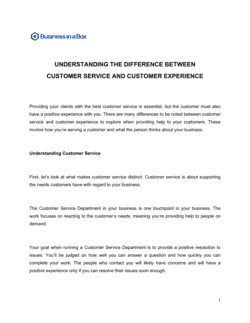
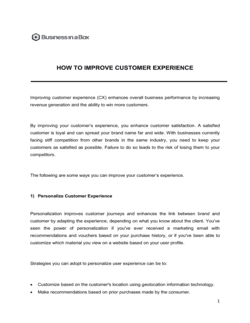
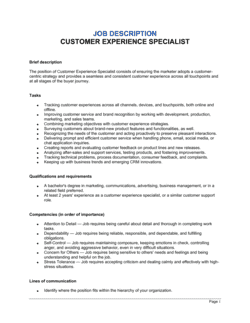
Personalized Customer Experience Template

Free Word download • Edit online • Save & share with Drive • Export to PDF

3 pages25–30 min to fillDifficulty: StandardSignature requiredLegal review recommended
Learn more ↓
FreePersonalized Customer Experience Template

At a glance

What it is
A Personalized Customer Experience Agreement is a binding document between a business and its customers that governs how the company collects, stores, and uses personal data and behavioral information to tailor products, services, communications, and recommendations. This free Word download gives you a structured, editable starting point you can customize and export as PDF for customer acknowledgment or digital signature.
When you need it
Use it whenever your business leverages customer data — purchase history, browsing behavior, stated preferences, or demographic information — to deliver individualized offers, content, or service experiences. It is especially critical before launching a loyalty program, recommendation engine, or targeted marketing campaign.
What's inside
Data collection scope and consent, preference management rights, opt-out procedures, data retention and deletion timelines, third-party sharing restrictions, security obligations, and the customer's right to access or correct their stored information.

What is a Personalized Customer Experience Agreement?

A Personalized Customer Experience Agreement is a binding document between a business and its customers that governs how personal data — including purchase history, browsing behavior, stated preferences, and demographic information — is collected, stored, and used to tailor products, services, content, and communications to each individual. Unlike a general privacy policy, which is a unilateral disclosure, this agreement requires an affirmative customer acknowledgment and creates enforceable obligations on both parties: the business commits to defined data practices, retention limits, and opt-out mechanisms; the customer consents to specified personalization activities with full transparency about what data is used and why.

The document operates at the intersection of contract law and data protection regulation, incorporating obligations from GDPR, the CCPA/CPRA, PIPEDA, and sector-specific frameworks where applicable. It covers the scope of personalization activities, the legal basis for each data category, third-party processor disclosures, automated profiling transparency, and the customer's rights to access, correct, port, or delete their stored information.

Why You Need This Document

Operating a personalization program without a specific, documented consent agreement creates compounding legal and commercial risk. Regulators in the EU, UK, Canada, and California do not accept consent buried in a general terms of service as sufficient for targeted data use — each imposes granular, purpose-specific consent requirements backed by fines that reach 4% of global revenue under GDPR and CAD 25 million under Quebec's Law 25. Beyond regulatory exposure, businesses that cannot demonstrate documented consent face class action liability from customers who claim their data was used without authorization.

Practically, the absence of a clear agreement also undermines customer trust at the moment it matters most: when a customer receives a recommendation or offer that reveals how much the business knows about them. A transparent, signed agreement transforms that moment from a privacy concern into a value proposition. This template gives you a structured, legally grounded starting point that closes the consent gap, names your processors, and equips your customers with clear rights — reducing regulatory exposure and building the trust that makes personalization commercially effective in the first place.

Which variant fits your situation?

If your situation is…Use this template
Collecting behavioral data from website visitors for targeted adsCookie Consent and Privacy Policy
Running a points-based loyalty program with purchase trackingLoyalty Program Terms and Conditions
Personalizing a SaaS dashboard based on in-app usage patternsSaaS Terms of Service with Data Processing Addendum
Sharing customer data with a third-party analytics or ad platformData Processing Agreement
Sending individually tailored promotional emails using purchase historyEmail Marketing Consent Form
Providing personalized healthcare or wellness recommendationsInformed Consent for Personalized Health Services
Using AI or automated profiling to customize pricing or offersAutomated Decision-Making Disclosure Agreement

Common mistakes to avoid

❌ Bundling personalization consent into general terms of service

Why it matters: Privacy regulators in the EU, Canada, and California require specific, granular consent for personalization — burying it in a 40-page ToS is treated as no consent at all, exposing the business to fines.

Fix: Present personalization consent as a standalone, clearly labeled acknowledgment with a specific opt-in action, separate from acceptance of general terms.

❌ No defined data retention period

Why it matters: Without a specific retention limit, the business is exposed to regulatory findings of indefinite storage — a violation under GDPR, PIPEDA, and the CCPA's 'reasonably necessary' standard.

Fix: Set a specific retention period tied to last active interaction, confirm a technical deletion process exists, and document it in an internal data map.

❌ Generic third-party sharing language without naming processors

Why it matters: Clauses like 'we may share with trusted partners' do not meet the transparency requirements of GDPR, PIPEDA, or the CCPA — each of which requires disclosure of the categories or identities of recipients.

Fix: Name every vendor receiving personalization data, describe their role, and confirm a Data Processing Agreement governs each relationship.

❌ Making opt-out harder than opt-in

Why it matters: If consent was granted with a single click but withdrawal requires emailing a privacy team and waiting 10 business days, regulators treat the original consent as coerced and therefore invalid.

Fix: Build a preference center or account settings toggle that allows customers to withdraw consent in the same number of steps — or fewer — than granting it.

❌ Omitting automated profiling disclosure

Why it matters: Businesses using AI-driven recommendation or pricing engines without disclosing them violate GDPR Article 22 and face increasing exposure under the EU AI Act's transparency obligations.

Fix: Add an explicit automated profiling clause describing the system used, its effect on the customer experience, and the process to contest automated outputs.

❌ Selecting a governing law with no connection to the customer's location

Why it matters: Courts in the EU, Canada, and California routinely apply local consumer protection and privacy law regardless of the governing-law clause when customers reside there — a mismatch creates a false sense of legal protection.

Fix: Identify the primary jurisdiction where your customers are located and confirm the governing law clause aligns with or at minimum does not conflict with mandatory local privacy obligations.

The 10 key clauses, explained

Parties and Scope of Personalization

In plain language: Identifies the business and the customer, defines what 'personalized experience' means in the context of this agreement, and lists the specific services or touchpoints covered.

Sample language
This Agreement is entered into between [COMPANY LEGAL NAME] ('Company') and the customer identified at registration ('Customer'). Personalization services covered include [LIST OF SERVICES — e.g., product recommendations, targeted email, in-app content customization] provided through [PLATFORM/CHANNEL].

Common mistake: Defining scope so broadly that the customer cannot reasonably understand what activities are covered — courts and regulators treat vague scope definitions as insufficient consent.

Data Collection and Categories

In plain language: Lists exactly what types of personal and behavioral data the business collects, the collection method (passive tracking, forms, third-party import), and the legal basis for each category.

Sample language
Company collects the following data categories to provide personalization: (a) purchase and transaction history; (b) browsing and click behavior on [PLATFORM]; (c) stated preferences submitted via [PREFERENCE CENTER URL]; (d) demographic data provided at registration. Collection is based on [CONSENT / LEGITIMATE INTEREST / CONTRACT PERFORMANCE].

Common mistake: Omitting the legal basis for each data category. Under GDPR and PIPEDA, each processing purpose requires its own lawful basis — bundling all categories under a single 'by using our service' justification is non-compliant.

Purpose Limitation and Use of Data

In plain language: Restricts how the collected data may be used — specifically to deliver personalization — and prohibits repurposing it for unrelated activities without fresh consent.

Sample language
Customer data collected under this Agreement shall be used solely for the purpose of delivering personalized [PRODUCT / CONTENT / OFFERS] as described in Section 2. Data shall not be repurposed for [EXCLUDED USES — e.g., credit scoring, sale to third parties, advertising outside the platform] without Customer's prior written consent.

Common mistake: Allowing broad secondary uses like 'improving our services' without clearly defining what that includes — regulators treat this as a catch-all that undermines purpose limitation.

Consent, Preference Management, and Opt-Out

In plain language: Documents the customer's affirmative consent, explains how they can update their preferences or withdraw consent at any time, and confirms that withdrawal does not affect core service access.

Sample language
Customer provides explicit consent to personalization activities as described herein by [CHECKING THE BOX / SIGNING BELOW]. Customer may withdraw consent or update preferences at any time via [PREFERENCE CENTER URL] or by contacting [EMAIL ADDRESS]. Withdrawal of consent will not affect the Customer's access to [CORE SERVICE NAME] but will disable [SPECIFIC PERSONALIZATION FEATURES].

Common mistake: Making consent withdrawal harder than granting it — requiring a written letter to opt out when opt-in was a single checkbox. This is explicitly prohibited under GDPR Article 7(3).

Data Retention and Deletion

In plain language: Sets the maximum period for retaining identifiable customer data and describes the process for deletion or anonymization when the period expires or the customer requests erasure.

Sample language
Identifiable Customer data used for personalization shall be retained for a maximum of [X] months from the Customer's last active interaction. Upon expiration or receipt of a deletion request, Company shall delete or anonymize such data within [30] calendar days. Anonymized aggregate data may be retained indefinitely for analytics.

Common mistake: Setting a retention period without an enforcement mechanism — stating '12 months' but having no automated process to purge data means the stated period is unenforceable and the company remains liable.

Third-Party Sharing and Processors

In plain language: Identifies which third-party vendors receive customer data for personalization purposes, limits their use to the contracted purpose, and confirms data processing agreements are in place.

Sample language
Company may share Customer data with the following third-party processors for the sole purpose of delivering personalization services: [LIST VENDORS — e.g., Salesforce, Segment, Google Analytics]. Each processor is bound by a Data Processing Agreement requiring compliance with [APPLICABLE LAW]. Company shall not sell Customer data to third parties for independent marketing.

Common mistake: Using a generic 'we may share with partners' clause without naming processors or confirming DPAs are in place — a standard GDPR audit finding that results in enforcement action.

Security and Data Protection Measures

In plain language: Describes the technical and organizational measures the business applies to protect personalization data from unauthorized access, breach, or misuse.

Sample language
Company implements the following security measures to protect Customer data: [ENCRYPTION IN TRANSIT AND AT REST / ACCESS CONTROLS / ANNUAL PENETRATION TESTING / EMPLOYEE TRAINING]. In the event of a data breach affecting personalization data, Company shall notify Customer within [72] hours of discovery in accordance with applicable law.

Common mistake: Vague security language like 'industry-standard measures' with no specifics. Regulators and plaintiffs treat this as an admission that no defined standard was actually implemented.

Customer Rights: Access, Correction, and Portability

In plain language: Enumerates the customer's rights to access their stored data, correct inaccuracies, and receive a portable copy — and states the timeline and process for responding to such requests.

Sample language
Customer may submit a data access, correction, or portability request by contacting [EMAIL / DATA RIGHTS PORTAL URL]. Company shall respond within [30] calendar days. Access requests will be fulfilled in [CSV / JSON / PDF] format. Company may verify the Customer's identity before processing the request.

Common mistake: Providing a rights mechanism that routes to a general support inbox with no defined SLA — this fails GDPR, CCPA, and PIPEDA response-time requirements and creates class action exposure.

Automated Decision-Making and Profiling Disclosure

In plain language: Discloses whether the business uses automated profiling to make decisions that affect the customer — such as pricing, content ranking, or offer eligibility — and states whether a human review option exists.

Sample language
Company uses automated profiling to [DESCRIBE USE — e.g., rank product recommendations, determine promotional offer eligibility]. No automated decision shall produce a [LEGAL / SIGNIFICANTLY AFFECTING] outcome for Customer without an opportunity to request human review. Customer may contest an automated decision by contacting [EMAIL].

Common mistake: Failing to disclose automated profiling at all, even when it materially affects what prices or products the customer sees — GDPR Article 22 and the EU AI Act require explicit disclosure and, in some cases, a human review option.

Governing Law and Dispute Resolution

In plain language: Specifies which jurisdiction's law governs the agreement and how disputes about personalization practices or data rights are resolved.

Sample language
This Agreement is governed by the laws of [STATE / PROVINCE / COUNTRY]. Any dispute arising from personalization practices or data rights under this Agreement shall first be addressed through [INTERNAL COMPLAINTS PROCESS] within [30] days. Unresolved disputes shall be submitted to [ARBITRATION / COMPETENT COURT] in [CITY / JURISDICTION].

Common mistake: Selecting a governing law in a jurisdiction with weak privacy protections when customers are located in stricter jurisdictions — the customer's local law typically applies regardless of what the contract states.

How to fill it out

  1. 1

    Identify the parties and covered services

    Enter the company's full legal name and the platform or service where personalization occurs. List each touchpoint covered — email, in-app recommendations, website content, or loyalty rewards — so the scope is unambiguous.

    💡 Narrow the scope to only the personalization activities you currently operate. Listing aspirational future uses without separate consent creates compliance liability.

  2. 2

    List every data category collected and its legal basis

    Enumerate each type of data — purchase history, behavioral tracking, stated preferences, demographic data — and pair each with its legal basis: consent, contract performance, or legitimate interest.

    💡 If you rely on 'legitimate interest,' document your balancing test in a separate internal record before using that basis in the agreement.

  3. 3

    Define purpose limitations explicitly

    Write out precisely what personalization activities the data enables and add a short list of expressly excluded uses — selling to third parties, credit profiling, or cross-context behavioral advertising.

    💡 A narrow, specific purpose clause is your strongest defense in a regulatory audit — vague purpose language is the single most common GDPR enforcement finding.

  4. 4

    Configure the consent and opt-out mechanism

    Specify how consent is captured (checkbox, signature, in-app toggle), the URL or process for the preference center, and the exact features that change when a customer opts out.

    💡 Test the opt-out flow end-to-end before launch — if it takes more than three steps to withdraw consent, regulators in the EU and California may treat it as a barrier.

  5. 5

    Set data retention periods and deletion SLAs

    Enter a specific retention period in months, tied to the customer's last active interaction. State the deletion or anonymization SLA (30 days is standard) and confirm you have a technical process to enforce it.

    💡 Map the retention period to your actual data purge automation — a stated period you cannot technically enforce creates greater liability than omitting one.

  6. 6

    Name third-party processors and confirm DPAs

    List every vendor that will receive customer personalization data and confirm a Data Processing Agreement is in place with each. Include the vendor's data processing role and geographic location.

    💡 If any processor is located outside the EU or a GDPR-equivalent jurisdiction, note the transfer mechanism used — Standard Contractual Clauses, adequacy decision, or binding corporate rules.

  7. 7

    Complete the automated profiling disclosure

    Describe any algorithm or automated system that ranks, scores, or filters what the customer sees. State clearly whether any automated output can affect pricing, access, or eligibility, and provide a human review contact if required.

    💡 If you use a third-party recommendation engine (e.g., a vendor's AI), confirm whether it constitutes 'solely automated decision-making' under GDPR Article 22 before finalizing this clause.

  8. 8

    Execute before collecting personalization data

    Have the customer sign or affirmatively accept the agreement before any personalization data collection begins. For digital signatures, use a timestamped consent record you can retrieve later.

    💡 Store a version-stamped copy of the agreement the customer accepted, not just the current live version — regulators require proof of what was disclosed at the time of consent.

Frequently asked questions

What is a personalized customer experience agreement?

A personalized customer experience agreement is a binding document between a business and its customers that governs how personal data and behavioral information are collected, stored, and used to tailor products, services, content, and communications. It establishes the customer's consent, defines the scope of personalization activities, and sets out the customer's rights to access, correct, or delete their data. Unlike a general privacy policy, this agreement is specific to personalization use cases and typically requires an affirmative customer signature or opt-in action.

Is a separate personalization agreement required if I already have a privacy policy?

A privacy policy describes how you handle data broadly — a personalized customer experience agreement goes further by documenting specific consent for targeted activities, named processors, and opt-out mechanisms tied to individual features. Regulators in the EU and California increasingly require granular, purpose-specific consent for personalization activities that cannot be satisfied by a general privacy policy alone. Having both documents reduces enforcement risk and provides a clearer customer experience.

What laws govern personalized customer experience practices?

The primary frameworks are GDPR in the EU, the UK GDPR post-Brexit, PIPEDA and provincial privacy laws in Canada (including Quebec's Law 25), and the CCPA/CPRA in California. Each imposes specific requirements around consent, purpose limitation, data subject rights, and automated profiling disclosure. The US does not have a single federal privacy law as of 2025, but sector-specific rules (HIPAA for health data, COPPA for children) apply in relevant contexts.

Do I need customer signatures for a personalization agreement?

An affirmative, documented consent action is required in most jurisdictions — this can be a digital signature, a timestamped checkbox acceptance, or an explicit in-app toggle. Passive acceptance such as continued use of a service is not sufficient to establish consent for personalization under GDPR or PIPEDA. For high-risk personalization activities — profiling that affects pricing or eligibility — written or digital signature is strongly recommended to create a clear audit trail.

What rights do customers have under a personalization agreement?

Customers typically hold the right to access a copy of their stored personalization data, correct inaccurate information, request deletion, withdraw consent at any time, receive a portable data export, and object to automated profiling that produces decisions affecting them. The specific rights and timelines for the business to respond depend on the governing jurisdiction — GDPR mandates a 30-day response window, as does PIPEDA in most circumstances.

Can I use a single agreement for customers in multiple countries?

A single template can cover multiple jurisdictions if it meets the highest applicable standard — typically GDPR for EU customers — and includes jurisdiction-specific addenda where local law requires additional disclosures or rights. Confirm that the governing law clause does not conflict with mandatory consumer protection requirements in each customer's location. For businesses with significant customer bases in the EU, UK, Canada, and California, a legal review of jurisdiction coverage is advisable before launch.

How often should a personalized customer experience agreement be updated?

The agreement should be reviewed any time personalization activities materially change — adding a new data source, integrating a new third-party processor, or deploying an AI recommendation engine. Annual review against the current regulatory landscape is standard practice. When changes require new or broader consent, customers must be re-notified and asked to affirmatively accept the revised terms before the new activities begin.

What are the consequences of non-compliance with personalization data obligations?

Under GDPR, fines for unlawful personalization practices can reach 4% of global annual turnover or EUR 20 million, whichever is higher. California CPRA enforcement by the California Privacy Protection Agency carries civil penalties of up to $7,500 per intentional violation. Beyond regulatory fines, businesses face class action exposure, reputational damage, and the loss of customer trust — which in personalization-dependent business models translates directly to reduced conversion and retention.

How this compares to alternatives

vs Privacy Policy

A privacy policy is a unilateral disclosure document describing all of a business's data practices — it does not require customer signature and does not constitute consent. A personalized customer experience agreement is bilateral and binding, documents specific consent for personalization activities, and creates enforceable obligations on both parties. Both documents are needed: the privacy policy covers the full data ecosystem; the personalization agreement governs the targeted consent layer.

vs Data Processing Agreement

A data processing agreement governs the relationship between a business (data controller) and a third-party vendor (data processor) — it is a B2B document. A personalized customer experience agreement governs the relationship between the business and its end customers (data subjects) — it is a B2C document. Both are required when personalization involves third-party processors: the customer agreement establishes consent; the DPA governs how the processor handles the data.

vs Terms of Service

Terms of service govern the rules of using a product or platform broadly — access rights, acceptable use, liability, and payment. A personalized customer experience agreement is narrower and more specific, focused solely on data collection and use for personalization. Regulators treat consent buried in general terms of service as insufficient for personalization activities — a standalone agreement provides the granularity required.

vs Customer Loyalty Program Agreement

A loyalty program agreement covers the mechanics of earning and redeeming rewards — tiers, points, expiry, and redemption rules. A personalized customer experience agreement covers the data layer underneath loyalty programs — what behavioral data is collected, how it is used to personalize offers, and the customer's rights over that data. Loyalty programs that use purchase history for personalization need both documents.

Industry-specific considerations

E-commerce and Retail

Purchase history, abandoned cart data, and browsing behavior drive recommendation engines — each requires explicit consent and named processor disclosure for platforms like Salesforce Commerce Cloud or Klaviyo.

Financial Services

Personalized product recommendations based on transaction behavior must comply with sector-specific rules — GLBA in the US, OSFI guidelines in Canada — layered on top of general privacy obligations.

Healthcare and Wellness

Personalized health content or appointment reminders involve sensitive health data requiring HIPAA authorization in the US and explicit consent under GDPR Article 9, with tighter retention and security standards.

SaaS and Technology

In-app behavioral data used to personalize onboarding flows, feature suggestions, or pricing tiers must be disclosed in both the ToS and a separate consent layer, particularly for B2C products with EU users.

Travel and Hospitality

Loyalty programs, personalized pricing, and travel preference profiles combine behavioral and identity data — requiring clear retention limits and processor disclosures for GDS and CRM integrations.

Media and Publishing

Content recommendation algorithms and reader profiling for targeted advertising require transparent automated profiling disclosure and clear opt-out paths under both GDPR and the Digital Services Act.

Jurisdictional notes

United States

There is no single federal privacy law governing personalization as of 2025. The California Consumer Privacy Act (CCPA) and its 2023 amendments under CPRA impose opt-out rights for 'sharing' of personal data for cross-context behavioral advertising and require disclosure of automated profiling. Sector-specific rules apply — HIPAA for health data, COPPA for children under 13, and GLBA for financial data. State-level laws in Virginia, Colorado, Connecticut, Texas, and Montana impose similar but not identical obligations.

Canada

PIPEDA requires meaningful consent for the collection and use of personal data, including for personalization. Quebec's Law 25 (Bill 64), fully in force since September 2023, imposes GDPR-equivalent requirements including mandatory privacy impact assessments for profiling and the right to refuse automated decisions. Federal and provincial privacy commissioners can investigate and order corrective action; Quebec can impose fines up to CAD 25 million or 4% of worldwide turnover.

United Kingdom

UK GDPR, retained post-Brexit and administered by the Information Commissioner's Office (ICO), applies the same consent, purpose limitation, and automated profiling rules as EU GDPR. The ICO has issued specific guidance on personalization and direct marketing that requires a lawful basis for each processing activity and a clear opt-out mechanism. The UK's proposed Data (Use and Access) Bill may modify some obligations — monitor for legislative changes.

European Union

GDPR is the primary framework — personalization based on behavioral data typically requires explicit consent under Article 6(1)(a) or a documented legitimate interest balancing test. Article 22 restricts solely automated decision-making that produces legal or similarly significant effects, requiring human review options. The EU AI Act, phasing in from 2025–2027, imposes additional transparency obligations on AI-driven personalization and recommendation systems categorized as limited-risk.

Template vs lawyer — what fits your deal?

PathBest forCostTime
Use the templateSMBs and startups running standard e-commerce or SaaS personalization without cross-border EU customer basesFree30–60 minutes
Template + legal reviewBusinesses with EU, UK, or California customers, those using AI-driven profiling, or loyalty programs with sensitive data categories$500–$1,500 for a privacy lawyer review3–7 days
Custom draftedEnterprise platforms, healthcare or financial services personalization, or products subject to the EU AI Act or HIPAA$3,000–$8,000+2–6 weeks

Glossary

Personalization
The practice of tailoring products, communications, or experiences to an individual customer based on their data, preferences, or behavioral history.
Explicit Consent
A freely given, specific, informed, and unambiguous affirmative act by the customer authorizing the collection or use of their personal data for a stated purpose.
Data Controller
The entity — typically the business — that determines the purposes and means of processing personal data collected from customers.
Data Subject
The individual whose personal data is being collected, processed, or used — in this context, the customer.
Behavioral Data
Information derived from a customer's actions, such as pages viewed, items clicked, purchase frequency, and session duration.
Preference Center
A self-service interface that allows customers to view, update, or withdraw their personalization consents and communication preferences.
Data Retention Period
The defined length of time a business may store a customer's personal data before it must be deleted or anonymized.
Opt-Out
A mechanism allowing a customer to withdraw consent for personalization activities without penalty or loss of core service access.
Profiling
Any automated processing of personal data used to evaluate, analyze, or predict aspects of an individual — such as purchasing preferences or creditworthiness.
Right of Access
A customer's legal right to obtain a copy of the personal data a business holds about them and a description of how it is being used.
Anonymization
The irreversible process of modifying personal data so that the individual can no longer be identified, directly or indirectly.
Third-Party Processor
An external vendor — such as a CRM platform, analytics tool, or ad network — that processes customer data on behalf of the business under contractual obligations.

Part of your Business Operating System

This document is one of 3,000+ business & legal templates included in Business in a Box.

  • Fill-in-the-blanks — ready in minutes
  • 100% customizable Word document
  • Compatible with all office suites
  • Export to PDF and share electronically

Create your document in 3 simple steps.

From template to signed document — all inside one Business Operating System.
1
Download or open template

Access over 3,000+ business and legal templates for any business task, project or initiative.

2
Edit and fill in the blanks with AI

Customize your ready-made business document template and save it in the cloud.

3
Save, Share, Send, Sign

Share your files and folders with your team. Create a space of seamless collaboration.

Save time, save money, and create top-quality documents.

★★★★★

"Fantastic value! I'm not sure how I'd do without it. It's worth its weight in gold and paid back for itself many times."

Managing Director · Mall Farm
Robert Whalley
Managing Director, Mall Farm Proprietary Limited
★★★★★

"I have been using Business in a Box for years. It has been the most useful source of templates I have encountered. I recommend it to anyone."

Business Owner · 4+ years
Dr Michael John Freestone
Business Owner
★★★★★

"It has been a life saver so many times I have lost count. Business in a Box has saved me so much time and as you know, time is money."

Owner · Upstate Web
David G. Moore Jr.
Owner, Upstate Web

Run your business with a system — not scattered tools

Stop downloading documents. Start operating with clarity. Business in a Box gives you the Business Operating System used by over 250,000 companies worldwide to structure, run, and grow their business.

Start free · No credit card required