1
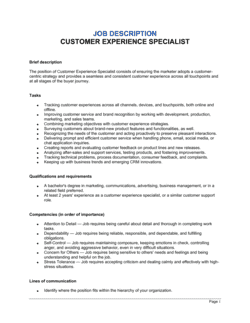
Enter the official job title and reporting line
Use the exact job title as it appears in your HR system and payroll records. Identify the direct supervisor by title, not personal name, so the document remains valid through personnel changes.
💡 Cross-check the title against your existing org chart before publishing — title inconsistencies between postings, offer letters, and contracts are a common source of classification disputes.
2
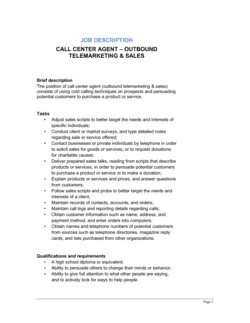
Write a concise role summary
Draft 2–4 sentences describing why the role exists, the primary customer segment served, and the main channels the representative will work across — phone, email, chat, or in-person.
💡 If you are updating an existing job description, have the current role-holder review the summary for accuracy before finalizing — discrepancies between the posted description and actual duties create ADA and wrongful-termination exposure.
3
List essential duties and label non-essential ones
Itemize all core responsibilities and mark each as 'essential' or 'non-essential.' Essential functions are those the role could not exist without — handling customer inquiries, logging interactions, and escalating unresolved cases.
💡 Under the ADA and most equivalent statutes, only essential functions can form the basis for a performance action — mislabeling non-essential duties as essential weakens your documentation in any future dispute.
4
Set qualification thresholds at the minimum necessary level
Enter the lowest qualifications a person would need to perform the essential functions safely and competently. Review required qualifications against EEOC adverse-impact guidelines — degree requirements, for example, require a documented business necessity.
💡 For customer service roles, experience in a customer-facing environment is almost always more predictive of success than formal education credentials — and is less likely to trigger a disparate-impact analysis.
5
Define measurable performance standards
Fill in specific KPI targets for first-contact resolution rate, average handle time, CSAT score, and documentation turnaround. Tie these numbers to the SLAs in your customer service policy.
💡 Performance standards that are already in use by your team are more defensible in a dispute than aspirational targets created solely for the job description.
6
Complete the compensation block and FLSA classification
Enter the pay rate or salary band, pay cycle, and FLSA classification (exempt or non-exempt). Most customer service representatives qualify as non-exempt and are entitled to overtime pay.
💡 If your jurisdiction has pay transparency requirements — Colorado, New York, Illinois, Washington — confirm the posted range reflects genuine hiring intent before the description goes live.
7
Describe working conditions and physical demands
Specify whether the role is office-based, remote, or hybrid. Document any physical requirements — extended computer use, headset wearing, or standing — so the employer has a pre-existing record if a reasonable-accommodation request arises.
💡 For remote roles, include the equipment-provision policy and any home-office setup requirements in this section.
8
Collect the employee's signed acknowledgment
Have the employee sign and date the acknowledgment block before or on their first day. Retain the signed copy in the employee's personnel file.
💡 For remote onboarding, use an e-signature platform to timestamp acknowledgment — a timestamped electronic signature is admissible in most jurisdictions and eliminates the risk of a lost paper form.