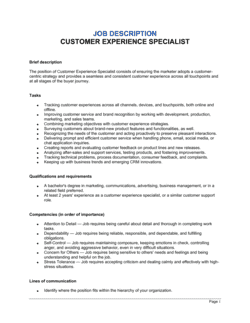
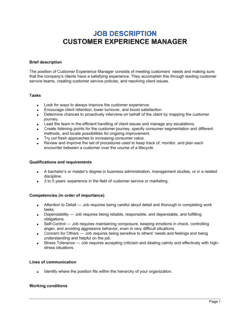
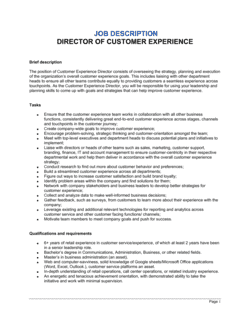
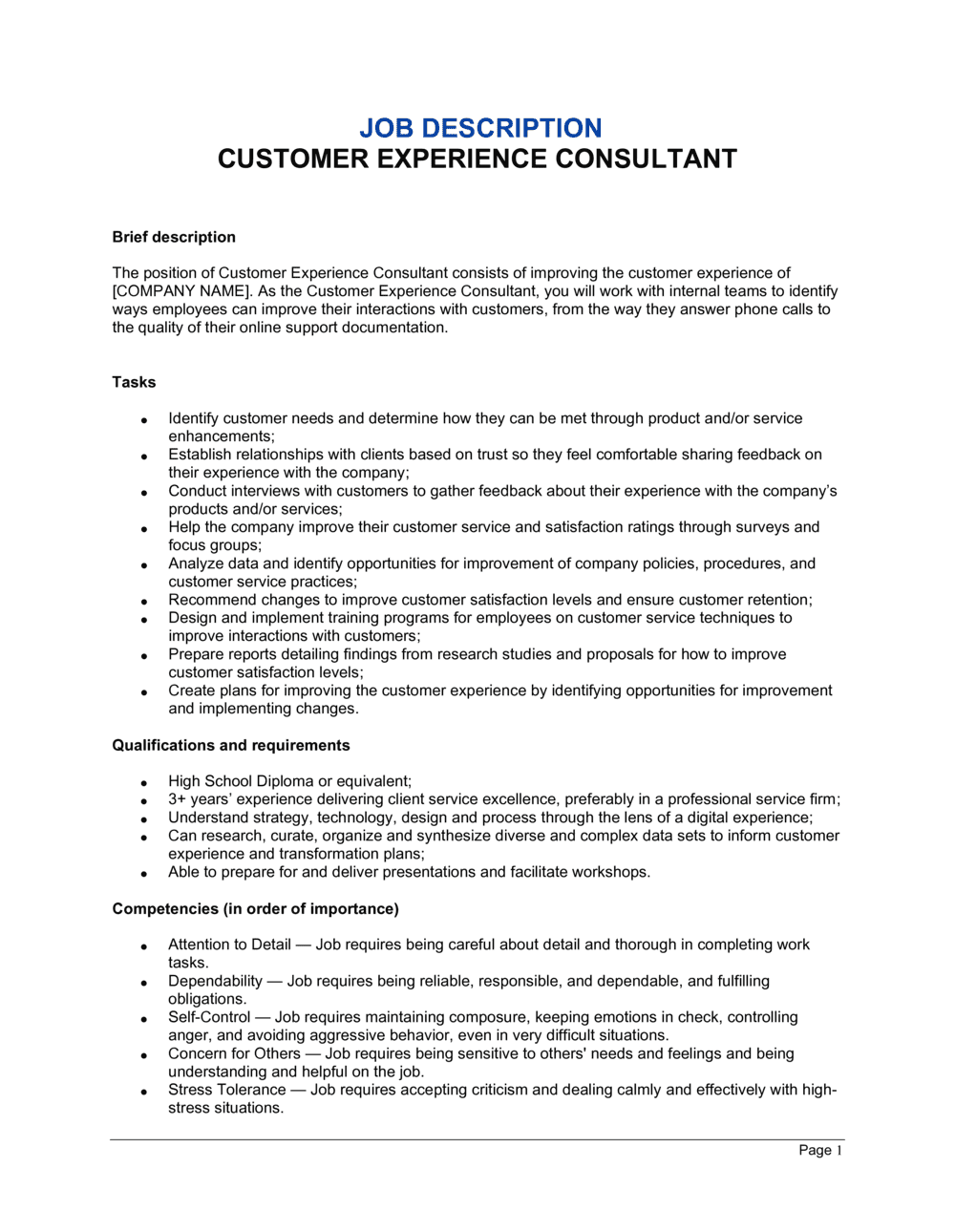
Customer Experience Consultant Job Description Template

Free Word download • Edit online • Save & share with Drive • Export to PDF

2 pages20–30 min to fillDifficulty: StandardSignature requiredLegal review recommended
Learn more ↓
FreeCustomer Experience Consultant Job Description Template

At a glance

What it is
A Customer Experience Consultant Job Description is a binding document that defines the scope of work, responsibilities, performance expectations, qualifications, and engagement terms for a CX consultant hired on a contract or employment basis. This free Word download lets you edit the role details online and export as PDF — giving both parties a clear, signed record of what is expected before work begins.
When you need it
Use it when engaging a CX consultant — whether as a full-time hire, fixed-term contractor, or external agency resource — to define deliverables, reporting lines, and success metrics before the engagement starts.
What's inside
Role title and reporting structure, core responsibilities and KPIs, required qualifications and tools, engagement type and compensation, confidentiality and IP ownership clauses, and termination conditions.

What is a Customer Experience Consultant Job Description?

A Customer Experience Consultant Job Description is a binding document that defines the scope of work, core responsibilities, performance metrics, required qualifications, and engagement terms for a CX consultant hired on an employment or independent contractor basis. It goes beyond a standard job posting by incorporating confidentiality obligations, intellectual property assignment, non-solicitation restrictions, and termination conditions — giving both parties a clear, enforceable record of what is expected before work begins. The document functions simultaneously as a role definition, a performance management framework, and a legal agreement governing access to sensitive customer data and proprietary business processes.

Why You Need This Document

Without a signed CX consultant job description, four risks materialize simultaneously. First, any frameworks, journey maps, or VoC methodologies the consultant develops may remain their intellectual property — not yours — leaving your operations dependent on work you do not legally own. Second, a consultant with unrestricted access to your customer data, CRM records, and complaint logs faces no enforceable confidentiality obligations after the engagement ends. Third, vague responsibilities and absent KPIs turn performance disputes into subjective arguments with no objective resolution. Fourth, a consultant who builds direct relationships with your key accounts and core team members faces no barrier to soliciting them after leaving. A properly executed job description agreement closes all four gaps before the consultant's first day and provides the evidentiary foundation needed to enforce any of these obligations if disputes arise.

Which variant fits your situation?

If your situation is…Use this template
Engaging a self-employed CX consultant for a defined projectIndependent Contractor Agreement
Hiring a full-time CX consultant as a permanent employeeEmployment Contract
Bringing on a senior CX advisor with equity or profit-sharingExecutive Employment Agreement
Engaging a CX consulting firm rather than an individualConsulting Services Agreement
Running a short-term CX audit or customer journey mapping projectStatement of Work
Hiring a CX consultant on a probationary or trial basisProbationary Employment Contract
Protecting proprietary customer data shared during the engagementNon-Disclosure Agreement

Common mistakes to avoid

❌ Using a generic job description instead of a binding document

Why it matters: An unsigned job description posted on a job board creates no contractual obligations — IP ownership, confidentiality, and non-solicitation have no legal force without a signed agreement.

Fix: Convert the job description into a signed engagement agreement with a signature block, effective date, and clauses covering IP, confidentiality, and termination before the consultant starts work.

❌ Setting KPIs without a documented baseline

Why it matters: A target NPS of +40 is meaningless if neither party recorded the starting score. Disputes about whether KPIs were met become subjective arguments with no objective resolution.

Fix: Run a baseline measurement of all KPIs before or at contract execution and record the results in a Schedule B attached to the agreement.

❌ No change-order mechanism for out-of-scope requests

Why it matters: CX engagements routinely expand — additional surveys, new touchpoint audits, extra training sessions — without a formal budget or timeline adjustment, creating unpaid work or billing disputes.

Fix: Add a single clause stating that any work outside the defined deliverables requires a written change order signed by both parties before the work begins.

❌ Omitting customer data from the confidentiality clause

Why it matters: CX consultants access VoC survey responses, CRM records, and customer complaint logs. A generic confidentiality clause that covers only 'business information' may not protect identifiable customer data under GDPR or CCPA.

Fix: Explicitly name customer data, survey responses, CRM records, and any data subject to applicable privacy regulation as protected Confidential Information.

❌ No IP assignment clause for deliverables

Why it matters: Without explicit assignment language, a consultant who builds a proprietary CX framework, journey map, or customer segmentation model may retain ownership of work your operations depend on.

Fix: Include an IP assignment clause covering all deliverables created in connection with the engagement, regardless of where or when they were produced.

❌ Signing after the consultant begins work

Why it matters: In common-law jurisdictions, restrictive covenants and IP assignments signed after work has started may be unenforceable without fresh consideration — a court may find the employee or contractor gave nothing new in exchange.

Fix: Execute the agreement before day one. If circumstances require a post-start signature, document a specific benefit — additional fee, extended term, or bonus — provided at the time of signing.

The 10 key clauses, explained

Role Title, Reporting Structure, and Engagement Type

In plain language: States the exact job title, who the consultant reports to, and whether the engagement is full-time employment, part-time, fixed-term, or independent contract.

Sample language
The Consultant shall serve as [JOB TITLE] reporting directly to [MANAGER TITLE]. This engagement is structured as a [FULL-TIME EMPLOYEE / FIXED-TERM CONTRACT / INDEPENDENT CONTRACTOR] commencing [START DATE].

Common mistake: Using 'Consultant' as the title without specifying the engagement type — misclassification between employee and contractor creates tax and benefits liability that both parties discover only when a dispute arises.

Core Responsibilities and Deliverables

In plain language: Lists the specific duties the consultant is expected to perform, including any tangible deliverables such as journey maps, VoC reports, or CX strategy documents.

Sample language
Consultant shall: (a) conduct customer journey mapping across [CHANNELS]; (b) analyze NPS, CSAT, and CES data quarterly; (c) deliver a written CX Improvement Roadmap by [DATE]; (d) facilitate [NUMBER] customer feedback workshops per [PERIOD].

Common mistake: Listing generic responsibilities like 'improve customer experience' without measurable deliverables — making it impossible to evaluate performance or enforce the agreement when outcomes are disputed.

Key Performance Indicators and Success Metrics

In plain language: Defines the specific, quantified metrics used to evaluate the consultant's performance and the measurement cadence.

Sample language
Performance shall be evaluated against the following KPIs: (a) increase NPS from [BASELINE] to [TARGET] within [TIMEFRAME]; (b) reduce average resolution time by [X]%; (c) achieve CSAT of [X]% or above by [DATE].

Common mistake: Setting KPIs without a baseline measurement — targets like 'improve NPS' are unenforceable without a documented starting point agreed by both parties at signing.

Required Qualifications and Tools

In plain language: Specifies the minimum experience, certifications, and technology platforms the consultant must have or be proficient in to perform the role.

Sample language
Consultant shall have: (a) minimum [X] years' experience in CX strategy or customer success; (b) proficiency in [CRM / VoC PLATFORM / ANALYTICS TOOL]; (c) [CERTIFICATION, e.g., CCXP or equivalent] preferred.

Common mistake: Omitting tool and platform requirements — a CX consultant who has never used your CRM or VoC platform requires onboarding time not budgeted for in the engagement.

Compensation, Invoicing, and Expenses

In plain language: States the rate (hourly, daily, or fixed fee), payment frequency, invoicing process, and what expenses the company will reimburse.

Sample language
Company shall pay Consultant a [HOURLY RATE of $X / FIXED FEE of $X per month], payable within [NET 30] days of receipt of a valid invoice. Reasonable pre-approved expenses shall be reimbursed within [30] days with supporting receipts.

Common mistake: Agreeing on a fixed fee without specifying what constitutes out-of-scope work — consultants frequently encounter scope creep when additional requests are made without a change-order mechanism.

Confidentiality and Data Handling

In plain language: Prohibits the consultant from disclosing customer data, proprietary processes, or business intelligence accessed during the engagement — during and after the term.

Sample language
Consultant shall not disclose or use any Confidential Information — including customer data, CX strategies, financial results, or internal processes — without prior written consent. Confidentiality obligations survive termination for [X] years.

Common mistake: Failing to define 'Confidential Information' to include customer-level data specifically — a CX consultant has access to personally identifiable customer records that require explicit protection language.

Intellectual Property Ownership

In plain language: Assigns ownership of all frameworks, reports, journey maps, and other deliverables created during the engagement to the hiring company.

Sample language
All deliverables, frameworks, journey maps, VoC reports, and documentation created by Consultant in connection with this engagement are the sole property of [COMPANY NAME] and are hereby irrevocably assigned to the Company upon creation.

Common mistake: No IP clause at all — without it, a consultant who creates a proprietary CX methodology or customer segmentation model may retain ownership of work your business depends on.

Non-Solicitation of Customers and Staff

In plain language: Prevents the consultant from directly soliciting the company's customers or employees for competing work during and for a defined period after the engagement.

Sample language
For [12] months following termination, Consultant shall not: (a) solicit or accept business from any customer of the Company that Consultant interacted with during the engagement; (b) recruit or induce any Company employee to leave their role.

Common mistake: Applying non-solicitation only to customers and omitting employees — CX consultants who build relationships with support and success teams are well-positioned to recruit them to a competitor or their own practice.

Term, Termination, and Notice

In plain language: States the duration of the engagement, the notice period required to end it, and the conditions under which either party may terminate immediately for cause.

Sample language
This Agreement commences on [START DATE] and continues for [TERM] unless terminated earlier. Either party may terminate with [30] days' written notice. Company may terminate immediately for Cause, including material breach, fraud, or gross negligence.

Common mistake: No termination-for-convenience clause — without one, a company that needs to end an engagement early due to budget cuts or a strategy change may face a claim for the full contract value.

Governing Law and Dispute Resolution

In plain language: Specifies which jurisdiction's law governs the agreement and the mechanism for resolving disputes — arbitration, mediation, or litigation.

Sample language
This Agreement is governed by the laws of [STATE / PROVINCE / COUNTRY]. Any dispute shall be resolved by binding arbitration administered by [AAA / JAMS / equivalent] in [CITY], except claims for injunctive relief which may be brought in any court of competent jurisdiction.

Common mistake: Choosing a governing law with no connection to where the consultant performs the work — several jurisdictions apply local employment and contractor law regardless of what the contract states.

How to fill it out

  1. 1

    Define the engagement type before completing any other field

    Decide whether this is an employment contract, a fixed-term engagement, or an independent contractor arrangement. The answer determines tax treatment, benefits obligations, and which clauses apply.

    💡 Use the IRS 20-factor test (US) or equivalent local guidance to confirm your classification before signing — misclassification penalties can exceed the value of the engagement.

  2. 2

    Enter the role title, reporting line, and start date

    Use the exact job title you will use in payroll or invoicing records. Name the specific manager by title, and enter a firm start date to anchor all term-related clauses.

    💡 Align the title with your internal job-level framework so compensation benchmarking and future promotions stay consistent.

  3. 3

    Write specific, deliverable-based responsibilities

    Convert each responsibility into a concrete output — a journey map, a VoC report, a training session — with a delivery date or cadence. Avoid vague language like 'support CX initiatives.'

    💡 Attach a Schedule A with full deliverable details rather than embedding everything in the body — this lets you update scope via an addendum without amending the main agreement.

  4. 4

    Set KPIs with documented baselines

    For every metric (NPS, CSAT, CES, churn), record the current baseline in the agreement. Targets without baselines cannot be evaluated objectively at review time.

    💡 Include a 90-day measurement window before KPI assessment begins — CX initiatives take time to register in survey data.

  5. 5

    Complete the compensation and invoicing block

    State the rate or fixed fee, payment currency, invoicing cadence, and net payment terms. Add a change-order clause specifying how out-of-scope requests are priced.

    💡 For contractors, 'Net 30 from invoice receipt' is standard. For employees, align with your payroll cycle and specify whether bonuses are discretionary.

  6. 6

    Tailor the confidentiality clause to cover customer data explicitly

    Add language covering personally identifiable customer information, VoC survey responses, and CRM data — not just generic 'business information.' CX roles have unusually broad access to customer records.

    💡 Reference any applicable data-protection regulation (GDPR, CCPA) by name so the consultant knows exactly what compliance obligations they are accepting.

  7. 7

    Set non-solicitation scope proportionate to the consultant's access

    Calibrate the non-solicitation period (typically 6–12 months) and breadth to the actual customer and employee relationships the consultant will build during the engagement.

    💡 Senior CX consultants working directly with your top 20 accounts warrant a longer and more specific non-solicitation clause than junior analysts.

  8. 8

    Sign before the engagement start date

    Both parties must execute the document before the consultant begins any work. Post-start signatures create fresh-consideration problems in common-law jurisdictions, potentially voiding IP and non-solicitation clauses.

    💡 Use a timestamped eSign tool and store the fully executed copy in a shared document repository accessible to HR and the hiring manager.

Frequently asked questions

What is a customer experience consultant job description?

A customer experience consultant job description is a binding document that defines the scope of work, responsibilities, qualifications, KPIs, and engagement terms for a CX consultant hired on an employment or contractor basis. It goes beyond a simple role posting by including confidentiality, IP ownership, and termination clauses that create enforceable obligations for both parties before work begins.

What should a customer experience consultant job description include?

At minimum it should cover: role title and engagement type, reporting structure, core responsibilities with specific deliverables, KPIs with documented baselines, required qualifications and tools, compensation and invoicing terms, confidentiality covering customer data, IP assignment for deliverables, non-solicitation restrictions, termination notice period, and governing law. Missing any of these creates gaps that typically surface as disputes over payment, ownership, or scope.

Is a job description a legally binding document?

A job description posted on a careers page is generally not legally binding. However, a signed CX consultant job description that includes an engagement type, compensation terms, confidentiality clause, IP assignment, and termination conditions is generally enforceable as a contract in most jurisdictions when properly executed by both parties. The signature block and clear mutual obligations are what create binding legal effect.

What KPIs should a customer experience consultant be measured on?

Common KPIs include Net Promoter Score (NPS), Customer Satisfaction Score (CSAT), Customer Effort Score (CES), churn rate, average resolution time, first-contact resolution rate, and revenue from retained customers. The most effective agreements set a specific baseline for each metric at signing and a target to be reached within a defined timeframe — typically 6 or 12 months.

What is the difference between a CX consultant job description and a consulting agreement?

A job description defines the role, responsibilities, qualifications, and performance expectations. A consulting agreement governs the commercial relationship — payment terms, liability, indemnification, and dispute resolution. For a hired employee, the job description forms part of or is attached to an employment contract. For an independent contractor, both documents are typically merged into a single consulting agreement with a scope-of-work attachment.

Does a customer experience consultant need to sign an NDA?

In most cases, yes. CX consultants access customer-level data, VoC survey responses, CRM records, and internal process documentation. A standalone NDA or a robust confidentiality clause embedded in the job description agreement protects this information during and after the engagement. Under GDPR and CCPA, protecting customer data is also a regulatory obligation — not just a commercial one.

Who owns the work a CX consultant produces?

Ownership depends entirely on what the contract says. Without an explicit IP assignment clause, a contractor may retain ownership of frameworks, journey maps, segmentation models, and reports they create — even if you paid for them. An employee's work product is generally owned by the employer under work-for-hire doctrine in the US, but the same is not automatically true for independent contractors. Always include a written IP assignment.

Can I use this template for both employees and independent contractors?

The template covers both engagement types, but the applicable clauses differ. For employees, use the employment and at-will or notice-period termination sections and ensure benefits are referenced. For independent contractors, replace at-will language with fixed-term or project-based terms, remove employee benefit references, and confirm the contractor classification meets applicable local tests. Using identical language for both engagement types risks misclassification liability.

How long should a non-solicitation clause last for a CX consultant?

Six to twelve months is the typical enforceable range for a CX consultant non-solicitation clause. Senior consultants with direct access to your top accounts and core CX team warrant the longer end. Junior analysts or project-based consultants with limited relationship depth are better suited to a six-month restriction. Courts in most jurisdictions assess proportionality — the narrower and shorter the restriction, the more likely it is to be upheld.

How this compares to alternatives

vs Independent Contractor Agreement

An independent contractor agreement governs the commercial relationship — payment, liability, and dispute resolution — but does not define the role in detail. A CX consultant job description specifies the exact responsibilities, KPIs, and qualifications. For a contractor engagement, both documents are typically used together: the job description as a scope-of-work attachment to the contractor agreement.

vs Employment Contract

An employment contract is the governing document for a full-time or fixed-term employee, covering benefits, termination notice, and statutory protections. A CX consultant job description focuses on role scope, deliverables, and performance metrics. For a permanent CX hire, the job description is typically attached to and incorporated into the employment contract, rather than standing alone.

vs Consulting Agreement

A consulting agreement sets the commercial and legal framework for a consulting engagement — fees, IP, indemnification, and dispute resolution. A CX consultant job description defines what is actually being done — specific tasks, KPIs, tools, and reporting lines. The two documents serve different but complementary purposes and are typically used together for formal consulting engagements.

vs Non-Disclosure Agreement

An NDA protects confidential information shared between parties and is narrowly focused on secrecy obligations. A CX consultant job description encompasses confidentiality as one clause among many, also covering role scope, KPIs, IP ownership, and termination. When a CX engagement involves particularly sensitive customer data, a standalone NDA signed at the outset — before any information is shared — complements the job description agreement.

Industry-specific considerations

Financial Services

CX consultants in financial services focus on onboarding friction, complaint resolution time, and regulatory compliance in customer communications — with confidentiality clauses covering sensitive financial data explicitly.

Retail and E-commerce

Omnichannel journey mapping, post-purchase survey design, and loyalty program optimization are core deliverables, with KPIs tied to repeat purchase rate and cart abandonment reduction.

Healthcare

Patient experience consultants must comply with HIPAA in the US and equivalent privacy regulations elsewhere, requiring explicit data-handling obligations and breach notification procedures in the agreement.

SaaS and Technology

CX consultants are typically measured on NPS, churn reduction, and support ticket resolution time, with IP clauses covering product feedback frameworks and in-app survey methodologies developed during the engagement.

Hospitality and Travel

Guest journey mapping across pre-arrival, on-property, and post-stay touchpoints; CX consultants often own VoC program design and staff training deliverables, both of which require IP assignment.

Professional Services

Client satisfaction measurement, feedback loop design, and service recovery protocols are typical CX deliverables, with non-solicitation clauses critical given the consultant's direct access to key client relationships.

Jurisdictional notes

United States

Worker classification between employee and independent contractor is governed by the IRS 20-factor test and, in California, the ABC test under AB5. Misclassification of a CX consultant as a contractor when the role meets employee criteria triggers back payroll taxes, penalties, and benefits liability. Non-solicitation enforceability varies by state — California prohibits most post-employment restrictions, while other states enforce reasonable scope and duration.

Canada

Provinces set their own employment standards minimums for notice and severance; a CX consultant engaged as an employee is entitled to statutory minimums regardless of what the contract says. PIPEDA and provincial privacy laws (including Quebec's Law 25) impose strict obligations on how customer data accessed by the consultant is handled. Non-solicitation clauses are enforceable if reasonable in duration and scope.

United Kingdom

UK employment law recognizes a three-tier classification — employee, worker, and self-employed contractor — and CX consultants may fall into the 'worker' category, triggering holiday pay and minimum wage entitlements even without a full employment relationship. IR35 rules apply when a consultant operates through a personal service company. UK GDPR requires that any handling of customer personal data by the consultant is governed by a data processing agreement.

European Union

GDPR Article 28 requires a written Data Processing Agreement whenever a consultant processes personal data on behalf of the company — a CX consultant accessing customer feedback, CRM data, or VoC responses almost always meets this threshold. Member states impose varying minimum notice and severance requirements for employed consultants. Post-employment non-solicitation restrictions typically require financial compensation to the consultant in France and several other member states to be enforceable.

Template vs lawyer — what fits your deal?

PathBest forCostTime
Use the templateStandard CX consultant hires or short-term contractor engagements in a single domestic jurisdictionFree30 minutes
Template + legal reviewSenior CX hires with access to key accounts, cross-border engagements, or roles involving regulated customer data (GDPR, CCPA, HIPAA)$300–$6001–3 days
Custom draftedExecutive-level CX consultants with equity or profit-sharing, multi-jurisdiction teams, or engagements with complex IP and data-governance obligations$1,500–$4,000+1–2 weeks

Glossary

Customer Experience (CX)
The cumulative perception a customer forms across every interaction with a business — from first contact through post-purchase support.
Net Promoter Score (NPS)
A metric measuring customer loyalty by asking how likely customers are to recommend a business on a scale of 0–10, expressed as a score from -100 to +100.
Customer Satisfaction Score (CSAT)
A transactional metric that captures a customer's satisfaction with a specific interaction, product, or service, typically expressed as a percentage of positive responses.
Customer Effort Score (CES)
A metric measuring how easy it was for a customer to complete a specific action — resolve an issue, make a purchase, or get support — on a defined scale.
Customer Journey Mapping
A structured exercise documenting every touchpoint a customer has with a business, including pain points, emotions, and opportunities for improvement.
Voice of the Customer (VoC)
A research methodology for capturing customers' expectations, preferences, and complaints through surveys, interviews, and behavioral data.
Churn Rate
The percentage of customers who stop doing business with a company in a given period — a primary KPI for CX consultants in subscription and service businesses.
Scope of Work
A written description of the specific tasks, deliverables, and boundaries of a consultant's engagement, used to prevent scope creep and disputes.
Intellectual Property Assignment
A clause transferring ownership of deliverables, frameworks, and documentation created during the engagement to the hiring company.
Omnichannel Experience
A customer experience strategy that delivers consistent, connected interactions across all channels — in-store, online, mobile, and phone — simultaneously.
Key Performance Indicator (KPI)
A quantifiable metric tied to a specific business objective, used to evaluate whether the consultant's work is achieving the intended outcomes.

Part of your Business Operating System

This document is one of 3,000+ business & legal templates included in Business in a Box.

  • Fill-in-the-blanks — ready in minutes
  • 100% customizable Word document
  • Compatible with all office suites
  • Export to PDF and share electronically

Create your document in 3 simple steps.

From template to signed document — all inside one Business Operating System.
1
Download or open template

Access over 3,000+ business and legal templates for any business task, project or initiative.

2
Edit and fill in the blanks with AI

Customize your ready-made business document template and save it in the cloud.

3
Save, Share, Send, Sign

Share your files and folders with your team. Create a space of seamless collaboration.

Save time, save money, and create top-quality documents.

★★★★★

"Fantastic value! I'm not sure how I'd do without it. It's worth its weight in gold and paid back for itself many times."

Managing Director · Mall Farm
Robert Whalley
Managing Director, Mall Farm Proprietary Limited
★★★★★

"I have been using Business in a Box for years. It has been the most useful source of templates I have encountered. I recommend it to anyone."

Business Owner · 4+ years
Dr Michael John Freestone
Business Owner
★★★★★

"It has been a life saver so many times I have lost count. Business in a Box has saved me so much time and as you know, time is money."

Owner · Upstate Web
David G. Moore Jr.
Owner, Upstate Web

Run your business with a system — not scattered tools

Stop downloading documents. Start operating with clarity. Business in a Box gives you the Business Operating System used by over 250,000 companies worldwide to structure, run, and grow their business.

Start free · No credit card required