1
Enter the company name, role title, and reporting structure
Replace all [COMPANY NAME] placeholders with your legal entity name. Confirm the job title matches your HRIS or payroll system exactly, and identify the specific person or title this role will report to.
💡 Align the title with your compensation bands before publishing — reclassifying a title after offer acceptance creates salary expectation conflicts.
2
Write or adapt the role summary
In 3–5 sentences, describe why this position exists, which customer segments it covers, and the primary outcome the business is hiring for. Avoid generic language — be specific about your product, market, and CX maturity.
💡 Candidates evaluate role summaries in the first 10 seconds. Lead with the most compelling aspect of the role — team size, budget ownership, or strategic impact — not a list of tasks.
3
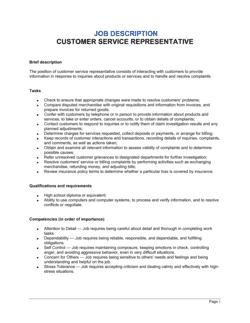
Define duties in priority order
List the five to eight most critical responsibilities, ranked by time allocation or business impact. Each duty should be specific enough to support a performance review conversation six months from now.
💡 For each duty, ask: 'Could I use this line to support a performance improvement plan?' If not, make it more specific.
4
Set measurable KPIs with baselines and targets
Insert the actual current baseline for each metric (NPS, CSAT, churn, FCR) and the target the new hire is expected to reach. If baselines are unknown, commit to establishing them in the first 30 days.
💡 Quantified KPIs in a signed job description are far easier to enforce in a performance conversation than subjective assessments.
5
Review qualifications for necessity and legal compliance
For each required qualification, confirm it is genuinely necessary for the role — not merely a proxy for experience level. Remove degree requirements that are not operationally justified, particularly in jurisdictions with skills-based hiring guidance.
💡 In the US, requiring a four-year degree for a role that does not need it has triggered disparate-impact claims under Title VII. Audit every requirement before posting.
6
Add the compensation range and benefits reference
Enter the salary band, bonus eligibility, and employment classification. Reference your benefits program by category rather than detailing specific plan terms — plans change annually.
💡 Check Colorado, New York, California, Washington, and Canadian provinces for pay-transparency posting requirements before you go live — fines for non-compliance can reach $10,000 per violation.
7
Specify location, schedule, and travel expectations
State whether the role is remote, hybrid, or on-site. For hybrid, specify minimum in-office days. Include any travel estimate as a percentage of working time.
💡 For remote roles, specify the permitted work locations (states or countries) — tax nexus and employment law follow the employee's physical location, not the employer's headquarters.
8
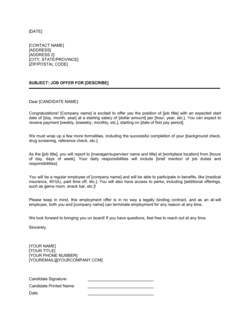
Obtain a signed acknowledgment before the start date
Send the completed job description to the candidate with the offer letter and collect their dated signature before day one. File the signed copy in the employee's HR record.
💡 A signed job description executed after the start date may require fresh consideration (a bonus, salary increase, or additional benefit) to be enforceable in common-law jurisdictions.