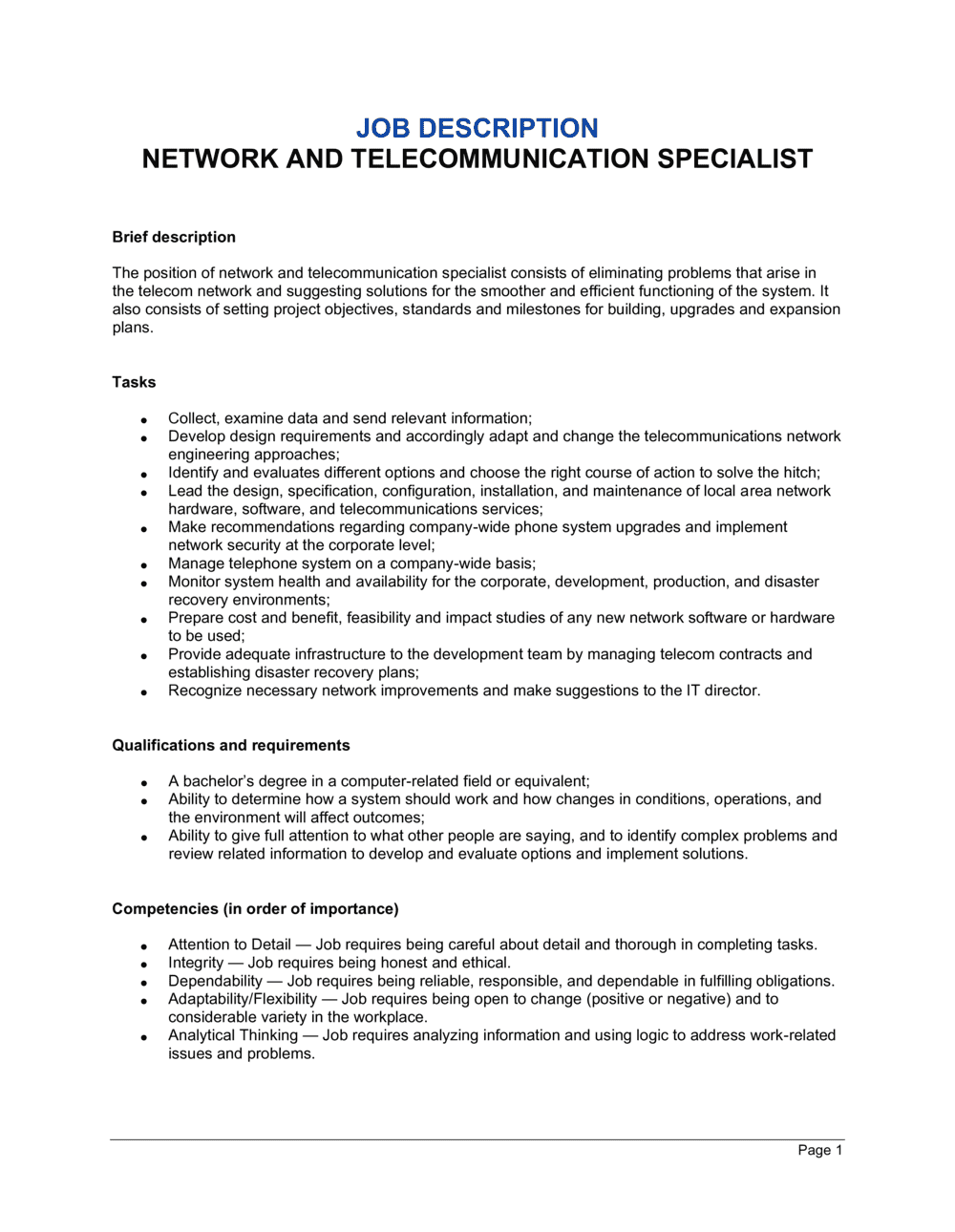
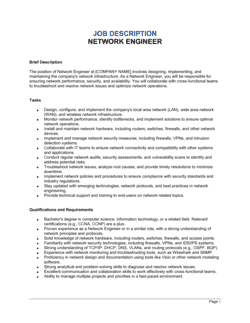
- Job Description
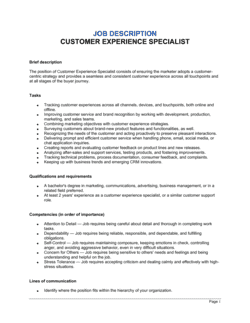
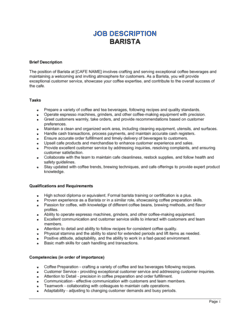
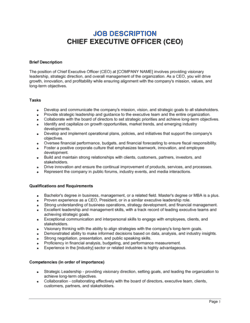
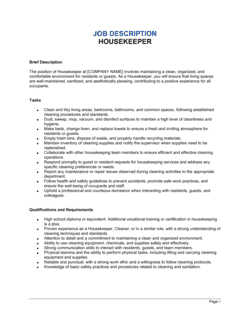
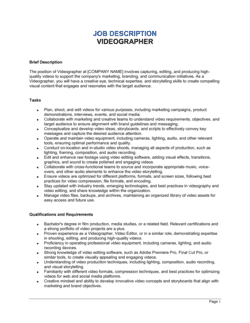
- A formal document that specifies the duties, qualifications, reporting structure, and conditions of a particular role within an organization.
- Network Infrastructure
- The physical and virtual hardware — routers, switches, firewalls, cabling, and wireless access points — that enables data communication within and between organizations.
- Telecommunication Systems
- Voice and data transmission platforms including VoIP, PBX, unified communications suites, and carrier-managed WAN connections.
- SLA (Service Level Agreement)
- A contractual commitment defining the minimum performance standards — such as uptime percentage and incident response time — a network team must meet.
- MPLS (Multiprotocol Label Switching)
- A high-performance routing technique used in enterprise WANs to direct data along predetermined paths for speed and reliability.
- IP Assignment Clause
- A contractual provision transferring ownership of any work product, configurations, or tools created by the employee to the employer.
- Confidentiality Obligation
- A binding requirement that the employee not disclose sensitive information — network topology, credentials, vendor contracts — during or after employment.
- Essential Functions
- The core duties a role must perform, used in jurisdictions with disability accommodation laws to distinguish required tasks from marginal ones.
- Scope of Work
- The defined boundaries of what a role is responsible for, used to prevent scope creep and to support performance management.
- At-Will Employment
- A US doctrine allowing either the employer or employee to end the working relationship at any time for any lawful reason without advance notice.
- Certifications (CCNA / CompTIA Network+)
- Vendor-specific or vendor-neutral credentials validating a technician's knowledge of networking concepts, used as hiring benchmarks.