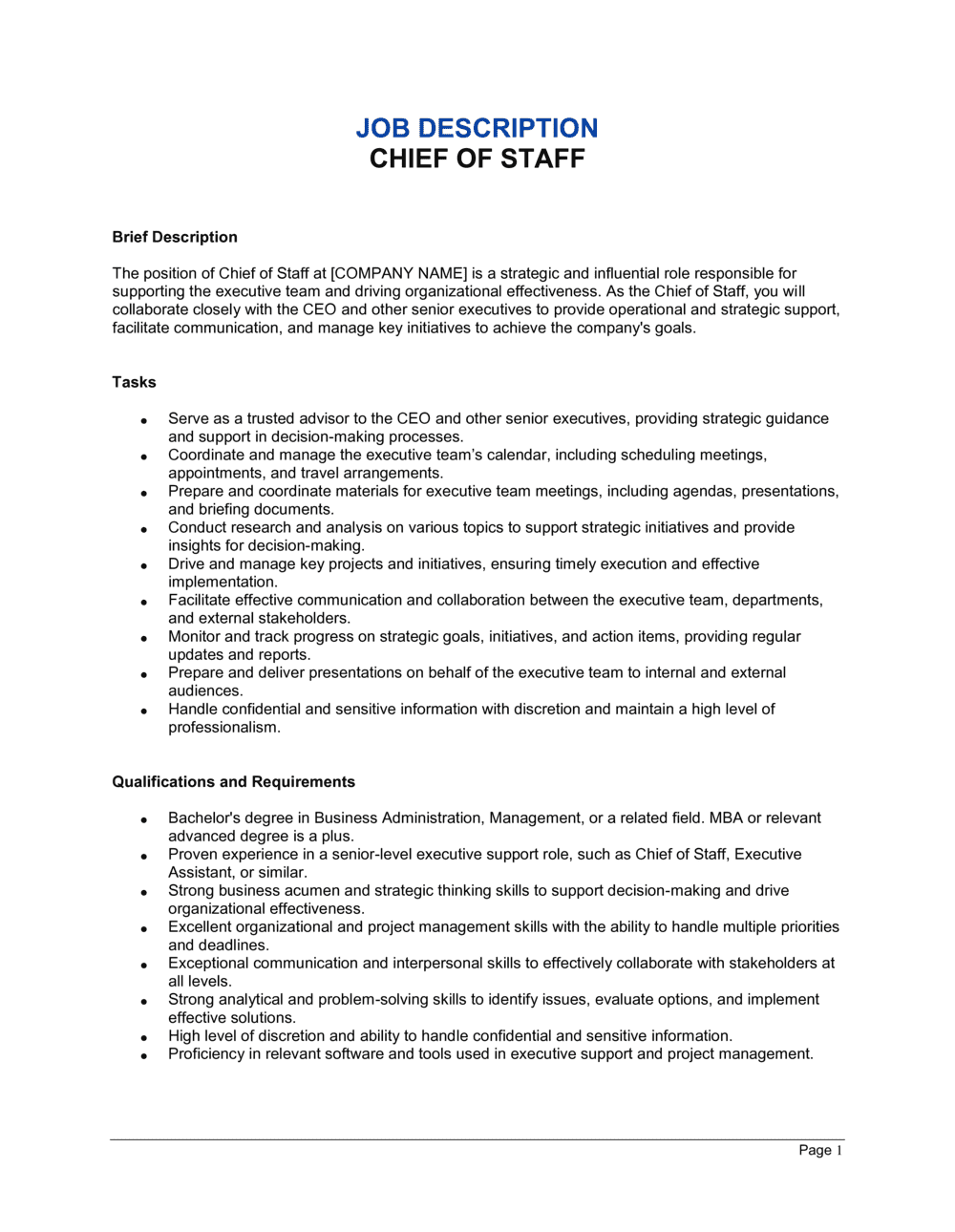
Chief Of Staff Job Description Template

Free Word download • Edit online • Save & share with Drive • Export to PDF

2 pages20–30 min to fillDifficulty: StandardSignature requiredLegal review recommended
Learn more ↓
FreeChief Of Staff Job Description Template

At a glance

What it is
A Chief of Staff Job Description is a formal document that defines the scope, authority, reporting structure, and performance expectations for a Chief of Staff role within an organization. This free Word download gives you an editable, structured template you can tailor to your company size and industry, then export as PDF or incorporate into an employment contract.
When you need it
Use it when hiring, promoting, or restructuring a Chief of Staff role — especially when the position carries cross-functional authority, access to confidential strategic information, or budget oversight. It is also essential when onboarding an external executive hire who needs written clarity on scope before accepting an offer.
What's inside
Role summary and organizational positioning, detailed responsibilities and decision-making authority, reporting lines and key stakeholder relationships, required qualifications and competencies, performance metrics and KPIs, compensation framework, confidentiality obligations, and conflict-of-interest provisions.

What is a Chief of Staff Job Description?

A Chief of Staff Job Description is a formal document that defines the scope, authority, reporting structure, performance expectations, and legal obligations attached to a Chief of Staff role within an organization. Unlike a standard job posting, a well-drafted Chief of Staff job description functions as a governance document — it maps decision rights across functional domains, sets measurable KPIs tied to the principal's strategic priorities, and establishes confidentiality and conflict-of-interest obligations appropriate for a role with direct access to board materials, M&A strategy, and investor communications. When incorporated by reference into a signed employment agreement, it becomes a binding exhibit that both parties can enforce.

Why You Need This Document

Hiring a Chief of Staff without a clearly documented scope is one of the most reliable ways to derail an otherwise strong executive hire. Without explicit decision rights, peer C-suite leaders resist the Chief of Staff's involvement, strategic initiatives stall, and the role loses credibility within months. Without measurable KPIs, annual performance reviews become subjective disputes about whether the hire is delivering. Without tailored confidentiality provisions, a Chief of Staff who attends board meetings, reviews M&A targets, and manages investor communications is governed only by generic employee handbook language — which was not written for that level of information access. This template gives you a structured, legally sound starting point that covers every material dimension of the role, from organizational positioning and decision authority to compensation disclosure and governing law. The time you invest in drafting it precisely is returned many times over in a faster hire, a clearer onboarding, and a Chief of Staff who can operate at full effectiveness from day one.

Which variant fits your situation?

If your situation is…Use this template
Hiring a Chief of Staff in an early-stage startup with a small teamChief of Staff Job Description (Startup)
Installing a Chief of Staff to support a C-suite executive in a large enterpriseChief of Staff Job Description (Enterprise)
Creating a Chief of Staff role in a nonprofit organizationChief of Staff Job Description (Nonprofit)
Hiring a Chief of Staff with primary focus on board and investor relationsChief of Staff Job Description (Board-Facing)
Combining the Chief of Staff role with VP of Operations responsibilitiesChief of Staff / VP Operations Job Description
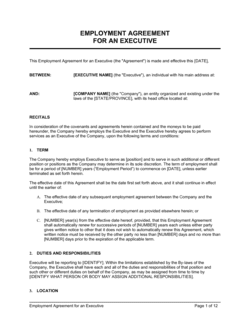
Documenting the role as part of a broader employment contract packageExecutive Employment Agreement
Hiring a fractional or interim Chief of Staff through a contractor arrangementIndependent Contractor Agreement

Common mistakes to avoid

❌ Leaving decision rights undefined

Why it matters: A Chief of Staff without explicit authority will either over-step into peer executives' lanes — creating conflict — or under-deliver because no one accepts their direction.

Fix: Build a one-page decision-rights matrix covering at least five functional domains before the role is posted. Circulate it to existing C-suite leaders for sign-off.

❌ Using only qualitative performance criteria

Why it matters: Phrases like 'strong strategic thinking' cannot be measured, which makes annual reviews subjective and creates disputes about whether the employee is meeting expectations.

Fix: Define at least four KPIs with numeric targets — hours recaptured for the principal per week, initiative on-time delivery rate, meeting effectiveness score — before the hire starts.

❌ Omitting confidentiality provisions specific to the role

Why it matters: A Chief of Staff routinely accesses board materials, M&A strategy, and investor communications — far more sensitive than the information covered by a standard employee handbook confidentiality clause.

Fix: Include a role-specific confidentiality clause that enumerates the information categories the Chief of Staff will access, with explicit restrictions on disclosure during and after employment.

❌ Treating the job description as non-binding HR paperwork

Why it matters: Without incorporation-by-reference language in the employment agreement, the scope, KPIs, and restrictions in the job description may not be legally enforceable against either party.

Fix: Add a clause in the employment agreement stating the job description is attached as Exhibit A and incorporated by reference, then obtain the employee's signature on both documents before day one.

❌ Failing to align the role design with existing C-suite leaders

Why it matters: When peer executives have not agreed to the Chief of Staff's authority in advance, they resist involvement, duplicate work, and the role becomes ineffective within months.

Fix: Present the decision-rights matrix and reporting structure to the full C-suite and get documented acknowledgment before posting the position externally.

❌ Publishing a salary range disconnected from the approved budget

Why it matters: In a small executive candidate pool, a misaligned salary range damages employer brand permanently and collapses offer negotiations after significant time investment by both parties.

Fix: Confirm the approved compensation band with the board or CFO before publishing. In salary-disclosure jurisdictions, a non-compliant posting also creates regulatory exposure.

The 10 key clauses, explained

Role title, grade, and organizational position

In plain language: States the official job title, job grade or band, FLSA classification, and where the role sits in the organizational hierarchy.

Sample language
Job Title: Chief of Staff | Reports to: [PRINCIPAL TITLE, e.g., Chief Executive Officer] | Job Grade: [GRADE/BAND] | FLSA Status: Exempt | Department: Office of the [PRINCIPAL TITLE]

Common mistake: Omitting the FLSA exemption classification. A Chief of Staff whose duties do not meet the executive exemption test may legally be entitled to overtime pay, creating unexpected payroll liability.

Role summary and strategic purpose

In plain language: A 3–5 sentence overview of why the role exists, the problems it solves, and the organizational outcomes it drives.

Sample language
The Chief of Staff serves as the principal strategic and operational partner to the [PRINCIPAL TITLE], ensuring that [COMPANY NAME]'s priorities are executed with speed and alignment. The role acts as a force multiplier for the [PRINCIPAL TITLE] by managing cross-functional initiatives, preparing decision-ready information, and holding the leadership team accountable to agreed commitments.

Common mistake: Writing a generic summary that could apply to any executive role. A vague summary produces vague candidate applications and makes performance management harder after hire.

Core responsibilities and decision rights

In plain language: An itemized list of primary duties organized by function — strategic support, operations, communications, and cross-functional project leadership — with explicit decision-making authority for each.

Sample language
The Chief of Staff is authorized to: (a) make independent decisions on matters within [LIST OF DOMAINS]; (b) recommend, but not finalize, decisions on [LIST OF DOMAINS]; and (c) escalate to the [PRINCIPAL TITLE] all decisions relating to [LIST OF DOMAINS].

Common mistake: Listing responsibilities without defining decision rights. When a Chief of Staff's authority is undefined, they either over-step into other executives' territory or under-deliver because no one will accept their direction.

Reporting lines and stakeholder relationships

In plain language: Defines who the Chief of Staff reports to directly, any dotted-line reporting relationships, and the key internal and external stakeholders the role regularly interfaces with.

Sample language
The Chief of Staff reports directly to the [PRINCIPAL TITLE]. Dotted-line accountability to: [BOARD CHAIR / CFO / COO] for [SPECIFIC MATTERS]. Primary internal stakeholders: [LIST OF LEADERSHIP ROLES]. External stakeholders: [INVESTORS / BOARD / KEY PARTNERS].

Common mistake: Failing to document dotted-line relationships. When a Chief of Staff coordinates across the C-suite without explicit authority, peer executives resist their involvement and strategic initiatives stall.

Required qualifications and competencies

In plain language: States minimum education, years of experience, and the specific functional skills and leadership competencies required to perform the role at the expected level.

Sample language
Required: [X]+ years of experience in [strategy / operations / management consulting / investment banking]; demonstrated ability to manage cross-functional teams without direct authority; advanced proficiency in [TOOLS/SYSTEMS]. Preferred: MBA or equivalent advanced degree; prior experience as Chief of Staff or in a senior strategy role.

Common mistake: Setting credential requirements so high that they screen out the best candidates, or so low that the role attracts applicants without the maturity to operate at the executive level.

Performance metrics and KPIs

In plain language: Defines the specific, measurable outcomes by which the Chief of Staff's performance will be evaluated — tied to the principal's priorities and organizational goals.

Sample language
Performance will be evaluated on: (a) on-time delivery of [X] strategic initiatives per quarter; (b) leadership team meeting effectiveness score of [X]% or higher; (c) [PRINCIPAL TITLE] time-recapture target of [X] hours per week; (d) [CUSTOM KPI].

Common mistake: Using only qualitative descriptors like 'strong communication skills' as performance criteria. Without measurable KPIs, annual reviews become subjective and disputes about performance are hard to resolve.

Compensation, benefits, and equity

In plain language: States the base salary range, bonus eligibility, equity participation (if any), and a reference to the applicable benefits program.

Sample language
Base Salary: $[MIN]–$[MAX] per year, commensurate with experience. Annual Bonus Target: [X]% of base salary, discretionary. Equity: [OPTION GRANT / RSU GRANT / N/A] per separate option agreement. Benefits: Participation in the Company's standard executive benefits program as in effect from time to time.

Common mistake: Publishing a salary range that does not reflect the actual approved budget, creating expectation mismatches that collapse offer negotiations and damage employer brand in a small executive candidate market.

Confidentiality and information-handling obligations

In plain language: Specifies that the Chief of Staff will have access to highly sensitive organizational information and sets out their obligation to protect it during and after employment.

Sample language
In the course of this role, Employee will have access to Confidential Information including but not limited to board materials, M&A strategy, personnel records, investor communications, and financial projections. Employee shall not disclose or use any such information outside the scope of their duties without prior written authorization from [PRINCIPAL TITLE].

Common mistake: Relying on a generic confidentiality clause from an employee handbook rather than role-specific language. A Chief of Staff's access to sensitive information is broader than most roles and warrants a more comprehensive, tailored provision.

Conflict-of-interest and outside activity restrictions

In plain language: Prohibits the Chief of Staff from engaging in outside activities — advisory roles, investments, board seats — that could conflict with their duties or create a reputational risk.

Sample language
Employee shall not, without prior written approval from the [PRINCIPAL TITLE], (a) serve on the board of any company that competes with or does business with [COMPANY NAME], (b) accept advisory or consulting engagements that involve a time commitment exceeding [X] hours per month, or (c) make personal investments in direct competitors of [COMPANY NAME].

Common mistake: Omitting conflict-of-interest provisions entirely. A Chief of Staff with access to M&A targets, competitive strategy, and investor relationships who also advises a competitor creates significant legal and reputational risk.

Governing law and acknowledgment

In plain language: States the jurisdiction whose employment law governs the document and includes a signature block confirming the employee has read, understood, and agreed to the terms.

Sample language
This Job Description is governed by the laws of [STATE / PROVINCE / COUNTRY] and is incorporated by reference into Employee's Employment Agreement dated [DATE]. Employee acknowledges receipt and understanding of this document. Signed: [EMPLOYEE NAME] __________ Date: __________ | [AUTHORIZED SIGNATORY] __________ Date: __________

Common mistake: Treating the job description as an informal HR document rather than a contractually incorporated exhibit. Without explicit incorporation language, the scope and KPIs in the job description may not be enforceable against either party.

How to fill it out

  1. 1

    Define the principal and the organizational context

    Enter the name and title of the executive the Chief of Staff will serve, the company's size and structure, and the specific strategic challenges that make this role necessary now.

    💡 Start with the principal's three biggest time drains — the Chief of Staff's core job is to own those. Build the role description around them.

  2. 2

    Draft the role summary in terms of outcomes, not activities

    Write 3–5 sentences explaining the organizational problem this role solves and the measurable outcomes it will drive within the first 12 months.

    💡 Test your draft by asking: if this role disappears in 12 months, what specifically did not get done? If you can't answer that, the summary is too vague.

  3. 3

    Map decision rights across functional domains

    For each major responsibility area — strategy, operations, communications, cross-functional projects — specify whether the Chief of Staff has independent decision authority, advisory authority, or escalation duty.

    💡 Circulate the decision-rights matrix to your existing C-suite before posting the role. Unresolved authority conflicts with peers are the single biggest reason Chiefs of Staff fail within six months.

  4. 4

    Set qualification requirements calibrated to the actual role

    List the minimum years of experience, functional background, and competencies required. Separate hard requirements from preferred qualifications to avoid screening out strong candidates unnecessarily.

    💡 The most effective Chiefs of Staff typically have 5–10 years of experience, not 15+. Requiring 15 years for a role that reports to a 35-year-old CEO produces a mismatch in pace and communication style.

  5. 5

    Define at least four measurable KPIs

    Link each KPI to a specific strategic priority — time recaptured for the principal, initiatives delivered on schedule, meeting effectiveness scores, or cross-functional alignment metrics.

    💡 Agree on KPIs with the principal before the hire is posted, not after the candidate accepts. Retroactively setting metrics is a leading cause of early executive departure.

  6. 6

    Enter the compensation range and equity details

    Insert the approved base salary range, annual bonus target as a percentage of base, and any equity component with a reference to the separate option or RSU agreement.

    💡 In jurisdictions that require salary range disclosure — California, New York, Colorado — publishing the range in the job description is a legal compliance requirement, not just a best practice.

  7. 7

    Tailor confidentiality and conflict-of-interest provisions to this role

    Replace generic confidentiality language with provisions specific to the information categories the Chief of Staff will actually access — board materials, M&A targets, investor data, personnel records.

    💡 Have legal counsel review these provisions if the Chief of Staff will have access to material non-public information or sit in on board meetings.

  8. 8

    Incorporate into the employment agreement and obtain signatures

    Add explicit incorporation-by-reference language in the body of the employment agreement, attach the job description as a signed exhibit, and execute before the employee's first day.

    💡 Keep a counter-signed copy in both the employee's personnel file and your legal document management system — not just in an email thread.

Frequently asked questions

What does a Chief of Staff do?

A Chief of Staff serves as the primary strategic and operational partner to a senior executive — typically a CEO or President — by managing cross-functional priorities, preparing decision-ready information, running the leadership operating cadence, and ensuring strategic initiatives move forward on schedule. The role is a force multiplier: it extends the principal's bandwidth by absorbing coordination, communication, and project management work that would otherwise consume executive time.

What should a Chief of Staff job description include?

A complete Chief of Staff job description covers the role summary and organizational positioning, core responsibilities with explicit decision rights, reporting lines and key stakeholder relationships, required qualifications and competencies, measurable KPIs, compensation range, confidentiality obligations, conflict-of-interest restrictions, and governing law with a signature block. Missing any of these — particularly decision rights and KPIs — produces a role that is difficult to staff and harder to manage.

Is a job description a legally binding document?

On its own, a job description is not a binding contract in most jurisdictions. However, when it is explicitly incorporated by reference into a signed employment agreement — attached as an exhibit with a cross-reference clause — its terms become contractually enforceable. For a Chief of Staff role, where scope, authority, and confidentiality obligations are material, incorporating the job description into the employment contract is strongly advisable.

What is the difference between a Chief of Staff and an Executive Assistant?

An Executive Assistant manages the principal's calendar, travel, and administrative workflows. A Chief of Staff operates at a strategic level — owning cross-functional initiatives, managing the leadership team's operating cadence, and making independent decisions within defined domains. The two roles are complementary, not interchangeable. A Chief of Staff typically has direct reports or cross-functional authority; an Executive Assistant typically does not.

What qualifications should a Chief of Staff have?

Most effective Chiefs of Staff have 5–10 years of experience in strategy, management consulting, investment banking, operations, or a prior executive role. An MBA or equivalent advanced degree is common but not universal. Critical competencies include operating without direct authority, synthesizing complex information into clear recommendations, managing senior stakeholders, and maintaining strict confidentiality. Industry expertise matters less than general executive operating skill and judgment.

How is a Chief of Staff compensated?

At growth-stage companies, Chief of Staff base salaries typically range from $120,000 to $200,000, with bonus targets of 10–20% of base. At larger enterprises, base salaries range from $180,000 to $280,000 or higher for roles with significant board exposure. Equity is common at venture-backed startups — typically 0.1–0.5% in options. The compensation range should be published in the job description both as a best practice and to comply with pay-transparency laws in California, New York, Colorado, and other jurisdictions.

Can a Chief of Staff be an independent contractor?

Technically possible, but high-risk in most jurisdictions. A Chief of Staff who works full-time hours, under the direction of the principal, using company equipment and systems, almost certainly meets the legal definition of an employee — regardless of how the contract labels the relationship. Misclassification exposes the company to back taxes, penalties, and benefit liability. Fractional or project-based Chiefs of Staff engaged for a defined scope may qualify for contractor treatment under careful legal analysis.

What KPIs should be used to evaluate a Chief of Staff?

Effective KPIs for a Chief of Staff include: hours recaptured for the principal per week (target: 5–10 hours), on-time delivery rate for strategic initiatives (target: 80%+), leadership team meeting effectiveness score from a quarterly pulse survey, number of cross-functional blockers resolved per quarter, and a composite principal-satisfaction rating. Avoid relying solely on qualitative assessments — they make annual reviews subjective and create disputes.

Does a Chief of Staff job description need to be reviewed by a lawyer?

For most domestic hires in a standard operating environment, a well-drafted template is sufficient. Legal review is advisable when the Chief of Staff will have access to material non-public information, sit in on board meetings, operate in a heavily regulated industry, or work across multiple jurisdictions. In those cases, a 1–2 hour counsel review of the confidentiality, conflict-of-interest, and governing law provisions — costing $300–$600 — is worthwhile insurance.

How this compares to alternatives

vs Executive Employment Agreement

An employment agreement is the binding legal contract governing the full employment relationship — compensation, equity, IP assignment, non-compete, and termination. A job description defines scope, responsibilities, and performance expectations. The two documents work together: the employment agreement governs the legal relationship; the job description, incorporated as an exhibit, governs day-to-day accountability. A job description alone is not sufficient for a C-suite hire.

vs Independent Contractor Agreement

An independent contractor agreement engages a self-employed professional for a defined scope without employment entitlements. A Chief of Staff job description, by contrast, defines a full-time employee relationship with benefits, equity, and ongoing performance accountability. Misclassifying a full-time Chief of Staff as a contractor to avoid employment obligations is high-risk and routinely challenged by tax authorities in the US, Canada, and the EU.

vs VP of Operations Job Description

A VP of Operations owns specific operational functions — supply chain, facilities, or service delivery — with direct-line authority over staff and budgets. A Chief of Staff is a cross-functional integrator who derives authority from the principal rather than from a functional domain. Some organizations combine both roles; when they do, the job description must explicitly resolve the dual-authority structure to avoid confusion.

vs Employee Offer Letter

An offer letter confirms compensation and start date to secure candidate acceptance — it is not a comprehensive governance document. A Chief of Staff job description defines the full scope, authority, KPIs, and legal obligations of the role. Relying on an offer letter alone for a Chief of Staff hire leaves critical questions — decision rights, confidentiality scope, conflict-of-interest restrictions — legally unanswered.

Industry-specific considerations

Technology / SaaS

Chief of Staff coordinates OKR cycles, board prep, and fundraising due-diligence workflows in a fast-moving environment where the CEO's time is the binding constraint.

Financial Services

Enhanced confidentiality provisions covering client data, trading strategy, and regulatory communications are standard; FINRA/FCA licensing status may need to be referenced in qualifications.

Healthcare and Life Sciences

HIPAA obligations must be incorporated by reference; the Chief of Staff often coordinates regulatory submission timelines, clinical-trial updates, and payer relations on behalf of the principal.

Nonprofit and Public Sector

The role typically manages board relations, grant reporting cycles, and coalition stakeholder communications, with compensation governed by sector-specific benchmarks and donor-disclosure norms.

Professional Services

Chief of Staff drives client portfolio reviews, partner-meeting preparation, and internal capability-building initiatives, often without formal authority over fee-earning partners.

Manufacturing and Industrial

Focus shifts to operational cadence management, supply-chain initiative tracking, and capital project oversight, with KPIs tied to throughput, cost reduction, and on-time delivery milestones.

Jurisdictional notes

United States

A Chief of Staff must be classified as FLSA-exempt under the executive or administrative exemption — confirm the role meets the salary threshold (currently $684/week) and the duties test. California, New York, Colorado, Illinois, and Washington require salary range disclosure in job postings. Non-compete enforceability varies sharply by state; California bans most post-employment restrictions entirely.

Canada

At-will employment does not exist in Canada; the job description should be incorporated into an employment contract that specifies notice periods meeting or exceeding provincial Employment Standards Act minimums. Quebec requires that job descriptions for provincially-regulated employers be available in French. Non-solicitation and confidentiality clauses must be reasonable in scope to be enforceable.

United Kingdom

UK employers must provide a written statement of employment particulars on or before day one — the job description, when incorporated into that statement, satisfies part of this obligation. Garden leave provisions are commonly used for senior roles to protect confidential information during the notice period. Post-employment restrictions require careful drafting to be enforceable under UK common law.

European Union

The EU Transparent and Predictable Working Conditions Directive requires written terms within 7 days of hire, including a description of duties. GDPR applies to the processing of candidate and employee personal data referenced in the job description and hiring process. Post-employment non-competes in most EU member states require financial compensation to the employee — typically 25–100% of base salary during the restriction period.

Template vs lawyer — what fits your deal?

PathBest forCostTime
Use the templateDomestic hires at startups and SMBs where the role has standard scope and no unusual access to regulated or classified informationFree1–2 hours
Template + legal reviewChiefs of Staff with board access, M&A exposure, multi-jurisdiction scope, or roles in regulated industries such as healthcare or financial services$300–$6002–4 days
Custom draftedFortune 500 Chiefs of Staff, government-adjacent roles, or arrangements with complex equity, clawback, or cross-border employment structures$1,500–$4,000+1–3 weeks

Glossary

Chief of Staff
A senior executive who serves as a force multiplier for a principal leader — managing cross-functional priorities, filtering decisions, and ensuring strategic initiatives move forward.
Principal
The executive — typically a CEO, President, or C-suite leader — whom the Chief of Staff directly serves and whose bandwidth the role extends.
Span of Control
The number of direct reports, departments, or initiatives a role is formally accountable for overseeing.
Decision Rights
A documented matrix specifying which decisions the Chief of Staff can make independently, which require principal approval, and which require broader leadership consensus.
KPI (Key Performance Indicator)
A measurable metric tied to a specific outcome — used in job descriptions to define what successful performance looks like in the role.
Confidentiality Obligation
A contractual duty to protect sensitive organizational information — strategy, financials, personnel — from unauthorized disclosure during and after employment.
Conflict of Interest
A situation in which the employee's personal or financial interests could improperly influence their judgment or actions in carrying out their duties.
Exempt Classification
Under US FLSA rules, a role classified as exempt is not entitled to overtime pay because it meets the salary and duties tests for executive, administrative, or professional exemption.
Force Multiplier
An informal descriptor for a Chief of Staff who amplifies the CEO's impact by executing priorities, removing friction, and keeping the leadership team aligned.
Onboarding Plan
A structured 30-60-90 day integration plan for a new hire that defines learning milestones and early deliverables — often attached to the job description as an exhibit.
Reporting Line
The formal organizational relationship specifying who a role reports to and, where applicable, who has dotted-line or functional authority over the position.

Part of your Business Operating System

This document is one of 3,000+ business & legal templates included in Business in a Box.

  • Fill-in-the-blanks — ready in minutes
  • 100% customizable Word document
  • Compatible with all office suites
  • Export to PDF and share electronically

Create your document in 3 simple steps.

From template to signed document — all inside one Business Operating System.
1
Download or open template

Access over 3,000+ business and legal templates for any business task, project or initiative.

2
Edit and fill in the blanks with AI

Customize your ready-made business document template and save it in the cloud.

3
Save, Share, Send, Sign

Share your files and folders with your team. Create a space of seamless collaboration.

Save time, save money, and create top-quality documents.

★★★★★

"Fantastic value! I'm not sure how I'd do without it. It's worth its weight in gold and paid back for itself many times."

Managing Director · Mall Farm
Robert Whalley
Managing Director, Mall Farm Proprietary Limited
★★★★★

"I have been using Business in a Box for years. It has been the most useful source of templates I have encountered. I recommend it to anyone."

Business Owner · 4+ years
Dr Michael John Freestone
Business Owner
★★★★★

"It has been a life saver so many times I have lost count. Business in a Box has saved me so much time and as you know, time is money."

Owner · Upstate Web
David G. Moore Jr.
Owner, Upstate Web

Run your business with a system — not scattered tools

Stop downloading documents. Start operating with clarity. Business in a Box gives you the Business Operating System used by over 250,000 companies worldwide to structure, run, and grow their business.

Free Forever Plan · No credit card required