- Breakeven Point
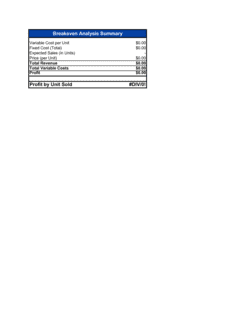
- The sales volume — in units or revenue dollars — at which total revenues exactly equal total costs, producing zero profit or loss.
- Fixed Costs
- Costs that remain constant regardless of production or sales volume, such as rent, salaries, insurance, and depreciation.
- Variable Costs
- Costs that change in direct proportion to production or sales volume, such as raw materials, direct labor, and sales commissions.
- Contribution Margin
- Revenue minus variable costs — the amount each unit sold contributes toward covering fixed costs and generating profit.
- Contribution Margin Ratio
- Contribution margin expressed as a percentage of revenue, showing how many cents of each sales dollar cover fixed costs and profit.
- Margin of Safety
- The difference between actual or projected sales and the breakeven sales level — expressed in units or dollars — showing how far sales can fall before a loss occurs.
- Cost-Volume-Profit (CVP) Analysis
- A framework examining the relationship between costs, sales volume, and profit to support pricing, production, and strategic decisions.
- Target Profit Volume
- The sales volume required to achieve a specific profit goal, calculated by adding the target profit to fixed costs and dividing by the contribution margin per unit.
- Semi-Variable Cost
- A cost that has both a fixed base component and a variable component that changes with activity level, such as a utility bill with a fixed connection fee plus usage charges.
- Operating Leverage
- The degree to which a business relies on fixed costs; high operating leverage means profits grow rapidly above the breakeven point but losses deepen quickly below it.