Responsibility Waiver Form Template

Free Word download β€’ Edit online β€’ Save & share with Drive β€’ Export to PDF

2 pagesβ€’20–25 min to fillβ€’Difficulty: Standard
Learn more ↓
FreeResponsibility Waiver Form Template

At a glance

What it is
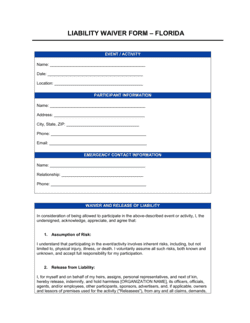
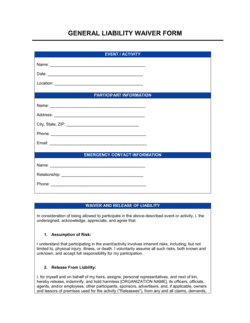
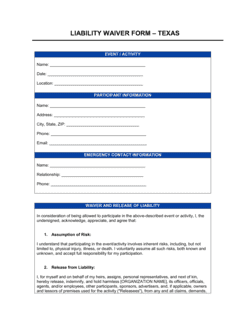
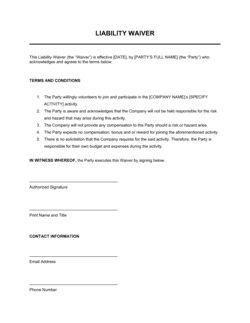
A Responsibility Waiver Form is a structured document in which a participant acknowledges the inherent risks of an activity and agrees not to hold the organizing business or individual liable for injury, loss, or damage arising from participation. This free Word download is fully editable online β€” add your organization's name, activity details, and risk disclosures, then print or distribute digitally for signatures before the activity begins.
When you need it
Use it before any activity, event, service, or program where participants face physical, financial, or other risk β€” from fitness classes and outdoor adventures to equipment rentals and volunteer programs. Collect it from every participant before the activity starts, not after an incident occurs.
What's inside
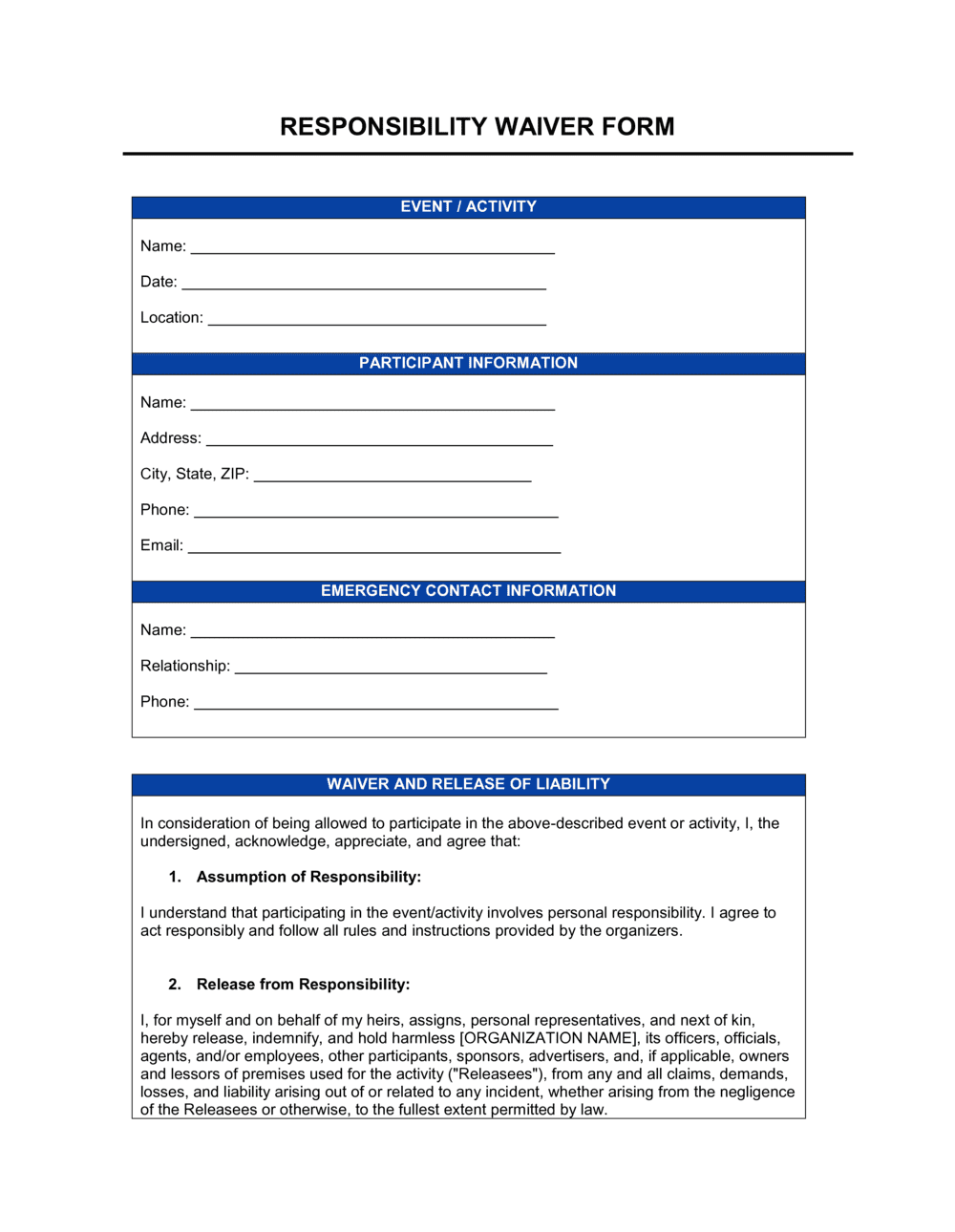
Participant identification details, activity description and risk disclosure, assumption of risk acknowledgment, release and indemnification language, emergency contact information, and a signature block with date.

What is a Responsibility Waiver Form?

A Responsibility Waiver Form is a structured document in which a participant formally acknowledges the inherent risks of an activity and voluntarily agrees to release the organizing business or individual from liability for injury, loss, or damage arising from that participation. It combines three key elements β€” a specific risk disclosure, an assumption of risk acknowledgment, and a release of liability clause β€” into a single form collected before the activity begins. Businesses ranging from fitness studios and adventure tour operators to schools and equipment rental companies use waivers to reduce legal exposure while ensuring participants make informed decisions about the risks they accept.

Why You Need This Document

Without a signed waiver on file, every activity your business runs carries unrestricted liability exposure. A participant who slips during a yoga class, falls on a hiking tour, or damages rented equipment can pursue a claim against your business with no prior acknowledgment that they understood the risk. Beyond the cost of litigation itself, a single uncontested injury claim can exceed the annual revenue of a small business. A properly completed responsibility waiver form documents the participant's informed consent, strengthens your position in any dispute, and signals to your insurance carrier that you operate with appropriate risk management practices. This template gives you a professionally structured starting point β€” ready to customize with your activity details, risk disclosures, and organization name in under 30 minutes.

Which variant fits your situation?

If your situation is…Use this template
General physical activity or sports eventResponsibility Waiver Form
Minor participant requiring parent or guardian consentParental Consent and Waiver Form
Releasing a party from all past and future claims after a disputeGeneral Release of Liability
Photography, media, or likeness rights at an eventPhoto and Media Release Form
Medical treatment or healthcare procedureInformed Consent Form
Equipment or vehicle rental involving physical riskEquipment Rental Agreement with Liability Waiver
Employee volunteer or off-duty activityEmployee Volunteer Waiver Form

Common mistakes to avoid

❌ Using a generic, one-size-fits-all risk list

Why it matters: A vague or mismatched risk disclosure can make the waiver unenforceable for the specific activity that caused an injury, leaving the organizer fully exposed.

Fix: Review the actual activity and venue with your staff, list every specific hazard by name, and update the risk section each time the activity changes.

❌ Collecting signatures after the activity has started or ended

Why it matters: A waiver signed after the fact provides minimal protection β€” the participant can argue they had no meaningful choice to decline once they were already participating.

Fix: Set up a signature station at check-in and make signing the waiver a prerequisite for receiving equipment, a bib number, or entry to the venue.

❌ Failing to get a parent or guardian signature for minors

Why it matters: Minors generally cannot enter binding contracts, so a waiver signed only by the minor is typically unenforceable against the parent's future claims.

Fix: Add a clearly labeled parent or guardian signature block and verify the signer is at least 18 before accepting the form.

❌ Not naming all covered parties in the release clause

Why it matters: A release that names only the business entity leaves employees, volunteers, and contractors personally exposed to lawsuits β€” and those individuals may look to the business for indemnification.

Fix: Explicitly list all covered parties by category: the organization, its officers, directors, employees, volunteers, agents, and contracted instructors.

The 9 key fields, explained

Participant Information

Activity or Event Description

Risk Disclosure Statement

Assumption of Risk Acknowledgment

Release and Hold Harmless Clause

Indemnification Clause

Emergency Contact and Medical Authorization

Severability and Entire Agreement Statement

Signature Block and Date

How to fill it out

  1. 1

    Enter your organization's name and contact details

    Add your business or organization's full legal name, address, phone number, and email to the header. These details identify who is protected by the waiver.

    πŸ’‘ Use the same legal entity name that appears on your business registration or insurance policy β€” inconsistencies can create coverage gaps.

  2. 2

    Describe the specific activity, date, and location

    Name the activity precisely β€” not just 'sports event' but 'trail running race on [TRAIL NAME].' Include the date range and address of the venue.

    πŸ’‘ If the waiver covers multiple sessions (e.g., a 6-week class), list the full date range and note that it applies to all sessions.

  3. 3

    Write a tailored risk disclosure

    List the specific hazards a participant may encounter β€” physical injury types, equipment involved, environmental factors, and contact risks. Review your actual activity checklist to ensure nothing is omitted.

    πŸ’‘ Ask your activity instructor or facility manager to review the risk list before finalizing. They will know hazards that a generic template misses.

  4. 4

    Review and customize the release and indemnification language

    Ensure the release clause names your organization, its officers, employees, volunteers, and any contracted third parties. Confirm the indemnification clause covers third-party claims.

    πŸ’‘ If you use independent contractors to run the activity, list them by role (e.g., 'certified instructors') in the release to ensure they are covered.

  5. 5

    Add the emergency contact and medical authorization section

    Include fields for the emergency contact's name, relationship, and phone number. Add a checkbox or statement authorizing emergency medical care if the participant becomes incapacitated.

    πŸ’‘ For activities involving minors, make the parent or guardian the emergency contact and require their signature on the medical authorization line.

  6. 6

    Include the severability clause and entire-agreement statement

    Add a standard severability clause and confirm the document represents the complete agreement on participant liability. These lines take two sentences and protect the rest of the form if a single clause is challenged.

    πŸ’‘ Place the severability clause near the signature block β€” courts are more likely to find it was reviewed when it appears just above where the participant signed.

  7. 7

    Collect signatures before the activity starts

    Distribute the form to every participant at check-in or registration, allow time to read it, and collect signed copies before the activity begins. File all completed forms in a secure, organized location.

    πŸ’‘ Keep signed waivers for at least three years β€” or longer if your jurisdiction's statute of limitations for personal injury claims exceeds that period.

Frequently asked questions

What is a responsibility waiver form?

A responsibility waiver form is a document in which a participant acknowledges the risks of an activity and agrees not to hold the organizer liable for injuries or losses that arise from participation. It combines a risk disclosure, an assumption of risk statement, and a release of liability clause in a single form that participants sign before taking part. When properly drafted and collected, it provides meaningful legal protection for businesses and event organizers.

Is a responsibility waiver form legally enforceable?

Waiver enforceability depends on the jurisdiction and the quality of the drafting. Most US states enforce waivers for ordinary negligence when the language is clear, the risks are specifically disclosed, and the participant signed voluntarily with adequate notice. Courts typically will not enforce waivers covering gross negligence or intentional misconduct. In some Canadian provinces and EU countries, enforcement standards differ β€” consider a legal review for high-risk activities or cross-border events.

Does a waiver form need to be notarized?

No. Responsibility waiver forms do not typically require notarization to be enforceable in most jurisdictions. A participant's dated signature is generally sufficient to demonstrate informed, voluntary consent. Notarization adds evidentiary value in some contexts but is rarely required for standard activity or event waivers.

Can a minor sign a waiver form?

No. Minors generally lack legal capacity to enter binding contracts, which means a waiver signed only by a participant under 18 is typically unenforceable. A parent or legal guardian must sign on the minor's behalf. Note that even a parent-signed waiver may not bar a minor's own future claim when they reach adulthood in some jurisdictions β€” consult a local attorney if you regularly work with minors.

How long should I keep signed waiver forms?

Keep signed waivers for at least as long as the statute of limitations for personal injury claims in your jurisdiction β€” typically two to three years in most US states, though some states allow up to six years. For activities involving minors, retain waivers until the minor reaches the age of majority plus the applicable limitations period, which can mean keeping records for 20 or more years.

What is the difference between a waiver form and a release of liability?

In practice, the terms are often used interchangeably. Technically, a waiver refers to a participant giving up a specific right β€” such as the right to sue β€” before the activity, while a release is typically signed after an incident to settle and close a claim. A responsibility waiver form collects this agreement upfront, before any harm occurs, making it a preventive tool rather than a post-incident settlement instrument.

Do I need a separate waiver for each activity or event?

It depends on how different the risk profiles are. A waiver signed for a 6-week yoga session can typically cover all sessions in that series if the form states so explicitly. A waiver for one activity β€” say, rock climbing β€” should not be stretched to cover a completely different activity like whitewater rafting. When the risks differ materially, use a separate, tailored form.

Can I use a digital or electronic waiver?

Yes. Electronic signatures are legally recognized under the ESIGN Act in the US and equivalent legislation in Canada, the UK, and the EU. An e-waiver collected through a compliant platform carries the same legal weight as a handwritten signature, provided the participant had a meaningful opportunity to read the document before signing. Digital waivers also make storage and retrieval far more practical for high-volume events.

Does a waiver protect me from all liability?

No. A waiver reduces liability exposure but does not eliminate it entirely. Courts will not enforce waiver clauses that cover gross negligence, intentional acts, or statutory rights that cannot be waived. Some jurisdictions also limit waiver enforceability in consumer-facing contexts or for regulated activities. Carrying adequate liability insurance alongside a well-drafted waiver form provides more complete protection than either measure alone.

How this compares to alternatives

vs General Release of Liability

A general release of liability is typically signed after an incident to settle a dispute and permanently close all claims between the parties. A responsibility waiver form is signed before the activity to proactively limit exposure. Use the waiver before participation and a release after any incident that leads to a potential claim.

vs Informed Consent Form

An informed consent form is most common in healthcare and research settings, where it documents that a patient or subject received and understood specific information about a procedure and chose to proceed. A responsibility waiver is broader and more activity-oriented, adding a release and indemnification clause that an informed consent form does not typically include.

vs Participation Agreement

A participation agreement covers the terms of involvement in a program, class, or service β€” scheduling, fees, conduct rules, and cancellation policies. A waiver focuses specifically on risk acknowledgment and liability limitation. High-risk programs benefit from using both: the participation agreement governs the relationship, and the waiver addresses injury liability.

vs Indemnification Agreement

A standalone indemnification agreement focuses exclusively on one party's obligation to cover the other's losses or legal costs. A responsibility waiver form is a broader, participant-facing document that includes assumption of risk, disclosure, and a release clause in addition to indemnification. Use a standalone indemnification agreement in B2B vendor or contractor relationships where a full consumer-facing waiver is not appropriate.

Industry-specific considerations

Sports and Fitness

Waivers cover equipment use, physical training risks, and class participation, and are typically collected at membership sign-up and renewed annually.

Hospitality and Events

Event organizers use waivers for races, festivals, and experiential activations where crowd, equipment, or environmental hazards create participant risk.

Education and Nonprofits

Schools and nonprofits collect parental consent and waiver forms for field trips, volunteer programs, and after-school activities involving physical or travel risk.

Tourism and Adventure

Tour operators running hiking, diving, climbing, or motorized excursions require signed waivers before every outing and must tailor risk lists to each specific activity.

Template vs pro β€” what fits your needs?

PathBest forCostTime
Use the templateSmall businesses, fitness studios, event organizers, and nonprofits running standard low-to-moderate risk activitiesFree15–30 minutes to customize and print
Template + professional reviewHigh-risk activities (extreme sports, motorized vehicles, water activities) or programs regularly involving minors$150–$400 for a one-hour attorney review1–3 days
Custom draftedLarge-scale events, regulated industries, or cross-border activities where jurisdiction-specific enforceability is critical$500–$2,000+1–2 weeks

Glossary

Assumption of Risk
A participant's acknowledgment that they understand the specific dangers of an activity and voluntarily choose to proceed despite those dangers.
Release of Liability
A contractual clause in which the participant agrees not to bring legal claims against the organizer for injuries or losses arising from the covered activity.
Indemnification
A promise by the participant to compensate the organizer for any costs, damages, or legal fees incurred as a result of the participant's actions during the activity.
Informed Consent
Voluntary agreement to participate in an activity after receiving a clear explanation of the risks involved β€” the foundation of an enforceable waiver.
Waiver
The voluntary relinquishment of a known right β€” in this context, the right to sue the organizer for negligence related to the disclosed activity.
Hold Harmless Clause
Language that prevents the participant from holding the organizer responsible for injuries or damages, even if the organizer's own negligence contributed.
Minor Participant
A participant under 18 years of age, for whom a parent or legal guardian must sign the waiver because minors generally cannot enter binding legal agreements.
Gross Negligence
A severe lack of reasonable care that courts often refuse to allow waivers to cover β€” distinguishable from ordinary negligence, which waivers typically can address.
Consideration
Something of value exchanged by both parties to make a contract enforceable β€” in a waiver, the participant's consideration is the right to take part in the activity.
Severability Clause
A provision stating that if any part of the waiver is found unenforceable, the remainder of the document continues to apply.

Part of your Business Operating System

This document is one of 3,000+ business & legal templates included in Business in a Box.

  • Fill-in-the-blanks β€” ready in minutes
  • 100% customizable Word document
  • Compatible with all office suites
  • Export to PDF and share electronically

Create your document in 3 simple steps.

From template to signed document β€” all inside one Business Operating System.
1
Download or open template

Access over 3,000+ business and legal templates for any business task, project or initiative.

2
Edit and fill in the blanks with AI

Customize your ready-made business document template and save it in the cloud.

3
Save, Share, Send, Sign

Share your files and folders with your team. Create a space of seamless collaboration.

Save time, save money, and create top-quality documents.

β˜…β˜…β˜…β˜…β˜…

"Fantastic value! I'm not sure how I'd do without it. It's worth its weight in gold and paid back for itself many times."

Managing Director Β· Mall Farm
Robert Whalley
Managing Director, Mall Farm Proprietary Limited
β˜…β˜…β˜…β˜…β˜…

"I have been using Business in a Box for years. It has been the most useful source of templates I have encountered. I recommend it to anyone."

Business Owner Β· 4+ years
Dr Michael John Freestone
Business Owner
β˜…β˜…β˜…β˜…β˜…

"It has been a life saver so many times I have lost count. Business in a Box has saved me so much time and as you know, time is money."

Owner Β· Upstate Web
David G. Moore Jr.
Owner, Upstate Web

Run your business with a system β€” not scattered tools

Stop downloading documents. Start operating with clarity. Business in a Box gives you the Business Operating System used by over 250,000 companies worldwide to structure, run, and grow their business.

Start freeΒ Β·Β No credit card required