Consumer Credit Application Template

Free Word download β€’ Edit online β€’ Save & share with Drive β€’ Export to PDF

1 pageβ€’15–25 min to fillβ€’Difficulty: Standard
Learn more ↓
FreeConsumer Credit Application Template

At a glance

What it is
A Consumer Credit Application is a standardized form a lender or retailer gives to a prospective borrower to collect the personal, employment, and financial information needed to evaluate a credit request. This free Word download is editable online and exportable as PDF β€” ready to hand to applicants at the counter or embed in an onboarding packet.
When you need it
Use it whenever a customer applies for retail credit, a store card, auto financing, or a personal loan and you need a consistent, documented record of their information before running a credit check.
What's inside
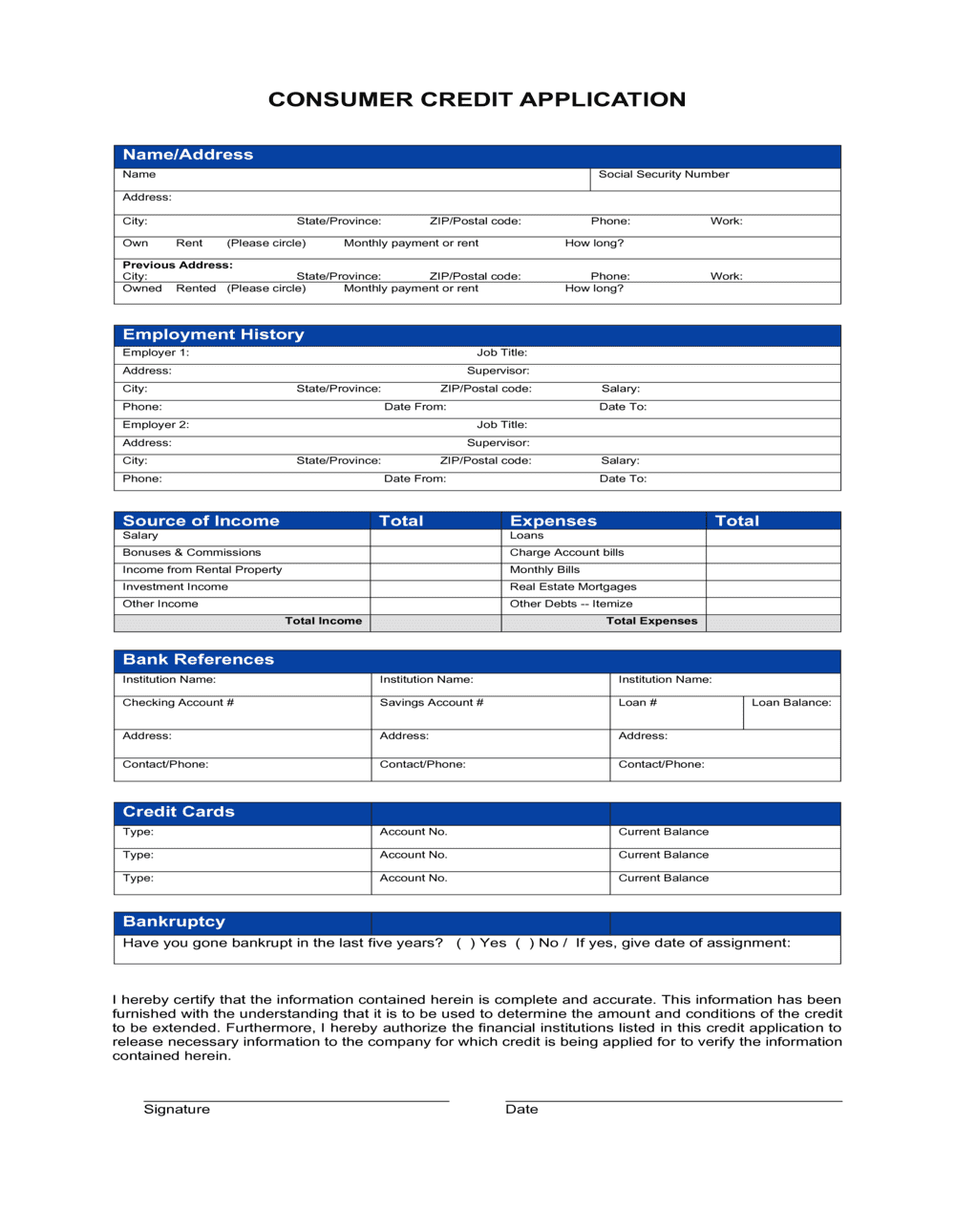
Personal identification, current and previous address history, employment and income details, co-applicant information, credit references, and a signed authorization for the lender to pull a credit report and verify the information provided.

What is a Consumer Credit Application?

A Consumer Credit Application is a standardized form a lender or retailer uses to collect the personal, employment, and financial information needed to evaluate a request for retail credit, a store card, auto financing, or a personal loan. It captures everything an underwriter needs to pull a credit bureau report and make an approval decision β€” legal name, address history, employer details, gross income, co-applicant information, and a signed authorization. Unlike an informal intake form, a properly structured credit application creates a consistent, documented record that supports compliance with the Fair Credit Reporting Act and Equal Credit Opportunity Act requirements.

Why You Need This Document

Operating without a standardized credit application exposes your business to two compounding risks: regulatory liability and underwriting errors. Pulling a consumer credit report without a signed, documented authorization violates the Fair Credit Reporting Act and can trigger civil penalties and regulatory action. At the same time, an inconsistent intake process β€” collecting different information from different applicants β€” produces unreliable DTI calculations, missed income sources, and incomplete bureau submissions that stall or invalidate applications. A uniform form also gives you a defensible paper trail if an applicant later disputes a decision or alleges discriminatory treatment. This template gives you a complete, ready-to-use intake document that captures every field underwriters need, includes the authorization language required before a bureau inquiry, and takes under ten minutes to customize with your business name and contact details.

Which variant fits your situation?

If your situation is…Use this template
Applying for business credit rather than personal creditBusiness Credit Application
Customer requesting trade credit for wholesale purchasesTrade Credit Application
Adding a joint applicant or co-signer to a loanConsumer Credit Application with Co-Applicant
Applying for a personal loan with income verification documentsPersonal Loan Application
Offering deferred-payment retail financing at point of saleRetail Installment Contract
Evaluating rental applicant creditworthiness for a leaseRental Application Form

Common mistakes to avoid

❌ Pulling a credit report before collecting a signed authorization

Why it matters: Under the Fair Credit Reporting Act, obtaining a consumer report without a permissible purpose and signed authorization exposes the lender to civil liability and regulatory penalties.

Fix: Make the signed authorization the last step before submission β€” build a checklist that includes 'authorization signed' as a hard gate.
❌ Recording net income instead of gross income

Why it matters: DTI calculations based on net pay produce an artificially low ratio, potentially approving applicants who cannot actually service the debt β€” or rejecting those who can.

Fix: Label the income field 'gross monthly income (before taxes)' explicitly on the form and verify against a pay stub at intake.

❌ Leaving the co-applicant block partially blank

Why it matters: An incomplete co-applicant section means the co-applicant's income cannot be counted and their credit cannot be pulled β€” removing the benefit of having a co-applicant entirely.

Fix: Treat the co-applicant block as a second full application. Every required field for the primary applicant applies equally to the co-applicant.

❌ Accepting self-employment income without a business contact

Why it matters: Self-employment income cannot be verified without a business name, address, and contact number β€” the application will stall in underwriting until the information is collected separately.

Fix: Add a sub-field for business name, address, and phone that appears when 'self-employed' is selected, and make it required before the form is accepted.

The 9 key fields, explained

Personal identification

Current and previous address

Employment information

Income details

Co-applicant information

Housing expenses

Credit references

Credit request details

Authorization and applicant signature

How to fill it out

  1. 1

    Add your business name and contact details

    Replace the lender placeholder at the top with your business's legal name, address, phone number, and any required license numbers. This identifies the creditor on the form and in the authorization clause.

    πŸ’‘ Include your NMLS number or state lending license number if applicable β€” omitting it can void the authorization clause in regulated states.

  2. 2

    Have the applicant complete the personal identification block

    Collect legal name, date of birth, SSN or government ID, phone, and email. Verify the name against a government-issued photo ID before accepting the form.

    πŸ’‘ A name mismatch between the form and the ID is the single most common reason a bureau match fails β€” check it at intake, not after submission.

  3. 3

    Confirm two years of address history

    If the applicant's current address tenure is under two years, ensure the previous address field is fully completed. Two years of history is the standard bureau matching window.

    πŸ’‘ For applicants who have moved frequently, add a second previous-address row rather than cramming multiple addresses into one field.

  4. 4

    Record employment and gross income accurately

    Enter the employer's full name, address, and direct phone number. Record gross monthly income β€” before taxes β€” from all disclosed sources and total them.

    πŸ’‘ Ask for a recent pay stub at intake. It takes 30 seconds to verify the figures and eliminates the most common income discrepancy that delays underwriting.

  5. 5

    Complete the co-applicant section if applicable

    If a co-applicant or co-signer is involved, ensure they complete and sign their own section in full. Combined income can strengthen the application, but only if all fields are complete and the co-applicant has signed the authorization.

    πŸ’‘ Do not prefill co-applicant income based on what the primary applicant tells you β€” have the co-applicant write and confirm their own figures.

  6. 6

    Record the credit request and purpose

    Enter the exact dollar amount requested, the purpose (vehicle, retail purchase, personal use), and the product type. Route the completed form to the correct underwriting workflow based on this field.

    πŸ’‘ Round numbers like '$5,000' are fine, but a stated purpose of 'misc' delays approval β€” the underwriter needs to confirm product eligibility.

  7. 7

    Obtain the applicant's signature before any bureau inquiry

    Have the applicant review and sign the authorization block in your presence. Date the signature and retain the original. Do not submit to a credit bureau until the signed form is in hand.

    πŸ’‘ Keep a scanned copy in the applicant file β€” if a dispute arises later under the FCRA, the signed authorization is your primary defense.

Frequently asked questions

What is a consumer credit application?

A consumer credit application is a standardized form a lender or retailer uses to collect the personal, employment, and financial information needed to evaluate a request for retail credit, a store card, auto financing, or a personal loan. It also captures the applicant's signed authorization for the lender to pull a credit report and verify the information provided.

What information is typically collected on a consumer credit application?

Most applications collect full legal name, date of birth, Social Security number, current and previous address history, employment details, gross monthly income, housing expenses, co-applicant information if applicable, credit references, the amount and purpose of the credit request, and a signed authorization for a credit bureau inquiry. Missing any of these fields typically stalls underwriting.

Does a consumer credit application require a signature?

The application form itself does not create a binding obligation, so a signature on the body of the form is not legally required to document the request. However, the authorization section β€” which permits the lender to pull a credit report β€” must be signed before the bureau inquiry is initiated. Without that signature, the credit pull is not authorized under the Fair Credit Reporting Act.

What is the difference between a consumer credit application and a business credit application?

A consumer credit application evaluates an individual's personal creditworthiness based on personal income, personal credit history, and personal assets. A business credit application evaluates an entity's creditworthiness using business revenue, business credit history, and business financials β€” though lenders often require a personal guarantee from the business owner as well. Use a consumer application for individual retail or auto credit; use a business application for trade accounts or commercial financing.

How long does a lender retain a consumer credit application?

Retention requirements vary by jurisdiction and product type. In the US, the Equal Credit Opportunity Act (ECOA) requires lenders to retain application records for 25 months for consumer credit. State laws may require longer periods. Regardless of the legal minimum, retaining the signed authorization is essential in case of a later FCRA dispute over the bureau inquiry.

What is a hard inquiry and will the application trigger one?

A hard inquiry is a formal credit report pull initiated by a lender in response to a credit application. It is visible to other lenders for up to two years and can lower a consumer's credit score by a few points. Submitting a completed consumer credit application with a signed authorization will typically trigger a hard inquiry once the lender decides to proceed. Some lenders run a soft inquiry first for pre-screening, which does not affect the score.

Can a co-applicant be added to a consumer credit application?

Yes. Most consumer credit application forms include a co-applicant section for a joint borrower or co-signer. The co-applicant must complete their own personal, employment, and income information and sign the authorization block separately. Combined income can improve approval odds or increase the available credit limit, but both applicants are equally liable for the debt.

Is this form compliant with the Fair Credit Reporting Act?

This template includes the core authorization language required under the FCRA to obtain a consumer credit report for a permissible purpose. However, specific disclosure requirements β€” including adverse action notices and state-level privacy disclosures β€” apply after the application is processed. Consider having a compliance professional review your intake process if you extend credit regularly or operate in multiple states.

How this compares to alternatives

vs Business Credit Application

A business credit application evaluates an entity's creditworthiness using business financials, trade references, and business credit history. A consumer credit application evaluates an individual using personal income and personal credit history. Use the business version for trade accounts, commercial lines of credit, or vendor financing; use the consumer version for any personal or retail credit product.

vs Trade Credit Application

A trade credit application is used by businesses applying for net-30 or net-60 payment terms with a supplier β€” it focuses on business banking references and trade references rather than personal income. A consumer credit application is for individuals applying for retail or personal loan products. The two serve entirely different relationships and underwriting processes.

vs Rental Application Form

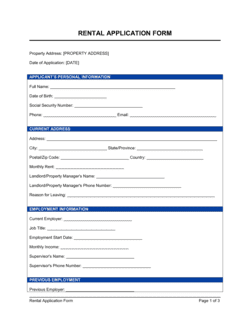
A rental application also collects income, employment, and authorization for a credit check, but its purpose is evaluating a prospective tenant rather than a borrower. It includes landlord references instead of credit references and does not capture a loan amount or repayment terms. Landlords and property managers should use the rental application; lenders and retailers should use the consumer credit application.

vs Personal Financial Statement

A personal financial statement is a snapshot of an individual's total assets, liabilities, and net worth β€” used to support larger loan applications or SBA financing. A consumer credit application captures the information needed to initiate a bureau inquiry and underwriting decision. For small retail or auto credit, the application alone is sufficient; for loans above $100K, lenders typically require both.

Industry-specific considerations

Automotive retail

Applications feed directly into dealer management systems and are submitted to multiple lenders simultaneously β€” completeness of employment and income fields determines how many lenders can be reached.

Retail and consumer goods

Store cards and deferred-payment plans require a point-of-sale intake process; the form must be short enough to complete at the counter without losing the sale.

Financial services

Community banks and credit unions use the form as the intake record that opens a loan file, triggering underwriting queues, ECOA compliance tracking, and adverse action workflows.

Furniture and appliance retail

High-ticket installment purchases require income verification and DTI analysis; co-applicant sections are frequently used to qualify household income rather than a single earner.

Template vs pro β€” what fits your needs?

PathBest forCostTime
Use the templateRetailers, dealerships, and small lenders collecting standard consumer credit information at point of saleFree10 minutes to customize, 5 minutes per applicant to complete
Template + professional reviewLenders extending credit regularly across multiple states who need compliance review of authorization language$200–$500 for a compliance attorney review1–3 days
Custom draftedLicensed consumer finance companies or banks with high application volume, multi-state operations, or system-integrated digital intake workflows$1,000–$5,000+ for custom form development and compliance sign-off2–6 weeks

Glossary

Credit Bureau
An agency β€” such as Equifax, Experian, or TransUnion β€” that collects consumer credit histories and issues reports used by lenders to evaluate creditworthiness.
Hard Inquiry
A formal credit report pull triggered by a credit application that is visible to other lenders and can temporarily lower a consumer's credit score.
Co-Applicant
A second borrower who shares equal responsibility for repaying the debt and whose income and credit history are evaluated alongside the primary applicant.
Debt-to-Income Ratio (DTI)
Monthly debt obligations divided by gross monthly income, expressed as a percentage β€” a key underwriting metric lenders use to assess repayment capacity.
Authorization Clause
The section of a credit application where the applicant signs to permit the lender to pull their credit report and verify the information submitted.
Employment Verification
The process of confirming an applicant's employer, job title, and income, typically by contacting the employer directly or reviewing pay stubs.
Gross Monthly Income
Total income before taxes and deductions β€” the income figure most lenders use when calculating debt-to-income ratio.
Credit Reference
A person or institution β€” such as a prior lender or landlord β€” that a lender may contact to confirm an applicant's history of meeting financial obligations.
Previous Address History
A record of addresses where the applicant has lived, typically covering the past two years, used to verify identity and locate credit records.
Installment Credit
A loan repaid in fixed regular payments over a defined term β€” such as an auto loan or personal loan β€” as opposed to a revolving line of credit.

Part of your Business Operating System

This document is one of 3,000+ business & legal templates included in Business in a Box.

  • Fill-in-the-blanks β€” ready in minutes
  • 100% customizable Word document
  • Compatible with all office suites
  • Export to PDF and share electronically

Create your document in 3 simple steps.

From template to signed document β€” all inside one Business Operating System.
1
Download or open template

Access over 3,000+ business and legal templates for any business task, project or initiative.

2
Edit and fill in the blanks with AI

Customize your ready-made business document template and save it in the cloud.

3
Save, Share, Send, Sign

Share your files and folders with your team. Create a space of seamless collaboration.

Save time, save money, and create top-quality documents.

β˜…β˜…β˜…β˜…β˜…

"Fantastic value! I'm not sure how I'd do without it. It's worth its weight in gold and paid back for itself many times."

Managing Director Β· Mall Farm
Robert Whalley
Managing Director, Mall Farm Proprietary Limited
β˜…β˜…β˜…β˜…β˜…

"I have been using Business in a Box for years. It has been the most useful source of templates I have encountered. I recommend it to anyone."

Business Owner Β· 4+ years
Dr Michael John Freestone
Business Owner
β˜…β˜…β˜…β˜…β˜…

"It has been a life saver so many times I have lost count. Business in a Box has saved me so much time and as you know, time is money."

Owner Β· Upstate Web
David G. Moore Jr.
Owner, Upstate Web

Run your business with a system β€” not scattered tools

Stop downloading documents. Start operating with clarity. Business in a Box gives you the Business Operating System used by over 250,000 companies worldwide to structure, run, and grow their business.

Start freeΒ Β·Β No credit card required