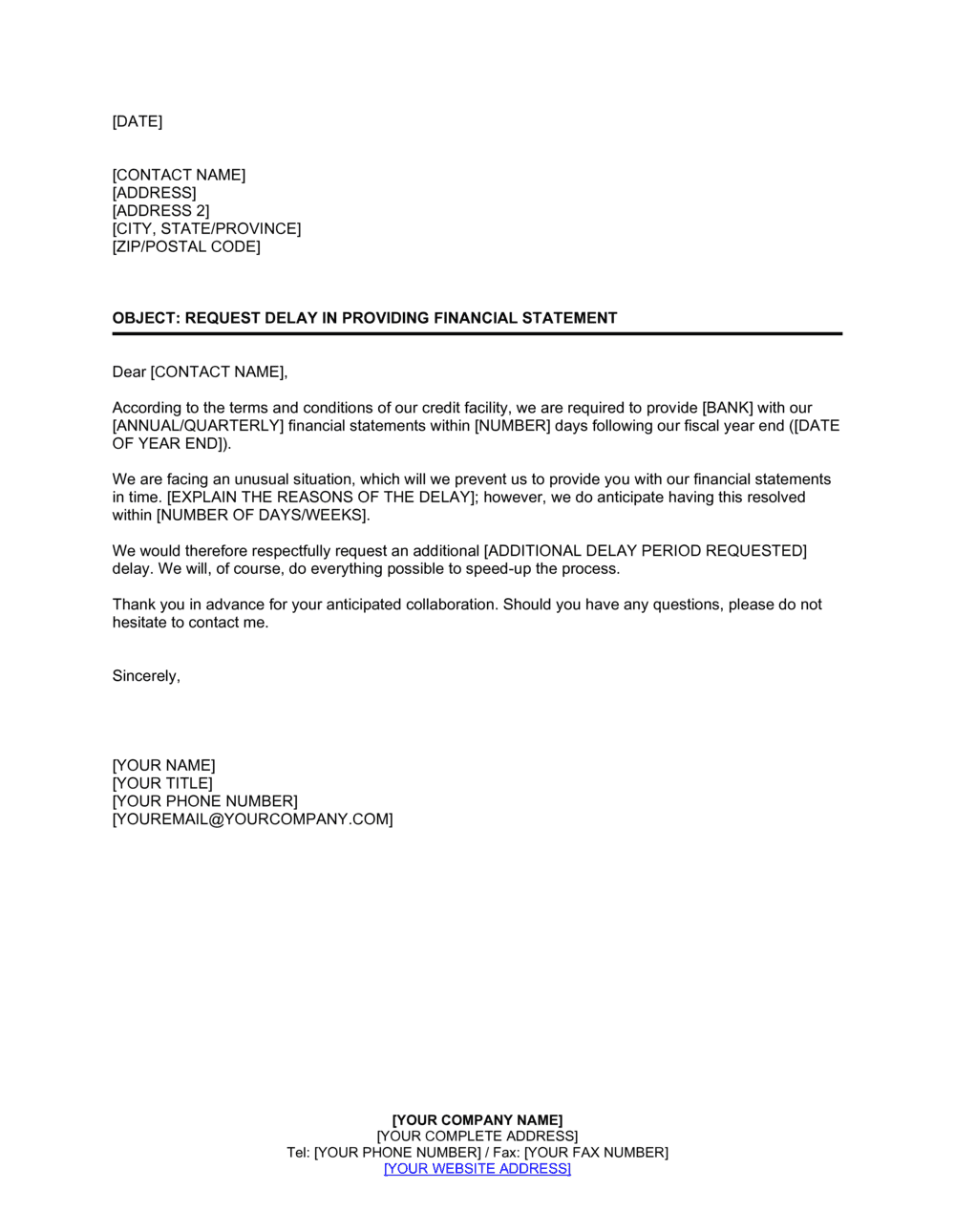
Request Delay to Present Financial Statement Template

Free Word download β€’ Edit online β€’ Save & share with Drive β€’ Export to PDF

1 pageβ€’20–30 min to fillβ€’Difficulty: Standardβ€’Signature requiredβ€’Legal review recommended
Learn more ↓
FreeRequest Delay to Present Financial Statement Template

At a glance

What it is
A Request Delay To Present Financial Statement is a formal written communication from a company or individual to a board, lender, regulator, or counterparty asking for an extension of time before presenting or submitting financial statements. This free Word download gives you a structured, professionally worded document you can edit online and export as PDF to protect your compliance standing and preserve the relationship with the receiving party.
When you need it
Use it when an audit is running behind schedule, when a key financial officer is unavailable, when a material accounting issue requires additional review, or when regulatory deadlines conflict with operational realities. Sending a proactive, written request demonstrates good faith and reduces the risk of technical default or penalty.
What's inside
Identification of the requesting and receiving parties, the original presentation or filing deadline, a specific and documented reason for the delay, the proposed new deadline, and a formal acknowledgment and authorization block. Supporting provisions cover confidentiality of the disclosed reasons and the parties' mutual agreement on the extension terms.

What is a Request Delay To Present Financial Statement?

A Request Delay To Present Financial Statement is a formal written communication in which a company or individual formally asks a lender, board of directors, investor, or regulatory counterparty for additional time before presenting or submitting required financial statements. The document identifies the original contractual or regulatory deadline, provides a specific and documented reason for the anticipated delay, proposes a revised deadline, and seeks the receiving party's written consent β€” creating a binding extension arrangement that suspends the risk of technical default during the agreed period. Unlike an informal email or verbal conversation, a properly executed delay request with a countersigned acknowledgment modifies the underlying obligation in a legally recognized form.

Why You Need This Document

Missing a financial statement deadline without advance notice can trigger technical default under a loan agreement, expose the company to regulatory penalties, or breach shareholder or investor reporting obligations β€” even when every payment is current and the business is fundamentally sound. Lenders and regulators respond very differently to a company that proactively requests an extension in writing before the deadline than to one that simply misses it. A formal, signed request demonstrates that management is in control, aware of its obligations, and acting transparently. Without it, the receiving party has no documented basis to waive their enforcement rights and may feel compelled to issue a notice of default or accelerate remedies they would otherwise defer. This template gives companies the structured, professionally worded instrument they need to protect compliance standing, preserve the relationship with the receiving party, and buy the time necessary to deliver accurate, complete financial statements.

Which variant fits your situation?

If your situation is…Use this template
Requesting an extension from a commercial lender under a loan covenantRequest Delay To Present Financial Statement
Notifying a board of directors that annual statements will be delayedBoard Resolution β€” Financial Reporting Extension
Requesting a regulatory filing extension from a securities regulatorRegulatory Extension Request Letter
Notifying a business partner of a delay in delivering contractual financial reportsNotice of Delay in Performance
Acknowledging an extension granted by a counterpartyAcknowledgment of Extension of Time
Accompanying a partial financial disclosure while the full statement is being finalizedInterim Financial Report
Waiving a financial reporting deadline breach under an existing agreementWaiver of Default Letter

Common mistakes to avoid

❌ Submitting the request after the original deadline

Why it matters: Once the deadline passes without a request, a technical default has already occurred under most loan agreements and regulatory frameworks. The receiving party shifts from considering an extension to evaluating remedies.

Fix: Set an internal trigger date at least ten business days before the financial statement deadline to assess whether a delay request is needed β€” this gives time to draft, authorize, and deliver the request while the deadline is still live.

❌ Providing a vague or open-ended new deadline

Why it matters: Phrases like 'as soon as reasonably practicable' give the receiving party no enforceable commitment and no basis to schedule their own review processes, making consent unlikely.

Fix: Calculate a specific calendar date that is both realistic for your finance team and acceptable under the terms of the underlying agreement, and commit to it explicitly in the request.

❌ Failing to obtain a countersigned acknowledgment

Why it matters: Delivering the request does not create an extension β€” the counterparty's written consent does. Without countersignature, the original deadline remains legally operative and the company remains exposed to default.

Fix: Include a signature block for the receiving party on the request document and follow up actively until a countersigned copy is returned. Do not mark the matter closed until the signed acknowledgment is in hand.

❌ Omitting the confidentiality clause when disclosing sensitive reasons

Why it matters: Disclosing a material accounting restatement, audit qualification, or officer departure to a lender without a confidentiality restriction can result in that information reaching other creditors, co-investors, or market counterparties before the company is ready to manage disclosure.

Fix: Include a specific confidentiality provision in every delay request that discloses a reason beyond a routine scheduling issue, and confirm the counterparty's acceptance of that restriction in the countersigned acknowledgment.

The 10 key clauses, explained

Parties and authority

In plain language: Identifies the requesting party (company or individual) and the receiving party (lender, board, regulator, or counterparty) and confirms that the person signing the request has authority to bind the requesting party.

Sample language
This request is submitted by [REQUESTING PARTY LEGAL NAME], a [ENTITY TYPE] incorporated under the laws of [JURISDICTION] ('Company'), acting through its duly authorized officer [NAME], [TITLE], to [RECEIVING PARTY NAME] ('Recipient').

Common mistake: Signing the letter with a personal name only, without confirming the signer's corporate authority. If the signer lacks authorization, the request may not bind the company and the extension may not be legally effective.

Reference to original obligation

In plain language: Cites the specific agreement, covenant, or regulatory provision that imposed the financial statement deadline, and states the exact date by which statements were originally due.

Sample language
Pursuant to Section [X] of the [AGREEMENT NAME] dated [DATE] between the Company and Recipient, the Company was required to present its audited financial statements for the fiscal year ended [DATE] no later than [ORIGINAL DEADLINE].

Common mistake: Referencing the agreement by informal name or approximate date. If the citation doesn't match the counterparty's records exactly, they may dispute which obligation the request covers.

Statement of delay and reason

In plain language: Clearly states that the company will not meet the original deadline and provides a specific, factual reason for the delay β€” such as an ongoing audit, a staffing gap, or a material accounting determination.

Sample language
The Company respectfully advises that it will be unable to present the required financial statements by [ORIGINAL DEADLINE] due to [SPECIFIC REASON β€” e.g., the ongoing audit by [AUDITOR NAME], which requires additional time to complete procedures relating to [SUBJECT MATTER]].

Common mistake: Giving a vague reason such as 'administrative delays.' Counterparties and regulators expect a specific, documented explanation β€” vague language signals poor financial management and invites scrutiny.

Proposed new deadline

In plain language: States the specific date by which the company commits to presenting the completed financial statements, giving the receiving party a concrete revised timeline.

Sample language
The Company proposes to present the required financial statements no later than [PROPOSED NEW DATE], being [X] days after the original deadline.

Common mistake: Proposing an open-ended or conditional new deadline such as 'as soon as practicable.' A counterparty needs a fixed date to evaluate whether to grant the extension and to schedule their own processes accordingly.

Confirmation of good standing

In plain language: Represents that except for the anticipated delay in financial statement presentation, the company is not aware of any other breach of the underlying agreement and remains in compliance with all other obligations.

Sample language
The Company confirms that, to the best of its knowledge, it is in compliance with all other terms and conditions of the [AGREEMENT NAME] as of the date of this request, and that no other event of default has occurred or is anticipated.

Common mistake: Omitting this confirmation entirely. Without it, the receiving party may worry that the financial delay is a symptom of a wider compliance problem and may be less willing to grant the extension.

Request for acknowledgment and consent

In plain language: Formally asks the receiving party to acknowledge the delay notice and provide written consent to the proposed extended deadline, confirming they will not treat the late presentation as a default during the extension period.

Sample language
The Company respectfully requests that Recipient acknowledge receipt of this notice and confirm in writing its consent to the proposed extension, and that Recipient agrees not to treat the delay in presentation as an event of default under the [AGREEMENT NAME] during the extension period.

Common mistake: Treating the delivery of the request itself as equivalent to receiving consent. The extension is only effective when the counterparty provides written acknowledgment β€” do not assume silence is acceptance.

Interim reporting commitment

In plain language: Offers the receiving party access to preliminary or management-prepared financial information during the extension period, demonstrating transparency while the audited statements are being finalized.

Sample language
During the extension period, the Company agrees to provide Recipient with unaudited management accounts for the period ended [DATE] within [X] business days of a written request, subject to the confidentiality provisions of this letter.

Common mistake: Making no interim disclosure offer at all. Lenders and investors granted an extension will expect some financial visibility in the interim β€” a proactive commitment builds goodwill and reduces the likelihood of the extension being refused.

Confidentiality of disclosed information

In plain language: Restricts the receiving party from disclosing the reason for the delay or any preliminary financial information shared during the extension period to third parties, protecting the company from reputational or market damage.

Sample language
Recipient agrees to treat the information contained in this letter, including the reason for the delay and any interim financial information provided, as confidential and not to disclose it to any third party without the Company's prior written consent, except as required by applicable law.

Common mistake: Skipping confidentiality provisions when disclosing a sensitive reason such as a material accounting restatement. Without this clause, the receiving party may share the information with co-lenders, other creditors, or market counterparties.

Governing law and notices

In plain language: Specifies which jurisdiction's law governs the interpretation of the request letter and states how formal notices must be delivered between the parties.

Sample language
This letter is governed by the laws of [STATE / PROVINCE / COUNTRY]. Notices under this letter shall be delivered in writing to the addresses set out below and shall be effective upon receipt by email with read confirmation or courier.

Common mistake: Using a different governing law than the underlying agreement. Inconsistent governing law creates ambiguity about which jurisdiction's courts would interpret the extension arrangement if disputed.

Authorization and signature block

In plain language: Provides signature lines for an authorized officer of the requesting party and a countersignature block for the receiving party to confirm consent, with date fields for each.

Sample language
Signed by [AUTHORIZED OFFICER NAME], [TITLE], for and on behalf of [COMPANY NAME], on [DATE]. Acknowledged and consented to by [RECIPIENT AUTHORIZED SIGNATORY NAME], [TITLE], for and on behalf of [RECIPIENT NAME], on [DATE].

Common mistake: Using only one signature line without a countersignature block for the receiving party. Without the counterparty's signed acknowledgment, the extension has not been formally granted and the original deadline remains operative.

How to fill it out

  1. 1

    Identify the parties and confirm authorization

    Enter the full legal name, entity type, and jurisdiction of the requesting company, and the full name of the receiving party. Confirm that the signing officer holds a role (CFO, CEO, or Corporate Secretary) with authority to make contractual representations on the company's behalf.

    πŸ’‘ Check the underlying agreement for any specific notice or authorization requirements β€” some loan agreements require the request to come from a specific officer or be countersigned by legal counsel.

  2. 2

    Cite the original obligation precisely

    Locate the exact section, clause number, and date in the underlying agreement or regulation that imposes the financial statement deadline. Copy the obligation language verbatim into the reference clause to avoid any dispute about which provision applies.

    πŸ’‘ Cross-reference with your loan officer or compliance contact to confirm they recognize the citation before sending β€” a misquoted clause reference can delay consent.

  3. 3

    State the reason for delay with specifics

    Write a clear, factual explanation of why the statements cannot be ready on time β€” naming the auditor, the specific accounting issue, or the personnel gap. Avoid euphemisms. One specific sentence is more persuasive than a paragraph of vague explanation.

    πŸ’‘ If the delay is audit-related, attach a brief letter from the auditor confirming the timeline β€” this converts a one-sided assertion into corroborated evidence.

  4. 4

    Propose a specific new deadline

    Calculate a realistic new date that gives the auditor or finance team adequate time to complete their work, adds a five-to-seven-day buffer for review, and falls before any secondary triggers in the agreement. Enter that specific calendar date.

    πŸ’‘ Propose a date you are highly confident you can meet. Requesting a second extension within the same reporting period substantially damages credibility and may trigger a formal default review.

  5. 5

    Draft the good-standing confirmation

    Review all other obligations under the underlying agreement β€” interest payments, insurance requirements, other financial covenants β€” and confirm in writing that none are in breach. If any other obligation is at risk, do not make this representation without disclosing it.

    πŸ’‘ Run a brief covenant compliance checklist with your CFO or legal team before signing this clause. A false representation of good standing can accelerate the default you are trying to avoid.

  6. 6

    Add the interim reporting commitment and confidentiality terms

    Specify what unaudited information you will provide during the extension period β€” management accounts, trial balance, or a narrative update β€” and the timeframe for delivery. Then include a confidentiality clause covering both the reason for delay and any interim information shared.

    πŸ’‘ Offering management accounts within 10 business days of a written request is a standard and credible commitment β€” it shows the delay is procedural, not substantive.

  7. 7

    Sign and deliver before the original deadline

    Obtain the authorized officer's signature and deliver the request to the receiving party's designated notice address β€” typically email with read receipt plus courier β€” before the original deadline passes. A request submitted after the deadline has already created a technical default.

    πŸ’‘ Send a calendar reminder five business days before the original deadline. Delivering the request with lead time gives the counterparty time to process and countersign before the deadline.

  8. 8

    Follow up to obtain a countersigned acknowledgment

    Do not treat delivery of the request as confirmation of consent. Follow up within two business days to confirm receipt and ask for a countersigned copy. File the fully executed exchange with your corporate records and notify your auditor and legal counsel.

    πŸ’‘ Store the countersigned acknowledgment in the same folder as the underlying agreement β€” you will need both documents if the extension arrangement is ever contested.

Frequently asked questions

What is a request delay to present financial statement?

A request delay to present financial statement is a formal written communication from a company to a lender, board, investor, or regulator asking for additional time before presenting or filing required financial statements. It identifies the original deadline, explains the specific reason for the delay, proposes a new deadline, and seeks the receiving party's written consent. When properly executed and countersigned, it prevents the delay from being treated as a contractual default or regulatory breach.

When should I send a request to delay presenting financial statements?

Send the request as early as you know the original deadline cannot be met β€” ideally ten or more business days before the deadline, never after it has passed. Common triggers include an audit running behind schedule, a key finance team member leaving, a material accounting judgment that requires additional time to resolve, or a system migration affecting financial reporting. Proactive notice demonstrates good faith and significantly improves the likelihood of consent.

Is a delay in presenting financial statements a default under a loan agreement?

In most commercial loan agreements, a missed financial reporting deadline constitutes a technical default β€” even if payments are current. The agreement typically gives the lender the right to accelerate the loan or invoke other remedies. A properly submitted and consented extension request suspends that right for the agreed extension period. Without written consent from the lender, the technical default stands regardless of the reason for the delay.

Does the receiving party have to agree to the extension?

No. A lender, board, or regulator is not obligated to grant the extension simply because a request was made. However, a well-documented request submitted with lead time, a specific new deadline, a credible reason, and an offer of interim reporting significantly increases the likelihood of consent. In some regulated contexts β€” such as securities filings β€” regulators have a formal process for considering extension applications, with defined criteria for approval.

What information should I include in the extension request?

At minimum: the full legal names of both parties, a precise citation of the original obligation and its deadline, a specific and documented reason for the delay, a proposed new deadline stated as a calendar date, a representation that no other obligation is in breach, an offer of interim financial information during the extension period, a confidentiality clause if sensitive reasons are disclosed, and a countersignature block for the receiving party. Missing any of these elements weakens the request and may cause it to be refused or to fail as a legal notice.

What happens if I need a second extension?

Requesting a second extension within the same reporting period is a significant credibility concern for any lender or investor. It signals that the first request underestimated the problem and raises questions about management's control over financial reporting. If a second extension becomes necessary, accompany the request with a detailed root-cause explanation, a concrete remediation plan, and β€” where possible β€” a letter from the auditor confirming the new timeline is realistic. Engage legal counsel before submitting a second request.

Does this document need to be signed by both parties?

Yes. The requesting party's authorized officer must sign the request, and the receiving party must countersign to confirm their consent to the extended deadline and agreement not to treat the delay as a default. Without the receiving party's countersignature, the extension arrangement is one-sided and unenforceable. Some agreements specify additional formalities β€” such as board approval or notarization β€” for extension consents, so check the governing agreement before finalizing the document.

Can I use this document for regulatory filing extensions?

This template is designed primarily for contractual extension requests between private parties β€” lenders, investors, boards, and business partners. Regulatory filing extensions (such as SEC Form 12b-25 in the US or equivalent filings with HMRC, ASIC, or SEDAR) are governed by specific statutory forms and procedures that vary by jurisdiction and regulator. Consult the relevant regulatory authority's guidance and consider engaging legal counsel before using this template for a regulatory filing extension.

How long of an extension is typically acceptable?

For commercial loan covenants, lenders typically consider extensions of 15 to 60 days reasonable for audit-related delays, depending on the complexity of the audit and the company's track record. Extensions beyond 60 days attract greater scrutiny and may require additional conditions β€” such as weekly management reporting or a fee. For shareholder or board reporting, the acceptable range depends on the company's articles of association or shareholder agreement. In all cases, propose the shortest realistic extension and build in a buffer of five to seven days beyond your expected completion date.

How this compares to alternatives

vs Waiver of Default Letter

A waiver of default letter is issued by the receiving party after a default has already occurred, formally relinquishing the right to enforce remedies for that specific breach. A request delay to present financial statement is submitted by the requesting party before the deadline passes to prevent a default from occurring at all. Use this template first; a waiver letter becomes necessary only if the extension request is not submitted in time.

vs Notice of Default

A notice of default is a formal communication from the non-breaching party declaring that the other party has failed to meet a contractual obligation β€” including a financial reporting deadline. A delay request is the preemptive document that, when consented to, prevents a notice of default from being issued. The two documents occupy opposite sides of the same situation.

vs Loan Covenant Compliance Certificate

A loan covenant compliance certificate is a periodic document certifying that the borrower meets all financial ratio and reporting requirements. It is delivered alongside or shortly after the financial statements. A delay request is the instrument used when the financial statements β€” and therefore the compliance certificate β€” cannot be delivered on time. The two documents work in sequence, not as alternatives.

vs Interim Financial Report

An interim financial report presents unaudited management-prepared financial information for a period shorter than a full year. It is used to provide financial visibility between annual reporting dates, not to formally extend a filing deadline. A delay request governs the extension of the deadline; an interim report may be offered as part of the extension arrangement to keep the receiving party informed in the interim.

Industry-specific considerations

Financial services and banking

Regulated entities in financial services face strict statutory and prudential reporting deadlines; a formal extension request is often the only mechanism to avoid regulatory sanction while audit or restatement work is completed.

Real estate and construction

Project-based financing agreements frequently require periodic financial statements tied to construction milestones; delays in cost reporting or audit completion commonly trigger extension requests to lenders.

SaaS and technology

Venture-backed companies with investor information rights and revenue recognition complexities under ASC 606 or IFRS 15 often need additional time for auditor sign-off, particularly in the first year of an audit relationship.

Professional services

Accounting firms and consultancies with partnership structures may need to delay financial statement presentation to partners or lenders while complex profit-allocation or capital-account reconciliations are finalized.

Jurisdictional notes

United States

Under most US commercial loan agreements, financial reporting covenants include a cure period β€” typically 5 to 30 days β€” before a technical default triggers lender remedies. Public companies must use SEC Form 12b-25 to notify the SEC of a late filing and gain an automatic 5- or 15-day extension for annual or quarterly reports. State law governs private contract extension arrangements; New York and Delaware courts require clear written consent to modify contractual deadlines.

Canada

Canadian corporate law (CBCA and provincial equivalents) requires companies to present annual financial statements to shareholders within defined periods after the fiscal year-end β€” typically within 18 months of incorporation for the first year and at each annual general meeting thereafter. SEDAR+ governs public company filing extensions. Private company lender extensions are contractual and require written consent from each lender; syndicated credit facilities often require majority-lender approval for any covenant modification.

United Kingdom

The Companies Act 2006 requires private limited companies to file accounts at Companies House within 9 months of the accounting reference date and public companies within 6 months. Extensions must be applied for before the deadline using a Companies House application; the registrar may grant an extension for specific reasons such as an overseas subsidiary causing delay. Lender extension arrangements under UK law require consideration to be enforceable as a contract variation β€” a practical concession such as an interim reporting obligation typically satisfies this requirement.

European Union

EU member states implement financial reporting deadlines under national company law, typically transposing the EU Accounting Directive which requires large companies to file within 6 to 9 months of the financial year-end. Timelines and extension mechanisms vary significantly by member state β€” Germany (Bundesanzeiger filing), France (greffe du tribunal de commerce), and the Netherlands (Kamer van Koophandel) each have distinct procedures. GDPR may apply to extension correspondence disclosing personal data about officers or advisors; confidentiality provisions in extension letters should account for lawful processing obligations.

Template vs lawyer β€” what fits your deal?

PathBest forCostTime
Use the templateCompanies requesting a short extension from a single lender or investor for a routine audit delay with no other compliance concernsFree30–60 minutes
Template + legal reviewCompanies with syndicated lenders, material accounting issues, or extensions that may trigger cross-default provisions in other agreements$300–$800 for a legal review1–3 business days
Custom draftedRegulated entities, public companies, companies in financial distress, or situations involving multiple creditors with intercreditor agreements$1,500–$5,000+3–10 business days

Glossary

Financial Statement
A formal record of a company's financial position and performance, typically comprising a balance sheet, income statement, and cash flow statement.
Filing Deadline
The specific date by which financial statements must be presented, submitted, or filed under a contract, regulatory requirement, or shareholder resolution.
Extension of Time
A written agreement between parties to defer a contractual or regulatory deadline to a later agreed date without constituting a breach.
Loan Covenant
A condition in a credit agreement requiring the borrower to maintain certain financial ratios or submit periodic financial statements by defined dates.
Technical Default
A breach of a loan covenant or contractual condition β€” such as missing a financial reporting deadline β€” that does not involve a missed payment but can trigger lender remedies.
Good Faith
The principle that a party acted honestly and with genuine intent to comply, which courts and counterparties consider when evaluating a late or deficient performance.
Material Accounting Issue
An error, uncertainty, or judgment question in a company's accounts that is significant enough to affect the reliability of reported financial results.
Audit Completion
The point at which an independent auditor has gathered sufficient evidence and issued a signed opinion on whether financial statements present a true and fair view.
Force Majeure
An unforeseeable event β€” natural disaster, government action, or other extraordinary circumstance β€” that excuses a party from performing a contractual obligation on time.
Waiver
A voluntary relinquishment by one party of a right or remedy β€” such as the right to declare default β€” typically confirmed in writing to avoid future disputes.
Notice Requirement
A contractual provision specifying how and when a party must inform the other of a material event, such as an anticipated delay in performance.

Part of your Business Operating System

This document is one of 3,000+ business & legal templates included in Business in a Box.

  • Fill-in-the-blanks β€” ready in minutes
  • 100% customizable Word document
  • Compatible with all office suites
  • Export to PDF and share electronically

Create your document in 3 simple steps.

From template to signed document β€” all inside one Business Operating System.
1
Download or open template

Access over 3,000+ business and legal templates for any business task, project or initiative.

2
Edit and fill in the blanks with AI

Customize your ready-made business document template and save it in the cloud.

3
Save, Share, Send, Sign

Share your files and folders with your team. Create a space of seamless collaboration.

Save time, save money, and create top-quality documents.

β˜…β˜…β˜…β˜…β˜…

"Fantastic value! I'm not sure how I'd do without it. It's worth its weight in gold and paid back for itself many times."

Managing Director Β· Mall Farm
Robert Whalley
Managing Director, Mall Farm Proprietary Limited
β˜…β˜…β˜…β˜…β˜…

"I have been using Business in a Box for years. It has been the most useful source of templates I have encountered. I recommend it to anyone."

Business Owner Β· 4+ years
Dr Michael John Freestone
Business Owner
β˜…β˜…β˜…β˜…β˜…

"It has been a life saver so many times I have lost count. Business in a Box has saved me so much time and as you know, time is money."

Owner Β· Upstate Web
David G. Moore Jr.
Owner, Upstate Web

Run your business with a system β€” not scattered tools

Stop downloading documents. Start operating with clarity. Business in a Box gives you the Business Operating System used by over 250,000 companies worldwide to structure, run, and grow their business.

Start freeΒ Β·Β No credit card required