Rental Application Form Template

Free Word download β€’ Edit online β€’ Save & share with Drive β€’ Export to PDF

3 pagesβ€’15–25 min to fillβ€’Difficulty: Standard
Learn more ↓
FreeRental Application Form Template

At a glance

What it is
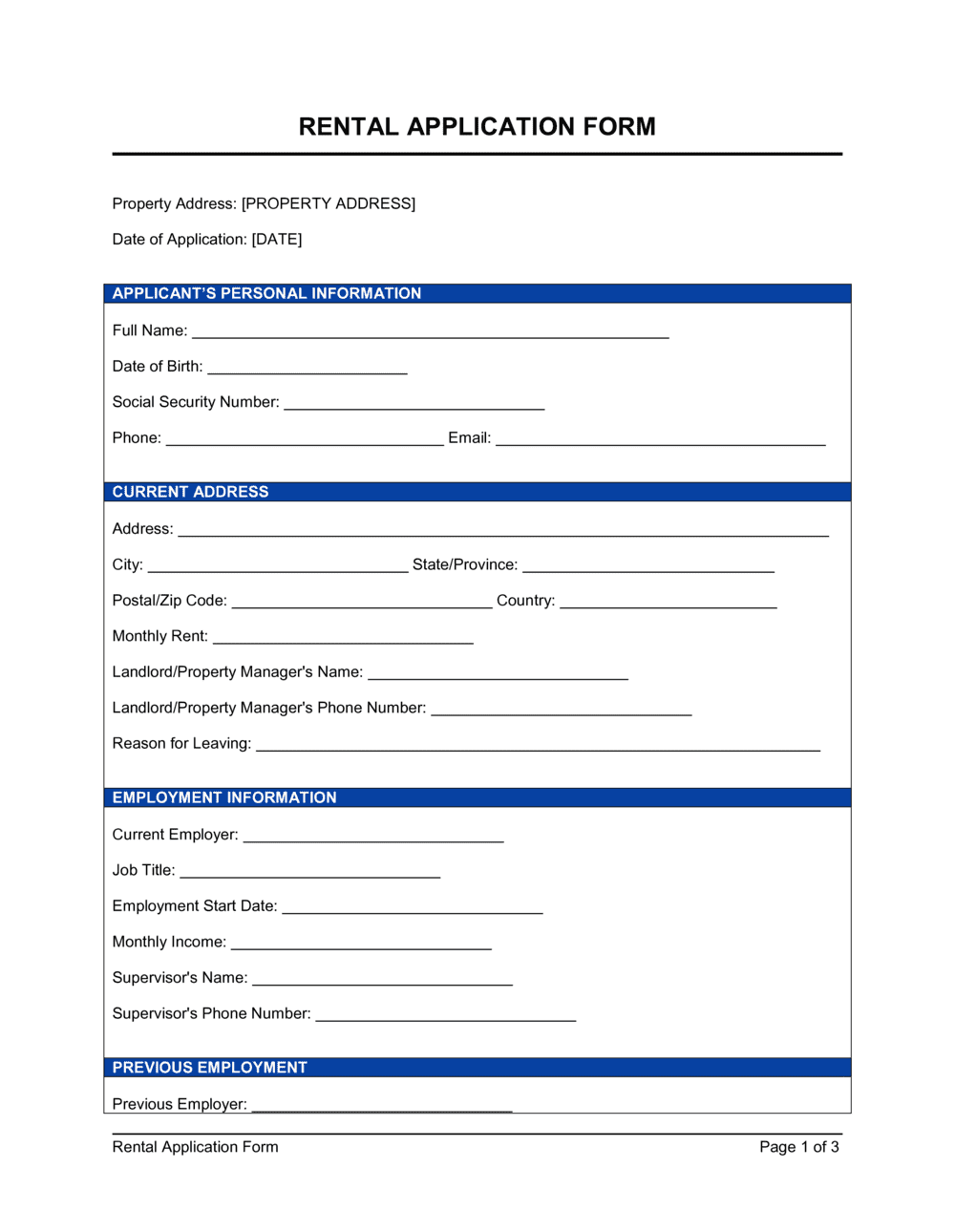
A Rental Application Form is a standardized document a prospective tenant completes when applying to rent a residential or commercial property. This free Word download lets landlords and property managers collect personal details, employment and income information, rental history, references, and written authorization for credit and background checks β€” all in one consistent, printable form.
When you need it
Use it every time a prospective tenant expresses serious interest in a vacancy, before you run any screening checks or make a leasing decision. Collecting the same information from every applicant in the same format simplifies comparison and supports fair, documented decision-making.
What's inside
Personal identification, current and prior address history, employment and income details, rental history with landlord references, personal references, pet and vehicle information, and a signed authorization for credit and background screening.

What is a Rental Application Form?

A Rental Application Form is a standardized document a prospective tenant completes when expressing interest in renting a residential or commercial property. It captures everything a landlord needs to screen a candidate before offering a lease: personal identification, current and prior address history, employment status, income sources and verification, rental history with landlord contacts, personal references, and written authorization for credit and background checks. The form creates a consistent, comparable record for every applicant and gives the landlord documented evidence of the criteria used to approve or deny each application.

Why You Need This Document

Evaluating tenants without a standardized application exposes you to two compounding risks: making uninformed leasing decisions and inadvertently violating fair housing law. Verbal conversations and informal note-taking produce inconsistent information across applicants, making it nearly impossible to defend a denial if a rejected applicant files a complaint. A uniform form ensures you collect the same fields from everyone β€” eliminating the appearance of selective scrutiny. Beyond compliance, the application is your first line of financial protection: it surfaces income shortfalls, undisclosed evictions, and landlord reference concerns before you sign a lease and hand over the keys. This template gives landlords and property managers a professionally formatted, field-complete starting point that can be handed to applicants in minutes.

Which variant fits your situation?

If your situation is…Use this template
Renting a single-family home or apartment to an individual tenantResidential Rental Application Form
Leasing commercial or retail space to a businessCommercial Lease Application
Short-term or vacation rental with a brief stayShort-Term Rental Agreement
Tenant has been approved and you are ready to formalize occupancyResidential Lease Agreement
Collecting a holding deposit while the application is under reviewRental Deposit Receipt
Notifying an unsuccessful applicant of the decisionRental Application Denial Letter
Screening a roommate or co-tenant joining an existing tenancyRoommate Agreement

Common mistakes to avoid

❌ Applying different screening criteria to different applicants

Why it matters: Inconsistent standards β€” requiring a co-signer from one applicant but not another with a similar profile β€” can constitute fair housing discrimination even without intent.

Fix: Write down your screening criteria (minimum income multiple, minimum credit score, acceptable rental history) before advertising the unit and apply them identically to every applicant.

❌ Not collecting a signed credit check authorization

Why it matters: Running a credit report without written consent violates the Fair Credit Reporting Act and exposes the landlord to fines of up to $1,000 per violation plus actual damages.

Fix: Use an application form with a built-in authorization clause and confirm it is signed before submitting any screening request to a third-party provider.

❌ Skipping prior landlord reference calls

Why it matters: A credit score reflects payment behavior on debt β€” it does not reveal property damage, lease violations, or noise complaints that a prior landlord would disclose in a two-minute phone call.

Fix: Call at least the two most recent landlords before approving any application. Document the date, time, and substance of each call in writing and keep it with the application file.

❌ Accepting incomplete applications and approving based on partial information

Why it matters: An application with blank employment fields or missing income data cannot be fairly evaluated β€” and a landlord who approves it has no documented basis for the decision if a dispute arises later.

Fix: Return incomplete applications to the applicant with a checklist of missing fields, and set a clear deadline for resubmission. Do not begin screening until the form is fully complete.

The 8 key fields, explained

Personal identification

Current and prior address history

Employment and employer details

Income information

Rental history

Personal and professional references

Pets and vehicles

Credit and background check authorization

How to fill it out

  1. 1

    Add your property and contact details at the top

    Enter the rental property address, the unit number if applicable, the listed monthly rent, and the landlord or property manager's name and contact information. This pre-populates the form before you hand it to applicants.

    πŸ’‘ Include the application deadline and any stated minimum income requirement (e.g., gross monthly income at least 3Γ— the monthly rent) in the header so applicants self-screen before completing the form.

  2. 2

    Distribute the form to every adult applicant separately

    Each adult who will live in the unit must complete and sign their own application β€” including co-applicants and roommates. A joint application with a single signature provides incomplete information for multi-person screening.

    πŸ’‘ Note the date and time each application was received. In competitive markets, first-qualified-applicant policies require documented timestamps to be defensible.

  3. 3

    Review the identification section for completeness

    Confirm the applicant has provided a full legal name, date of birth, and a government ID number. These three fields are required by most background-screening services to run an accurate check.

    πŸ’‘ Cross-reference the name and date of birth on the form against the physical ID before accepting the application β€” transposed digits in an ID number are common and invalidate the screening result.

  4. 4

    Verify the address history covers at least two years

    Check that the applicant has listed current and prior addresses accounting for at least 24 months. Flag any unexplained gaps of more than 30 days and ask the applicant to clarify before proceeding.

    πŸ’‘ A gap between tenancies that the applicant cannot explain β€” or explains as 'stayed with a friend' β€” sometimes indicates an undisclosed eviction filing that was later dismissed.

  5. 5

    Confirm income documentation before running screening

    Note on the form which income verification documents the applicant has provided β€” pay stubs (most recent two), most recent tax return, or 90 days of bank statements for self-employed applicants.

    πŸ’‘ Calculate the debt-to-income ratio yourself using the income stated. If monthly rent divided by gross monthly income exceeds 33%, flag it before spending money on a credit pull.

  6. 6

    Contact prior landlord references directly

    Call the landlord listed for the two most recent tenancies. Ask specifically whether rent was paid on time, whether the unit was returned in good condition, and whether they would rent to the applicant again.

    πŸ’‘ Search the prior landlord's name and address online before calling β€” applicants occasionally list a friend as a fake prior landlord. Verifying the address matches a real rental property takes under two minutes.

  7. 7

    Collect the signed authorization and run screening checks

    Confirm the authorization field is signed and dated before submitting to a tenant-screening service. Store the signed form on file for at least three years regardless of whether the applicant was approved.

    πŸ’‘ In jurisdictions with application fee caps (California: $62.33 in 2025; Oregon: $10), charge the applicant only the documented cost of the actual screening report β€” not a flat administrative fee.

Frequently asked questions

What is a rental application form?

A rental application form is a standardized document a prospective tenant completes to provide a landlord with the information needed to screen them for a rental unit. It typically captures personal identification, employment and income details, rental history, references, and signed authorization for credit and background checks. Landlords use it to compare applicants consistently and document the basis for their leasing decisions.

What information should a rental application include?

At minimum: full legal name and government ID, current and prior address history for at least two years, employment and income details with verification method, two to three prior landlord references, personal references, pet and vehicle information, and a signed authorization for credit and background screening. Missing any of these fields reduces the quality of the screening decision and can create fair housing compliance gaps.

Can a landlord charge a fee for a rental application?

Yes, in most US jurisdictions, but many states cap the amount. California limits application fees to the documented cost of screening (approximately $62 in 2025). Oregon caps fees at $10. Some cities prohibit fees entirely. Check the rules in the property's jurisdiction before charging any fee, and provide applicants with a receipt and a copy of the screening report.

What credit score is typically required to rent an apartment?

Most landlords look for a score of 620 or higher for standard rentals, though requirements vary by market and property type. Luxury properties often require 700 or above. Applicants below a landlord's threshold may still qualify with a qualified co-signer or a larger security deposit, where local law permits those accommodations.

Does a rental application form need to be signed?

The application itself does not legally require a signature in most jurisdictions, but the credit and background check authorization embedded in or attached to the form must be signed. Without written consent, running a consumer credit report violates the Fair Credit Reporting Act. Many landlords require a signature on the full application as well to confirm the accuracy of the information provided.

How long should a landlord keep rental applications on file?

Retain all applications β€” approved and denied β€” for at least two to three years. The Fair Housing Act allows complaints to be filed within one year of an alleged discriminatory act, and some state laws extend that window to two years. Keeping all applications on file demonstrates that consistent criteria were applied to every applicant and provides documentation if a denial is challenged.

What is the difference between a rental application and a lease agreement?

A rental application is completed before approval β€” it collects the information a landlord needs to decide whether to offer a tenancy. A lease agreement is the binding contract signed after approval that governs the actual tenancy β€” rent amount, term, rules, and obligations. Completing an application does not create a tenancy; only a signed lease does.

Can a landlord deny an applicant based on the rental application?

Yes, provided the denial is based on legitimate, consistently applied screening criteria β€” such as insufficient income, poor credit history, or a prior eviction β€” and not on protected characteristics under the Fair Housing Act. In some jurisdictions, landlords are required to provide a written adverse action notice citing the specific reason for denial, particularly when a credit report was used in the decision.

How this compares to alternatives

vs Residential Lease Agreement

A rental application is completed by the prospective tenant before a leasing decision is made β€” it is a screening tool, not a contract. A lease agreement is the binding document signed after approval that creates the actual tenancy. The application feeds the decision; the lease governs the relationship.

vs Roommate Agreement

A rental application is used by a landlord to screen an applicant before approving tenancy. A roommate agreement is a private arrangement between co-tenants that governs how they share the unit, split costs, and handle disputes among themselves. Both may be needed when a new roommate is joining an existing tenancy.

vs Lease Renewal Agreement

A rental application is for new applicants who have not yet been approved. A lease renewal agreement is for existing tenants whose term is ending and who wish to continue occupancy β€” no new application or screening is typically required unless the landlord's policy mandates periodic re-screening.

vs Credit Check Authorization Form

A standalone credit check authorization collects only the consent needed to run a credit report. A rental application includes that authorization alongside the full set of personal, employment, income, and rental history fields needed to make a complete leasing decision. Use the standalone form only when re-screening an existing tenant at renewal.

Industry-specific considerations

Residential property management

High application volumes require a consistent form that feeds directly into a tenant-screening workflow and creates a paper trail for fair housing compliance.

Commercial real estate

Applications collect both personal financial details of the guarantor and business financials of the tenant entity, including two years of business tax returns and a personal net worth statement.

Student housing

Co-signer or guarantor sections are critical because most student applicants lack rental history and sufficient income; the application must capture the guarantor's full employment and credit authorization separately.

Short-term and vacation rentals

Simplified identity verification and vehicle information replace the full rental history section, with emphasis on ID confirmation and damage deposit authorization for stays under 30 days.

Template vs pro β€” what fits your needs?

PathBest forCostTime
Use the templateIndependent landlords and small property managers screening applicants for residential unitsFree5 minutes to set up; 10–15 minutes per applicant to review
Template + professional reviewLandlords in states with specific application fee caps, disclosure requirements, or ban-the-box rules affecting criminal history questions$100–$300 for a one-time attorney review of the form1–3 days
Custom draftedLarge property management companies, commercial landlords, or portfolios spanning multiple states with varying fair housing and screening regulations$500–$1,500 for a jurisdiction-specific custom form1–2 weeks

Glossary

Credit Check Authorization
Written consent from an applicant allowing the landlord or a third-party service to pull a credit report as part of the screening process.
Background Check
A review of an applicant's criminal, eviction, and public records history, typically conducted by a tenant-screening service.
Debt-to-Income Ratio
Monthly debt obligations divided by gross monthly income β€” landlords commonly require this ratio to be below 40–50% to approve an application.
Rental History
A record of an applicant's prior addresses, landlord contact details, length of tenancy, and reason for leaving each property.
Co-Signer
A third party who agrees to be legally responsible for rent and damages if the primary tenant fails to pay, often used when an applicant's income or credit falls below the landlord's threshold.
Eviction Record
A court filing showing a prior landlord pursued legal action to remove a tenant, visible on background checks and typically a disqualifying factor.
Security Deposit
A refundable sum collected before move-in, held by the landlord to cover unpaid rent or damages beyond normal wear and tear.
Income Verification
Documentation β€” pay stubs, tax returns, or bank statements β€” confirming that an applicant earns the income stated on the application.
Application Fee
A non-refundable charge collected from each applicant to cover the cost of credit and background screening; maximum amounts are capped by law in many jurisdictions.
Fair Housing Act
US federal law prohibiting landlords from discriminating against applicants on the basis of race, color, national origin, religion, sex, familial status, or disability.

Part of your Business Operating System

This document is one of 3,000+ business & legal templates included in Business in a Box.

  • Fill-in-the-blanks β€” ready in minutes
  • 100% customizable Word document
  • Compatible with all office suites
  • Export to PDF and share electronically

Create your document in 3 simple steps.

From template to signed document β€” all inside one Business Operating System.
1
Download or open template

Access over 3,000+ business and legal templates for any business task, project or initiative.

2
Edit and fill in the blanks with AI

Customize your ready-made business document template and save it in the cloud.

3
Save, Share, Send, Sign

Share your files and folders with your team. Create a space of seamless collaboration.

Save time, save money, and create top-quality documents.

β˜…β˜…β˜…β˜…β˜…

"Fantastic value! I'm not sure how I'd do without it. It's worth its weight in gold and paid back for itself many times."

Managing Director Β· Mall Farm
Robert Whalley
Managing Director, Mall Farm Proprietary Limited
β˜…β˜…β˜…β˜…β˜…

"I have been using Business in a Box for years. It has been the most useful source of templates I have encountered. I recommend it to anyone."

Business Owner Β· 4+ years
Dr Michael John Freestone
Business Owner
β˜…β˜…β˜…β˜…β˜…

"It has been a life saver so many times I have lost count. Business in a Box has saved me so much time and as you know, time is money."

Owner Β· Upstate Web
David G. Moore Jr.
Owner, Upstate Web

Run your business with a system β€” not scattered tools

Stop downloading documents. Start operating with clarity. Business in a Box gives you the Business Operating System used by over 250,000 companies worldwide to structure, run, and grow their business.

Start freeΒ Β·Β No credit card required