1
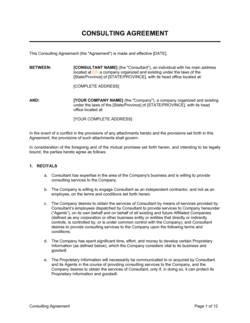
Identify and name the parties correctly
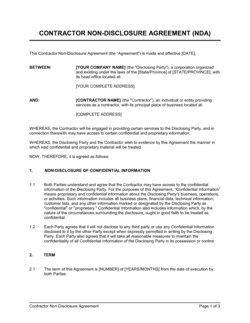
Enter the company's full registered legal entity name and the consultant's full legal name or business entity. If the consultant operates through a corporation or LLC, use that entity — not their personal name.
💡 Ask for the consultant's W-9 or business registration before the agreement is signed — the name on the NDA should match their tax filing exactly.
2
Define the engagement purpose
Write a specific, narrow description of the consulting engagement that will govern what counts as a permitted use of confidential information. Generic phrases like 'business advisory services' leave the door open for misuse.
💡 One precise sentence — e.g., 'evaluating supply chain cost reduction options for the [PRODUCT LINE] division' — is more enforceable than three vague ones.
3
Scope the confidential information definition
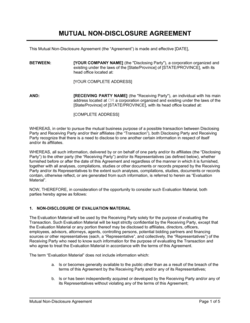
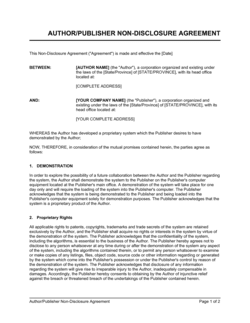
Customize the definition to reflect the actual categories of information you will share: financial models, customer data, technical specifications, pricing structures, or strategic plans. List them explicitly rather than relying solely on catch-all language.
💡 If you will be sharing personal data covered by GDPR, CCPA, or PIPEDA, add a data protection clause or attach a data processing addendum — this NDA alone does not satisfy those obligations.
4
Set the term and survival period
Choose the agreement term — typically coterminous with the engagement plus a defined tail — and set the survival period for confidentiality obligations. Use 3–5 years for sensitive trade secrets and proprietary financial data.
💡 If the engagement has no fixed end date, tie the term to 'the earlier of completion of the engagement or [DATE]' to avoid an open-ended obligation on both sides.
5
Confirm the return or destruction clause
Specify whether you prefer return or destruction of materials, set a deadline (10 business days is standard), and require written certification. Add a clause allowing you to retain copies in legal hold if litigation is reasonably anticipated.
💡 For digital materials, destruction means permanent deletion from all devices and cloud storage — add explicit language covering backup systems.
6
Select governing law and dispute forum
Choose the jurisdiction whose law will govern — typically your company's home state or province — and decide between court litigation and binding arbitration. Arbitration is faster and private; litigation preserves appeal rights.
💡 For cross-border engagements, confirm that your chosen governing law is enforceable in the consultant's jurisdiction before finalizing — some countries restrict foreign governing-law clauses.
7
Execute before any information is shared
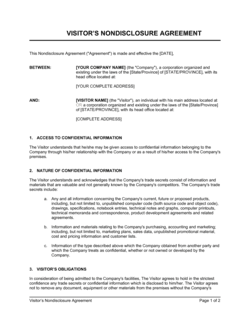
Both parties must sign the agreement before the first briefing, document handover, or access to any system. Send via eSign and retain a timestamped, fully executed copy in your records.
💡 Information shared before execution is not covered by the NDA — even if you sign the next day. When in doubt, delay the briefing, not the signature.
8
Retain the executed agreement and log disclosures
Store the signed NDA in a secure contract management system and log each significant disclosure with a date and description. This log is your first line of evidence if a breach occurs.
💡 A simple spreadsheet tracking disclosure date, material type, and recipient is sufficient for most small businesses and dramatically strengthens any enforcement action.