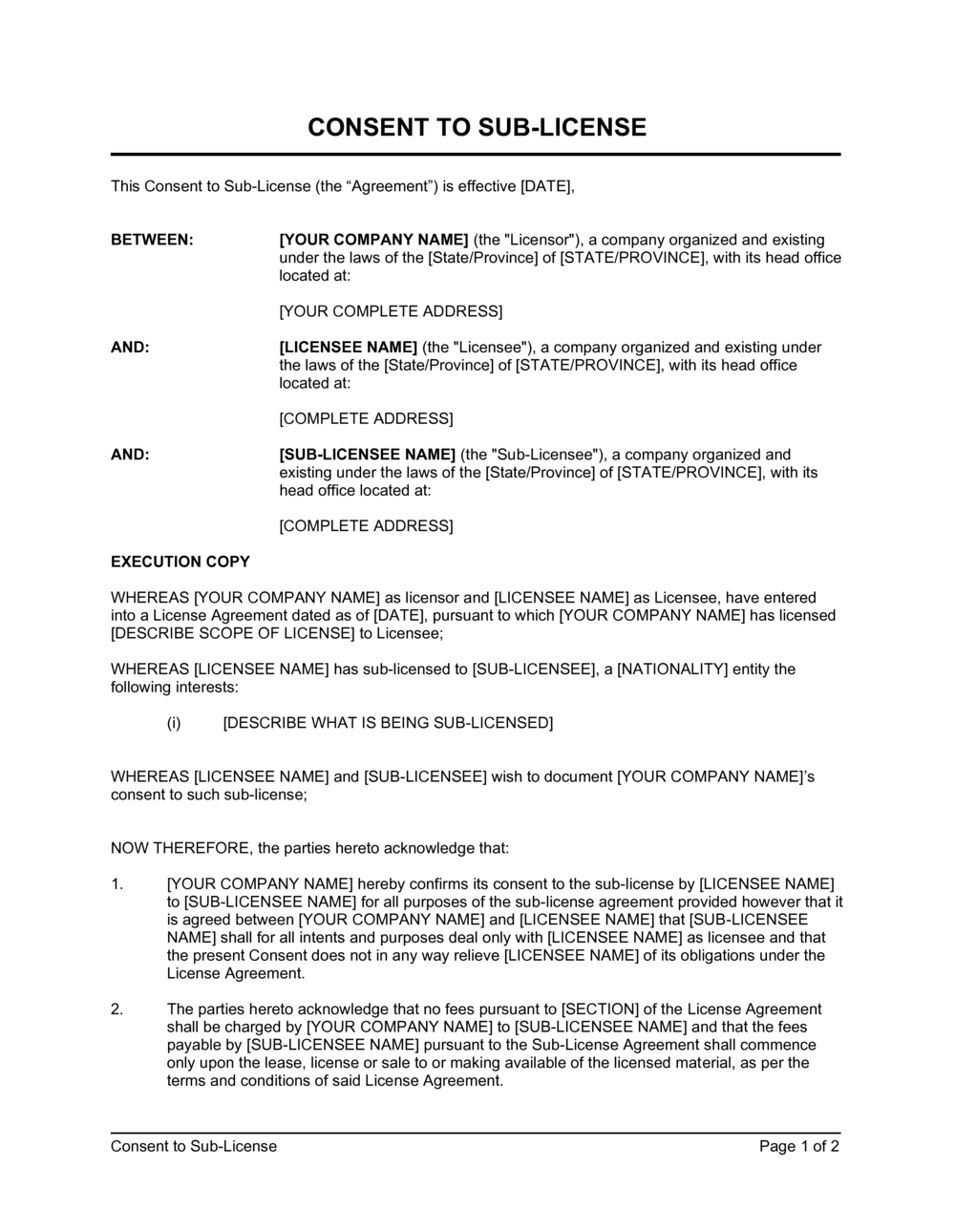
Consent to Sub-License Template

Free Word download β€’ Edit online β€’ Save & share with Drive β€’ Export to PDF

2 pagesβ€’20–30 min to fillβ€’Difficulty: Standardβ€’Signature requiredβ€’Legal review recommended
Learn more ↓
FreeConsent to Sub-License Template

At a glance

What it is
A Consent To Sub License is a legally binding document in which an original licensor formally authorizes a licensee to grant sublicense rights to a third party for a defined scope of intellectual property, software, or other licensed assets. This template is a free Word download you can edit online and export as PDF, covering the scope of permitted use, sublicensee restrictions, royalty flow-through, and termination conditions.
When you need it
Use it whenever an existing license agreement requires the licensor's written consent before the licensee may sublicense β€” which most license agreements do by default. It is also needed when a licensee wants to incorporate licensed IP into a product or service delivered to end users or downstream business partners.
What's inside
Identification of all three parties (licensor, licensee, and sublicensee), the scope and restrictions of the sublicense, royalty and payment obligations, warranties and indemnification, audit rights, and termination and remedies provisions that protect the original licensor throughout the sublicense chain.

What is a Consent To Sub License?

A Consent To Sub License is a legally binding document in which an original licensor formally authorizes a licensee to extend some or all of the licensed rights to a third party β€” the sublicensee. Most professionally drafted license agreements prohibit sublicensing as a default, requiring prior written consent before any secondary grant of rights can take effect. This document satisfies that requirement, defines the exact scope and conditions under which sublicensing is permitted, and preserves the licensor's control over how its intellectual property is used throughout the downstream chain. It is distinct from the sublicense agreement itself: the consent authorizes the relationship; the sublicense agreement governs it.

The document typically operates as a three-party instrument, bringing the sublicensee into a defined relationship with the licensor through mechanisms such as third-party beneficiary status and flow-through audit rights β€” even though the sublicensee is not a party to the original license.

Why You Need This Document

Sublicensing without documented licensor consent is a material breach of most license agreements and, for copyright-protected works, may constitute outright infringement β€” exposing the licensee to termination of the primary license, damages claims, and injunctive relief. The consequences travel downstream too: a sublicensee operating under an unauthorized sublicense holds no valid rights and faces infringement liability of its own. Obtaining formal consent before sublicensing begins protects all three parties by establishing clear scope, financial obligations, and termination procedures in writing. For licensors, a well-drafted consent document preserves audit rights, ensures royalty flow-through, and provides direct enforcement remedies against sublicensee misconduct β€” protections that do not arise automatically under general contract law. This template gives all parties a structured, enforceable starting point that a legal review can be applied to efficiently, rather than drafting from scratch.

Which variant fits your situation?

If your situation is…Use this template
Sublicensing software to end users through a reseller channelSoftware Sublicense Agreement
Granting a manufacturing partner rights to use patented technologyPatent Sublicense Agreement
Permitting a distributor to sublicense branded contentContent Sublicense Agreement
Setting up a master franchise sublicensing structureMaster Franchise Agreement
Creating the underlying license that governs what may be sublicensedLicense Agreement
Granting limited non-exclusive rights without a full sublicense chainNon-Exclusive License Agreement
Terminating or revoking a previously granted sublicense consentLicense Termination Agreement

Common mistakes to avoid

❌ Failing to get consent before sublicensing begins

Why it matters: Most license agreements require prior written consent before sublicensing. Sublicensing without it constitutes a material breach of the primary license, potentially triggering immediate termination and infringement liability.

Fix: Obtain signed consent before the licensee executes any sublicense agreement. Build consent processing time into the sublicense timeline as a non-negotiable prerequisite.

❌ Granting sublicense scope broader than the primary license

Why it matters: A sublicensee cannot receive rights the licensee does not hold. Attempting to sublicense beyond the primary license scope exposes the licensee to breach claims and the sublicensee to infringement claims the licensor can pursue directly.

Fix: Map the proposed sublicense scope against the primary license before drafting. Highlight any rights the licensee needs but does not currently hold and seek a primary license amendment if necessary.

❌ Omitting third-party beneficiary status for the licensor

Why it matters: Without express third-party beneficiary language, the licensor lacks direct legal standing to enforce the sublicense agreement against the sublicensee, leaving only breach claims against the licensee β€” who may be judgment-proof.

Fix: Include a clause explicitly designating the licensor as a third-party beneficiary of the sublicense agreement, with the right to enforce its terms directly against the sublicensee.

❌ Not addressing what happens to sublicensee rights on primary license termination

Why it matters: If the primary license terminates for any reason β€” including the licensor's own breach β€” sublicensees can lose rights overnight with no protection or wind-down period, exposing the licensee to claims from the sublicensee.

Fix: Include a clause specifying whether sublicensee rights survive primary license termination for a defined wind-down period or whether the licensor may elect to step in and maintain the sublicense directly.

❌ Using vague field-of-use and territory definitions

Why it matters: Ambiguous scope is the leading cause of sublicense disputes. Without precise geographic and use boundaries, sublicensees expand activity into unintended areas, and litigation over interpretation is expensive and unpredictable.

Fix: List permitted territories by country or region code and define the field of use with the specificity of a patent claim β€” if the document cannot be read by a stranger to the transaction and understood without ambiguity, rewrite it.

❌ No audit rights covering the sublicensee's records

Why it matters: Royalty underpayment is among the most common sublicense disputes. If the licensor's audit right extends only to the licensee's books and the sublicensee controls the revenue data, verification is practically impossible.

Fix: Draft audit rights to flow through to the sublicensee's books, either directly or by requiring the licensee to include equivalent audit rights in the sublicense agreement and to exercise them on the licensor's behalf upon request.

The 10 key clauses, explained

Recitals and defined parties

In plain language: Identifies all three parties β€” licensor, licensee, and sublicensee β€” by their full legal names and entity types, and references the underlying license agreement that governs the relationship.

Sample language
This Consent To Sub License ('Consent') is entered into as of [DATE] by and among [LICENSOR LEGAL NAME] ('Licensor'), [LICENSEE LEGAL NAME] ('Licensee'), and [SUBLICENSEE LEGAL NAME] ('Sublicensee'). This Consent is issued pursuant to the License Agreement dated [DATE] between Licensor and Licensee (the 'Primary License').

Common mistake: Failing to reference the exact Primary License by date and title. If the consent document does not tie back to the underlying agreement, the scope of permitted sublicensing is undefined and courts cannot determine what rights were actually transferred.

Grant of consent and scope

In plain language: States explicitly what the licensor is consenting to β€” the specific IP, territory, field of use, and duration for which sublicensing is permitted.

Sample language
Licensor hereby consents to Licensee's grant of a non-exclusive sublicense to Sublicensee to [USE DESCRIPTION] the [LICENSED IP DESCRIPTION] solely within [TERRITORY] and solely for [FIELD OF USE] for a term not to exceed [DURATION], subject to the conditions set forth herein.

Common mistake: Using broad language like 'all rights under the Primary License.' The sublicense scope should be narrower than or equal to the primary license β€” never broader β€” and granting uncapped rights can expose the licensor to unintended uses.

Restrictions and prohibited uses

In plain language: Defines what the sublicensee cannot do β€” sub-sublicensing, use outside the stated field, modification, reverse engineering, or transfer to third parties.

Sample language
Sublicensee shall not: (a) further sublicense, assign, or transfer the Licensed Rights; (b) use the Licensed IP outside the Field of Use; (c) modify, reverse-engineer, or create Derivative Works without prior written consent of Licensor; or (d) use the Licensed IP in any jurisdiction not listed in Schedule A.

Common mistake: Omitting a prohibition on further sublicensing by the sublicensee. Without it, the sublicensee can create an uncontrolled chain of downstream users the licensor never authorized.

Royalties and financial obligations

In plain language: States whether the sublicense triggers any additional royalty obligation to the licensor, how sublicense revenue is reported, and the payment timeline.

Sample language
Licensee shall pay Licensor [X]% of all Sublicense Revenue received from Sublicensee within [30] days of each calendar quarter end. 'Sublicense Revenue' means all consideration received by Licensee in connection with the sublicense, excluding VAT and documented out-of-pocket costs.

Common mistake: Not defining 'Sublicense Revenue' specifically. If the sublicensee pays through services, equity, or non-cash consideration, an undefined revenue term creates disputes over what the royalty base actually is.

Sublicense agreement requirements

In plain language: Requires that the sublicense agreement between licensee and sublicensee contain minimum protective provisions that mirror the primary license and protect the licensor's rights.

Sample language
Licensee shall ensure that any sublicense agreement with Sublicensee includes, at minimum: (a) confidentiality obligations no less protective than those in the Primary License; (b) IP ownership provisions consistent with Section [X] of the Primary License; and (c) termination rights exercisable by Licensor as a third-party beneficiary.

Common mistake: Not requiring that the sublicense agreement be provided to the licensor for review. The licensor has no way to confirm protective provisions are in place if they never see the sublicense document.

Licensor as third-party beneficiary

In plain language: Establishes the licensor's right to enforce the sublicense agreement directly against the sublicensee, even though the licensor is not a direct party to that agreement.

Sample language
Licensor is an express third-party beneficiary of the sublicense agreement between Licensee and Sublicensee and shall have the right to enforce its terms directly against Sublicensee in the event of a breach that Licensee has failed to remedy within [30] days of written notice.

Common mistake: Assuming the licensor has automatic enforcement rights against the sublicensee. Without an explicit third-party beneficiary clause, the licensor may lack standing to sue the sublicensee directly, leaving only breach-of-primary-license claims against the licensee.

Audit rights

In plain language: Grants the licensor the right to audit the licensee's and sublicensee's books and records to verify royalty calculations and compliance with the scope of the sublicense.

Sample language
Licensor shall have the right, upon [30] days' written notice, to audit Licensee's (and, through Licensee, Sublicensee's) books and records relating to Sublicense Revenue and compliance with this Consent no more than [once] per calendar year. Audit costs shall be borne by Licensor unless the audit reveals an underpayment of more than [5]%, in which case Licensee shall bear the cost.

Common mistake: Limiting audit rights to the licensee only. If the sublicensee controls the revenue data, a licensor without pass-through audit access cannot verify accuracy.

Term and termination

In plain language: States when the consent expires, the events that trigger automatic termination, and the survival of obligations after termination.

Sample language
This Consent shall remain in effect until the earlier of: (a) termination or expiration of the Primary License; (b) [DATE]; or (c) written notice of termination by Licensor following Licensee's or Sublicensee's uncured material breach. Upon termination, Sublicensee shall immediately cease all use of the Licensed IP and certify destruction or return of all copies within [15] business days.

Common mistake: Failing to address what happens to sublicensee rights when the primary license terminates. Courts in most jurisdictions do not automatically protect sublicensees from upstream termination unless the consent document includes a survival or step-in clause.

Indemnification and liability

In plain language: Allocates liability for third-party claims arising from the sublicensee's use of the licensed IP and requires the licensee to indemnify the licensor against losses caused by the sublicense.

Sample language
Licensee shall indemnify, defend, and hold harmless Licensor from and against any claims, damages, and expenses (including reasonable legal fees) arising from: (a) Sublicensee's use of the Licensed IP; (b) any breach by Sublicensee of the sublicense agreement; or (c) any misrepresentation by Licensee in connection with this Consent.

Common mistake: Omitting indemnification for the sublicensee's acts entirely. If the sublicensee infringes a third party's IP or violates the license terms, the licensor should not bear costs arising from a relationship it did not directly create.

Governing law and dispute resolution

In plain language: Specifies the jurisdiction whose laws govern the consent document and how disputes between the parties are resolved.

Sample language
This Consent is governed by the laws of [STATE / PROVINCE / COUNTRY] without regard to its conflict-of-law principles. Any dispute arising under this Consent shall be resolved by [binding arbitration / litigation] in [CITY], and all parties consent to the exclusive jurisdiction of the courts or arbitral body located therein.

Common mistake: Choosing a governing law that differs from the Primary License's governing law without explanation. Inconsistent governing law between the consent and the primary license creates ambiguity about which jurisdiction's rules apply when disputes span both documents.

How to fill it out

  1. 1

    Identify all three parties by full legal name

    Enter the licensor's, licensee's, and sublicensee's registered legal entity names β€” not trade names β€” along with their entity type and jurisdiction of incorporation.

    πŸ’‘ Verify entity names against official corporate registry records before signing. A name mismatch can make the consent unenforceable against the intended party.

  2. 2

    Reference the primary license precisely

    Insert the exact title, effective date, and parties of the underlying license agreement. This anchors the consent to the correct agreement and prevents scope ambiguity.

    πŸ’‘ Attach the relevant scope provisions of the primary license as an exhibit so all parties confirm the same understanding of the base rights.

  3. 3

    Define the sublicense scope specifically

    Describe the licensed IP by name or registration number, state the permitted field of use, list the authorized territory or territories, and set a definite sublicense term.

    πŸ’‘ Never default to 'all rights under the primary license.' The sublicense scope should be the minimum necessary for the sublicensee's stated purpose.

  4. 4

    State the royalty obligations and reporting requirements

    Enter the royalty rate or flat fee the licensee owes the licensor for sublicensing, define the revenue base, and specify quarterly or monthly reporting and payment deadlines.

    πŸ’‘ Include a definition of 'Sublicense Revenue' that explicitly addresses non-cash consideration β€” equity, services, or barter β€” to prevent future disputes over the royalty base.

  5. 5

    Include the sublicense agreement requirements and approval process

    Specify which minimum terms the licensee must include in the sublicense agreement and whether the licensor must approve the sublicense document before execution.

    πŸ’‘ Requiring a 10-business-day licensor review period before the sublicense takes effect is a common and enforceable protective measure.

  6. 6

    Set the termination triggers and post-termination obligations

    List the events that automatically terminate the consent β€” primary license termination, material breach, insolvency β€” and state the sublicensee's obligations upon termination, including IP return or destruction.

    πŸ’‘ Consider a step-in clause allowing the licensor to step into the sublicense relationship directly if the licensee becomes insolvent, preserving sublicensee continuity where commercially desirable.

  7. 7

    Execute with all three parties before sublicense takes effect

    Obtain original signatures from the licensor, licensee, and sublicensee β€” or authorized representatives β€” before any sublicensing activity begins. Date the consent on the signature page.

    πŸ’‘ Use a countersigned PDF or eSign platform with an audit trail. Unsigned or undated consent documents are routinely challenged in IP disputes.

Frequently asked questions

What is the difference between a license and a sublicense?

A license is a direct grant of rights from the IP owner to a licensee. A sublicense is a secondary grant of some of those same rights from the licensee to a third party β€” the sublicensee. The sublicensee's rights are always limited to what the licensee received from the original licensor. The licensor typically has no direct contractual relationship with the sublicensee unless the consent document establishes one through a third-party beneficiary clause.

Does a sublicensee have rights if the primary license is terminated?

Under general contract law principles, a sublicense is dependent on the primary license β€” if the primary license terminates, the sublicense typically terminates as well. Some jurisdictions and courts have created exceptions for sublicensees who acted in good faith, but this protection is not guaranteed. The Consent To Sub License should address this explicitly with either a wind-down period, a survival clause, or a licensor step-in right to avoid sublicensee exposure.

Can a sublicensee further sublicense the rights it receives?

No, unless the Consent To Sub License or the sublicense agreement explicitly permits it. Sub-sublicensing without authorization is a breach of both the sublicense and the primary license. The Consent should include a clear prohibition on further sublicensing by the sublicensee to keep the license chain controlled and auditable.

What happens if a sublicensee breaches the sublicense terms?

Without a third-party beneficiary clause in the Consent, the licensor has no direct claim against the sublicensee and must rely on breach of the primary license claims against the licensee. A well-drafted Consent designates the licensor as a third-party beneficiary of the sublicense agreement, enabling direct enforcement against the sublicensee. The Consent should also require the licensee to notify the licensor promptly of any sublicensee breach and to terminate the sublicense if the breach is not cured within a defined period.

How this compares to alternatives

vs License Agreement

A License Agreement is the primary grant of rights directly from the IP owner to the licensee and creates the underlying relationship that a Consent To Sub License extends. The Consent operates as a derivative authorization layered on top of the primary license β€” without a valid primary license in place, there are no rights to sublicense and no consent to grant.

vs Non-Exclusive License Agreement

A Non-Exclusive License Agreement grants rights to a licensee while the licensor retains the ability to grant the same rights to others. A Consent To Sub License does not grant new rights from the licensor β€” it permits the existing licensee to extend its already-granted rights to a third party. They address different levels of the licensing chain and are often used together.

vs Assignment of Intellectual Property

An IP Assignment permanently transfers ownership of intellectual property to a new owner β€” it is not a license at all. A Consent To Sub License leaves ownership with the original licensor and creates only a temporary, conditional right of use for the sublicensee. Assignments are irrevocable; sublicenses can be terminated under defined conditions.

vs Technology Transfer Agreement

A Technology Transfer Agreement conveys know-how, technical documentation, and training alongside rights β€” typically used for manufacturing or development partnerships where capability transfer is as important as legal rights. A Consent To Sub License addresses only the authorization to extend existing license rights and does not convey additional technical assets or obligations.

Industry-specific considerations

Software and SaaS

Reseller and OEM channels commonly require sublicense consent to embed or re-sell licensed software; end-user license flow-through and seat-count reporting provisions are standard.

Media and Entertainment

Content distributors sublicense broadcast, streaming, and print rights across regional sub-distributors; territory carve-outs and content modification restrictions are essential.

Pharmaceutical and Life Sciences

Patent sublicenses to manufacturing partners or regional distributors involve regulatory approval conditions, milestone payments, and strict field-of-use limitations tied to approved indications.

Franchising

Master franchisees sublicense brand, system, and operational IP to unit franchisees; consent documents must address brand standards enforcement, sublicense fee flow-through, and unit agreement minimum terms.

Jurisdictional notes

United States

US courts generally enforce sublicense consent requirements strictly β€” sublicensing without written consent is treated as a breach of the primary license and, for copyright, may constitute infringement. State law varies on whether sublicensees receive any independent protections on upstream termination. In patent licensing, the Supreme Court's decision in Rite-Hite v. Kelley and its progeny affect how sublicense royalty chains are valued in infringement damages calculations.

Canada

Canadian copyright and patent law follows similar principles to the US on sublicense consent requirements. Quebec's Civil Code may affect contractual interpretation for consent documents governed by Quebec law. Provincial courts have found that sublicensees can have limited equitable protections against upstream licensor termination where the licensor acted in bad faith β€” include clear wind-down provisions to manage this risk.

United Kingdom

UK intellectual property law, governed by the Copyright, Designs and Patents Act 1988 and the Patents Act 1977, requires express sublicense authorization from the licensor. Post-Brexit, IP rights that previously covered the EU must now be addressed separately for UK and EU territories. UK courts apply a strict interpretation of license scope and will not imply sublicense rights that are not expressly stated.

European Union

EU member states apply varying approaches to sublicense consent requirements under national IP law, but all require express authorization for sublicensing as a baseline. GDPR considerations arise when licensed software or content involves personal data processing β€” the sublicense consent should address data processing obligations if relevant. The EU Software Directive and Database Directive impose specific constraints on software and database sublicensing that may limit the scope of permissible sublicense grants.

Template vs lawyer β€” what fits your deal?

PathBest forCostTime
Use the templateStandard domestic sublicensing arrangements β€” software resellers, content sub-distributors, or franchise unit operators β€” in a single jurisdictionFree30–60 minutes
Template + legal reviewCross-border sublicenses, significant royalty obligations, or licensed IP that is material to the business$300–$7002–5 days
Custom draftedMulti-territory pharmaceutical or patent sublicenses, complex revenue-sharing structures, or sublicenses involving regulated industries$2,000–$8,000+2–4 weeks

Glossary

Licensor
The original rights holder who owns the intellectual property and granted the primary license to the licensee.
Licensee
The party who holds the primary license from the licensor and is seeking consent to extend those rights to a third party through a sublicense.
Sublicensee
The third party who receives a subset of the licensed rights from the licensee, subject to the licensor's consent and the terms of this document.
Sublicense
A secondary license granted by a licensee to a third party, conveying some or all of the rights the licensee received from the original licensor.
Scope of Use
The precise boundaries of permitted activity under the sublicense β€” what the sublicensee may do with the licensed IP, in which territory, and for how long.
Royalty Flow-Through
A mechanism requiring the licensee to pass a defined share of sublicense revenue up to the original licensor, as specified in the primary license agreement.
Audit Rights
A contractual right allowing the licensor to inspect the licensee's and sublicensee's records to verify accurate royalty reporting and compliance with the sublicense terms.
Derivative Work
A new creation that incorporates or is based upon the licensed IP β€” its ownership and sublicenseability must be addressed explicitly to avoid disputes.
Termination for Cause
A provision allowing the licensor to revoke consent and terminate the sublicense immediately upon a defined breach, such as unauthorized use or failure to pay royalties.
Privity of Contract
The legal relationship between contracting parties β€” sublicensees typically have no direct legal relationship with the licensor, which is why the consent document must address the licensor's remedies carefully.
Consent Condition
A specific requirement the licensee must satisfy before sublicensing rights are activated β€” such as providing 30 days' notice, submitting the sublicense agreement for approval, or paying a consent fee.
Non-Assignability
A restriction preventing the sublicensee from further transferring or assigning the sublicensed rights to another party without a new, separate consent from the licensor.

Part of your Business Operating System

This document is one of 3,000+ business & legal templates included in Business in a Box.

  • Fill-in-the-blanks β€” ready in minutes
  • 100% customizable Word document
  • Compatible with all office suites
  • Export to PDF and share electronically

Create your document in 3 simple steps.

From template to signed document β€” all inside one Business Operating System.
1
Download or open template

Access over 3,000+ business and legal templates for any business task, project or initiative.

2
Edit and fill in the blanks with AI

Customize your ready-made business document template and save it in the cloud.

3
Save, Share, Send, Sign

Share your files and folders with your team. Create a space of seamless collaboration.

Save time, save money, and create top-quality documents.

β˜…β˜…β˜…β˜…β˜…

"Fantastic value! I'm not sure how I'd do without it. It's worth its weight in gold and paid back for itself many times."

Managing Director Β· Mall Farm
Robert Whalley
Managing Director, Mall Farm Proprietary Limited
β˜…β˜…β˜…β˜…β˜…

"I have been using Business in a Box for years. It has been the most useful source of templates I have encountered. I recommend it to anyone."

Business Owner Β· 4+ years
Dr Michael John Freestone
Business Owner
β˜…β˜…β˜…β˜…β˜…

"It has been a life saver so many times I have lost count. Business in a Box has saved me so much time and as you know, time is money."

Owner Β· Upstate Web
David G. Moore Jr.
Owner, Upstate Web

Run your business with a system β€” not scattered tools

Stop downloading documents. Start operating with clarity. Business in a Box gives you the Business Operating System used by over 250,000 companies worldwide to structure, run, and grow their business.

Start freeΒ Β·Β No credit card required