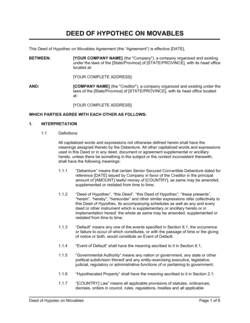
Deed of Movable Hypothec Template

Free Word download • Edit online • Save & share with Drive • Export to PDF

8 pages25–35 min to fillDifficulty: ComplexSignature requiredLegal review recommended
Learn more ↓
FreeDeed of Movable Hypothec Template

At a glance

What it is
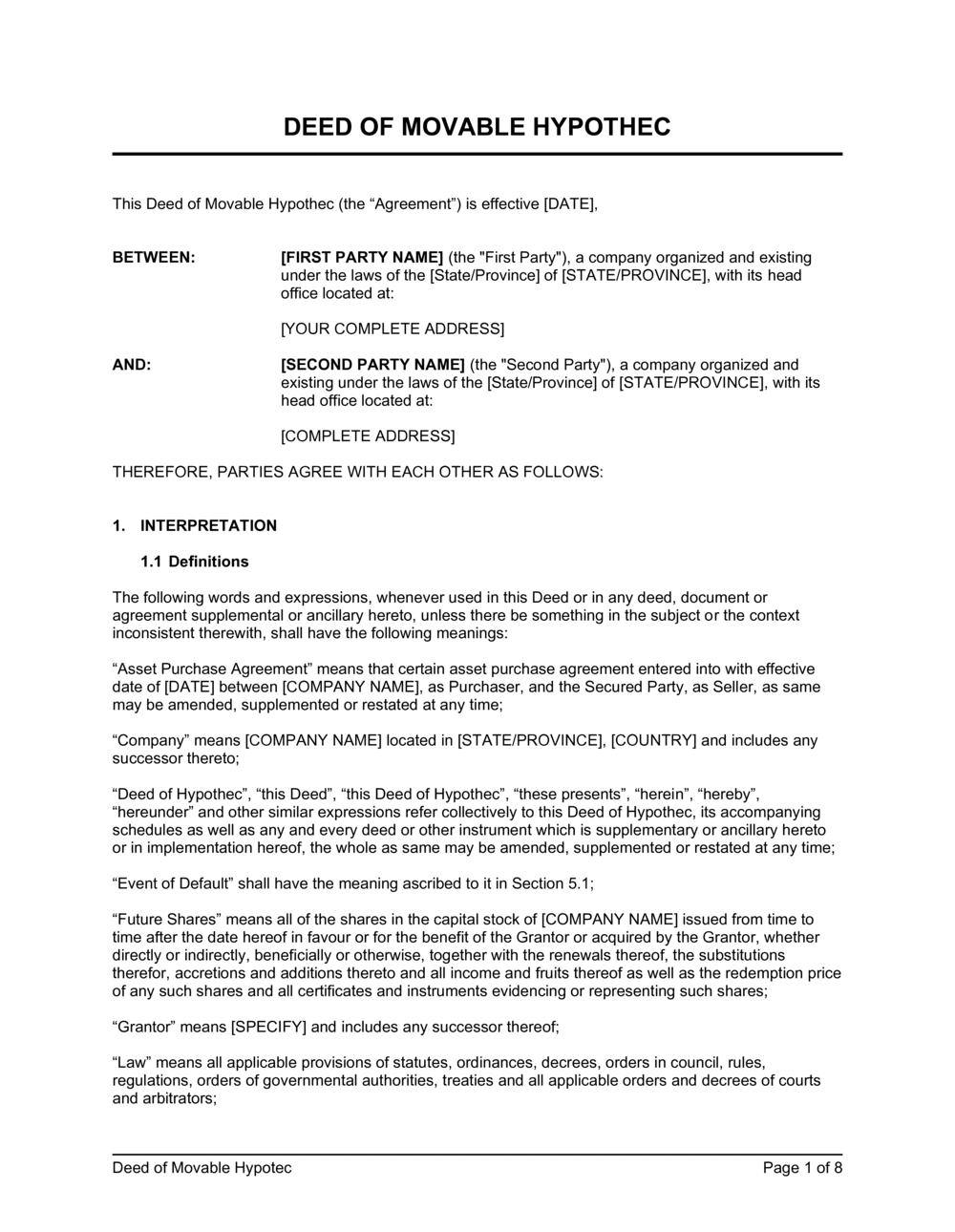
A Deed of Movable Hypothec is a legally binding security document in which a debtor grants a creditor a real right over specified movable property — such as equipment, inventory, receivables, or intellectual property — as collateral for a loan or obligation. This free Word download gives you a structured, notary-ready starting point you can edit online and export as PDF. It is most commonly used in Quebec civil law and other civil law jurisdictions as the functional equivalent of a security interest or chattel mortgage in common-law systems.
When you need it
Use it when a lender requires collateral security over movable business assets before advancing funds, or when a borrower wants to formally document and publish a hypothec to establish priority over other creditors. It is also needed whenever a financing arrangement requires registration under a personal property or movable-property registry.
What's inside
Identification of the grantor and creditor, a precise description of the hypothecated movable assets, the secured amount and interest rate, representations and warranties, obligations of the grantor, default and enforcement provisions, and governing law and publication clauses.

What is a Deed of Movable Hypothec?

A Deed of Movable Hypothec is a legally binding security document under which a debtor — the grantor — grants a creditor a real right over specified movable property as collateral for a loan or other financial obligation. Covered assets typically include equipment, machinery, vehicles, inventory, accounts receivable, intellectual property, and financial instruments — any property that is not permanently affixed to land. Unlike a pledge, the grantor generally retains possession and continues using the assets during the loan term; the hypothec operates as a registered encumbrance that gives the creditor priority rights over the collateral if the grantor defaults. The deed is the primary security instrument in Quebec and other civil-law jurisdictions, operating under the Civil Code rather than the common-law Personal Property Security Act framework used elsewhere in Canada and most of the English-speaking world.

Why You Need This Document

Without a properly drafted and registered Deed of Movable Hypothec, a creditor advancing funds against business assets has no real right in the collateral — only a personal claim against the debtor. If the grantor becomes insolvent, an unregistered or defective hypothec is unenforceable against the trustee in bankruptcy and against other creditors who registered first. The consequences are concrete: a creditor without a valid hypothec ranks as an unsecured creditor and typically recovers cents on the dollar, if anything, from an insolvent estate. For the grantor, an improperly documented hypothec can block future financing, create title defects that delay asset sales, and expose management to breach-of-warranty claims from lenders. This template provides the foundational structure — correct maximum-amount disclosure, precise asset description, statutory-compliant enforcement clauses, and discharge obligations — that keeps both parties protected and makes registration straightforward from day one.

Which variant fits your situation?

If your situation is…Use this template
Hypothec granted over specific identified equipment or machineryDeed of Movable Hypothec — Specific Assets
Hypothec granted over a universality of present and future assetsDeed of Movable Hypothec with Delivery (Universality)
Securing a line of credit with a floating charge over inventoryDeed of Movable Hypothec — Revolving Credit
Pledging accounts receivable as collateral for invoice financingDeed of Hypothec on Receivables
Securing obligations under a commercial lease with movable propertyCommercial Security Agreement
Common-law jurisdiction requiring a PPSA-style security interestGeneral Security Agreement
Creditor requiring immovable property as additional collateralDeed of Immovable Hypothec

Common mistakes to avoid

❌ Omitting the maximum secured amount

Why it matters: Under Quebec civil law and most civil-law equivalents, a hypothec that does not state a maximum secured amount is absolutely null — the entire security is void regardless of registration.

Fix: Always state a specific dollar maximum that covers principal, accrued interest at the contracted rate for at least one year, and estimated enforcement costs.

❌ Delaying registration after execution

Why it matters: A hypothec is not opposable to third parties until it is published in the applicable registry. A creditor who executes on Monday but registers on Friday loses priority to any creditor who registers in between.

Fix: Register the hypothec on the same day as execution, or instruct a notary or agent to file immediately. Treat the registration as part of the closing, not a post-closing formality.

❌ Vague or overbroad description of hypothecated assets

Why it matters: Registries and courts require the collateral description to be sufficient to identify the assets. An entry for 'all assets' without further detail can be challenged and may fail to attach to specific property.

Fix: Use serial numbers, VINs, or asset categories with location qualifiers. For a universality, specify the type of assets, their location, and whether future assets of the same class are included.

❌ No insurance loss-payee designation

Why it matters: If the hypothecated assets are destroyed by fire or flood and the creditor is not named as loss payee, the insurance proceeds go to the grantor — who may be insolvent and unable to repay.

Fix: Require the grantor to name the creditor as first loss payee in the hypothecated-asset insurance policy and deliver proof of coverage at closing.

❌ Purporting to waive mandatory statutory notice periods

Why it matters: In Quebec, the 60-day prior notice before taking in payment or forced sale is a matter of public order — any contractual waiver is void, and enforcing without proper notice exposes the creditor to a nullity action and damages.

Fix: Remove any waiver language and instead prepare the statutory prior-notice form in advance so it can be served immediately upon default.

❌ Using a trade name instead of the registered legal entity as grantor

Why it matters: A hypothec registered against a trade name rather than the legal entity name will not be found in a registry search against the entity — leaving the creditor unsecured against third-party searchers.

Fix: Confirm the grantor's exact registered corporate name from the applicable business registry before drafting and use that name verbatim throughout the deed and registration.

The 10 key clauses, explained

Identification of Parties

In plain language: Names and fully describes the grantor (debtor) and the creditor as legal entities, including their addresses and capacity to contract.

Sample language
This Deed of Movable Hypothec is granted by [GRANTOR LEGAL NAME], a [ENTITY TYPE] duly incorporated under the laws of [JURISDICTION], with its principal place of business at [ADDRESS] ('Grantor'), in favour of [CREDITOR LEGAL NAME], a [ENTITY TYPE], with its principal place of business at [ADDRESS] ('Creditor').

Common mistake: Using a trade name instead of the registered legal entity name. If the grantor name does not match the entity on the asset registry, the hypothec may be unenforceable against third parties.

Description of Hypothecated Property

In plain language: Precisely identifies the movable assets over which the hypothec is granted — either as a list of specific items or as a defined universality of present and future assets.

Sample language
The Grantor hereby hypothecates and charges in favour of the Creditor the following movable property: [LIST OF SPECIFIC ASSETS / all present and future [CATEGORY OF ASSETS] of the Grantor, including but not limited to [DESCRIPTION]] (collectively, the 'Hypothecated Property').

Common mistake: Using vague descriptions such as 'all business assets.' Courts and registries require sufficient specificity to identify the collateral — overbroad descriptions can be challenged and may fail to attach to specific assets.

Secured Amount and Interest

In plain language: States the maximum amount secured by the hypothec, the interest rate, and the nature of the obligation (term loan, line of credit, or other).

Sample language
This hypothec secures the repayment of the sum of $[AMOUNT] ([WRITTEN AMOUNT]), bearing interest at the rate of [X]% per annum, calculated [monthly/annually], together with all interest, fees, costs, and charges related to the Secured Obligation.

Common mistake: Failing to specify a maximum secured amount. In Quebec and other civil law jurisdictions, a hypothec without a stated maximum amount is void. Include a figure that covers principal, accrued interest, and enforcement costs.

Representations and Warranties of the Grantor

In plain language: The grantor confirms ownership of the collateral, absence of prior encumbrances, authority to grant the hypothec, and that the assets are in good condition and unencumbered.

Sample language
The Grantor represents and warrants that: (a) it is the sole owner of the Hypothecated Property, free and clear of all liens, hypothecs, and encumbrances except as disclosed; (b) it has full authority to grant this hypothec; and (c) no insolvency or bankruptcy proceedings are pending or threatened.

Common mistake: Omitting a representation about existing encumbrances. If the grantor has already pledged the same assets to another creditor, the new creditor's priority depends on registration date — not on a warranty the grantor failed to give.

Obligations of the Grantor

In plain language: Sets out ongoing covenants the grantor must maintain — preserving and insuring the collateral, not disposing of it without consent, and notifying the creditor of material changes.

Sample language
During the term of this hypothec, the Grantor shall: (a) maintain the Hypothecated Property in good repair; (b) keep it insured for not less than $[AMOUNT] naming the Creditor as loss payee; (c) not sell, transfer, or further encumber the Hypothecated Property without prior written consent of the Creditor.

Common mistake: No insurance requirement. If the collateral is destroyed without insurance and the grantor is insolvent, the creditor has no recovery. Require the grantor to name the creditor as loss payee on all applicable policies.

Events of Default

In plain language: Lists the specific events that trigger the creditor's hypothecary remedies — non-payment, breach of covenant, insolvency, material adverse change, or seizure by another creditor.

Sample language
Each of the following constitutes an Event of Default: (a) failure to pay any amount due within [X] days of the due date; (b) breach of any representation, warranty, or covenant herein not cured within [X] days of notice; (c) commencement of insolvency or bankruptcy proceedings; (d) seizure or attachment of any Hypothecated Property by a third party.

Common mistake: Defining default only as non-payment. A creditor whose collateral has been seized by the CRA or pledged again to a third party needs contractual rights to act immediately — not wait for a missed payment.

Hypothecary Remedies and Enforcement

In plain language: Describes the creditor's rights on default — including taking possession, selling the collateral, or taking it in payment — and incorporates the statutory notice requirements that apply in the governing jurisdiction.

Sample language
Upon an Event of Default, the Creditor may exercise any and all hypothecary rights available under applicable law, including: (a) taking possession of the Hypothecated Property; (b) selling it by private or public sale after giving [60] days' prior notice as required by law; or (c) taking the Hypothecated Property in payment of the Secured Obligation, subject to the conditions prescribed by law.

Common mistake: Purporting to waive the statutory prior-notice period. In Quebec, the 60-day prior notice for taking in payment is mandatory — any contractual waiver is void and can expose the creditor to liability for irregular enforcement.

Publication and Priority

In plain language: Requires the hypothec to be registered in the applicable movable-property registry (e.g., RPMRR in Quebec) to make it opposable against third parties and establish priority over subsequent creditors.

Sample language
The Grantor authorizes the Creditor to publish and register this hypothec in the Register of Personal and Movable Real Rights (RPMRR) or such other applicable registry, and to take all steps necessary to perfect and maintain the Creditor's rights hereunder.

Common mistake: Failing to register promptly after execution. An unregistered hypothec is not opposable to third parties — a subsequent creditor who registers first will rank ahead, regardless of who signed first.

Discharge and Release

In plain language: Sets out the conditions under which the creditor will discharge the hypothec from the registry upon full repayment of the secured obligation.

Sample language
Upon full and final payment of all amounts secured hereunder, the Creditor shall, within [30] days of written request by the Grantor, execute and deliver a discharge of this hypothec and authorize its removal from the applicable registry.

Common mistake: No timeline for discharge. Without a contractual obligation to discharge promptly, creditors may delay removal — leaving the grantor's assets encumbered and blocking future financing.

Governing Law and Dispute Resolution

In plain language: Specifies which jurisdiction's law governs the deed and how disputes will be resolved — arbitration, mediation, or courts of a named jurisdiction.

Sample language
This Deed is governed by and construed in accordance with the laws of the Province of [PROVINCE / JURISDICTION]. Any dispute arising under this Deed shall be submitted to the exclusive jurisdiction of the courts of [CITY / JURISDICTION], except that the Creditor may seek injunctive or hypothecary relief in any competent court.

Common mistake: Selecting a governing law with no connection to where the assets are located. Hypothecary rights over movable property are generally governed by the law of the jurisdiction where the property is situated — a conflicting governing-law clause can create unenforceable remedies.

How to fill it out

  1. 1

    Identify the parties with full legal entity names

    Enter the grantor's and creditor's complete registered legal names, entity types, jurisdictions of incorporation, and principal business addresses. Do not use trade names or abbreviations.

    💡 Cross-reference the grantor's corporate registry entry to confirm the exact legal name matches the entity that owns the assets — mismatches at registration will be rejected.

  2. 2

    Describe the hypothecated assets with precision

    List specific assets by serial number, VIN, or asset tag where possible. For a universality, define the category clearly (e.g., 'all present and future inventory of the Grantor located at [ADDRESS]'). Attach a Schedule A for long asset lists.

    💡 For accounts receivable, include the debtor names or categories, the outstanding balance as of the deed date, and any future receivables of the same class.

  3. 3

    State the secured amount and interest rate

    Enter the maximum principal amount secured, the annual interest rate, the calculation method (monthly or annually), and a cross-reference to the underlying loan agreement or credit facility.

    💡 Set the maximum secured amount at 10–15% above the principal to cover accrued interest and enforcement costs — this prevents a shortfall if you need to enforce.

  4. 4

    Complete the representations and warranties block

    Have the grantor confirm clear title, absence of prior encumbrances, corporate authority, and no pending insolvency. Request a personal property registry search before execution to verify the representations.

    💡 Run a registry search (RPMRR in Quebec, PPSA in other provinces) immediately before signing — encumbrances registered within the last 30 days may not appear in older searches.

  5. 5

    Set the grantor's ongoing obligations

    Define insurance minimums, maintenance covenants, disposal restrictions, and reporting requirements. Specify the creditor as loss payee and additional insured on the grantor's property policy.

    💡 Require the grantor to deliver a certificate of insurance at signing and annually thereafter — do not rely on a verbal assurance of coverage.

  6. 6

    Define events of default and cure periods

    List every default trigger and assign an appropriate cure period — typically 5 business days for payment defaults and 15–30 days for covenant breaches. Ensure insolvency events have no cure period.

    💡 Include a cross-default clause: if the grantor defaults under any other material financing agreement, it constitutes a default here as well.

  7. 7

    Review and incorporate jurisdiction-specific notice requirements

    Confirm the mandatory prior-notice periods for each hypothecary remedy in the governing jurisdiction. In Quebec, taking in payment requires 60 days' prior notice to the grantor and any subordinate hypothecary creditors.

    💡 Attach the required statutory prior-notice form as a schedule so it is ready to issue immediately upon default without delay.

  8. 8

    Execute and register without delay

    Both parties sign the deed, then the creditor (or its notary) registers it in the applicable movable-property registry — RPMRR in Quebec, PPSA in other Canadian provinces. Priority runs from the date and time of registration.

    💡 Register the same day as execution if possible. Even a one-day gap creates a window during which another creditor could register and rank ahead of you.

Frequently asked questions

What is a Deed of Movable Hypothec?

A Deed of Movable Hypothec is a legal security document under which a debtor (the grantor) grants a creditor a real right over specified movable property — such as equipment, inventory, receivables, or intellectual property — as collateral for a loan or other obligation. Unlike a pledge, the grantor typically retains possession of the assets while the hypothec remains registered. It is the civil-law equivalent of a security interest or chattel mortgage used in common-law jurisdictions and is most commonly encountered in Quebec and other civil-law systems.

How is a movable hypothec different from an immovable hypothec?

A movable hypothec is granted over property that is not permanently affixed to land — equipment, vehicles, inventory, receivables, IP, and financial instruments. An immovable hypothec is granted over land and buildings and is the equivalent of a mortgage. Both create real rights in favour of the creditor, but they are registered in different registries, governed by different rules, and involve different enforcement procedures. Many commercial financing transactions require both.

Does a movable hypothec need to be notarized?

In Quebec, a movable hypothec granted by an individual (as opposed to a legal person) must be executed before a notary to be valid. Hypothecs granted by legal persons (corporations) can be executed under private writing and are valid without notarization, though some lenders require notarial form for additional certainty. Requirements vary by jurisdiction — always confirm the formal requirements under the governing law before execution.

What assets can be covered by a movable hypothec?

Movable hypothecs can cover virtually any property that is not land or permanently affixed to land: equipment, machinery, vehicles, furniture, computers, raw materials, finished inventory, accounts receivable, bank accounts, intellectual property, shares in corporations, and even universalities of present and future assets. The description of hypothecated property must be precise enough to identify the assets — vague descriptions risk invalidity or registration rejection.

How is a movable hypothec enforced on default?

On default, the hypothecary creditor typically has three main remedies under Quebec civil law: taking possession and administering the property, selling the property by judicial or extrajudicial means after giving prior notice, or taking the property in payment (dation en paiement). Each remedy requires service of a prior notice on the debtor and any subordinate creditors — the notice period is generally 20 days for taking possession and 60 days for taking in payment. Courts can reduce notice periods in urgent circumstances.

What is the priority of a movable hypothec against other creditors?

Priority among hypothecary creditors is generally determined by the date and time of registration in the movable-property registry, not the date of the deed. A creditor who registers first ranks ahead of one who registered later, even if the later deed was signed first. However, certain prior claims — unpaid wages, municipal taxes, and costs of justice — rank ahead of all hypothecary creditors by operation of law regardless of registration date.

Is a movable hypothec the same as a General Security Agreement?

They serve the same function — securing a loan against movable assets — but they arise from different legal systems. A General Security Agreement (GSA) is a common-law instrument used in common-law Canadian provinces under PPSA legislation. A Deed of Movable Hypothec is a civil-law instrument used in Quebec under the Civil Code. A business with assets in both Quebec and other provinces may need both documents to achieve complete security coverage.

How long does a movable hypothec registration last?

In Quebec, a registration in the RPMRR is valid for the period specified in the registration, up to a maximum of 10 years. It must be renewed before it expires to maintain priority — a lapsed registration loses its ranked position and any creditor can register ahead of a renewal. Most commercial lenders set the registration period to match the loan term plus a buffer, and calendar a renewal reminder at least 6 months before expiry.

Can a movable hypothec cover future assets not yet owned by the grantor?

Yes. A movable hypothec can be granted over a universality of present and future assets of a defined category — for example, all present and future inventory or all receivables arising from a specified business activity. The hypothec attaches to future assets as soon as the grantor acquires them, provided the universality is clearly described in the deed and registration. This is the civil-law equivalent of an after-acquired property clause in a common-law security agreement.

How this compares to alternatives

vs General Security Agreement

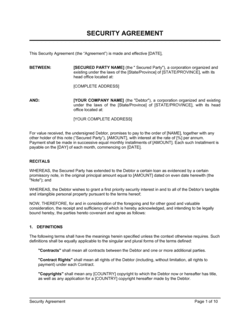
A General Security Agreement (GSA) is the common-law equivalent used in Canadian provinces outside Quebec under PPSA legislation. A Deed of Movable Hypothec is the civil-law instrument used in Quebec under the Civil Code. Both secure movable assets but operate under different legal regimes, registration systems, and enforcement procedures. Businesses with assets in both Quebec and other provinces need both documents for complete coverage.

vs Deed of Immovable Hypothec

A Deed of Immovable Hypothec — the civil-law mortgage — creates a real security right over land and buildings. A Deed of Movable Hypothec covers equipment, inventory, receivables, and other non-land assets. Both create hypothecary rights but are registered in different registries and involve different enforcement rules. Lenders financing a business purchase often require both.

vs Pledge Agreement

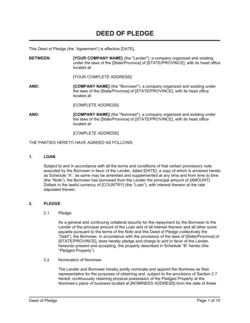
A pledge requires the creditor to take actual physical possession of the collateral as a condition of the security right. A movable hypothec allows the grantor to retain possession while still granting the creditor a real right. For operational assets like equipment and inventory, a hypothec is almost always preferable to a pledge because the grantor can continue using the assets during the loan term.

vs Loan Agreement

A Loan Agreement defines the terms of the debt — principal, interest, repayment schedule, and covenants. A Deed of Movable Hypothec is a security document that creates a real right over collateral to back the loan. They are complementary, not interchangeable: the loan agreement creates the obligation; the hypothec secures it. Both documents are required for a fully documented secured financing transaction.

Industry-specific considerations

Manufacturing

Equipment, machinery, and raw-material inventory are the primary collateral categories; universality hypothecs covering production assets and finished goods are standard in asset-based lending facilities.

Retail and Distribution

Revolving hypothecs over inventory are common for seasonal retailers and distributors; registration must be updated when stock locations or categories change materially.

Technology and SaaS

Hypothecs over intellectual property, software licenses, and accounts receivable are used by venture lenders and revenue-based financing providers as alternatives to equity dilution.

Construction

Equipment financing in construction typically involves specific-asset hypothecs on identified heavy machinery with serial numbers; interaction with builder's liens and prior claims requires careful priority mapping.

Healthcare

Medical equipment financing and receivables hypothecs are used by clinics and diagnostic labs; receivables from provincial health insurers require specific assignment language to be effectively hypothecated.

Professional Services

Law firms, accounting practices, and consulting firms use hypothecs over work-in-progress receivables and office equipment to secure operating lines of credit from chartered banks.

Jurisdictional notes

United States

The United States does not use the civil-law hypothec concept. Security interests over movable personal property are governed by Article 9 of the Uniform Commercial Code (UCC), adopted in all 50 states. The functional equivalent is a Security Agreement with a UCC-1 financing statement filed with the Secretary of State. Louisiana, as a civil-law state, uses hypothec terminology but its framework also interacts with federal UCC principles for commercial transactions.

Canada

Quebec is the primary Canadian jurisdiction where movable hypothecs apply, governed by Articles 2660–2802 of the Civil Code of Quebec. Registration is made in the Register of Personal and Movable Real Rights (RPMRR). All other Canadian provinces and territories use the Personal Property Security Act (PPSA) and General Security Agreements instead. Businesses operating in both Quebec and other provinces need jurisdiction-specific instruments for each. The Quebec hypothec requires a stated maximum amount or it is void.

United Kingdom

English law does not recognize the hypothec as a distinct security instrument. Security over movable personal property in England and Wales is typically achieved through a fixed or floating charge under the Companies Act 2006, registered at Companies House within 21 days of creation. Scottish law has a distinct moveable hypothec concept in limited contexts (e.g., maritime and landlord hypothec), but commercial asset security follows broadly similar charge-registration principles. This template is not directly applicable to UK transactions without substantial adaptation.

European Union

The hypothec on movable property exists in varying forms across EU civil-law member states — France (nantissement), Belgium (hypothèque mobilière), and Luxembourg among them. Requirements for creation, formality, registration, and enforcement differ significantly by member state. The EU Financial Collateral Directive harmonizes rules for financial instruments and cash collateral, but general movable property security remains a matter of national law. This template requires local legal adaptation before use in any specific EU jurisdiction.

Template vs lawyer — what fits your deal?

PathBest forCostTime
Use the templateSimple single-asset hypothecs between known parties where the loan terms are already documented in a separate agreementFree30–60 minutes
Template + legal reviewCommercial loans above $50,000, universality hypothecs, or transactions involving multiple creditors or prior encumbrances$500–$1,500 for notarial or legal review2–5 business days
Custom draftedAsset-based lending facilities, structured finance transactions, cross-border security, or hypothecs over IP or complex receivables portfolios$2,000–$8,000+1–3 weeks

Glossary

Hypothec
A real security right granted over property that allows a creditor to have the property sold and recover the debt from the proceeds if the debtor defaults, without requiring the creditor to take physical possession.
Grantor (Hypothecor)
The debtor or owner of the movable property who grants the hypothec to the creditor as security for an obligation.
Creditor (Hypothecary Creditor)
The lender or obligee in whose favour the hypothec is granted, giving them a real right over the collateral.
Movable Property
Physical or intangible assets that are not permanently affixed to land, including equipment, vehicles, inventory, receivables, intellectual property, and financial instruments.
Universality of Assets
A floating charge over all present and future assets of a defined category — such as all inventory or all receivables — rather than individually identified items.
Publication (Registration)
The formal filing of the hypothec in the applicable personal property or movable-property registry to make it enforceable against third parties and establish creditor priority.
Prior Claim
A preferential right recognized by law that ranks ahead of hypothecary claims in the distribution of proceeds on enforcement — such as unpaid wages or municipal taxes.
Hypothecary Rights
The remedies available to a creditor on default, including taking possession, selling the collateral, or taking the asset in payment (dation en paiement) subject to court or statutory process.
Accessory Hypothec
A hypothec that secures a specific, defined debt and extinguishes automatically when that debt is fully repaid.
Autonomous Hypothec
A hypothec securing a demand obligation or letter of credit independent of the underlying debt — does not automatically extinguish when the primary obligation is paid.
Dation en Paiement (Taking in Payment)
A hypothecary remedy where the creditor takes ownership of the collateral in full satisfaction of the debt, subject to a 60-day prior notice requirement and court oversight in most civil law jurisdictions.

Part of your Business Operating System

This document is one of 3,000+ business & legal templates included in Business in a Box.

  • Fill-in-the-blanks — ready in minutes
  • 100% customizable Word document
  • Compatible with all office suites
  • Export to PDF and share electronically

Create your document in 3 simple steps.

From template to signed document — all inside one Business Operating System.
1
Download or open template

Access over 3,000+ business and legal templates for any business task, project or initiative.

2
Edit and fill in the blanks with AI

Customize your ready-made business document template and save it in the cloud.

3
Save, Share, Send, Sign

Share your files and folders with your team. Create a space of seamless collaboration.

Save time, save money, and create top-quality documents.

★★★★★

"Fantastic value! I'm not sure how I'd do without it. It's worth its weight in gold and paid back for itself many times."

Managing Director · Mall Farm
Robert Whalley
Managing Director, Mall Farm Proprietary Limited
★★★★★

"I have been using Business in a Box for years. It has been the most useful source of templates I have encountered. I recommend it to anyone."

Business Owner · 4+ years
Dr Michael John Freestone
Business Owner
★★★★★

"It has been a life saver so many times I have lost count. Business in a Box has saved me so much time and as you know, time is money."

Owner · Upstate Web
David G. Moore Jr.
Owner, Upstate Web

Run your business with a system — not scattered tools

Stop downloading documents. Start operating with clarity. Business in a Box gives you the Business Operating System used by over 250,000 companies worldwide to structure, run, and grow their business.

Free Forever Plan · No credit card required