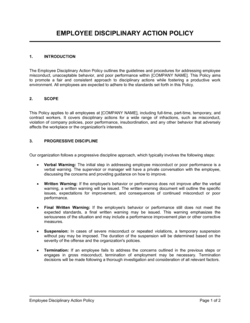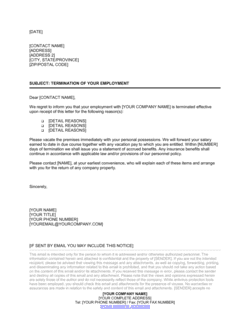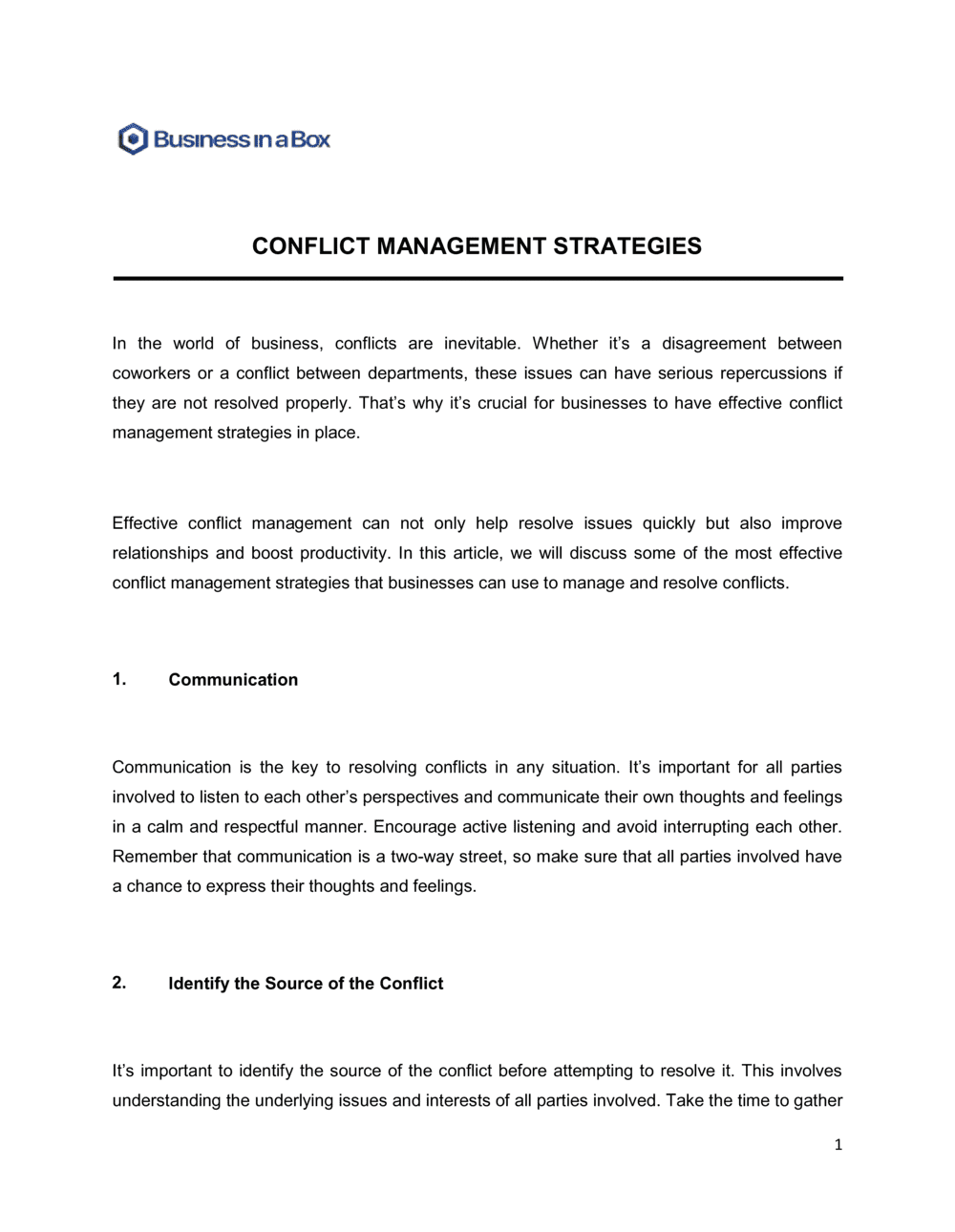
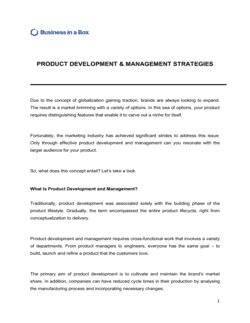
Conflict Management Strategies

Free Word download β€’ Edit online β€’ Save & share with Drive β€’ Export to PDF

3 pagesβ€’20–25 min to fillβ€’Difficulty: Standard
Learn more ↓
FreeConflict Management Strategies Template

At a glance

What it is
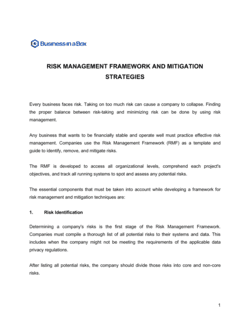
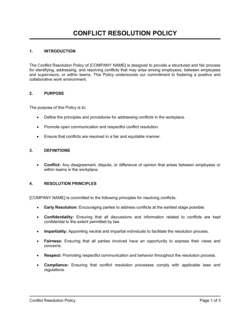
A Conflict Management Strategies document is an operational policy and reference guide that defines how an organization identifies, escalates, and resolves interpersonal or team-level disputes. This free Word download gives managers and HR professionals a structured framework they can edit online, adapt to their organization's culture, and distribute as a standalone policy or embed in an employee handbook.
When you need it
Use it when onboarding managers who need a consistent approach to handling disputes, when a pattern of unresolved team conflict is affecting productivity, or when building out an HR policy library for a growing team.
What's inside
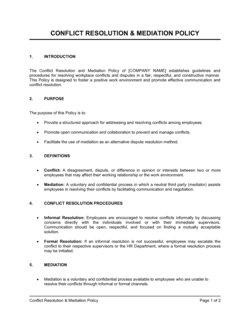
The document covers the organizational conflict philosophy, a tiered escalation framework, specific resolution strategies (negotiation, mediation, arbitration), communication protocols, documentation requirements, and post-resolution follow-up procedures.

What is a Conflict Management Strategies document?

A Conflict Management Strategies document is an operational policy and reference guide that defines how an organization identifies, escalates, and resolves workplace disputes in a structured, consistent way. It maps conflict resolution to a tiered escalation framework β€” from direct peer conversation through manager-facilitated dialogue, HR-led mediation, and formal arbitration β€” and assigns clear roles, documentation requirements, and follow-up procedures at each level. Unlike a reactive response to a single incident, a conflict management strategies document establishes the standing process that applies before, during, and after any dispute, regardless of who is involved or what triggered it.

Why You Need This Document

Without a written conflict management process, disputes are handled differently by every manager β€” some escalate too quickly, others ignore early signals until a situation becomes unmanageable, and most document nothing. The organizational cost is concrete: unresolved conflict reduces team productivity, drives up voluntary turnover, and in serious cases creates legal exposure when a complaint resurfaces months later with no paper trail to show what was done. A structured strategies document protects the organization by ensuring every dispute follows the same defensible process, equips managers with specific techniques rather than leaving them to improvise, and signals to employees that the organization takes workplace relationships seriously. This template gives you a ready-to-adapt framework that covers every stage of the conflict lifecycle β€” from early detection to post-resolution follow-up β€” in a format your team can implement without outside help.

Which variant fits your situation?

If your situation is…Use this template
Resolving a one-on-one interpersonal dispute between two employeesConflict Management Strategies
Documenting a formal employee grievance or complaintEmployee Grievance Form
Setting company-wide norms for acceptable workplace behaviorCode of Conduct Policy
Managing a specific performance or disciplinary issueEmployee Disciplinary Action Form
Documenting a formal mediation session between two partiesMediation Agreement
Building a full suite of employee relations policiesEmployee Handbook
Outlining a process for resolving disputes between business partnersDispute Resolution Policy

Common mistakes to avoid

❌ Routing harassment complaints through the general conflict process

Why it matters: Harassment and discrimination complaints require a separate, legally protected investigation process. Handling them as ordinary conflict disputes can expose the organization to regulatory liability and undermine the complainant's rights.

Fix: Explicitly exclude harassment, discrimination, and whistleblower complaints from scope and redirect employees to the dedicated policy in writing.
❌ Over-escalating minor disputes to HR

Why it matters: When managers refer every interpersonal friction to HR instead of handling Tier 1 and Tier 2 situations themselves, HR becomes a bottleneck and managers lose the trust of their teams.

Fix: Build manager capability through training and define clear criteria β€” not just 'if you feel uncomfortable' β€” for when HR involvement is actually required.

❌ Documenting only the final resolution, not the process

Why it matters: If a resolved conflict resurfaces or escalates to a legal claim, a record showing only the outcome gives the organization nothing to work with. Courts and employment tribunals look at the process, not just the result.

Fix: Require a dated log entry after every Tier 2 and above interaction, capturing what was said, what was agreed, and the follow-up timeline.

❌ Publishing the policy without training managers on it

Why it matters: A conflict management document that no one has been trained to apply is ignored when it matters most β€” during a high-stress dispute when a manager defaults to instinct rather than process.

Fix: Build a 90-minute manager training module (facilitated or self-paced) that walks through each tier, each technique, and the documentation requirement using scenario-based examples.

The 9 key sections, explained

Purpose and conflict philosophy

Scope and applicability

Conflict identification and early signals

Tiered escalation framework

Resolution strategies and techniques

Communication and documentation standards

Roles and responsibilities

Post-resolution follow-up

Training and policy review

How to fill it out

  1. 1

    Customize the purpose statement for your culture

    Replace the placeholder company name and edit the values language to reflect how your organization actually operates. Avoid generic phrases like 'we value respect' without defining what respectful behavior looks like in your context.

    πŸ’‘ Pull one or two specific behavioral examples from your existing code of conduct or values framework to make the purpose statement concrete.

  2. 2

    Define the scope and carve out exclusions

    List which employee groups are covered and explicitly name which complaint types β€” harassment, discrimination, whistleblowing β€” are handled under separate policies. Link to those policies by name.

    πŸ’‘ Have your HR lead or legal counsel confirm the exclusions before publishing. Routing a discrimination complaint through a general conflict process can create liability.

  3. 3

    Set specific timeframes for each escalation tier

    Replace the bracketed day ranges in the escalation framework with timeframes that match your organization's size and pace β€” smaller teams can move faster; larger organizations may need more buffer.

    πŸ’‘ A Tier 1 window of five business days is standard. Going beyond ten days without escalation signals the process is stalling.

  4. 4

    Select and describe two or three core resolution techniques

    Choose the approaches your managers are trained in or can realistically apply β€” typically direct negotiation, structured dialogue, and HR-facilitated mediation. Remove techniques your organization does not have the capacity to support.

    πŸ’‘ Add a one-paragraph summary of each technique in plain language. Managers should be able to explain the approach to an employee without reading from a script.

  5. 5

    Assign named roles, not just titles

    Where possible, name the specific role β€” 'People Operations Manager' rather than 'designated HR representative' β€” so employees know exactly who to contact at each tier.

    πŸ’‘ Include an org chart excerpt or contact list as an appendix if your HR structure is complex or distributed across locations.

  6. 6

    Attach a conflict log template as an appendix

    Link or embed a documentation form β€” fields for parties, date, issue summary, agreed actions, and follow-up dates β€” that managers can fill out immediately after a Tier 2 or higher discussion.

    πŸ’‘ A single-page log form doubles compliance with documentation requirements. Managers who have to build their own template skip it entirely.

  7. 7

    Set the review date and owner before publishing

    Enter the name of the policy owner (typically the HR director or Head of People) and a specific 12-month review date in the document footer before distribution.

    πŸ’‘ Calendar the review date the moment you publish. Policies with no review date drift out of alignment with organizational changes within 18 months.

Frequently asked questions

What are conflict management strategies in the workplace?

Conflict management strategies are structured approaches an organization uses to identify, address, and resolve interpersonal or team-level disputes before they damage productivity, morale, or business outcomes. Common strategies include direct negotiation, manager-facilitated dialogue, HR-led mediation, and formal arbitration β€” each appropriate at different levels of conflict intensity. A written strategies document ensures these approaches are applied consistently rather than reactively.

What should a conflict management strategies document include?

A complete document covers the organization's conflict philosophy and scope, a tiered escalation framework with specific timeframes, at least two or three resolution techniques with guidance on when to use each, documentation requirements, clearly assigned roles, and a post-resolution follow-up process. It should also explicitly exclude complaint types β€” such as harassment or discrimination β€” that require a separate process.

What is the difference between conflict management and conflict resolution?

Conflict resolution refers to reaching a specific agreement that ends a particular dispute. Conflict management is the broader organizational practice of identifying, de-escalating, and structuring how disputes are handled β€” including prevention, early intervention, and follow-up after resolution. A conflict management strategies document covers the full lifecycle, not just the moment of resolution.

When should HR get involved in a workplace conflict?

HR involvement is typically appropriate at Tier 3 β€” after the two parties have attempted direct resolution and a manager-facilitated discussion has not produced agreement. HR should be involved immediately, regardless of tier, when allegations involve potential policy violations, power imbalances, harassment, or a risk of retaliation. Routing every minor disagreement to HR weakens manager accountability and creates processing delays.

How do you document a workplace conflict?

Document the date, the parties involved, a neutral summary of each party's stated concern, the resolution steps agreed upon, the follow-up timeline, and the names of anyone present at the discussion. Store records in a secure HR system with restricted access and retain them for at least three years. Avoid language that editorializes or assigns blame β€” document facts and agreed actions only.

What is a tiered escalation framework for conflict?

A tiered escalation framework organizes conflict resolution into sequential levels of formality β€” typically Tier 1 (direct peer conversation), Tier 2 (manager-facilitated discussion), Tier 3 (HR mediation), and Tier 4 (formal arbitration or executive decision). Each tier has defined timeframes and criteria for moving to the next level. The framework prevents both under-escalation (ignoring serious disputes) and over-escalation (involving senior leadership in minor friction).

Can this template be used as part of an employee handbook?

Yes. The conflict management strategies document is designed to stand alone as a reference guide or to be embedded as a section within a broader employee handbook or HR policy manual. If embedded, link to it from the handbook's table of contents and ensure the scope and exclusions sections align with other handbook policies, particularly the harassment and grievance procedures.

How often should a conflict management policy be reviewed?

Review the policy annually or whenever a significant organizational change occurs β€” a merger, a major restructuring, rapid headcount growth, or a shift to remote or hybrid work. Remote and hybrid teams frequently experience conflict through asynchronous communication channels that existing in-person escalation frameworks do not address adequately. Assign a named policy owner who is accountable for the annual review.

What is the difference between mediation and arbitration in workplace conflict?

Mediation is a facilitated conversation in which a neutral third party helps the disputing parties reach their own agreement β€” the mediator has no decision-making authority. Arbitration involves a neutral arbitrator who hears both sides and issues a decision that may be binding or non-binding depending on the agreement. Mediation preserves relationships and is appropriate for most workplace disputes; arbitration is reserved for situations where the parties cannot reach agreement on their own.

How this compares to alternatives

vs Code of Conduct Policy

A code of conduct defines the behavioral standards all employees are expected to meet β€” it sets the rules. A conflict management strategies document defines the process for addressing situations where those standards break down between individuals. Both documents are necessary; the code of conduct is the standard, and the conflict management strategies document is the procedure for enforcing it constructively.

vs Employee Disciplinary Action Form

A disciplinary action form documents a specific policy violation and the formal consequence applied to the offending employee. Conflict management strategies cover disputes where no clear policy violation has occurred β€” just a breakdown in working relationships. Use conflict management first; escalate to disciplinary action only when a party's behavior constitutes a policy violation.

vs Employee Handbook

An employee handbook is a comprehensive reference covering all workplace policies, benefits, and expectations. Conflict management strategies can be embedded as a standalone chapter in the handbook or maintained as a separate policy document that the handbook references. A standalone document is easier to update independently when escalation procedures or contacts change.

vs Mediation Agreement

A mediation agreement is a document signed by both parties at the start or conclusion of a formal mediation session, confirming the process and any agreed resolution terms. It is a transaction-level document for a single dispute. Conflict management strategies is the organizational-level framework that specifies when and how mediation is invoked as one tool within a broader resolution process.

Industry-specific considerations

Technology / SaaS

Remote and distributed teams require asynchronous conflict detection signals β€” delayed responses, Slack tone, and missed stand-ups β€” and tiered escalation adapted to time-zone constraints.

Healthcare

High-stakes, high-stress clinical environments mean unresolved conflict directly affects patient safety, making rapid Tier 1 and Tier 2 resolution timelines critical.

Professional Services

Client-facing teams where interpersonal conflict becomes visible to clients require both internal resolution procedures and client communication protocols when disputes affect delivery.

Manufacturing

Shift-based environments with union representation require conflict management procedures that align with collective bargaining agreement grievance provisions.

Template vs pro β€” what fits your needs?

PathBest forCostTime
Use the templateHR managers and operations leaders building or standardizing conflict procedures for teams of 10–200 employeesFree2–4 hours to customize and distribute
Template + professional reviewOrganizations in regulated industries, unionized workforces, or those that have recently experienced a formal complaint or legal dispute$300–$800 for an HR consultant or employment law review3–5 business days
Custom draftedEnterprise organizations with multi-jurisdiction operations, complex union agreements, or a history of litigation requiring a legally defensible framework$2,000–$6,000 for an employment lawyer or specialized HR consultancy2–4 weeks

Glossary

Conflict Escalation
The process of moving an unresolved dispute to a higher level of authority or a more formal resolution process when initial attempts fail.
Mediation
A voluntary, structured conversation facilitated by a neutral third party who helps the disputing parties reach their own mutually acceptable resolution.
Arbitration
A formal dispute resolution process in which a neutral arbitrator hears both sides and issues a binding or non-binding decision.
Active Listening
A communication technique in which the listener fully concentrates, reflects back, and responds to what is being said rather than preparing a rebuttal.
Interests vs. Positions
A negotiation framework that distinguishes between what a party demands (position) and the underlying need driving that demand (interest) β€” resolving interests produces more durable agreements.
De-escalation
Techniques used to reduce the emotional intensity of a dispute so that productive conversation and problem-solving can occur.
Grievance
A formal complaint raised by an employee about a workplace condition, decision, or interpersonal situation that they believe violates a policy or their rights.
Restorative Practice
A conflict resolution approach focused on repairing relationships and restoring trust between parties rather than assigning blame or imposing punishment.
BATNA
Best Alternative to a Negotiated Agreement β€” the course of action a party will take if negotiations fail, which determines their minimum acceptable outcome.
Cooling-Off Period
A defined time β€” typically 24 to 72 hours β€” during which parties step back from a dispute before formal resolution begins, reducing reactive decision-making.

Part of your Business Operating System

This document is one of 3,000+ business & legal templates included in Business in a Box.

  • Fill-in-the-blanks β€” ready in minutes
  • 100% customizable Word document
  • Compatible with all office suites
  • Export to PDF and share electronically

Create your document in 3 simple steps.

From template to signed document β€” all inside one Business Operating System.
1
Download or open template

Access over 3,000+ business and legal templates for any business task, project or initiative.

2
Edit and fill in the blanks with AI

Customize your ready-made business document template and save it in the cloud.

3
Save, Share, Send, Sign

Share your files and folders with your team. Create a space of seamless collaboration.

Save time, save money, and create top-quality documents.

β˜…β˜…β˜…β˜…β˜…

"Fantastic value! I'm not sure how I'd do without it. It's worth its weight in gold and paid back for itself many times."

Managing Director Β· Mall Farm
Robert Whalley
Managing Director, Mall Farm Proprietary Limited
β˜…β˜…β˜…β˜…β˜…

"I have been using Business in a Box for years. It has been the most useful source of templates I have encountered. I recommend it to anyone."

Business Owner Β· 4+ years
Dr Michael John Freestone
Business Owner
β˜…β˜…β˜…β˜…β˜…

"It has been a life saver so many times I have lost count. Business in a Box has saved me so much time and as you know, time is money."

Owner Β· Upstate Web
David G. Moore Jr.
Owner, Upstate Web

Run your business with a system β€” not scattered tools

Stop downloading documents. Start operating with clarity. Business in a Box gives you the Business Operating System used by over 250,000 companies worldwide to structure, run, and grow their business.

Free Forever PlanΒ Β·Β No credit card required