Complaint Policy Template

Free Word download β€’ Edit online β€’ Save & share with Drive β€’ Export to PDF

4 pagesβ€’20–30 min to fillβ€’Difficulty: Standard
Learn more ↓
FreeComplaint Policy Template

At a glance

What it is
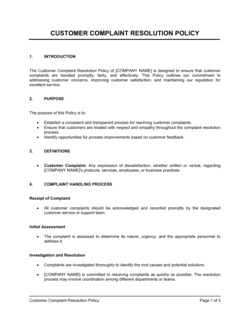
A Complaint Policy is a formal internal document that defines how an organization receives, logs, investigates, escalates, resolves, and reports on complaints from customers, clients, or stakeholders. This free Word download gives you a structured, editable starting point you can tailor to your industry and export as PDF for staff training or regulatory submission.
When you need it
Use it when launching a new business, responding to a regulator's request for a documented complaints process, or standardizing an inconsistent approach that is generating repeat complaints or staff confusion.
What's inside
Policy purpose and scope, complaint intake channels, logging and tracking requirements, investigation procedures, escalation thresholds, response-time standards, resolution and closure rules, root-cause review expectations, and reporting and governance requirements.

What is a Complaint Policy?

A Complaint Policy is a formal operational document that defines how an organization receives, logs, investigates, escalates, resolves, and reports on complaints from customers, clients, or stakeholders. It establishes measurable response-time standards at each stage of the process, assigns clear roles and responsibilities, and creates the governance structure needed to handle complaints consistently and fairly. Unlike an informal customer service guideline, a complaint policy creates an auditable framework with defined triggers for escalation and root-cause review β€” functions that regulators, auditors, and senior leadership can inspect and measure against.

Why You Need This Document

Without a documented complaint policy, every complaint is handled differently depending on who picks it up, and the organization has no defensible record of how it responded. Dissatisfied customers escalate faster to regulators and review platforms when they receive inconsistent or delayed responses β€” both of which a policy directly prevents by setting binding internal standards. In regulated industries including financial services, healthcare, and utilities, the absence of a written complaints process is itself a compliance failure that can trigger enforcement action independent of any individual complaint outcome. A formal policy also converts complaint data from a liability into an operational asset: when every complaint is logged in a structured register and reviewed for root causes, recurring process failures surface early enough to fix before they generate further complaints, refund exposure, or reputational damage. This template gives you the structure to go from zero to a workable policy in a single editing session.

Which variant fits your situation?

If your situation is…Use this template
Handling complaints from retail or e-commerce customersCustomer Complaint Policy
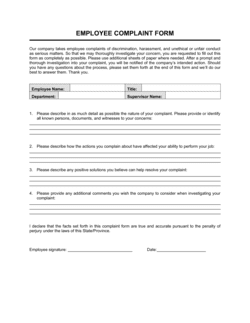
Managing employee grievances and internal disputesEmployee Grievance Policy
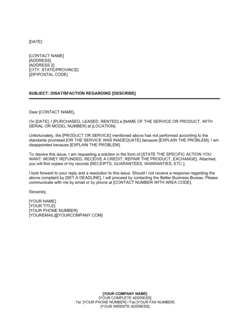
Responding to a specific customer complaint in writingCustomer Complaint Response Letter
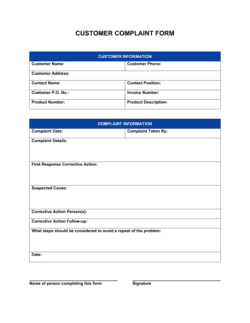
Documenting an individual complaint for investigation trackingComplaint Form
Satisfying financial services or healthcare regulatory requirementsRegulatory Complaint Handling Policy
Capturing and escalating complaints across a franchise networkFranchise Complaint Policy
Setting out a refund and returns dispute processRefund and Returns Policy

Common mistakes to avoid

❌ No named owner for each intake channel

Why it matters: Complaints sent to an unmonitored email address or phone line sit unacknowledged, breaching your own response-time standards and frustrating complainants into regulatory referrals.

Fix: Assign a specific role β€” not a team or department β€” to monitor each intake channel and confirm coverage during holidays and absences.

❌ Logging complaints in email threads instead of a structured register

Why it matters: Without a central log, you cannot report on volumes, track resolution times, or identify systemic issues β€” all of which regulators and auditors will ask for.

Fix: Choose one system β€” even a simple spreadsheet with defined fields β€” and make logging within one business day a non-negotiable step in the policy.

❌ Setting response-time targets below regulatory minimums

Why it matters: If your policy promises a 30-day final response but the applicable regulation requires 15 days, your policy creates a compliance gap on the face of the document.

Fix: Check the specific regulatory requirements for your industry and jurisdiction before entering any time standard, and build in a buffer of at least two business days.

❌ Closing complaints before the complainant has responded

Why it matters: Closing a case the moment a resolution letter is sent β€” without allowing time for the complainant to accept or contest it β€” can result in the same issue being re-raised as a new complaint and inflates your closure rate artificially.

Fix: Build a minimum five-business-day response window into your closure procedure and only mark the case closed once the window has lapsed with no further contact.

The 9 key sections, explained

Purpose and scope

Complaint intake channels

Logging and tracking requirements

Acknowledgement standards

Investigation procedure

Escalation thresholds and procedure

Resolution, redress, and closure

Root-cause analysis and continuous improvement

Reporting and governance

How to fill it out

  1. 1

    Define the scope and who is covered

    Specify which complaint types (customer, employee, supplier) the policy governs and which departments or locations are bound by it. Be explicit β€” if certain business units are excluded, state why.

    πŸ’‘ A narrowly scoped policy is better than an overly broad one no one follows. Start with customer complaints and expand scope in the next review cycle.

  2. 2

    List and assign all intake channels

    Enter every channel through which complaints can be received β€” email, phone, web form, post, in-person β€” and assign a named role or team responsible for monitoring each one.

    πŸ’‘ Test every intake channel before publishing the policy. A broken web form or unmanned email inbox creates a compliance gap on day one.

  3. 3

    Set your response-time standards

    Define the maximum number of business days for acknowledgement, investigation completion, and final response. Confirm these meet any regulatory minimums that apply to your industry.

    πŸ’‘ Industry-specific regulations β€” financial services, healthcare, utilities β€” often mandate specific response windows. Check these before entering your own targets.

  4. 4

    Document the investigation steps

    Write out the specific actions a handler must take: which records to review, who to interview, what to document, and whose approval is required before the response is issued.

    πŸ’‘ Give new handlers a one-page investigation checklist drawn from this section β€” it cuts training time and reduces inconsistency in outcomes.

  5. 5

    Define escalation triggers precisely

    Enter specific, measurable conditions for escalation β€” elapsed days, complaint category, dollar threshold, or complainant request β€” so frontline staff can apply the rule without judgment calls.

    πŸ’‘ Pilot the escalation thresholds for 30 days after launch and adjust if more than 20% of complaints are triggering escalation β€” that signals the thresholds are too low.

  6. 6

    Set the root-cause analysis threshold

    Enter the number of same-category complaints within a set period that triggers a root-cause review, the timeframe to complete it, and the role accountable for submitting the corrective action plan.

    πŸ’‘ Start with a threshold of three complaints in 30 days for a small team. Adjust upward as volume grows to avoid triggering reviews for statistical noise.

  7. 7

    Configure reporting cadence and governance

    Decide how frequently complaint summaries are reported (monthly is standard), which metrics are included, and who receives and acts on the report. Name the role accountable for annual policy review.

    πŸ’‘ Add complaint volume and average resolution time as standing agenda items in your monthly operations meeting β€” visibility drives accountability faster than any policy clause.

  8. 8

    Communicate and train before go-live

    Share the final policy with all in-scope staff before the effective date, run a short briefing on the intake and logging steps, and confirm the complaint log is set up and accessible.

    πŸ’‘ A policy no one knows exists offers no protection. Keep the briefing to 30 minutes and focus on the three steps staff will use every week: intake, logging, and acknowledgement.

Frequently asked questions

What is a complaint policy?

A complaint policy is a formal document that defines how an organization receives, records, investigates, escalates, resolves, and reports on complaints from customers, clients, or stakeholders. It sets response-time standards, assigns roles and responsibilities, and creates the governance structure needed to handle complaints consistently and fairly. Many regulated industries require a documented complaints policy as a condition of operating.

Who needs a complaint policy?

Any organization that receives complaints β€” which is effectively every business β€” benefits from a formal policy. It is particularly important for financial services firms, healthcare providers, utilities, and professional services businesses operating under sector-specific regulations that mandate documented complaint-handling procedures. Small businesses benefit too: a clear policy reduces staff inconsistency and protects the organization if a complaint escalates to a regulator or court.

What response times should a complaint policy include?

Standard targets for most industries are: acknowledgement within 2 business days of receipt, investigation completion within 10 business days, and a final written response within 20 business days. Financial services firms in the UK, US, and EU are subject to shorter mandatory windows β€” often 3 days for acknowledgement and 15–35 days for final response depending on the regulator. Always confirm the applicable regulatory minimum before setting internal targets.

What is the difference between a complaint policy and a complaints procedure?

A complaint policy states the organization's commitment, principles, and governance framework for complaint handling β€” the 'what' and 'why.' A complaints procedure is the step-by-step operational guide staff follow to handle each complaint β€” the 'how.' In practice, many organizations combine both in a single document, which is the approach this template takes. Larger organizations may separate them so the policy can be published externally while the procedure remains an internal operational guide.

Does a complaint policy need to be approved by a regulator?

In most industries, formal regulator approval is not required, but the policy must meet the regulatory standards that apply to your sector. Financial services firms regulated by the FCA, CFPB, or equivalent bodies are typically required to have a documented complaints process that meets specific standards, and regulators may review it during an inspection. Healthcare providers and utilities face similar requirements in many jurisdictions. A legal or compliance review is advisable if your business operates in a regulated sector.

How often should a complaint policy be reviewed?

Annual review is the standard in most organizations. You should also trigger an out-of-cycle review if complaint volumes increase significantly, if a systemic issue is identified through root-cause analysis, if your regulatory environment changes, or if the policy fails during a specific incident. The policy should name the role accountable for the annual review and set a fixed calendar date for it.

What data should a complaint log capture?

At minimum: a unique complaint reference number, date received, complainant name and contact details, complaint category, a brief description, the assigned handler, current status, key milestone dates (acknowledged, investigation complete, response sent), outcome or redress offered, and closure date. Capturing category consistently is the most important field for identifying systemic issues β€” free-text descriptions cannot be aggregated for trend analysis.

What is root-cause analysis in the context of complaints?

Root-cause analysis is a structured review of why a complaint occurred, aimed at identifying and fixing the underlying process failure rather than just resolving the individual case. In a complaints context, it is typically triggered when a set number of complaints in a defined period share a common category or cause. The output is a corrective action plan assigned to a specific owner with a completion deadline β€” not just a note in a meeting's minutes.

Can employees use the complaint policy for internal grievances?

It depends on how the policy is scoped. Some organizations use a single policy covering both customer and employee complaints; others maintain separate documents β€” a complaint policy for external stakeholders and an employee grievance policy for internal matters. If your organization handles both through one policy, the scope section must explicitly state this and the escalation paths must distinguish between customer and employee complaint routes.

How this compares to alternatives

vs Customer Service Policy

A customer service policy sets the standards for how staff interact with customers day-to-day β€” tone, response times for general enquiries, and service commitments. A complaint policy is a narrower, more formal document triggered specifically when dissatisfaction is expressed and a resolution is required. The two documents are complementary: the service policy prevents complaints; the complaint policy handles them when they arise.

vs Refund and Returns Policy

A refund and returns policy governs a specific category of customer dissatisfaction β€” product returns, exchanges, and refunds β€” with defined eligibility and process rules. A complaint policy is broader, covering any expression of dissatisfaction including service failures, staff conduct, billing errors, and regulatory complaints. Many complaints result in a refund; not all refunds constitute a formal complaint.

vs Employee Grievance Policy

An employee grievance policy handles complaints raised by staff about their employment β€” working conditions, manager conduct, or policy breaches. A complaint policy typically addresses external stakeholders: customers, clients, or the public. Some smaller organizations use a single document for both, but regulated industries usually require separate policies with distinct escalation paths.

vs Incident Report

An incident report documents a specific operational event β€” an accident, system failure, or safety breach β€” immediately after it occurs. A complaint policy governs the ongoing process of receiving and resolving dissatisfaction that may or may not be linked to an incident. Serious incidents often generate complaints, and the two documents should cross-reference each other so cases are handled in both systems simultaneously.

Industry-specific considerations

Financial services

Regulated response windows, mandatory FCA or CFPB reporting, Financial Ombudsman referral rights, and complaint data used in product governance reviews.

Healthcare

Patient complaint pathways aligned to CQC or Joint Commission standards, clinical incident integration, and mandatory reporting thresholds for serious complaints.

Retail and e-commerce

High volume, multi-channel intake, refund and returns integration, chargeback dispute linkage, and consumer protection law compliance.

Professional services

Client complaint handling required by professional bodies (law societies, accounting institutes), fee dispute procedures, and reputational risk management.

Education

Student and parent complaint channels, regulatory body reporting requirements, safeguarding escalation paths, and academic appeals integration.

Construction and trades

Defect and workmanship complaints, subcontractor dispute escalation, warranty claim integration, and adjudication referral rights under construction contracts.

Template vs pro β€” what fits your needs?

PathBest forCostTime
Use the templateSmall and mid-sized businesses in non-regulated industries establishing a first formal complaints processFree2–4 hours
Template + professional reviewBusinesses in regulated sectors β€” financial services, healthcare, utilities β€” where the policy must meet specific regulatory standards$300–$800 for a compliance or legal review1–3 days
Custom draftedLarge organizations with complex multi-channel complaint operations, ombudsman referral obligations, or multi-jurisdiction regulatory requirements$1,500–$5,000+2–4 weeks

Glossary

Complaint
An expression of dissatisfaction from a customer, client, or stakeholder about a product, service, or staff interaction that requires a formal response.
Acknowledgement
A written or verbal confirmation to the complainant that their complaint has been received and is being processed, issued within a defined timeframe.
Escalation
The transfer of a complaint to a higher authority or specialist team when it cannot be resolved at the frontline level within the defined timeframe.
Root-Cause Analysis
A structured review of why a complaint occurred, aimed at identifying and correcting the underlying process failure rather than just resolving the individual case.
Response Time Standard
The maximum number of business days within which each stage of the complaints process β€” acknowledgement, investigation, and final response β€” must be completed.
Closure
The formal conclusion of a complaint, recorded in the log once a resolution has been communicated and either accepted or escalated by the complainant.
Complaint Log
A centralized register recording every complaint received, its category, status, assigned owner, key dates, and outcome.
Ombudsman
An independent third-party dispute resolution body that a complainant may refer to if they remain dissatisfied after exhausting the organization's internal process.
Redress
The remedy offered to a complainant β€” such as a refund, replacement, apology, or service credit β€” to resolve the complaint to their satisfaction.
Systemic Complaint
A recurring pattern of complaints pointing to a shared root cause, requiring a policy or process change rather than case-by-case resolution.

Part of your Business Operating System

This document is one of 3,000+ business & legal templates included in Business in a Box.

  • Fill-in-the-blanks β€” ready in minutes
  • 100% customizable Word document
  • Compatible with all office suites
  • Export to PDF and share electronically

Create your document in 3 simple steps.

From template to signed document β€” all inside one Business Operating System.
1
Download or open template

Access over 3,000+ business and legal templates for any business task, project or initiative.

2
Edit and fill in the blanks with AI

Customize your ready-made business document template and save it in the cloud.

3
Save, Share, Send, Sign

Share your files and folders with your team. Create a space of seamless collaboration.

Save time, save money, and create top-quality documents.

β˜…β˜…β˜…β˜…β˜…

"Fantastic value! I'm not sure how I'd do without it. It's worth its weight in gold and paid back for itself many times."

Managing Director Β· Mall Farm
Robert Whalley
Managing Director, Mall Farm Proprietary Limited
β˜…β˜…β˜…β˜…β˜…

"I have been using Business in a Box for years. It has been the most useful source of templates I have encountered. I recommend it to anyone."

Business Owner Β· 4+ years
Dr Michael John Freestone
Business Owner
β˜…β˜…β˜…β˜…β˜…

"It has been a life saver so many times I have lost count. Business in a Box has saved me so much time and as you know, time is money."

Owner Β· Upstate Web
David G. Moore Jr.
Owner, Upstate Web

Run your business with a system β€” not scattered tools

Stop downloading documents. Start operating with clarity. Business in a Box gives you the Business Operating System used by over 250,000 companies worldwide to structure, run, and grow their business.

Start freeΒ Β·Β No credit card required