Grievance Policy Template

Free Word download β€’ Edit online β€’ Save & share with Drive β€’ Export to PDF

1 pageβ€’20–25 min to fillβ€’Difficulty: Standard
Learn more ↓
FreeGrievance Policy Template

At a glance

What it is
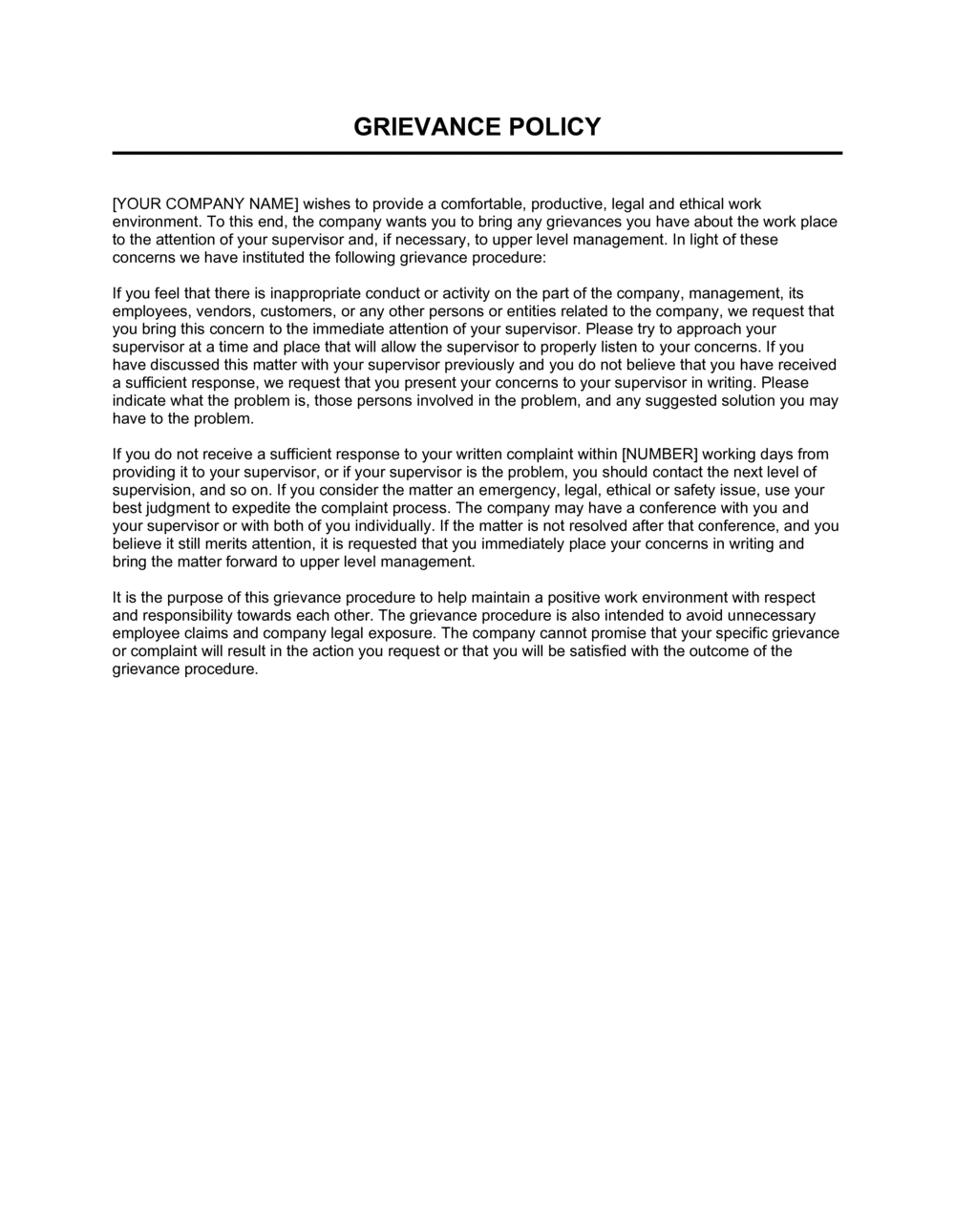
A Grievance Policy is an internal HR document that defines how an organization receives, investigates, and resolves formal employee complaints in a consistent and documented way. This free Word download gives you a ready-to-edit template covering every stage from initial complaint intake through final resolution and record retention.
When you need it
Use it when establishing or updating your employee handbook, when preparing for a workforce audit or regulatory inspection, or after a complaint incident reveals that your current process is informal and inconsistent.
What's inside
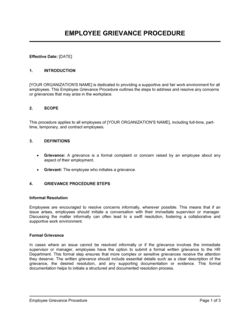
Policy purpose and scope, definitions of a grievance, step-by-step complaint procedures, roles and responsibilities for HR and management, confidentiality obligations, timelines for each stage, escalation and appeals process, anti-retaliation protections, and record-keeping requirements.

What is a Grievance Policy?

A Grievance Policy is an internal HR document that defines the formal process employees follow to raise a workplace complaint and the steps the organization takes to investigate and resolve it. It establishes who receives complaints, how investigations are conducted, what timelines apply at each stage, and how decisions β€” including appeals β€” are communicated in writing. By creating a consistent, documented procedure, the policy ensures that every complaint is handled by the same standard regardless of which manager, department, or HR staff member is involved.

Why You Need This Document

Without a written grievance policy, complaints are handled informally and inconsistently β€” outcomes depend on the individual manager's judgment rather than a fair, repeatable process. That inconsistency creates legal exposure: courts and labor tribunals in most jurisdictions treat the absence of a documented grievance procedure as evidence that the employer failed to take reasonable steps to address workplace issues. Practically, unresolved or poorly handled complaints escalate to external bodies, generate constructive dismissal claims, and damage retention across the broader team when employees see that raising concerns leads nowhere. A well-structured grievance policy closes these gaps by giving employees a credible channel, giving HR a defensible process, and giving the organization the documentation trail it needs if a complaint ever reaches litigation.

Which variant fits your situation?

If your situation is…Use this template
Handling complaints specifically about harassment or discriminationAnti-Harassment Policy
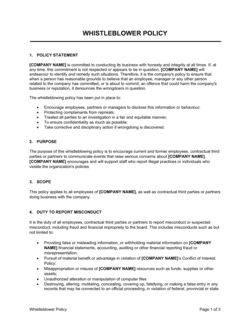
Reporting suspected fraud, safety violations, or legal misconductWhistleblower Policy
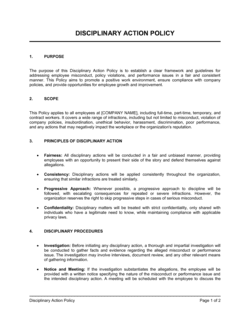
Managing a formal disciplinary process for employee misconductDisciplinary Action Policy
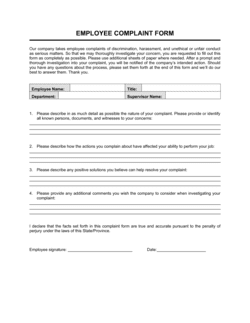
Documenting a specific complaint or incident for an employee fileEmployee Complaint Form
Communicating the grievance process inside the employee handbookEmployee Handbook
Resolving a dispute between two employees through a neutral third partyMediation Agreement
Documenting the outcome of a formal grievance investigationEmployee Warning Letter

Common mistakes to avoid

❌ Leaving timelines as aspirational rather than binding

Why it matters: When HR consistently misses non-binding deadlines, employees lose confidence in the process and are more likely to escalate externally to labor boards or employment tribunals.

Fix: Replace language like 'as soon as possible' with specific working-day counts at every stage and designate who is accountable for tracking them.

❌ Allowing the direct manager to investigate a complaint about themselves

Why it matters: A manager investigating a grievance in which they are the respondent creates an obvious conflict of interest and invalidates the investigation in the eyes of the grievant and any external reviewer.

Fix: Name an independent investigator β€” a different HR staff member, a senior manager outside the reporting line, or an external HR consultant β€” in the policy's roles section.

❌ Promising complete confidentiality

Why it matters: Investigations require disclosing the nature of the complaint to the respondent and witnesses; promising otherwise sets an expectation the organization cannot meet and damages credibility when disclosure happens.

Fix: Use language like 'information will be shared only on a need-to-know basis' rather than promising absolute confidentiality.

❌ Omitting an anti-retaliation clause

Why it matters: Without an explicit prohibition, employees who experience adverse treatment after filing a complaint have no internal policy to cite β€” increasing the likelihood of an external complaint and potential legal liability.

Fix: Add a dedicated anti-retaliation section that defines prohibited conduct, names consequences for violations, and provides an alternative reporting channel if the retaliation involves the employee's own manager.

❌ Storing grievance records in the general personnel file

Why it matters: Mixing grievance records with performance and compensation data means future managers reviewing the file may form biased impressions of an employee who raised a good-faith complaint.

Fix: Maintain grievance records in a separate, access-controlled file within your HR system, restricted to those directly involved in case management.

❌ Failing to communicate the policy to existing employees after adoption

Why it matters: A policy that employees do not know exists provides no procedural protection and does not meet the 'reasonable steps' defense available in many jurisdictions when harassment or discrimination claims arise.

Fix: Issue the policy to all staff on adoption, obtain acknowledgment receipts, and include it in onboarding materials for every new hire thereafter.

The 10 key sections, explained

Purpose and scope

Definition of a grievance

Informal resolution step

Formal complaint submission

Investigation process

Roles and responsibilities

Timeline and decision

Appeals process

Confidentiality and anti-retaliation

Record retention and documentation

How to fill it out

  1. 1

    Confirm scope and covered population

    Define which employee categories the policy covers β€” full-time, part-time, contractors, and temporary workers. Clarify which complaint types fall under this policy and which are handled by separate procedures such as anti-harassment or disciplinary policies.

    πŸ’‘ Cross-reference your disciplinary and anti-harassment policies before finalizing scope to eliminate overlap and close procedural gaps.

  2. 2

    Set timelines for each procedural stage

    Enter specific working-day counts for acknowledgment, investigation, decision, and appeal at each bracketed placeholder. Timelines should be realistic for your HR team's capacity β€” aspirational deadlines you routinely miss are worse than slightly longer ones you keep.

    πŸ’‘ Three to five working days for acknowledgment, fifteen for investigation, and ten for appeal resolution are widely accepted benchmarks for organizations of 50–500 employees.

  3. 3

    Assign named roles or job titles to each responsibility

    Replace generic role references with the specific job titles or names of the people who will receive complaints, conduct investigations, and issue decisions. If your organization is small, one person may hold multiple roles β€” document this explicitly.

    πŸ’‘ Designate a backup investigator in case the primary HR contact is the subject of the grievance or is on leave when a complaint is filed.

  4. 4

    Customize the appeals authority

    Name the person or body that hears appeals β€” this must be someone more senior than the original decision-maker and independent of the investigation. For small organizations, consider naming an external HR consultant as the final appellate authority.

    πŸ’‘ An external appellate authority increases perceived fairness and reduces the risk that an employee escalates to a labor tribunal claiming internal bias.

  5. 5

    Draft or attach the grievance submission form

    Create a simple form as Appendix A that captures the grievant's name, date, description of the issue, witnesses, and desired outcome. Reference the form explicitly in the formal submission section of the policy.

    πŸ’‘ A structured submission form prevents ambiguous complaints and gives the investigator a clear scope before the first interview.

  6. 6

    Add confidentiality and anti-retaliation language specific to your jurisdiction

    Review the confidentiality and anti-retaliation sections with your jurisdiction's employment standards in mind. Some provinces and countries require specific statutory language around protected disclosures and whistleblower rights.

    πŸ’‘ If your organization operates in multiple countries, create jurisdiction-specific addenda rather than trying to address all variations in a single policy body.

  7. 7

    Integrate with the employee handbook and communicate to staff

    Cross-reference the grievance policy in your employee handbook and communicate the policy to all staff when it is introduced or materially updated. Require acknowledgment signatures or confirmed email receipt.

    πŸ’‘ An undistributed policy provides no protection β€” courts and labor tribunals routinely ask whether the employee was aware of the procedure.

  8. 8

    Schedule an annual review date

    Add a 'Next Review Date' field at the top of the policy and assign an owner responsible for updating it. Regulatory changes, workforce growth, or a significant grievance case can all make the existing policy obsolete quickly.

    πŸ’‘ Tie the annual policy review to a specific HR calendar event β€” such as the start of the fiscal year or an annual employment law audit β€” so it does not get skipped.
Frequently asked questions

What is a grievance policy?

A grievance policy is an internal HR document that defines the formal process employees must follow to raise a workplace complaint and the steps the organization will take to investigate and resolve it. It covers who receives complaints, how investigations are conducted, what timelines apply, and how decisions are communicated. A written policy ensures complaints are handled consistently regardless of which manager or HR staff member is involved.

Why do organizations need a grievance policy?

Without a written grievance policy, complaints are handled differently depending on the manager involved β€” creating inconsistency, perceived bias, and legal exposure. In many jurisdictions, having a documented grievance procedure is a factor courts and labor tribunals consider when evaluating whether an employer took reasonable steps to address workplace issues. A clear policy also reduces the likelihood of informal complaints escalating into formal external claims.

What is the difference between a grievance policy and a disciplinary policy?

A grievance policy is employee-initiated β€” it gives employees a formal channel to raise complaints about working conditions, management conduct, or policy application. A disciplinary policy is employer-initiated β€” it defines how the organization addresses employee misconduct or performance failures. The two policies can be triggered simultaneously but should remain procedurally separate to avoid conflicts of interest.

Who should investigate a grievance?

The investigator should be someone independent of both the grievant and the respondent β€” typically an HR manager, a senior manager outside the relevant reporting line, or an external HR consultant for small organizations. The investigator must not have a pre-existing personal or professional relationship with either party that could reasonably appear to affect their impartiality.

How long should a grievance investigation take?

A standard timeline is 3 working days for acknowledgment, 15 working days for investigation and initial decision, and 10 working days for an appeal decision β€” totaling approximately 28 working days end-to-end for complex cases. Simpler complaints can be resolved faster. The key is that timelines are written into the policy as binding commitments rather than aspirational targets.

Do employees have a right to be accompanied during a grievance meeting?

In the United Kingdom, employees have a statutory right to be accompanied by a colleague or trade union representative at formal grievance hearings under the Employment Relations Act 1999. In the United States and Canada, there is no universal statutory right to accompaniment for non-union employees, though many organizations permit it as a matter of fairness. Review applicable employment standards for your jurisdiction before finalizing this section of the policy.

What records should be kept after a grievance is resolved?

Retain the original written complaint, all interview notes, any witness statements, the investigator's findings, the formal written decision, any corrective actions taken, and the outcome of any appeal. Store these separately from the general personnel file and retain them for a minimum of five years β€” longer if the matter relates to discrimination or harassment, which may carry extended limitation periods for legal claims.

Can an employee be disciplined for filing a grievance?

No. Employees who raise a grievance in good faith must be protected from any adverse action as a result of filing β€” this is the anti-retaliation principle. Retaliating against a grievant is itself a disciplinary matter and, in many jurisdictions, a separate legal violation. The policy should explicitly state this protection and provide an alternative reporting channel in case the retaliation comes from the employee's own manager.

How often should a grievance policy be reviewed?

At minimum, review the policy annually and whenever relevant employment legislation changes in your operating jurisdiction. A significant grievance case that reveals a gap in the current procedure is also a trigger for an immediate targeted review. Assign a named policy owner who is accountable for initiating reviews on schedule.

How this compares to alternatives

vs Disciplinary Action Policy

A disciplinary policy is initiated by the employer to address employee misconduct or poor performance. A grievance policy is initiated by an employee to raise a complaint about their treatment or working conditions. The two procedures can run concurrently but must remain procedurally separate β€” using the same process for both creates conflicts of interest and procedural unfairness claims.

vs Whistleblower Policy

A whistleblower policy covers reports of suspected illegal activity, fraud, safety violations, or regulatory breaches β€” often allowing anonymous disclosure and providing heightened legal protection. A grievance policy handles interpersonal or employment-related complaints that do not necessarily involve unlawful conduct. Complaints that start as grievances sometimes escalate to whistleblower disclosures; having both policies clearly delineated prevents procedural confusion.

vs Employee Complaint Form

A grievance policy is the governing framework β€” it defines the entire complaint-handling process, roles, timelines, and protections. An employee complaint form is the intake document an employee completes to initiate that process. The form is a component of the policy, not a substitute for it; without the policy, the completed form has no defined procedure attached to it.

vs Employee Handbook

An employee handbook is a broad reference document covering all major employment policies, including the grievance procedure as a summary section. A standalone grievance policy provides the full procedural detail β€” timelines, investigation steps, appeal rights, and record-keeping requirements β€” that a handbook summary cannot accommodate. Both documents should exist and cross-reference each other.

Industry-specific considerations

Professional services

Partnership structures and client-facing teams create elevated risk of complaints about billing pressure, unequal opportunity, and management favoritism that require a neutral, documented process.

Healthcare

Complaints about rostering, supervision, and patient safety concerns must be handled through a process that satisfies both employment standards and clinical governance requirements.

Manufacturing

Shift-based workforces with union agreements require a grievance policy that aligns with collective bargaining terms and respects steward representation rights.

Retail and hospitality

High staff turnover and variable scheduling create frequent complaints about rota fairness, tip allocation, and supervisory conduct that benefit from a fast-track informal resolution step.

SaaS and technology

Remote and hybrid workforces mean complaints often arise asynchronously across time zones, requiring clear digital submission channels and virtual investigation procedures.

Education

Schools and universities must balance staff grievance rights with safeguarding obligations, often requiring complaints involving students to be routed through parallel child-protection procedures.

Template vs pro β€” what fits your needs?

PathBest forCostTime
Use the templateSmall and mid-size organizations establishing a first formal grievance procedureFree2–4 hours to customize and distribute
Template + professional reviewOrganizations operating across multiple jurisdictions or with union agreements$300–$800 for an HR consultant or employment lawyer review3–5 days
Custom draftedLarge enterprises, regulated industries, or organizations with complex collective bargaining obligations$1,500–$5,000+2–4 weeks

Glossary

Grievance
A formal complaint raised by an employee about a workplace issue, policy application, or interpersonal conflict that they believe has not been resolved informally.
Grievant
The employee who files the formal complaint and is the subject of the grievance procedure.
Respondent
The individual β€” manager, colleague, or the organization itself β€” against whom the grievance is directed.
Informal Resolution
A first-step attempt to resolve a complaint through direct conversation between the parties, without triggering the formal grievance procedure.
Escalation
The process of moving an unresolved or complex grievance to a higher level of authority β€” typically from line manager to HR director or senior leadership.
Anti-Retaliation Protection
A policy commitment preventing any adverse action against an employee for having filed a grievance in good faith.
Adjudicator
The designated person or panel responsible for reviewing the evidence and issuing a formal written decision on the grievance.
Appeals Stage
A defined opportunity for either party to request review of the initial grievance decision by a more senior authority or independent party.
Record Retention
The organization's obligation to store grievance records β€” including the complaint, investigation notes, and outcome β€” for a defined period, typically three to seven years.
Natural Justice
The principle that both parties in a grievance must receive a fair hearing, be informed of allegations against them, and have a reasonable opportunity to respond.

Part of your Business Operating System

This document is one of 3,000+ business & legal templates included in Business in a Box.

  • Fill-in-the-blanks β€” ready in minutes
  • 100% customizable Word document
  • Compatible with all office suites
  • Export to PDF and share electronically

Create your document in 3 simple steps.

From template to signed document β€” all inside one Business Operating System.
1
Download or open template

Access over 3,000+ business and legal templates for any business task, project or initiative.

2
Edit and fill in the blanks with AI

Customize your ready-made business document template and save it in the cloud.

3
Save, Share, Send, Sign

Share your files and folders with your team. Create a space of seamless collaboration.

Save time, save money, and create top-quality documents.

β˜…β˜…β˜…β˜…β˜…

"Fantastic value! I'm not sure how I'd do without it. It's worth its weight in gold and paid back for itself many times."

Managing Director Β· Mall Farm
Robert Whalley
Managing Director, Mall Farm Proprietary Limited
β˜…β˜…β˜…β˜…β˜…

"I have been using Business in a Box for years. It has been the most useful source of templates I have encountered. I recommend it to anyone."

Business Owner Β· 4+ years
Dr Michael John Freestone
Business Owner
β˜…β˜…β˜…β˜…β˜…

"It has been a life saver so many times I have lost count. Business in a Box has saved me so much time and as you know, time is money."

Owner Β· Upstate Web
David G. Moore Jr.
Owner, Upstate Web

Run your business with a system β€” not scattered tools

Stop downloading documents. Start operating with clarity. Business in a Box gives you the Business Operating System used by over 250,000 companies worldwide to structure, run, and grow their business.

Start freeΒ Β·Β No credit card required