Collection Letter Offering Additional Discount Template

Free Word download β€’ Edit online β€’ Save & share with Drive β€’ Export to PDF

1 pageβ€’15–20 min to fillβ€’Difficulty: Standard
Learn more ↓
FreeCollection Letter Offering Additional Discount Template

At a glance

What it is
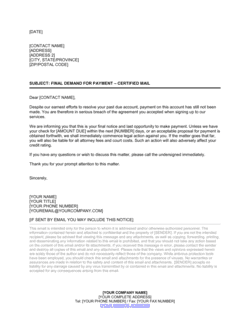
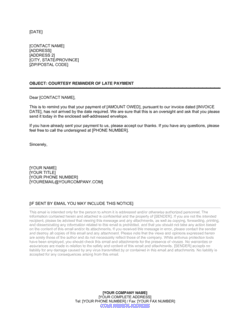
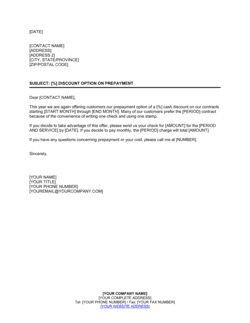
A Collection Letter Offering Additional Discount is a formal business letter sent to a customer with an overdue balance, offering a reduced settlement amount in exchange for prompt payment. This free Word download is fully editable β€” insert your company details, the outstanding amount, the discount percentage, and the payment deadline β€” then export as PDF and send in minutes.
When you need it
Use it when a customer's account is significantly past due, prior collection notices have gone unanswered, and you want to recover a meaningful portion of the balance without escalating to a collection agency or legal action. It is especially effective when preserving the customer relationship still has commercial value.
What's inside
A professional opening referencing the overdue account, a clear statement of the original balance and the discounted settlement amount, a firm deadline for the offer, accepted payment methods, and a courteous but direct closing that outlines next steps if the offer is not accepted.

What is a Collection Letter Offering Additional Discount?

A Collection Letter Offering Additional Discount is a formal business letter sent by a creditor to a customer with an overdue balance, proposing a reduced settlement amount in exchange for prompt, lump-sum payment by a stated deadline. Rather than demanding the full outstanding amount, the letter acknowledges the collection difficulty and offers a specific dollar reduction β€” typically 10–35% β€” as an incentive for the debtor to act immediately. The letter documents the original balance, the discounted settlement figure, the expiration date of the offer, accepted payment methods, and the escalation steps that will follow if the offer is not accepted.

Why You Need This Document

Leaving overdue accounts unresolved has a direct cost: every month an invoice ages, the statistical likelihood of collecting the full amount drops, and the expense of pursuing it through an agency or court rises. A collection letter offering a discount gives you a structured, professional way to recover a meaningful portion of the debt quickly β€” often for less than the commission a collection agency would charge on the same balance. Without a written record of the offer, any verbal agreement to settle for less is difficult to enforce, and disputes over what was agreed are common. This template ensures the terms are explicit and documented, protects you if the debtor later disputes whether the account was resolved, and presents your business as professional and solution-oriented rather than adversarial β€” which matters if there is any chance of resuming the commercial relationship after the debt is cleared.

Which variant fits your situation?

If your situation is…Use this template
First notice for a recently past-due balanceFirst Collection Letter
Second reminder with no discount, firmer toneSecond Collection Letter
Final demand before legal or agency escalationFinal Collection Letter
Negotiating a structured multi-payment settlement planPayment Plan Agreement
Formal demand letter from a legal representativeDemand Letter for Payment
Acknowledging receipt of a partial payment on an overdue accountPayment Acknowledgment Letter

Common mistakes to avoid

❌ Omitting the original balance before the discount

Why it matters: Showing only the settlement amount obscures the value of the offer and gives the debtor no anchor for how much they are saving, reducing the incentive to act quickly.

Fix: Always state the full original balance and the discounted settlement amount side by side so the savings figure is explicit.
❌ No firm expiration date on the offer

Why it matters: An open-ended offer removes all urgency and allows the debtor to delay indefinitely while still expecting the discount to apply weeks later.

Fix: Set a specific calendar date β€” typically 7–14 days from the send date β€” and repeat it in both the offer and the consequences paragraph.

❌ Making escalation threats you will not act on

Why it matters: If you threaten legal action or agency referral and then send another discount letter instead, the debtor learns your threats are empty and becomes harder to collect from.

Fix: Only include escalation language you are genuinely prepared to follow through on, and have the next step β€” referral or filing β€” ready to execute on the deadline date.

❌ Sending to the wrong contact at the company

Why it matters: A collection letter sent to the project manager or salesperson instead of accounts payable may never reach the person authorized to release payment, adding weeks of delay.

Fix: Confirm the accounts-payable contact name and email before sending. For larger accounts, call ahead to confirm the correct recipient.

The 8 key clauses, explained

Sender and recipient information

In plain language: Identifies both parties β€” the creditor's business name and address at the top and the debtor's name and billing address in the recipient block.

Sample language
[COMPANY NAME] | [ADDRESS] | [CITY, STATE, ZIP] | [DATE] | To: [CUSTOMER NAME] | [CUSTOMER ADDRESS]

Common mistake: Addressing the letter to a contact name instead of the legal entity or account holder β€” this can create confusion if the individual has left the company or is not the responsible payer.

Subject line and account reference

In plain language: A brief subject line that identifies the account number and the nature of the letter so the recipient immediately understands its purpose.

Sample language
Re: Overdue Account #[ACCOUNT NUMBER] β€” Special Settlement Offer

Common mistake: Omitting the account or invoice number, which forces the recipient to search their records and delays action.

Opening statement of the overdue balance

In plain language: States the original outstanding amount, the invoice or invoices it covers, and how many days past due the balance currently is.

Sample language
Our records indicate that your account carries an outstanding balance of $[AMOUNT] relating to Invoice(s) #[INVOICE NUMBERS], now [X] days past the original due date of [DATE].

Common mistake: Stating only the discounted amount without first establishing the full original balance β€” the reader needs to see both figures to understand the value of the offer.

Discount offer and settlement amount

In plain language: Clearly states the percentage discount being offered and the resulting dollar amount the creditor will accept as full settlement.

Sample language
As a gesture of goodwill and to assist you in resolving this matter promptly, we are prepared to accept $[SETTLEMENT AMOUNT] β€” a [X]% reduction from the outstanding balance β€” as full and final settlement of your account.

Common mistake: Using vague language like 'a significant discount' without stating the exact dollar amount and percentage β€” ambiguity slows acceptance and invites counter-negotiation.

Offer deadline

In plain language: Sets a firm expiration date for the discounted offer, after which the full balance becomes due and further collection steps will follow.

Sample language
This offer is valid until [DEADLINE DATE]. Payment must be received in full by that date for the settlement reduction to apply.

Common mistake: Setting no deadline or a deadline that is too far out, which removes urgency and allows the debtor to delay indefinitely.

Accepted payment methods

In plain language: Lists the specific ways the debtor can submit payment β€” bank transfer, check, credit card portal, or online payment link β€” with all necessary details included.

Sample language
Payment may be remitted by bank transfer (Account: [ACCOUNT NUMBER], Routing: [ROUTING NUMBER]), by check payable to [COMPANY NAME], or via our secure payment portal at [URL].

Common mistake: Listing payment methods without providing the actual account numbers, portal link, or mailing address β€” the debtor cannot act without the complete details.

Consequence of non-payment

In plain language: Briefly states what will happen if the offer is not accepted and payment is not received by the deadline β€” typically escalation to a collection agency or legal action.

Sample language
Should we not receive payment by [DEADLINE DATE], the full balance of $[ORIGINAL AMOUNT] will be reinstated and we will have no alternative but to refer this matter to [our collection agency / our legal counsel] without further notice.

Common mistake: Making a threat that the company has no intention of following through on β€” empty escalation language trains debtors to ignore notices.

Closing and contact information

In plain language: A professional closing that invites the debtor to contact the sender if they have questions, provides a direct name and phone number, and expresses willingness to resolve the matter.

Sample language
If you have any questions regarding this offer or wish to discuss your account, please contact [CONTACT NAME] at [PHONE NUMBER] or [EMAIL ADDRESS]. We remain committed to resolving this matter amicably.

Common mistake: Closing without a named contact person β€” anonymous letters generate fewer responses because the debtor has no one to call.

How to fill it out

  1. 1

    Insert sender and recipient details

    Add your company's full name, address, and contact information at the top. Enter the customer's legal name and billing address in the recipient block. Include the date the letter is being sent.

    πŸ’‘ Use the customer's legal entity name exactly as it appears on the original invoice or contract β€” mismatches create processing delays on their end.

  2. 2

    Reference the account number and invoice details

    Enter the customer's account number or reference code in the subject line. List each overdue invoice number and its original due date so the recipient can match your records to theirs.

    πŸ’‘ If there are multiple invoices, list them in a brief table rather than inline text β€” it is easier to scan and reduces disputes about which invoices are included.

  3. 3

    State the full outstanding balance

    Enter the total amount owed before any discount is applied and the number of days it has been past due. This establishes the baseline the discount is calculated from.

    πŸ’‘ Cross-reference your aging report before sending β€” confirming the exact balance prevents credibility-damaging errors if the customer has made a partial payment you haven't posted.

  4. 4

    Set the discount percentage and calculate the settlement amount

    Decide on the discount percentage β€” typically 10–30% for accounts aged 60–120 days. Enter both the percentage and the resulting dollar settlement amount so there is no ambiguity.

    πŸ’‘ For accounts over 120 days, a 25–35% discount is often enough to prompt action without materially understating what the debt is worth to you.

  5. 5

    Set a firm deadline for the offer

    Choose a specific calendar date 7–14 days from the send date. Enter it clearly in both the discount offer clause and the consequences clause.

    πŸ’‘ A 10-day window is the industry standard β€” long enough for the debtor to arrange funds, short enough to maintain urgency.

  6. 6

    Add complete payment instructions

    Include bank transfer details, a check payable address, or a direct payment portal link. Every payment method you list must have all the information the debtor needs to complete it without calling you.

    πŸ’‘ Adding a QR code linking to your payment portal can meaningfully increase response rates for debtors receiving a printed letter.

  7. 7

    Name a specific contact and review before sending

    Replace any generic 'our team' references with a real name, direct phone number, and email address. Read the letter once as if you were the debtor β€” verify the amounts, dates, and contact details are correct.

    πŸ’‘ Send via email with a PDF attachment and follow up with a physical copy by certified mail for accounts over $1,000 β€” the two-channel approach improves open rates and creates a delivery record.

Frequently asked questions

What is a collection letter offering an additional discount?

A collection letter offering an additional discount is a formal business letter sent to a customer with an overdue balance, proposing a reduced settlement amount in exchange for prompt payment by a set deadline. It is used when prior collection notices have failed to produce payment and the creditor would rather recover a discounted amount than escalate to a collection agency or court. The letter states the original balance, the discounted amount, the offer deadline, and the consequences of non-payment.

How much of a discount should I offer to settle an overdue account?

The appropriate discount depends on the age of the debt and your relationship with the customer. For accounts 60–90 days past due, 10–20% is a common starting point. For accounts aged 90–180 days, 20–35% is typical. Beyond 180 days, discounts of 40% or more are not unusual, since the alternative β€” collection agency fees β€” often runs 25–50% of the recovered amount anyway. Factor in the cost of continued pursuit before setting the offer.

Is a collection letter offering a discount legally binding?

The letter itself is not a binding agreement β€” it is an offer. If the debtor pays the stated settlement amount by the deadline, the transaction is generally treated as an accord and satisfaction, meaning the creditor has accepted the reduced amount as full payment and typically cannot later pursue the remainder. For significant balances, consider following the payment with a written settlement confirmation or release to document the resolution clearly.

How many collection letters should I send before offering a discount?

Most businesses send at least two standard reminder notices β€” a first notice at 30 days past due and a firmer second notice at 60 days β€” before introducing a discount offer. The discount letter is typically most effective as a third-stage tactic at the 60–90 day mark, before the account is aged enough to warrant agency referral or legal action.

What should I do if the debtor ignores the discount offer?

If the deadline passes without payment or contact, follow through on the escalation language in the letter. Refer the account to a collection agency, issue a formal demand letter through legal counsel, or file in small claims court for amounts within the applicable threshold. Acting promptly after the deadline maintains your credibility for future collection efforts and signals that your terms are real.

Can I send a collection letter offering a discount by email?

Yes β€” email is effective and creates a timestamp record of delivery. For accounts over $1,000 or where the relationship is formal, sending a PDF by email and a printed copy by certified mail provides both speed and a verifiable delivery record. Always use a clear subject line such as 'Settlement Offer β€” Account #[NUMBER] β€” Action Required by [DATE]' to ensure the email is not ignored or filtered.

Does offering a discount affect how the debt is recorded on my books?

Yes. When you accept a reduced settlement, the difference between the original invoice amount and the amount received is typically recorded as a bad-debt expense or an adjustment to accounts receivable. Consult your accountant to confirm the correct treatment for your jurisdiction and accounting method, particularly if the write-down is material.

What tone should a collection letter offering a discount use?

The tone should be professional, direct, and solution-oriented β€” not aggressive. The goal is to make it easy for the debtor to say yes. Lead with the offer rather than the threat, express willingness to resolve the matter amicably, and keep escalation language factual rather than emotional. A hostile tone increases the chance the letter is handed to the debtor's lawyer rather than their accounts-payable team.

How this compares to alternatives

vs Final Collection Letter

A final collection letter is a last-notice demand for the full balance with no discount, immediately preceding legal or agency escalation. A collection letter offering a discount takes a softer approach β€” trading a portion of the balance for speed of recovery. Use the discount letter when you want to avoid escalation; use the final collection letter when you are committed to escalating regardless.

vs Demand Letter for Payment

A demand letter for payment is typically issued by or on behalf of legal counsel, demands the full amount, and signals imminent legal action. A discount collection letter is a business-to-business communication that offers a settlement incentive. The demand letter is appropriate when the relationship is irreparably damaged and full recovery through litigation is the goal.

vs Payment Plan Agreement

A payment plan agreement structures the outstanding balance into scheduled installments without reducing the total owed. A discount collection letter offers a one-time reduction in exchange for a single lump-sum payment by a deadline. Use the payment plan when the debtor's cash flow is the problem; use the discount letter when recovering something quickly is more valuable than the full amount over time.

vs Settlement Agreement

A settlement agreement is a formal, signed contract in which both parties agree on a reduced amount and the creditor releases the remaining claim. A collection letter offering a discount is an informal offer that precedes a formal settlement. For balances under $5,000, the letter and receipt of payment typically suffice; for larger amounts, follow the letter with a written settlement agreement signed by both parties.

Industry-specific considerations

Professional Services

Law firms, accountants, and consultants use discount settlement letters to close out aged project invoices where the client relationship has already ended.

Wholesale and Distribution

Distributors with high invoice volumes use tiered discount offers to clear 90-day-plus AR before year-end without clogging the legal pipeline.

Healthcare and Medical Services

Medical practices use settlement discount letters for patient balances after insurance processing, where the cost of collections often exceeds the residual balance.

Retail and E-commerce

B2B retailers offering net-term credit accounts use discount letters to recover overdue balances from resellers before placing accounts on credit hold.

Template vs pro β€” what fits your needs?

PathBest forCostTime
Use the templateAny business recovering overdue balances up to $10,000 without legal involvementFree10–15 minutes per letter
Template + professional reviewAccounts over $10,000 or situations involving a disputed invoice alongside the overdue balance$100–$300 for a brief review by an accountant or collections consultant1–2 business days
Custom draftedLarge commercial debts, legally disputed accounts, or situations where a formal settlement agreement will follow the letter$300–$1,000+ for attorney-drafted demand with settlement offer3–7 business days

Glossary

Settlement Discount
A percentage reduction offered on an outstanding balance in exchange for the debtor paying the reduced amount by a specified deadline.
Past-Due Balance
The portion of an invoice or account that has not been paid by the agreed due date.
Accounts Receivable (AR)
Money owed to a business by its customers for goods or services already delivered but not yet paid for.
Aging Report
An AR report that groups outstanding balances by how long they have been unpaid β€” typically 0–30, 31–60, 61–90, and 90+ days.
Write-Off
An accounting entry that removes an uncollectible receivable from the books, recording it as a loss.
Dunning
The process of progressively escalating notices sent to a debtor to collect an overdue payment.
Collection Agency
A third-party firm hired to recover debts on behalf of a creditor, typically for a commission of 20–50% of the amount collected.
Goodwill Discount
A voluntary price reduction offered by a creditor as a gesture of goodwill to resolve a disputed or long-overdue account.
Promissory Note
A written promise to pay a specified sum by a specific date, sometimes used to formalize a settlement agreement.
Settlement Agreement
A binding document in which both parties agree to resolve a debt for a reduced or modified amount, with the creditor releasing the remainder of the claim upon receipt.

Part of your Business Operating System

This document is one of 3,000+ business & legal templates included in Business in a Box.

  • Fill-in-the-blanks β€” ready in minutes
  • 100% customizable Word document
  • Compatible with all office suites
  • Export to PDF and share electronically

Create your document in 3 simple steps.

From template to signed document β€” all inside one Business Operating System.
1
Download or open template

Access over 3,000+ business and legal templates for any business task, project or initiative.

2
Edit and fill in the blanks with AI

Customize your ready-made business document template and save it in the cloud.

3
Save, Share, Send, Sign

Share your files and folders with your team. Create a space of seamless collaboration.

Save time, save money, and create top-quality documents.

β˜…β˜…β˜…β˜…β˜…

"Fantastic value! I'm not sure how I'd do without it. It's worth its weight in gold and paid back for itself many times."

Managing Director Β· Mall Farm
Robert Whalley
Managing Director, Mall Farm Proprietary Limited
β˜…β˜…β˜…β˜…β˜…

"I have been using Business in a Box for years. It has been the most useful source of templates I have encountered. I recommend it to anyone."

Business Owner Β· 4+ years
Dr Michael John Freestone
Business Owner
β˜…β˜…β˜…β˜…β˜…

"It has been a life saver so many times I have lost count. Business in a Box has saved me so much time and as you know, time is money."

Owner Β· Upstate Web
David G. Moore Jr.
Owner, Upstate Web

Run your business with a system β€” not scattered tools

Stop downloading documents. Start operating with clarity. Business in a Box gives you the Business Operating System used by over 250,000 companies worldwide to structure, run, and grow their business.

Free Forever PlanΒ Β·Β No credit card required