Transmittal for Collection Template

Free Word download β€’ Edit online β€’ Save & share with Drive β€’ Export to PDF

1 pageβ€’15–20 min to fillβ€’Difficulty: Standard
Learn more ↓
FreeTransmittal for Collection Template

At a glance

What it is
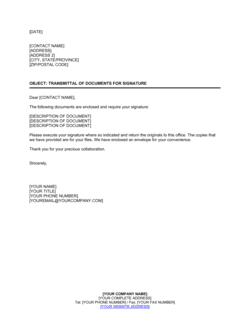
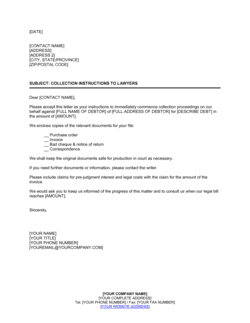
A Transmittal for Collection is a formal letter a creditor sends to a collection agent alongside unpaid invoices, bills of exchange, or other receivables. This free Word download gives you a ready-to-edit template that identifies the debtor, itemizes the documents enclosed, states the collection instructions, and records the fee arrangement β€” all in a single concise letter you can export as PDF and send immediately.
When you need it
Use it when you hand off overdue accounts to an external collection agent or agency and need a written record of exactly what documents you are transmitting, what action you are authorizing, and on what terms. It is also appropriate when forwarding receivables through a bank for documentary collection under a trade transaction.
What's inside
Creditor and agent identification, a reference to the debtor account, an itemized list of enclosed documents, specific collection instructions, the authorized fee or commission rate, and a signature block confirming the sender's authorization.

What is a Transmittal for Collection?

A Transmittal for Collection is a formal letter a creditor sends to a collection agent alongside unpaid invoices, bills of exchange, or other outstanding receivables, instructing the agent on the action they are authorized to take and the terms on which they are engaged. It identifies the debtor, itemizes every document being handed over, specifies whether the agent may accept partial settlement or initiate legal proceedings, and records the agreed commission rate and remittance instructions. Unlike a demand letter β€” which goes to the debtor β€” this document governs the relationship between the creditor and the agent, creating a written record of authority that both parties can rely on throughout the recovery process.

Why You Need This Document

Referring a debt to a collection agent without a written transmittal is one of the most common and costly administrative oversights in accounts receivable management. Without it, there is no documented record of which invoices were handed over, what settlement authority was granted, or what commission was agreed β€” leaving room for disputes on all three fronts once funds are recovered. Agents acting without clear written instructions tend to take conservative action, slowing recovery significantly. A properly completed transmittal also protects you if a debtor challenges the agent's authority to collect: the letter establishes the scope of that authority in unambiguous terms. This template gives you a structured, professional starting point that you can complete in under 15 minutes, send with confidence, and file as part of your collections audit trail.

Which variant fits your situation?

If your situation is…Use this template
Sending overdue invoices to a commercial collection agencyTransmittal for Collection
First internal reminder before escalating to a third partyPast Due Invoice Letter
Final demand to the debtor before collections handoffFinal Demand Letter
Forwarding a bill of exchange through a bankBill of Exchange
Formally claiming an unpaid debt with supporting invoice detailDemand for Payment Letter
Notifying the debtor that the account has been placed with a collectorNotice of Assignment of Debt
Settling the debt at a reduced amount through negotiationDebt Settlement Agreement

Common mistakes to avoid

❌ Vague or missing collection instructions

Why it matters: Without specific authority, collection agents default to minimum action β€” a single letter β€” and wait for guidance, sometimes for weeks before following up.

Fix: State the exact action authorized: full-amount demand, minimum acceptable settlement, or authority to instruct a solicitor. One clear sentence eliminates unnecessary back-and-forth.
❌ Not listing enclosed documents in the letter body

Why it matters: If a document goes missing in transit or is later disputed, there is no written record of what was originally enclosed, making it impossible to prove what was handed over.

Fix: Number every enclosed document in the letter body with its reference number, date, and amount. Attach a signed copy to your own records before sending.

❌ Omitting the commission rate

Why it matters: Relying on a verbal fee agreement causes disputes when the recovery takes longer than expected or the agent incurs extra costs. The agent may withhold funds pending a fee resolution.

Fix: Record the agreed commission percentage and any expense reimbursement cap in the transmittal itself, even if a separate agency agreement exists.

❌ No reporting or status-update requirement

Why it matters: Creditors who do not set reporting expectations often wait months without an update, miss limitation deadlines, and lose the ability to pivot strategy before the debt becomes uncollectable.

Fix: Specify an initial update deadline of 14 days and a recurring 30-day reporting cycle. Make it a condition of the engagement, not a polite request.

The 8 key clauses, explained

Header and parties

In plain language: Identifies the creditor (sender) and the collection agent (recipient) with full legal names, addresses, and contact details.

Sample language
From: [CREDITOR COMPANY NAME], [ADDRESS] | To: [COLLECTION AGENT NAME], [AGENCY NAME], [ADDRESS] | Date: [DATE] | Ref: [INTERNAL REFERENCE NUMBER]

Common mistake: Using a trade name instead of the creditor's registered legal entity name β€” mismatches between the transmittal and the underlying invoices can cause the agent to question authority to collect.

Subject line and debtor identification

In plain language: Names the debtor whose account is being referred and provides enough identifying detail β€” account number, debtor address β€” for the agent to locate and contact them.

Sample language
Re: Collection of Overdue Account β€” [DEBTOR FULL NAME / COMPANY], [DEBTOR ADDRESS], Account No. [ACCOUNT NUMBER]

Common mistake: Omitting the debtor's address. Without it, the collection agent must ask for it separately, delaying first contact and reducing recovery odds.

List of enclosed documents

In plain language: Itemizes every document being handed over β€” invoice numbers, dates, and amounts β€” so both parties have an unambiguous record of what was transmitted.

Sample language
Enclosed herewith for collection are the following documents: (1) Invoice No. [INV-001], dated [DATE], amount [CURRENCY][AMOUNT]; (2) Invoice No. [INV-002], dated [DATE], amount [CURRENCY][AMOUNT]. Total amount referred: [CURRENCY][TOTAL].

Common mistake: Attaching invoices without listing them in the letter body. If an attachment is later disputed or goes missing, there is no written record of what was originally enclosed.

Collection instructions

In plain language: States exactly what action the agent is authorized to take β€” demand full payment, accept partial settlement, initiate legal proceedings, or hold documents pending payment.

Sample language
You are hereby instructed to present the above documents to the debtor and demand payment of the full outstanding balance of [CURRENCY][TOTAL] no later than [DATE]. [Optional: You are authorized to accept a settlement of no less than [CURRENCY][MINIMUM AMOUNT] if full recovery is not possible.]

Common mistake: Leaving instructions vague β€” writing 'please collect as appropriate' without specifying whether partial settlement, legal action, or write-off is authorized. Agents act conservatively without clear authority, slowing recovery.

Commission and fee arrangement

In plain language: Records the agreed collection commission rate and any expense reimbursement terms so there is no dispute about the agent's compensation once funds are recovered.

Sample language
Your commission for this collection is agreed at [X]% of amounts recovered. Any out-of-pocket legal or filing expenses exceeding [CURRENCY][THRESHOLD] require prior written approval from the undersigned.

Common mistake: Omitting the commission rate entirely and relying on a verbal agreement. When recovery takes months, fee disputes are common without a written reference.

Remittance instructions

In plain language: Directs the agent on how and where to forward recovered funds β€” bank account details, timing of remittance, and currency if applicable.

Sample language
Recovered funds, net of your agreed commission, should be remitted to: [BANK NAME], Account Name: [ACCOUNT NAME], Account No.: [ACCOUNT NUMBER], Routing/Sort Code: [CODE], within [5] business days of receipt.

Common mistake: Providing remittance instructions only by phone or email and not in the transmittal itself. If the agent's file is separated from the email chain, they have no reference for where to send funds.

Reporting and status update requirement

In plain language: Sets expectations for how often the agent will report progress β€” contact attempts made, debtor responses, and amounts collected.

Sample language
Please provide a written status update within [14] days of receipt of this transmittal and every [30] days thereafter until the matter is resolved or closed.

Common mistake: No reporting requirement at all. Without one, creditors lose visibility into the collection effort and often only hear back when the agent closes the file β€” sometimes months later.

Sender's authorization and signature block

In plain language: Confirms the letter is issued by an authorized representative of the creditor, with name, title, and contact information for the agent to direct queries.

Sample language
This transmittal is issued on behalf of [CREDITOR COMPANY NAME] by the undersigned authorized representative. For queries, contact: [NAME], [TITLE], [EMAIL], [PHONE]. Signed: _________________________ | [NAME] | [TITLE] | [DATE]

Common mistake: Sending the transmittal unsigned or signed by a junior staff member with no stated authority. Collection agents and, more critically, debtors' lawyers may challenge the creditor's authorization if the letter is unsigned or the signatory's role is unclear.

How to fill it out

  1. 1

    Enter creditor and agent details

    Fill in your company's full registered legal name and address in the 'From' block, and the collection agent's full name, agency name, and address in the 'To' block. Add today's date and an internal reference number.

    πŸ’‘ Create a sequential reference numbering system (e.g., COL-2026-001) so you can cross-reference the transmittal in your accounts receivable records without searching by debtor name.

  2. 2

    Identify the debtor clearly

    Complete the subject line with the debtor's full legal name or registered company name, their billing address, and your internal account number. If the debtor is a company, include the registered number if known.

    πŸ’‘ Check that the debtor name on the transmittal exactly matches the name on the invoices being enclosed β€” discrepancies give debtors grounds to dispute the debt.

  3. 3

    List every enclosed document with its amount

    Number each document sequentially in the body of the letter: invoice number, date, and amount due. Calculate and state the total amount referred at the bottom of the list.

    πŸ’‘ Keep a scanned copy of every enclosed document in your records before sending β€” collection matters can take months, and the originals may not be returned.

  4. 4

    Write specific collection instructions

    State the collection action authorized: full demand only, or with a minimum acceptable settlement amount. If legal proceedings may be needed, explicitly authorize or exclude them here.

    πŸ’‘ Setting a minimum settlement threshold (e.g., 80% of the face amount) upfront saves a round trip of approvals when the debtor negotiates, which they almost always do.

  5. 5

    Record the commission rate and expense threshold

    Enter the agreed commission percentage and any cap on reimbursable expenses. If no separate collection agreement exists, this clause becomes the governing record of fee terms.

    πŸ’‘ If the commission rate is tiered β€” for example, lower for quick pays and higher if litigation is required β€” spell out both tiers in this clause.

  6. 6

    Add remittance instructions

    Enter your bank account name, account number, and routing or sort code. Specify the number of business days within which recovered funds should be forwarded to you.

    πŸ’‘ State the currency explicitly if there is any chance recovery may occur in a foreign currency β€” collection agents in cross-border matters sometimes remit in local currency by default.

  7. 7

    Set reporting intervals and sign

    Fill in the initial status-report deadline (14 days is standard) and the ongoing reporting frequency (every 30 days). Have an authorized signatory β€” a director, CFO, or credit manager with documented authority β€” sign and date the letter.

    πŸ’‘ Send the transmittal by a traceable method β€” email with read receipt or tracked post β€” and store the delivery confirmation with your collection file.

Frequently asked questions

What is a transmittal for collection?

A transmittal for collection is a formal cover letter a creditor sends to a collection agent when handing over unpaid invoices or other receivables for recovery. It identifies the debtor, itemizes the documents enclosed, gives specific collection instructions, and records the fee arrangement β€” creating a written record of the handoff that both parties can refer to throughout the collection process.

When should I use a transmittal for collection instead of collecting the debt myself?

Use a transmittal for collection when an account is 60–90 days overdue and your own follow-up letters and calls have not produced payment. Handing the matter to a specialist collection agent at this stage typically improves recovery rates and frees your team to focus on active accounts. The transmittal formalizes the transfer of authority and documents the scope of the agent's instructions.

Does a transmittal for collection need to be signed?

While no jurisdiction mandates a signature for the letter itself to be valid, signing it demonstrates that the instructions were issued by an authorized representative of the creditor. An unsigned transmittal can give a debtor's lawyer grounds to question the agent's authority, potentially delaying or complicating recovery. Having a director, CFO, or senior credit manager sign is best practice.

What documents should I enclose with a transmittal for collection?

Enclose every unpaid invoice or bill of exchange you are referring, along with any signed delivery notes, purchase orders, or contracts that establish the debt. The stronger the documentation package, the easier it is for the agent to substantiate the claim to the debtor β€” and, if necessary, to a court. List every enclosed document by number and amount in the letter body.

What is a standard collection agency commission rate?

Commission rates typically range from 15% to 35% of the amount recovered, depending on the age of the debt, the debtor's location, and whether litigation is required. Fresher debts under 90 days old usually attract rates at the lower end; debts over 180 days or requiring legal action attract higher rates. Always agree and record the rate in writing before instructing the agent.

What is the difference between a transmittal for collection and a demand letter?

A demand letter is addressed to the debtor and demands payment directly. A transmittal for collection is addressed to a collection agent and instructs them to pursue the debt on the creditor's behalf. Typically, a demand letter is the last step the creditor takes before escalation; the transmittal is the document that formalizes that escalation to a third-party agent.

Can I use a transmittal for collection for international debts?

Yes. For cross-border trade receivables, the transmittal typically accompanies bills of exchange or shipping documents forwarded through a bank under documentary collection rules β€” specifically ICC Uniform Rules for Collections (URC 522). In those cases, the transmittal must also specify whether the documents are released against payment (D/P) or against acceptance (D/A). For non-trade international debts, the transmittal follows the same format but should state the currency of recovery and remittance explicitly.

How long does the collection process typically take after I send the transmittal?

For straightforward commercial debts where the debtor is contactable and solvent, initial contact and payment demand typically take 2–4 weeks. Negotiated settlements add another 2–6 weeks. If legal proceedings are required, the timeline extends to 3–12 months depending on the jurisdiction and court workload. Setting a 30-day reporting requirement in the transmittal ensures you are kept informed at each stage.

Should I notify the debtor that I have referred their account to a collection agent?

In many jurisdictions, collection agents are required by consumer protection or debt collection regulations to identify themselves and disclose that they are acting for the creditor. For commercial debts, there is generally no legal obligation for the creditor to pre-notify, but doing so with a separate notice letter can prompt payment before the agent's commission is incurred. Your transmittal instructions can authorize the agent to send that notice on your behalf.

How this compares to alternatives

vs Demand for payment letter

A demand for payment letter is addressed directly to the debtor and requests payment by a specific deadline. A transmittal for collection is addressed to the collection agent and authorizes them to pursue the debt. The demand letter is typically the final creditor-to-debtor step; the transmittal follows if the demand goes unanswered.

vs Debt collection agency agreement

A collection agency agreement is the master contract governing the ongoing relationship between a creditor and an agency β€” commission rates, exclusivity, reporting obligations, and liability. A transmittal for collection is a transaction-level instruction issued under that agreement for a specific debtor or batch of accounts. You need both: the agreement sets the terms, the transmittal activates each individual referral.

vs Notice of assignment of debt

A notice of assignment informs the debtor that the debt has been sold or assigned to a new owner, who becomes the new creditor. A transmittal for collection does not transfer ownership β€” the creditor retains the debt and the agent acts on their behalf for a commission. Use a notice of assignment when selling the receivable outright; use a transmittal when retaining ownership but outsourcing recovery.

vs Past due invoice letter

A past due invoice letter is a direct reminder sent to the debtor by the creditor, typically at 30 and 60 days overdue, before escalation. A transmittal for collection is sent to the agent at the escalation stage. The past due letter is a self-help tool; the transmittal kicks off third-party involvement and creates a formal record of that handoff.

Industry-specific considerations

Wholesale and distribution

High-volume invoice batches forwarded to agencies when trade credit terms are breached, with commission tiers based on debt age.

Professional services

Single-client fee disputes escalated to collection after internal follow-up fails, with supporting engagement letters enclosed.

Financial services and trade finance

Bills of exchange and documentary collections routed through correspondent banks under ICC URC 522, requiring precise D/P or D/A instructions.

Healthcare

Outstanding patient or insurer balances referred to specialist medical collection agencies with HIPAA-compliant handling instructions noted in the transmittal.

Template vs pro β€” what fits your needs?

PathBest forCostTime
Use the templateSmall businesses and credit teams referring standard commercial overdue accounts to a collection agencyFree10–15 minutes per referral
Template + professional reviewHigh-value single debts over $25,000, cross-border collection, or accounts where legal proceedings may be needed$100–$300 for a solicitor or collections specialist to review the instructions1–2 business days
Custom draftedRepeat high-volume collection programs, international documentary collection under URC 522, or regulated industries with special handling requirements$500–$1,500 for a collections lawyer or trade finance specialist3–5 business days

Glossary

Transmittal Letter
A cover letter that accompanies documents sent from one party to another, providing instructions and a record of what was enclosed.
Collection Agent
A person or company authorized by a creditor to pursue and recover an unpaid debt on the creditor's behalf, typically for a fee or commission.
Receivable
A sum of money owed to a business by a customer for goods delivered or services rendered but not yet paid.
Bill of Exchange
A written, unconditional order from one party directing another to pay a fixed sum to a third party on a specified date β€” commonly used in trade finance.
Documentary Collection
A trade finance method in which a bank transmits shipping and payment documents to the buyer's bank with instructions to release them only upon payment or acceptance of a draft.
Commission Rate
The percentage of the recovered amount the collection agent retains as their fee, agreed before the handoff and recorded in the transmittal.
Remittance Instructions
Directions specifying how and where collected funds should be sent back to the creditor once recovered.
Debtor
The individual or company that owes money to the creditor and whose account is being referred for collection.
Aging Schedule
A report classifying outstanding receivables by how long they have been unpaid β€” typically 30, 60, 90, and 90+ days β€” used to prioritize collection efforts.
Net Proceeds
The amount remitted to the creditor after the collection agent's commission and any allowable expenses have been deducted from the recovered sum.

Part of your Business Operating System

This document is one of 3,000+ business & legal templates included in Business in a Box.

  • Fill-in-the-blanks β€” ready in minutes
  • 100% customizable Word document
  • Compatible with all office suites
  • Export to PDF and share electronically

Create your document in 3 simple steps.

From template to signed document β€” all inside one Business Operating System.
1
Download or open template

Access over 3,000+ business and legal templates for any business task, project or initiative.

2
Edit and fill in the blanks with AI

Customize your ready-made business document template and save it in the cloud.

3
Save, Share, Send, Sign

Share your files and folders with your team. Create a space of seamless collaboration.

Save time, save money, and create top-quality documents.

β˜…β˜…β˜…β˜…β˜…

"Fantastic value! I'm not sure how I'd do without it. It's worth its weight in gold and paid back for itself many times."

Managing Director Β· Mall Farm
Robert Whalley
Managing Director, Mall Farm Proprietary Limited
β˜…β˜…β˜…β˜…β˜…

"I have been using Business in a Box for years. It has been the most useful source of templates I have encountered. I recommend it to anyone."

Business Owner Β· 4+ years
Dr Michael John Freestone
Business Owner
β˜…β˜…β˜…β˜…β˜…

"It has been a life saver so many times I have lost count. Business in a Box has saved me so much time and as you know, time is money."

Owner Β· Upstate Web
David G. Moore Jr.
Owner, Upstate Web

Run your business with a system β€” not scattered tools

Stop downloading documents. Start operating with clarity. Business in a Box gives you the Business Operating System used by over 250,000 companies worldwide to structure, run, and grow their business.

Free Forever PlanΒ Β·Β No credit card required