Discount on Prepayment Option Template

Free Word download β€’ Edit online β€’ Save & share with Drive β€’ Export to PDF

1 pageβ€’20–30 min to fillβ€’Difficulty: Standardβ€’Signature requiredβ€’Legal review recommended
Learn more ↓
FreeDiscount on Prepayment Option Template

At a glance

What it is
A Discount On Prepayment Option is a binding legal agreement between a creditor and a debtor that grants the debtor the right β€” but not the obligation β€” to settle an outstanding balance before its due date in exchange for a specified percentage reduction in the amount owed. This free Word download provides a professionally structured template you can edit online and export as PDF, covering the discount rate, prepayment window, eligible obligations, and all conditions governing the option.
When you need it
Use it when a seller, lender, or creditor wants to incentivize early payment on invoices, loans, or trade credit arrangements, and needs a written, enforceable record of the discount terms. It is also used when a debtor negotiates a lump-sum prepayment in exchange for a reduced outstanding balance.
What's inside
Parties and obligation identification, discount rate and calculation method, prepayment window and expiry, conditions for exercising the option, payment mechanics, release and settlement language, and governing law with dispute resolution.

What is a Discount On Prepayment Option?

A Discount On Prepayment Option is a binding legal agreement between a creditor and a debtor that grants the debtor the right β€” but not the obligation β€” to settle an outstanding monetary obligation before its scheduled due date in exchange for a specified reduction in the amount owed. The creditor accepts less than the full balance in exchange for receiving cleared funds early; the debtor reduces its total liability by paying ahead of schedule. Unlike a simple invoice notation such as "2/10 net 30," this agreement is a signed, bilateral contract that specifies the exact discounted amount, the exercise procedure, the prepayment window with a hard expiry date, and full and final settlement language releasing the debtor from further liability upon timely payment.

Why You Need This Document

Without a written prepayment option agreement, both parties are exposed to avoidable disputes at the moment of settlement. A creditor who verbally agrees to accept early payment at a discount has no enforceable record of the terms β€” and no mechanism to restore the full obligation if the debtor fails to pay within the agreed window. A debtor who remits a reduced amount without a signed release has no protection against the creditor pursuing the remaining balance later. The absence of a precise discounted dollar amount leads to calculation disputes; the absence of an expiry date leaves the creditor's discount offer open indefinitely. This template closes all four gaps: it fixes the amount, defines the window, specifies the exercise procedure, and provides a release that conclusively discharges the obligation. For any prepayment arrangement involving a material balance, a signed agreement is the only way to ensure the transaction is clean, documented, and enforceable.

Which variant fits your situation?

If your situation is…Use this template
Offering a standard 2/10 net 30 early payment discount on invoicesDiscount On Prepayment Option
Settling a disputed or delinquent debt for a lump-sum amountDebt Settlement Agreement
Documenting dynamic discounting terms across multiple invoicesEarly Payment Program Agreement
Granting a buyer the right to prepay a loan at a reduced principalLoan Prepayment Agreement
Modifying existing payment terms to include an early payment incentiveAmendment to Payment Terms
Issuing a formal offer to accept reduced payment on a past-due accountSettlement Offer Letter
Structuring a supplier finance or reverse factoring arrangementSupply Chain Finance Agreement

Common mistakes to avoid

❌ Stating the discount percentage without fixing the dollar amount

Why it matters: If interest or fees continue to accrue between signing and exercise, the parties may calculate different discounted amounts when the debtor tries to pay, delaying settlement or triggering a dispute.

Fix: State both the percentage and the resulting dollar amount as of the agreement date, and include a per-diem adjustment formula if the balance changes daily.

❌ Using an open-ended or vague prepayment window

Why it matters: A window described as 'within a reasonable time' or left without an expiry date may obligate the creditor to accept a discounted payment indefinitely, long after the business rationale for the discount has passed.

Fix: Always specify a hard calendar date and time zone for option expiry, and include explicit language stating that the full obligation is restored if the window lapses unexercised.

❌ Writing a release clause that covers all claims between the parties

Why it matters: An overly broad release can inadvertently discharge unrelated invoices, loans, or claims that were never intended to be settled under this agreement, creating a windfall for the debtor.

Fix: Scope the release precisely to the identified outstanding obligation by reference number and amount, and add a carve-out preserving all other obligations.

❌ Omitting the preservation-of-original-terms clause

Why it matters: Without it, a debtor who fails to exercise the option may argue that the agreement itself modified the original due date or waived the creditor's right to enforce strict payment timelines.

Fix: Include an explicit clause stating that non-exercise leaves the original obligation fully intact and unaffected by the prepayment agreement.

❌ Not specifying when payment is deemed received

Why it matters: A debtor who mails a check on the expiry date that clears two days later can argue they exercised in time; without a cleared-funds clause, this becomes a credibility contest.

Fix: Define receipt as the date on which cleared funds are credited to the creditor's designated account, and require the debtor to use wire or ACH for any payment made within three business days of the expiry date.

❌ Having unauthorized signatories execute the agreement

Why it matters: A signature from someone without authority to bind the entity β€” such as an accounts payable clerk rather than an officer β€” can render the entire agreement voidable, especially if the underlying debt is material.

Fix: Confirm the signatory's authority before execution by reviewing corporate authorization records, and include a representation in the agreement that each signatory has full authority to bind their respective entity.

The 10 key clauses, explained

Parties and Recitals

In plain language: Identifies the creditor and debtor as legal entities, states the date of the agreement, and summarizes the background obligation that gives rise to the prepayment option.

Sample language
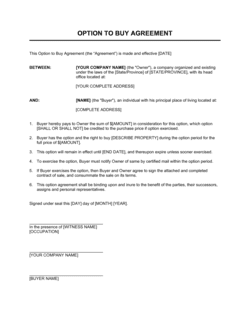
This Discount On Prepayment Option Agreement ('Agreement') is entered into as of [DATE] between [CREDITOR LEGAL NAME], a [STATE/PROVINCE] [ENTITY TYPE] ('Creditor'), and [DEBTOR LEGAL NAME], a [STATE/PROVINCE] [ENTITY TYPE] ('Debtor'). WHEREAS, Debtor owes Creditor the amount of $[AMOUNT] pursuant to [INVOICE NUMBER / LOAN AGREEMENT / CONTRACT] dated [DATE] ('Outstanding Obligation').

Common mistake: Using trade names instead of registered legal entity names. If the entity name on the agreement doesn't match the underlying invoice or loan document, enforcing the release clause becomes procedurally complicated.

Description of Outstanding Obligation

In plain language: Precisely identifies the debt or invoice subject to the prepayment option β€” including amount, reference number, and original due date β€” so there is no ambiguity about what the discount applies to.

Sample language
The Outstanding Obligation consists of Invoice No. [INVOICE NUMBER] dated [DATE] in the principal amount of $[AMOUNT], with a scheduled due date of [DUE DATE], issued by Creditor to Debtor for [DESCRIPTION OF GOODS/SERVICES].

Common mistake: Describing the obligation in vague terms such as 'amounts owed.' Without a specific reference number and amount, the debtor can argue the discount applies to a different or broader obligation.

Grant of Prepayment Option

In plain language: The core operative clause that grants the debtor the right β€” but not the obligation β€” to prepay the outstanding balance at the discounted amount during the prepayment window.

Sample language
Creditor hereby grants Debtor the option to prepay the Outstanding Obligation in full by remitting the Discounted Amount of $[DISCOUNTED AMOUNT] (representing a [X]% reduction from the Outstanding Obligation) at any time during the Prepayment Window defined in Section [X].

Common mistake: Failing to state that the option is the debtor's right, not an obligation. If the language implies the debtor must prepay, the creditor may inadvertently accelerate the debt or trigger a dispute over due dates.

Discount Rate and Calculation

In plain language: States the percentage discount, the exact discounted dollar amount after calculation, and the method used β€” ensuring both parties agree on the arithmetic before the option is exercised.

Sample language
The discount applicable to this prepayment option is [X]% of the Outstanding Obligation. The Discounted Amount equals $[OUTSTANDING AMOUNT] minus $[DISCOUNT DOLLAR AMOUNT] = $[DISCOUNTED AMOUNT]. This calculation is agreed by both parties as of the date of this Agreement.

Common mistake: Stating only the percentage without specifying the resulting dollar amount. If interest accrues between signing and exercise, both parties may calculate the discounted sum differently, creating a dispute at the moment of payment.

Prepayment Window and Expiry

In plain language: Defines the specific period during which the debtor may exercise the option, including the exact expiry date or trigger event after which the discount lapses and the full obligation is restored.

Sample language
The Prepayment Window commences on the date of this Agreement and expires at 11:59 p.m. [TIMEZONE] on [EXPIRY DATE] ('Expiry Date'). If Debtor does not exercise this option on or before the Expiry Date, this option shall terminate and the full Outstanding Obligation shall remain due and payable on its original terms.

Common mistake: Leaving the prepayment window open-ended or tied to a vague trigger such as 'within a reasonable time.' An undefined window creates uncertainty over when the discount offer expires and may inadvertently obligate the creditor to accept a discounted payment months later.

Procedure for Exercising the Option

In plain language: Sets out the steps the debtor must follow to validly exercise the prepayment option β€” including the form of notice, the payment method, and the account or address to which payment must be delivered.

Sample language
To exercise this option, Debtor shall (a) deliver written notice to Creditor at [EMAIL/ADDRESS] no later than [X] business days before the Expiry Date, and (b) remit the Discounted Amount via [WIRE TRANSFER / ACH / CERTIFIED CHECK] to [ACCOUNT DETAILS / ADDRESS] no later than the Expiry Date. Payment is deemed received only upon actual receipt of cleared funds.

Common mistake: Not specifying when payment is 'deemed received.' If the debtor sends a check on the expiry date that arrives two days later, both parties may have a valid argument β€” requiring an explicit cleared-funds clause to resolve the issue.

Full and Final Settlement

In plain language: Confirms that the creditor's receipt of the discounted prepayment constitutes complete satisfaction of the outstanding obligation and releases the debtor from any further liability for that specific debt.

Sample language
Upon Creditor's receipt of the Discounted Amount in cleared funds on or before the Expiry Date, the Outstanding Obligation shall be deemed fully satisfied and discharged. Creditor hereby releases Debtor from any and all claims arising from or related to the Outstanding Obligation.

Common mistake: Including a general release that inadvertently covers unrelated obligations between the parties. The release language must be scoped precisely to the identified outstanding obligation β€” not to 'all claims' between the parties.

Preservation of Original Terms on Non-Exercise

In plain language: States explicitly that if the debtor does not exercise the prepayment option, the original payment terms of the underlying invoice or agreement remain fully in force and unmodified.

Sample language
If Debtor does not exercise the prepayment option on or before the Expiry Date, this Agreement shall have no effect on the Outstanding Obligation, which shall remain due and payable on its original terms as if this Agreement had not been entered into.

Common mistake: Omitting this clause entirely. Without it, a debtor who misses the prepayment window may argue that the agreement modified the original due date or constituted a waiver of timely payment obligations.

Governing Law and Dispute Resolution

In plain language: Specifies the jurisdiction whose law governs the agreement and the mechanism β€” arbitration, mediation, or litigation β€” for resolving disputes.

Sample language
This Agreement is governed by the laws of [STATE/PROVINCE/COUNTRY], without regard to conflict-of-law principles. Any dispute arising under this Agreement shall be resolved by [binding arbitration before [AAA/JAMS] in [CITY] / litigation in the courts of [JURISDICTION]], and the prevailing party shall be entitled to reasonable attorneys' fees.

Common mistake: Choosing a governing law jurisdiction with no connection to where either party operates or where the obligation was created. Courts in some jurisdictions will disregard a governing-law clause that has no reasonable nexus to the transaction.

Entire Agreement and Modification

In plain language: Confirms that this document is the complete agreement on the prepayment option and that any modifications must be in writing and signed by both parties.

Sample language
This Agreement constitutes the entire agreement between the parties with respect to the prepayment option described herein and supersedes all prior negotiations, representations, and understandings. Any amendment to this Agreement must be in writing and executed by both parties.

Common mistake: Allowing oral modifications by not including this clause. A debtor who claims the creditor verbally extended the prepayment window can introduce that argument as a defense β€” the entire-agreement clause prevents it.

How to fill it out

  1. 1

    Identify both parties with their legal entity names

    Enter the full registered name of the creditor and debtor, their entity types, states or provinces of formation, and principal business addresses. Cross-reference these against the underlying invoice or loan document.

    πŸ’‘ The entity names here must match exactly those on the underlying obligation β€” a mismatch can create an ambiguity about which party is releasing the debt.

  2. 2

    Describe the outstanding obligation precisely

    Enter the invoice number, loan reference, or contract identifier, the outstanding principal amount, and the original due date. If interest has accrued, specify whether the discount applies to principal only or to the full outstanding balance including interest.

    πŸ’‘ If multiple invoices are covered, attach a schedule listing each invoice number and amount rather than describing them in the body β€” this prevents later disputes about what was included.

  3. 3

    Set the discount rate and calculate the discounted amount

    Enter the agreed percentage discount and compute the resulting dollar amount. Record both figures explicitly so there is no room for recalculation disputes at the time of payment.

    πŸ’‘ If the underlying obligation accrues interest daily, calculate the discounted amount as of a fixed date and include a per-diem adjustment formula so both parties know the exact amount to remit on any given day within the window.

  4. 4

    Define the prepayment window with a hard expiry date

    Enter a specific calendar date and time zone for the option expiry. Avoid relative periods like '30 days from execution' without also stating the resulting calendar date β€” ambiguity about the start date creates disputes.

    πŸ’‘ A 10–30 day prepayment window is standard for invoice discounts; loan prepayment options typically run 30–90 days. Match the window to the debtor's realistic ability to arrange payment.

  5. 5

    Specify the exercise procedure and payment mechanics

    State clearly how the debtor must notify the creditor of their intent to exercise, the required payment method (wire, ACH, or check), and the exact account details or address for remittance.

    πŸ’‘ Include a 'cleared funds' standard for deemed receipt β€” this prevents a dispute if a check is mailed before the expiry but arrives after it.

  6. 6

    Draft the full and final settlement clause

    Confirm that receipt of the discounted amount fully discharges the identified obligation and releases the debtor from further liability. Scope the release to the specific obligation β€” not to all claims between the parties.

    πŸ’‘ Have the creditor's finance team confirm that the obligation being released is the only open balance before signing β€” an inadvertent broad release can extinguish unrelated receivables.

  7. 7

    Confirm governing law and dispute resolution

    Choose the jurisdiction whose law governs based on where both parties operate or where the underlying obligation was created. Select arbitration or litigation as the dispute mechanism and state the venue.

    πŸ’‘ For cross-border transactions, consider specifying a neutral arbitration forum (e.g., ICC or AAA International) rather than the courts of either party's home jurisdiction.

  8. 8

    Execute before the prepayment window opens

    Both parties must sign the agreement before the prepayment window is intended to begin. Collect dated signatures from authorized signatories at each entity and retain executed copies for accounting and legal records.

    πŸ’‘ Use a digital signature platform that timestamps execution β€” this eliminates any dispute about whether the agreement was signed before or after the debtor attempted to exercise the option.

Frequently asked questions

What is a discount on prepayment option?

A discount on prepayment option is a contractual arrangement that gives a debtor the right β€” but not the obligation β€” to pay an outstanding balance before its scheduled due date in exchange for a reduced amount. The creditor offers the discount to accelerate cash receipt; the debtor benefits by reducing the total amount owed. The agreement records the discount rate, the discounted dollar amount, the window for exercising the option, and the release of the obligation upon payment.

What is the difference between a prepayment discount and standard trade credit terms like 2/10 net 30?

Standard trade credit terms like 2/10 net 30 are printed on invoices as standing offers β€” they do not require a separate agreement. A prepayment option agreement is a negotiated, bilateral document used when the discount terms are larger, the obligation is a specific invoice or loan balance rather than an open account, or the parties want a binding written record with full and final settlement language. It provides legal clarity that a standard invoice notation does not.

Is a discount on prepayment option legally binding?

Yes, when properly drafted and executed by authorized signatories, a discount on prepayment option agreement is generally enforceable as a binding contract. It requires consideration β€” the creditor's discount in exchange for early payment β€” which satisfies the basic requirements of contract formation in most jurisdictions. Legal enforceability depends on the specific language used and applicable local law, so consulting a lawyer is advisable for material amounts.

Does the creditor have to accept the discounted payment?

Yes β€” if the debtor exercises the option correctly within the prepayment window by delivering proper notice and remitting cleared funds in the specified amount, the creditor is contractually bound to accept the discounted payment as full satisfaction of the obligation. The creditor cannot later pursue the balance. This is why the discount rate and expiry date must be carefully considered before the agreement is signed.

What happens if the debtor misses the prepayment window?

If the debtor does not exercise the option on or before the expiry date, the prepayment option lapses and the original obligation β€” full amount, original due date, and original terms β€” is restored as if the prepayment agreement had never been entered into. A well-drafted agreement will include an explicit preservation-of-original-terms clause to make this consequence unambiguous.

What discount rate is typical in a prepayment option agreement?

Discount rates vary widely depending on the size of the obligation, the debtor's financial position, and the creditor's cost of capital. Trade invoice discounts typically range from 1% to 3% for a 10–30 day acceleration. Negotiated settlements on delinquent or disputed balances may involve discounts of 10% to 40% or more. The appropriate rate is a commercial decision; the agreement simply records whatever the parties have agreed upon.

Can a prepayment option agreement be used for loan balances as well as invoices?

Yes. While the template is commonly used for trade invoices, it can be adapted for loan balances, lease obligations, or any other fixed monetary obligation where the creditor is willing to accept early settlement at a reduced amount. When used for a loan, the parties should confirm that the underlying loan agreement does not prohibit prepayment or impose a prepayment penalty that would need to be addressed in the option terms.

Does this agreement need to be notarized?

Notarization is generally not required for a discount on prepayment option agreement to be enforceable in most jurisdictions. Signatures from authorized representatives of both entities are typically sufficient. However, if the underlying obligation is secured by real property or involves a public record filing, consult a lawyer about whether notarization or other formalities apply.

What tax implications does a prepayment discount have?

The creditor may need to recognize the forgiven portion of the balance as a revenue reduction or bad-debt write-off, depending on how the discount is structured and applicable accounting standards. The debtor may realize income equal to the discount if it relates to a debt obligation rather than a trade payable, depending on jurisdiction. Both parties should consult their accountants or tax advisors before entering into material prepayment discount arrangements.

How this compares to alternatives

vs Debt Settlement Agreement

A debt settlement agreement is used to resolve a disputed, delinquent, or defaulted obligation β€” often for a significantly reduced lump sum β€” where the debtor cannot pay in full. A discount on prepayment option applies to a current, non-defaulted obligation where the debtor is financially capable but simply incentivized to pay early. The prepayment option is a commercial incentive tool; the debt settlement agreement is a workout mechanism.

vs Payment Plan Agreement

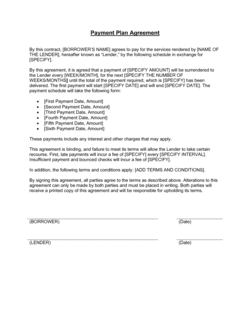
A payment plan agreement restructures an obligation into installments over time β€” it extends the payment period and may increase total cost through interest. A prepayment option agreement works in the opposite direction, shortening the payment period in exchange for a reduced total. Use a payment plan when the debtor cannot pay in full; use a prepayment option when the debtor can pay early and wants a discount for doing so.

vs Invoice (with early payment terms)

An invoice with early payment terms printed in the footer (e.g., '2/10 net 30') is an informal, non-negotiated offer that creates no binding bilateral obligation and includes no settlement or release language. A prepayment option agreement is a negotiated, signed contract with explicit exercise procedures, a full and final settlement clause, and enforceable expiry terms. Use the agreement when the amount is material or when a binding written record is required.

vs Promissory Note

A promissory note creates the underlying payment obligation β€” it records the debtor's promise to pay a specified amount on specified terms. A discount on prepayment option agreement is a supplementary document that modifies how an existing obligation may be discharged, offering the debtor a path to settle for less by paying early. The promissory note establishes the debt; the prepayment option agreement provides a conditional release mechanism.

Industry-specific considerations

Manufacturing and Wholesale

Suppliers offer prepayment discounts to distributors and retailers to accelerate cash conversion on large-volume trade credit balances, often structured as 2/10 net 60 on purchase orders exceeding $50,000.

Financial Services and Lending

Commercial lenders use prepayment option agreements to offer borrowers a discounted payoff on non-performing or early-stage loans, documenting the settlement terms and full discharge in a binding written record.

Construction and Real Estate

General contractors offer subcontractors or material suppliers prepayment discounts tied to project milestone payments, accelerating supplier cash flow while reducing the contractor's total payables.

Professional Services

Law firms, consultancies, and agencies offer clients a prepayment discount on retainer invoices or project fees to secure upfront revenue, particularly at year-end when cash collection targets are critical.

Jurisdictional notes

United States

Prepayment option agreements are governed by contract law under the Uniform Commercial Code (UCC) for goods transactions and common law for services and loans. A written agreement with the discount amount, expiry date, and full settlement language is generally enforceable in all states. Some states impose usury limits that may affect the imputed interest rate of a large prepayment discount on a loan β€” confirm this with local counsel for material amounts.

Canada

Canadian contract law (federal and provincial) recognizes prepayment option agreements when supported by consideration. Quebec is a civil law jurisdiction and applies the Civil Code of Quebec rather than common law principles β€” agreements involving Quebec parties should use French or bilingual versions and be reviewed by Quebec-licensed counsel. Interest Act provisions may apply if the discounted amount implies a rate of return above statutory limits.

United Kingdom

Discount on prepayment agreements are enforceable under English contract law when properly executed. The Consumer Credit Act 1974 applies if the debtor is an individual rather than a business entity β€” regulated credit agreements have specific form and disclosure requirements that supersede a simple prepayment option template. For B2B transactions, the Late Payment of Commercial Debts (Interest) Act 1998 context means creditors should confirm the discount does not inadvertently waive statutory interest rights on unrelated overdue invoices.

European Union

The EU Late Payment Directive (2011/7/EU) establishes maximum payment periods and statutory interest for B2B transactions β€” a prepayment discount agreement that settles within those periods is fully compliant. Member state implementation varies; France, Germany, and Spain have specific rules on maximum payment terms and early payment discounts in certain regulated sectors. For cross-border EU transactions, specify the governing law of a specific member state rather than referencing 'EU law' generally.

Template vs lawyer β€” what fits your deal?

PathBest forCostTime
Use the templateBusinesses offering standard early payment discounts on trade invoices up to $50,000 with straightforward termsFree15–30 minutes
Template + legal reviewMaterial obligations above $50,000, cross-border transactions, or agreements involving partial releases on contested balances$300–$7001–3 days
Custom draftedComplex loan prepayment options, regulated lending environments, multi-party obligations, or agreements with significant tax consequences$1,000–$3,500+1–2 weeks

Glossary

Prepayment Option
A contractual right granted to a debtor allowing them to pay an outstanding obligation before its scheduled due date, typically in exchange for a financial benefit such as a reduced balance.
Discount Rate
The percentage reduction applied to the outstanding balance when the debtor exercises the prepayment option within the specified window.
Prepayment Window
The defined period during which the debtor may exercise the prepayment option and receive the agreed discount β€” typically expressed as a number of days from invoice date or agreement execution.
Outstanding Obligation
The specific invoice, loan balance, or trade credit amount to which the prepayment discount applies, as identified in the agreement.
Exercise of Option
The debtor's formal act of invoking the prepayment right β€” usually by delivering written notice and remitting the discounted amount within the prepayment window.
Full and Final Settlement
A clause confirming that the discounted prepayment constitutes complete satisfaction of the outstanding obligation, releasing both parties from further claims related to it.
2/10 Net 30
A common trade credit term offering a 2% discount if payment is made within 10 days, with the full balance due within 30 days if the discount is not taken.
Consideration
The mutual exchange of value that makes a contract legally binding β€” in this context, the creditor's discount offer in exchange for the debtor's early payment.
Acceleration Clause
A provision in a loan or credit agreement that makes the entire outstanding balance immediately due upon a specified trigger event, such as default or breach.
Release of Claims
A contractual statement by which the creditor agrees to waive any remaining claims against the debtor for the discharged obligation once prepayment is received.
Net Present Value (NPV)
The current worth of a future payment stream, discounted at an appropriate rate β€” creditors use NPV analysis to determine whether offering a prepayment discount is financially beneficial.

Part of your Business Operating System

This document is one of 3,000+ business & legal templates included in Business in a Box.

  • Fill-in-the-blanks β€” ready in minutes
  • 100% customizable Word document
  • Compatible with all office suites
  • Export to PDF and share electronically

Create your document in 3 simple steps.

From template to signed document β€” all inside one Business Operating System.
1
Download or open template

Access over 3,000+ business and legal templates for any business task, project or initiative.

2
Edit and fill in the blanks with AI

Customize your ready-made business document template and save it in the cloud.

3
Save, Share, Send, Sign

Share your files and folders with your team. Create a space of seamless collaboration.

Save time, save money, and create top-quality documents.

β˜…β˜…β˜…β˜…β˜…

"Fantastic value! I'm not sure how I'd do without it. It's worth its weight in gold and paid back for itself many times."

Managing Director Β· Mall Farm
Robert Whalley
Managing Director, Mall Farm Proprietary Limited
β˜…β˜…β˜…β˜…β˜…

"I have been using Business in a Box for years. It has been the most useful source of templates I have encountered. I recommend it to anyone."

Business Owner Β· 4+ years
Dr Michael John Freestone
Business Owner
β˜…β˜…β˜…β˜…β˜…

"It has been a life saver so many times I have lost count. Business in a Box has saved me so much time and as you know, time is money."

Owner Β· Upstate Web
David G. Moore Jr.
Owner, Upstate Web

Run your business with a system β€” not scattered tools

Stop downloading documents. Start operating with clarity. Business in a Box gives you the Business Operating System used by over 250,000 companies worldwide to structure, run, and grow their business.

Start freeΒ Β·Β No credit card required