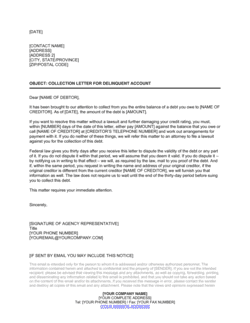
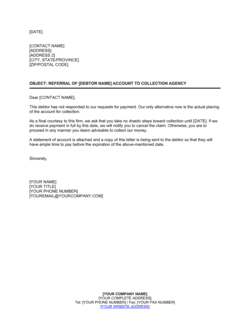
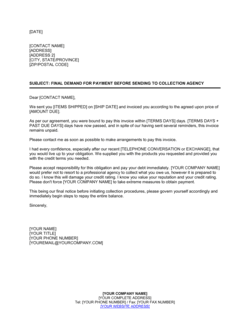
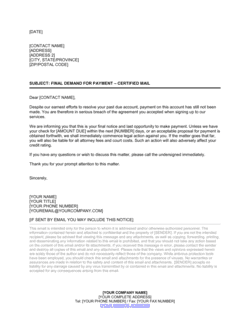
Collection Letter_Referral to Agency Template

Free Word download β€’ Edit online β€’ Save & share with Drive β€’ Export to PDF

1 pageβ€’20–30 min to fillβ€’Difficulty: Standardβ€’Signature requiredβ€’Legal review recommended
Learn more ↓
FreeCollection Letter_Referral to Agency Template

At a glance

What it is
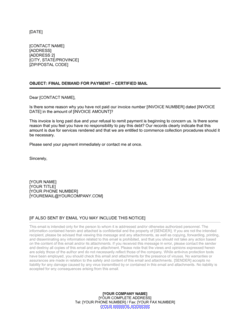
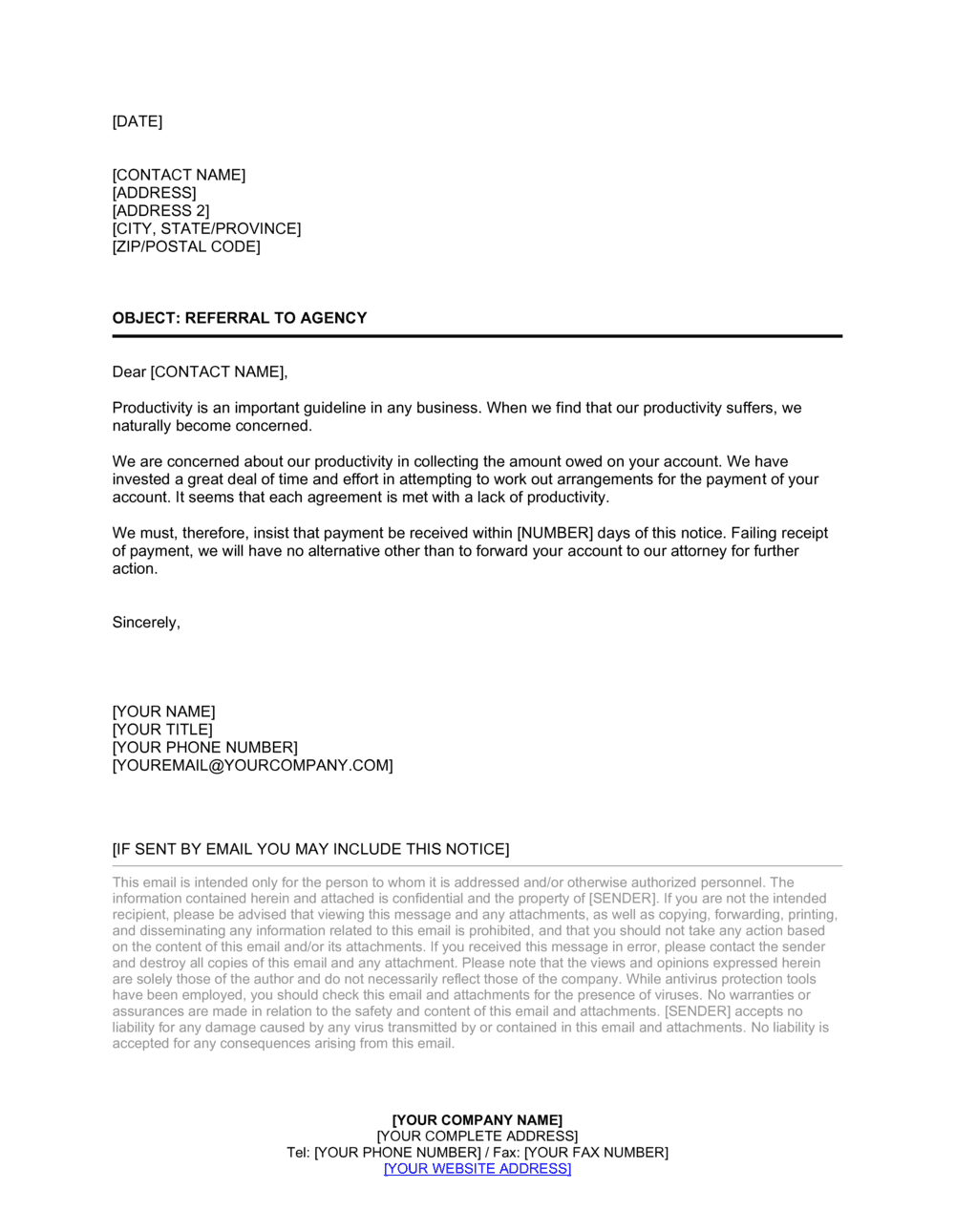
A Collection Letter Referral To Agency is a formal written notice sent by a creditor to a debtor informing them that their unpaid account is being transferred to a third-party collection agency for recovery. This free Word download gives you a structured, legally grounded letter you can edit online and export as PDF β€” covering the outstanding balance, original due date, final deadline, and the consequences of continued non-payment.
When you need it
Use it after earlier collection attempts β€” payment reminders, demand letters, and direct follow-ups β€” have failed to produce payment. It represents the final step before formal third-party debt collection begins and gives the debtor one last documented opportunity to resolve the balance directly.
What's inside
Creditor and debtor identification, account and invoice reference details, outstanding balance with accrued interest, a final payment deadline, notice of agency referral and its consequences, and instructions for resolving the debt before the transfer takes effect.

What is a Collection Letter Referral To Agency?

A Collection Letter Referral To Agency is a formal written notice issued by a creditor to a debtor informing them that their unpaid account is being transferred to a third-party collection agency for recovery. It serves as the final step in the creditor's internal escalation process β€” arriving after earlier payment reminders and demand letters have been sent and ignored β€” and gives the debtor one last documented opportunity to settle the balance directly before control of the account passes to the agency. The letter states the exact amount owed, references all prior collection attempts, sets a firm final deadline, and describes the credit and legal consequences of continued non-payment.

Why You Need This Document

Without a formal written referral notice, creditors expose themselves on two fronts simultaneously. First, in jurisdictions with consumer protection statutes β€” including the US FDCPA and equivalent provincial or national laws in Canada, the UK, and the EU β€” failing to provide proper written notice before collection activity can result in regulatory penalties against the creditor, not just the agency. Second, without a documented escalation trail, a debtor can credibly dispute that they were given adequate opportunity to pay, complicating any subsequent court proceeding or agency recovery effort. A properly completed collection referral letter creates an enforceable paper trail, puts the debtor on clear notice of the credit-reporting and legal consequences, and positions the creditor to pursue recovery through an agency immediately after the deadline passes. This template gives you a compliant, structured starting point that takes 15 minutes to complete and eliminates the most common errors that delay or derail the collection process.

Which variant fits your situation?

If your situation is…Use this template
First overdue reminder sent internally at 30 days past duePast Due Invoice Notice
Second escalation after initial reminder is ignoredSecond Collection Letter
Final internal demand before legal or agency actionFinal Demand Letter
Formally referring the account to a collection agencyCollection Letter Referral To Agency
Initiating a lawsuit for recovery of the unpaid amountDemand Letter for Payment
Settling a disputed debt for less than the full balanceDebt Settlement Agreement
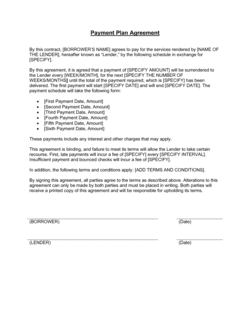
Documenting a payment plan agreed with the debtorPayment Plan Agreement

Common mistakes to avoid

❌ Omitting the dispute-rights clause for consumer debtors

Why it matters: Under the US FDCPA, collection communications to individual consumers must include a 30-day validation notice. Missing it exposes the creditor to regulatory penalties and potential class-action liability.

Fix: Always include the dispute-rights clause for any letter sent to an individual, and have counsel confirm the language meets the requirements of the debtor's state.

❌ Threatening consequences the creditor cannot or will not follow through on

Why it matters: Stating that the debtor will face criminal charges, immediate asset seizure, or other actions that are unlawful or untrue constitutes misrepresentation and can result in regulatory action against the creditor.

Fix: Limit consequences to actions the creditor is legally entitled to take and genuinely intends to pursue β€” credit reporting, collection fees, and civil legal proceedings are generally appropriate.

❌ Sending the letter without a documented prior collection history

Why it matters: A collection agency referral letter issued without prior documented attempts looks like a first contact rather than a final escalation, undermining the creditor's position and potentially breaching consumer protection requirements.

Fix: Retain records of every reminder, demand, and phone call before drafting this letter, and reference them explicitly in the summary of prior attempts clause.

❌ Stating an inaccurate or unverified balance

Why it matters: An overstated balance gives the debtor grounds to dispute the entire debt, stalls the agency's collection process, and in consumer-debt contexts may constitute a violation of applicable law.

Fix: Reconcile your accounts receivable records before completing the letter and have a second person verify the principal, interest, and fee calculation before sending.

❌ Using the wrong governing law for a consumer debtor

Why it matters: Consumer collection laws apply based on where the debtor resides, not where the creditor is located. Using the wrong jurisdiction's law in the letter can render required disclosures invalid.

Fix: Identify the debtor's state, province, or country of residence and confirm which consumer protection statutes apply before finalizing the governing-law clause.

❌ Sending via untracked delivery method

Why it matters: Without proof of delivery, a debtor can credibly claim they never received the letter, negating the entire escalation and resetting the collection clock.

Fix: Always send collection referral letters via certified mail, registered post, or a tracked courier service that generates a signed delivery receipt. Retain that receipt with your file.

The 9 key clauses, explained

Parties and Account Identification

In plain language: Identifies the creditor, the debtor, and the specific account or invoice(s) in dispute β€” providing the reference trail needed for the agency to pick up the file.

Sample language
This letter is issued by [CREDITOR LEGAL NAME] ('Creditor') to [DEBTOR FULL NAME / BUSINESS NAME] ('Debtor') regarding Account No. [ACCOUNT NUMBER], Invoice(s) [INVOICE NUMBERS], originally due on [ORIGINAL DUE DATE].

Common mistake: Using a trade name instead of the registered legal entity as the creditor. If the agency or a court needs to act, the name must match the entity that holds the debt.

Outstanding Balance and Accrued Interest

In plain language: States the exact amount owed as of the letter date, broken down into principal, accrued interest, and any applicable fees β€” eliminating disputes about the amount before the agency takes over.

Sample language
As of [DATE], the total outstanding balance on your account is [CURRENCY][AMOUNT], comprising principal of [CURRENCY][PRINCIPAL], accrued interest of [CURRENCY][INTEREST] at [RATE]% per annum, and late fees of [CURRENCY][FEES].

Common mistake: Stating a round-number estimate rather than the calculated balance. An inaccurate figure can create a dispute right after referral and slow the agency's collection process.

Summary of Prior Collection Attempts

In plain language: Documents the creditor's previous notices and communications, establishing that the debtor had reasonable opportunity to pay before the referral decision was made.

Sample language
Creditor has previously issued payment reminders on [DATE 1], [DATE 2], and a final demand on [DATE 3]. To date, no payment has been received and no satisfactory arrangement has been proposed.

Common mistake: Skipping this clause or stating prior attempts vaguely. A documented timeline protects the creditor in any subsequent dispute and demonstrates good faith under consumer protection laws.

Notice of Agency Referral

In plain language: Formally notifies the debtor that the account will be transferred to a named or unnamed collection agency if the balance is not resolved by the stated deadline.

Sample language
Unless full payment of [CURRENCY][AMOUNT] is received by [FINAL DEADLINE DATE], your account will be referred to [AGENCY NAME / 'a third-party collection agency'] for recovery. Once referred, collection fees and additional costs may be added to your balance.

Common mistake: Naming a specific agency before the referral agreement is confirmed. If the named agency declines or changes, the letter becomes inaccurate and may need to be re-issued.

Consequences of Non-Payment

In plain language: Describes what the debtor can expect if they do not pay β€” credit reporting, legal action, additional collection costs β€” creating a concrete incentive to resolve the account before referral.

Sample language
Referral to a collection agency may result in: (a) negative reporting to one or more credit bureaus; (b) additional collection fees and legal costs charged to your account; and (c) potential legal proceedings to recover the full amount owed.

Common mistake: Overstating consequences β€” threatening actions the creditor has no intention of taking or that are unlawful in the debtor's jurisdiction. This exposes the creditor to claims of harassment or misrepresentation.

Final Payment Deadline and Instructions

In plain language: Sets a specific calendar date by which the debtor must pay and tells them exactly how to do so β€” payment method, payee name, reference to use, and contact for questions.

Sample language
To prevent referral, remit full payment of [CURRENCY][AMOUNT] by [DATE] to [CREDITOR NAME] via [PAYMENT METHOD β€” bank transfer / check / online portal]. Reference: [ACCOUNT / INVOICE NUMBER]. For payment arrangements, contact [NAME] at [EMAIL / PHONE] before [DATE].

Common mistake: Giving a deadline without payment instructions. Debtors who want to pay but cannot figure out how to do so miss the deadline β€” resulting in an unnecessary referral.

Creditor's Right to Assign the Debt

In plain language: States the creditor's contractual or legal right to assign the collection obligation to a third party, referencing the original agreement if applicable.

Sample language
Pursuant to the terms of [ORIGINAL AGREEMENT / INVOICE TERMS] dated [DATE], Creditor expressly reserves the right to assign this debt to a third-party collection agency without further notice beyond this letter.

Common mistake: Omitting this clause when the original contract had a no-assignment provision. Assigning a debt in breach of contract terms can expose the creditor to counterclaims.

Dispute Rights

In plain language: Informs the debtor of their right to dispute the debt in writing within a defined period, as required by applicable consumer or commercial debt collection laws.

Sample language
If you dispute the validity of this debt or the amount stated, you must notify Creditor in writing at [ADDRESS / EMAIL] within [30] days of receiving this letter. Failure to dispute within this period does not waive your legal rights but may limit your ability to raise disputes once the account is transferred.

Common mistake: Omitting the dispute-rights clause in letters sent to individual consumers. Under the US FDCPA and equivalent statutes in other jurisdictions, failure to include this language can make the letter non-compliant and expose the creditor to regulatory action.

Governing Law and Creditor Contact Information

In plain language: Specifies which jurisdiction's law governs the debt and provides the creditor's full contact details for any last-minute payment or dispute before referral.

Sample language
This notice is issued under the laws of [STATE / PROVINCE / COUNTRY]. For all communications, contact [CREDITOR NAME], [ADDRESS], [PHONE], [EMAIL]. Please quote Reference [ACCOUNT NUMBER] in all correspondence.

Common mistake: Using the creditor's home jurisdiction when the debtor is located elsewhere and consumer protection laws apply where the debtor resides. Several US states and EU member countries apply their own collection regulations regardless of what the contract says.

How to fill it out

  1. 1

    Enter creditor and debtor legal names

    Use the full registered legal name of your business as the creditor and the debtor's legal name β€” individual or business entity β€” exactly as it appears on the original contract or invoice. Avoid trade names or nicknames.

    πŸ’‘ Cross-check the debtor's legal name against the signed agreement, not just their email or billing profile β€” discrepancies create disputes at the agency intake stage.

  2. 2

    List all account and invoice references

    Enter every invoice number, account number, or purchase order reference covered by this referral. If multiple invoices are bundled, list each individually with its original due date and balance.

    πŸ’‘ A clear reference list allows the agency to match the debt to any prior communications the debtor has on file and accelerates the collection process.

  3. 3

    Calculate and state the exact outstanding balance

    Total the principal balance, accrued interest at the contractual rate, and any documented late fees. State each component separately and confirm the arithmetic before entering the total.

    πŸ’‘ If your original agreement did not specify an interest rate, check the applicable statutory rate for your jurisdiction before accruing interest β€” charging an unsupported rate can void the claim.

  4. 4

    Summarize prior collection attempts with dates

    List each prior notice or demand you issued β€” date sent, method (email, certified mail, phone), and outcome. This creates the documented escalation trail that protects you if the debtor later claims they were not given adequate opportunity to pay.

    πŸ’‘ Attach copies of prior notices or your email thread as an exhibit if the amount is large enough to warrant a legal proceeding β€” the paper trail matters in court.

  5. 5

    Set the final payment deadline

    Choose a specific calendar date β€” typically 10–14 days from the letter date β€” as the final deadline before agency referral. Include complete payment instructions: payee name, account details, and reference number.

    πŸ’‘ Allow enough time for the payment to clear if using bank transfer β€” a deadline of 7 days may be too short for international payments.

  6. 6

    Confirm the consequences and dispute-rights language

    Review the consequences section to ensure you are only stating actions you are actually prepared to take. Confirm the dispute-rights clause complies with applicable law β€” the 30-day window is required under the FDCPA for consumer debts in the US.

    πŸ’‘ If your debtor is a consumer (not a business), apply extra scrutiny to the consequences language β€” consumer protection agencies actively monitor collection letters for misleading statements.

  7. 7

    Add governing law and sign the letter

    Specify the governing jurisdiction and enter the creditor's full contact information. Have an authorized officer of the business sign the letter. Send via certified or registered mail β€” or a method that generates a delivery receipt β€” and retain a copy.

    πŸ’‘ Certified mail creates a legal presumption of receipt in most jurisdictions, which matters if the debtor later claims they never received the letter.

  8. 8

    File a copy and notify your collection agency

    Retain a signed copy in your accounts receivable records. Simultaneously notify your collection agency of the pending referral so they can prepare the intake file and begin their process immediately after the deadline passes.

    πŸ’‘ Send the letter and the agency notification on the same day so the agency has a complete copy of the correspondence from the moment the account transfers.

Frequently asked questions

What is a collection letter referral to agency?

A collection letter referral to agency is a formal written notice a creditor sends to a debtor informing them that their unpaid account is being transferred to a third-party collection agency. It represents the final step in the creditor's internal collection process β€” after reminders and demand letters β€” and gives the debtor one last opportunity to pay directly before the agency takes over. The letter documents the amount owed, prior collection attempts, the referral deadline, and the consequences of continued non-payment.

When should I send a collection referral letter?

Send it after at least two or three prior written attempts to collect β€” typically a first overdue notice, a second reminder, and a final demand letter β€” have gone unanswered or unresolved. Most businesses trigger this step at 60–90 days past due for commercial accounts, though the timing depends on the original payment terms, the relationship with the debtor, and the amount involved. Sending it too early without prior documented attempts can weaken your position and may breach consumer protection requirements.

Does sending this letter mean I lose control of the debt?

Not necessarily β€” the letter notifies the debtor of the pending referral and gives them a final deadline to pay you directly. If the debtor pays in full before that deadline, you retain the full amount and the agency is never engaged. Once you actually transfer the file to the agency, they typically take over communication and the creditor collects a reduced amount after the agency's fee (usually 20–50% of the recovered sum). Review your agency agreement carefully to understand what happens if the debtor pays you directly after referral.

Does a collection referral letter damage the debtor's credit score?

The letter itself does not damage the debtor's credit. However, once the account is formally transferred to a collection agency, the agency typically reports the account to one or more credit bureaus, which does create a negative credit entry. In the US, a collections account can remain on a credit report for up to seven years from the original delinquency date. Informing the debtor of this consequence in the letter is both accurate and often motivates payment before the deadline.

Can I use this letter for both business and consumer debtors?

The core structure works for both, but consumer-debtor letters require additional disclosures β€” particularly the validation-of-debt notice under the FDCPA (US), the Consumer Credit Act (UK), or equivalent statutes. Business-to-business collection letters have fewer statutory requirements but must still be accurate, non-threatening, and consistent with the original contract terms. Consider separate templates for consumer and commercial debtors if you send these letters regularly.

What happens if the debtor disputes the debt after receiving this letter?

If the debtor submits a written dispute within the period stated in the letter, the creditor must cease collection activity until the debt is verified and a written response is provided. In the US, under the FDCPA, a collector must provide validation of the debt within five days of first contact. A creditor who refers a genuinely disputed debt to an agency without resolving the dispute first may face regulatory and legal exposure. Document all disputes in writing and respond promptly.

What should I do if the debtor pays after I have already referred the account?

Immediately notify the collection agency in writing that payment has been received and instruct them to cease collection activity on that account. Review your agency agreement β€” most contracts specify what happens to the agency's fee when payment is made directly to the creditor after referral, which can range from no fee to the full contingency percentage. Failing to notify the agency promptly can result in double collection attempts and consumer protection violations.

Does a collection referral letter need to be signed?

Yes. The letter should be signed by an authorized officer or accounts receivable representative of the creditor to establish authenticity and authority. An unsigned collection letter can be challenged as unofficial or unauthorized, weakening the escalation. Send it on official company letterhead with a wet or electronic signature and retain a signed copy for your records.

How this compares to alternatives

vs Final Demand Letter

A final demand letter is the last internal escalation before action β€” it warns of consequences but the creditor remains in control. A collection referral letter goes one step further: it formally notifies the debtor that control of the debt is being handed to a third party. Use the final demand letter first; if it fails, follow immediately with the referral letter.

vs Demand Letter for Payment

A demand for payment is an earlier-stage document requesting settlement and preserving the creditor's options. A collection referral letter is issued after the demand has been ignored and the creditor has made a definitive decision to engage an agency. The referral letter closes the internal process; the demand letter opens it.

vs Debt Settlement Agreement

A debt settlement agreement documents a negotiated compromise β€” the creditor accepts less than the full balance. A collection referral letter demands the full balance and signals that recovery will be pursued through a third party. If the debtor responds to the referral letter with a settlement offer, shift to the settlement agreement template to document the agreed terms.

vs Payment Plan Agreement

A payment plan agreement formalizes an instalment arrangement the debtor and creditor have agreed to. A collection referral letter is appropriate when no arrangement has been agreed and the creditor is escalating. If the debtor contacts you in response to the referral letter and proposes instalments, pause the referral and document the plan with a payment plan agreement.

Industry-specific considerations

Professional Services

Law firms, accountants, and consultants use this letter to refer unpaid project or retainer invoices after exhausting internal billing escalations, often with tight fee-dispute language to protect the professional's claim.

Healthcare

Clinics and hospitals must comply with HIPAA alongside debt collection laws, requiring careful handling of any patient information included in or attached to collection correspondence.

Construction and Trades

Contractors often combine collection referral letters with mechanic's lien warnings, giving debtors a dual incentive β€” clear the debt or face a lien on the property β€” before the account is transferred.

Retail and Wholesale

Wholesale distributors and trade suppliers refer overdue trade-account balances to specialist B2B collection agencies, where fee structures and recovery tactics differ significantly from consumer-debt agencies.

Jurisdictional notes

United States

The Fair Debt Collection Practices Act (FDCPA) governs third-party debt collectors and imposes disclosure requirements β€” including a 30-day validation notice β€” on consumer collection communications. Creditors collecting their own debts are not directly covered by the FDCPA, but state laws in California (Rosenthal Act), New York, Texas, and others extend similar requirements to original creditors. Always confirm the debtor's state of residence before finalizing the letter.

Canada

Collection and debt settlement legislation is provincially governed. Ontario's Collection and Debt Settlement Services Act, BC's Business Practices and Consumer Protection Act, and equivalent statutes in other provinces regulate the timing, frequency, and content of collection communications. Quebec requires that consumer collection correspondence be provided in French. Most provinces require a minimum notice period before referring a consumer account to an agency.

United Kingdom

The Financial Conduct Authority (FCA) regulates consumer debt collection under the Consumer Credit Act 1974 and associated guidance. Creditors must follow FCA debt collection guidance, which requires clear disclosure of the debt, the creditor's identity, and the debtor's right to seek independent advice. The Pre-Action Protocol for Debt Claims (2017) requires creditors to send a detailed letter of claim and allow 30 days for a response before initiating court proceedings.

European Union

Debt collection practices are governed at the member-state level with significant variation. Germany, France, and the Netherlands have specific rules on the form and content of pre-collection notices. GDPR compliance is mandatory β€” any personal data of the debtor included in the letter or transmitted to the collection agency must be handled with a lawful basis and documented accordingly. Cross-border debt collection within the EU may also trigger the Late Payment Directive (2011/7/EU), which sets statutory interest rates for commercial transactions.

Template vs lawyer β€” what fits your deal?

PathBest forCostTime
Use the templateSmall businesses referring commercial (B2B) accounts under $10,000 where prior written notices are already on fileFree15–20 minutes per letter
Template + legal reviewConsumer debt letters, accounts above $10,000, or debtors in jurisdictions with strict collection-law requirements$150–$400 for a single letter review by a collections attorney1–2 business days
Custom draftedHigh-value commercial disputes, regulated industries (healthcare, financial services), or multi-jurisdiction debtors$500–$2,000 depending on complexity and counsel's rates3–7 business days

Glossary

Collection Agency
A third-party company hired by a creditor to pursue recovery of unpaid debts on the creditor's behalf, typically in exchange for a percentage of the amount collected.
Debtor
An individual or business that owes money to a creditor under an invoice, contract, or other obligation.
Creditor
The party to whom a debt is owed β€” typically a business that has provided goods, services, or a loan that has not been paid.
Charge-Off
An accounting entry made by a creditor declaring an unpaid debt unlikely to be recovered, typically after 90–180 days of non-payment β€” it does not eliminate the debt.
FDCPA (Fair Debt Collection Practices Act)
A US federal law governing the conduct of third-party debt collectors, prohibiting harassment, false statements, and unfair practices.
Accrued Interest
Interest that has accumulated on an unpaid balance over time at the rate specified in the original agreement or applicable law.
Credit Reporting
The process by which a creditor or collection agency submits delinquency information to credit bureaus, negatively affecting the debtor's credit score.
Notice of Assignment
Formal communication to a debtor that the right to collect a debt has been transferred from the original creditor to a third party.
Statute of Limitations (Debt)
The legal time limit within which a creditor may file a lawsuit to enforce a debt β€” after which the debt becomes legally unenforceable in court, though it may still be owed.
Validation of Debt
A debtor's right under the FDCPA to request written verification of the amount and origin of a debt within 30 days of first contact by a collector.
Demand Date
The specific deadline stated in a collection letter by which the debtor must pay or respond before the creditor takes the next escalation step.

Part of your Business Operating System

This document is one of 3,000+ business & legal templates included in Business in a Box.

  • Fill-in-the-blanks β€” ready in minutes
  • 100% customizable Word document
  • Compatible with all office suites
  • Export to PDF and share electronically

Create your document in 3 simple steps.

From template to signed document β€” all inside one Business Operating System.
1
Download or open template

Access over 3,000+ business and legal templates for any business task, project or initiative.

2
Edit and fill in the blanks with AI

Customize your ready-made business document template and save it in the cloud.

3
Save, Share, Send, Sign

Share your files and folders with your team. Create a space of seamless collaboration.

Save time, save money, and create top-quality documents.

β˜…β˜…β˜…β˜…β˜…

"Fantastic value! I'm not sure how I'd do without it. It's worth its weight in gold and paid back for itself many times."

Managing Director Β· Mall Farm
Robert Whalley
Managing Director, Mall Farm Proprietary Limited
β˜…β˜…β˜…β˜…β˜…

"I have been using Business in a Box for years. It has been the most useful source of templates I have encountered. I recommend it to anyone."

Business Owner Β· 4+ years
Dr Michael John Freestone
Business Owner
β˜…β˜…β˜…β˜…β˜…

"It has been a life saver so many times I have lost count. Business in a Box has saved me so much time and as you know, time is money."

Owner Β· Upstate Web
David G. Moore Jr.
Owner, Upstate Web

Run your business with a system β€” not scattered tools

Stop downloading documents. Start operating with clarity. Business in a Box gives you the Business Operating System used by over 250,000 companies worldwide to structure, run, and grow their business.

Start freeΒ Β·Β No credit card required