Checklist Product Launch

Free download β€’ Use as a template β€’ Print or share

4 pagesβ€’20–25 min to useβ€’Difficulty: Standard
Learn more ↓
FreeChecklist Product Launch Template

At a glance

What it is
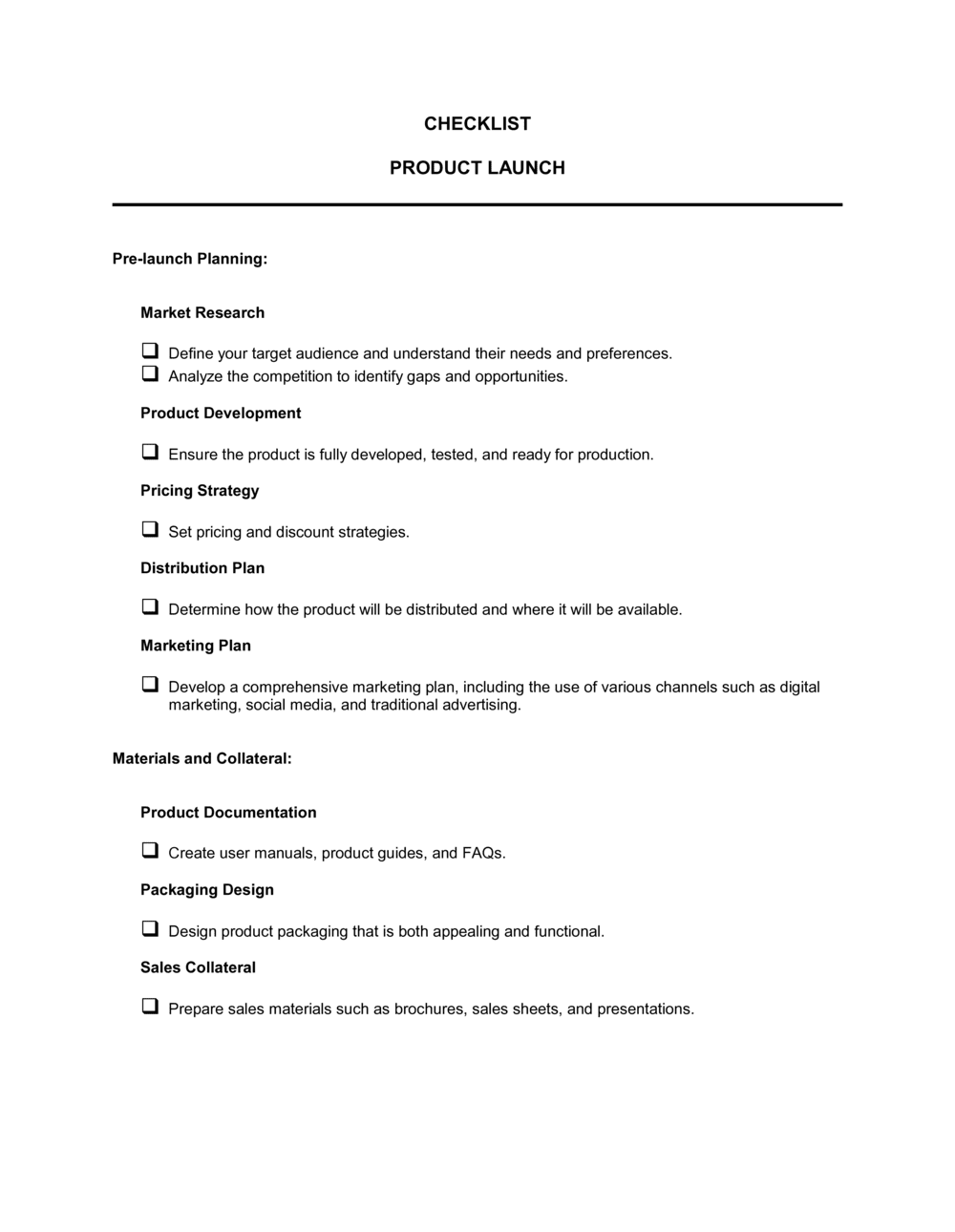
A Product Launch Checklist is a structured form that lists every task, approval, and deliverable required to take a product from final development to successful market release. This free Word download gives teams a ready-made, editable checklist they can adapt to any product type and export as PDF to share across departments.
When you need it
Use it any time you are planning a new product release, feature rollout, or market expansion β€” especially when multiple teams (product, marketing, sales, and ops) need to coordinate tasks against a shared deadline.
What's inside
Pre-launch preparation tasks, marketing and communications readiness, sales and channel enablement items, technical and operational go-live checks, and a post-launch review section to capture lessons learned.

What is a Product Launch Checklist?

A Product Launch Checklist is a structured form that organizes every task, approval, and deliverable required to bring a product to market β€” from final QA sign-off through launch day communications to the post-launch retrospective. It gives product, marketing, sales, and operations teams a single shared reference for what needs to be done, who owns each item, and when it must be completed. Rather than relying on tribal knowledge or scattered email threads, the checklist creates a repeatable, auditable process that improves with every release.

Why You Need This Document

Launching without a checklist means relying on memory and informal coordination β€” and something always slips. Support teams go live without a briefing. Conversion tracking is missing on launch day. A pricing change made on Tuesday never reaches the landing page before Thursday's announcement goes out. Each of these failures is individually recoverable, but together they erode the momentum a launch is supposed to generate. A completed product launch checklist eliminates the coordination failures that cause these gaps, compresses the time between "ready to launch" and "launched," and gives the whole team a shared standard to improve on for every subsequent release.

Which variant fits your situation?

If your situation is…Use this template
Launching a SaaS product or software featureSoftware Release Checklist
Introducing a physical consumer product to retail channelsNew Product Launch Plan
Rolling out a marketing campaign tied to a product launchMarketing Plan
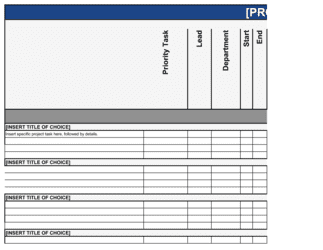
Tracking all launch tasks with owners, deadlines, and statusProject Action Plan
Documenting the full go-to-market strategy behind the launchGo-to-Market Strategy Template
Briefing a PR agency or media contacts on the launchPress Release Template
Onboarding sales reps to the new product before launchSales Training Plan

Common mistakes to avoid

❌ Launching before support is briefed

Why it matters: The first wave of customer questions arrives within hours of a launch announcement. Unprepared support agents give inconsistent answers and escalate avoidable issues to product and engineering.

Fix: Add a mandatory support-briefing checkbox that blocks the launch communications section from being marked complete.

❌ No owner assigned to checklist items

Why it matters: When every team member assumes someone else is handling a task, critical items β€” press release distribution, tracking setup, sales demo access β€” fall through on launch day.

Fix: Assign a named owner and due date to every single item before the checklist is distributed. Review assignments in a kick-off call.

❌ Skipping load testing for digital products

Why it matters: A product that goes offline during peak launch-day traffic generates negative press, kills conversion rates, and costs more to recover from than the test would have cost.

Fix: Add load testing at projected peak traffic (at minimum 2Γ— normal volume) as a hard gate in the technical readiness section.

❌ Publishing announcements before the product is live

Why it matters: Customers who click a launch announcement and reach a broken page, waitlist, or 404 error form a negative first impression that is difficult to reverse.

Fix: Sequence the communications schedule so the product goes live at least 30 minutes before the first public announcement is published.

❌ Skipping the post-launch retrospective

Why it matters: Without a structured review, the same coordination failures β€” missed briefings, last-minute asset changes, untested payment flows β€” repeat on every subsequent launch.

Fix: Book the 48-hour review and 30-day retrospective on the calendar before launch day, with a named facilitator and a shared document for capturing action items.

❌ Locking marketing assets before pricing is final

Why it matters: Last-minute pricing changes require simultaneous updates across landing pages, email sequences, ads, and sales decks β€” a time-pressured scramble that introduces errors on every channel.

Fix: Make pricing sign-off the first checkpoint in the marketing assets section so no asset is approved until the number is confirmed.

The 9 key fields, explained

Pre-launch product readiness

Pricing and packaging confirmation

Marketing assets and content

Sales team enablement

Technical and infrastructure readiness

Customer support readiness

Launch day communications schedule

Metrics and tracking setup

Post-launch review tasks

How to fill it out

  1. 1

    Set the launch date and work backwards

    Enter the confirmed launch date at the top of the checklist, then assign a target completion date to each section β€” pre-launch readiness should be done at least 5 business days before launch day.

    πŸ’‘ Build in a 2-day buffer before launch day for final end-to-end testing. Treat the day before launch as frozen β€” no new changes.

  2. 2

    Assign an owner to every checklist item

    Add a name or team next to each task. No item should be unassigned β€” shared ownership means no ownership when deadline day arrives.

    πŸ’‘ Use job titles rather than personal names for recurring launches so the checklist stays usable when team members change.

  3. 3

    Complete the product readiness section first

    Confirm QA sign-off, documentation, and any required approvals before filling in any downstream section. Marketing and sales readiness have no value if the product is not ready.

    πŸ’‘ Gate all other sections on a formal product-ready sign-off from your QA lead or engineering manager.

  4. 4

    Walk through marketing assets for consistency

    Review landing page, email copy, social posts, and ads side by side to confirm consistent messaging, pricing, and visuals across every channel.

    πŸ’‘ A single 30-minute cross-channel review catches 80% of the inconsistencies that would otherwise be found by customers on launch day.

  5. 5

    Verify technical systems under realistic load

    Confirm that payment processing, sign-up flows, and integrations have been tested at expected launch-day traffic volumes β€” not just in a development environment.

    πŸ’‘ Run a 'dress rehearsal' the day before launch: simulate a real user journey end-to-end on the production environment.

  6. 6

    Brief support and sales 48 hours before launch

    Hold a short alignment call with support and sales teams to walk through the product, known issues, and escalation paths before any external communications go live.

    πŸ’‘ Record the briefing and share the link in your team channel β€” late joiners and future hires can reference it without pulling in a senior team member.

  7. 7

    Schedule and confirm the post-launch review

    Book the 48-hour KPI review and 30-day retrospective before launch day β€” not after. Retrospectives that are scheduled reactively rarely happen.

    πŸ’‘ Assign a single person to own the lessons-learned document so that action items from the review are documented and carried into the next launch cycle.

Frequently asked questions

What is a product launch checklist?

A product launch checklist is a structured form that lists every task, approval, and deliverable required to release a product successfully. It spans pre-launch preparation, marketing and communications, sales enablement, technical readiness, and post-launch review β€” giving every team a single shared reference for what needs to be done, by whom, and by when.

How far in advance should I start a product launch checklist?

For most product launches, start filling in the checklist 4–6 weeks before the target launch date. Complex physical product launches or large-scale SaaS releases may require 8–12 weeks of preparation. The checklist itself should be distributed to all team leads at least 30 days out so owners can flag blockers early enough to resolve them.

What sections should a product launch checklist cover?

At minimum: product readiness and QA sign-off, pricing and packaging confirmation, marketing assets and content, sales team enablement, technical and infrastructure readiness, customer support briefing, launch day communications schedule, metrics and tracking setup, and post-launch review tasks. Each section should have named owners and due dates, not just checkbox items.

Who should own the product launch checklist?

The product manager or project manager typically owns the master checklist and is responsible for tracking completion across all sections. Each section has its own functional owner β€” marketing for assets, engineering for technical readiness, sales ops for enablement β€” but the PM is accountable for ensuring all sections are complete before launch day.

Can I use the same checklist for every product launch?

A core checklist covers 70–80% of what every launch needs. Customize it by product type: a SaaS feature release needs deployment runbook and rollback plan items that a physical product launch does not require, while a physical product launch needs retail channel setup and distribution logistics items. Maintain a master template and add a product-specific addendum for each release.

What is the difference between a product launch checklist and a product launch plan?

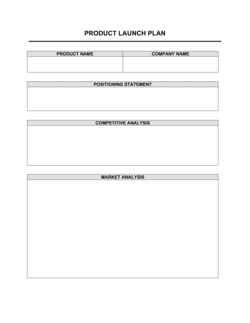
A product launch plan is a strategic document that defines your go-to-market approach β€” target audience, positioning, messaging, pricing, and channel strategy. A product launch checklist is the operational companion that tracks task completion against that strategy. You need both: the plan sets the direction; the checklist ensures execution stays on track.

What metrics should I track in the first 30 days after launch?

The most useful 30-day launch metrics are: sign-ups or units sold in the first 48 hours, conversion rate from landing page to trial or purchase, customer acquisition cost by channel, support ticket volume and category breakdown, and Net Promoter Score or early retention rate. Set targets for each before launch so you can assess performance against a benchmark rather than in a vacuum.

What should a post-launch retrospective include?

A post-launch retrospective should cover: performance against each launch KPI, a section-by-section review of what was completed on time versus what slipped and why, specific process failures with root causes, and a documented action list for the next launch with named owners. The output should be a shared document, not just meeting notes that get buried in a chat thread.

Is a product launch checklist useful for small teams or solo founders?

Yes β€” smaller teams benefit most from a checklist because there is no dedicated project manager to catch dropped items. A completed checklist forces a solo founder or two-person team to think through every launch dimension β€” support readiness, tracking setup, sales preparation β€” that is easy to skip when you are focused on the product itself.

How this compares to alternatives

vs Product Launch Plan

A product launch plan is a strategic document defining target audience, positioning, pricing, and channel strategy. A product launch checklist is the operational task tracker that ensures the plan is executed correctly. The plan sets the direction; the checklist confirms nothing is missed on the way there. Most teams need both documents for every significant release.

vs Project Action Plan

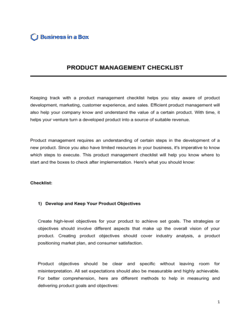
A project action plan tracks tasks, owners, and deadlines across any type of project. A product launch checklist is purpose-built for the specific sequence and categories of a product release β€” pre-launch readiness, marketing assets, sales enablement, technical checks β€” making it faster to use and less likely to miss launch-specific items.

vs Marketing Plan

A marketing plan defines the full strategy β€” target segments, messaging, channels, and budget β€” for promoting a product over time. A product launch checklist includes only the marketing tasks that must be completed before and on launch day. The marketing plan is the source of truth; the checklist confirms the plan's launch-day deliverables are ready.

vs Go-to-Market Strategy Template

A go-to-market strategy defines how a company will reach its target market β€” positioning, pricing, distribution, and sales motion. A product launch checklist operationalizes that strategy into specific tasks with owners and due dates. Completing a GTM strategy without a companion checklist frequently results in well-planned but poorly executed launches.

Industry-specific considerations

SaaS / Technology

Includes deployment runbook, feature flag configuration, rollback plan, and uptime monitoring activation as mandatory technical readiness items.

E-commerce / Retail

Covers product listing accuracy, inventory levels, payment gateway testing, and shipping carrier integration before any promotional email is sent.

Consumer Goods / Manufacturing

Adds retail channel setup, distributor briefing, product compliance documentation, and point-of-sale material delivery to the standard launch sections.

Creative and Marketing Agencies

Treats client approval gates as mandatory checklist items alongside asset delivery, ensuring no launch asset goes live without documented sign-off.

Template vs pro β€” what fits your needs?

PathBest forCostTime
Use the templateProduct managers, founders, and marketing managers running any product or feature launchFree30–60 minutes to customize; ongoing during the launch cycle
Template + professional reviewTeams launching into new markets, regulated industries, or with complex multi-channel distribution$200–$500 for a project manager or launch consultant review1–2 days
Custom draftedEnterprise product teams running quarterly release cycles who need a bespoke checklist integrated into project management software$500–$2,000 for a custom operations or project management setup3–5 days

Glossary

Go-to-Market (GTM) Strategy
The plan that defines how a company will bring a product to its target customers β€” covering pricing, channels, messaging, and sales approach.
Launch Readiness Review
A formal sign-off meeting or gate check confirming that all teams are prepared and no blocking issues remain before launch day.
Minimum Viable Product (MVP)
A version of a product with enough features to satisfy early users and generate validated feedback, without building the full feature set.
Sales Enablement
The process of equipping sales teams with the content, tools, and training they need to effectively sell a new product.
Product-Market Fit
The degree to which a product satisfies a strong market demand β€” typically measured by retention, referrals, and willingness to pay.
Beta Testing
A controlled pre-launch phase in which a limited group of real users test the product and report issues before it is released publicly.
Launch Day Runbook
A minute-by-minute operational guide detailing who does what and in what order on the actual day of product release.
Post-Mortem Review
A structured retrospective conducted after a launch to document what went well, what failed, and what should change for the next release.
Soft Launch
A limited release of a product to a small audience or single market before the full public launch, used to test systems and gather early feedback.
KPI (Key Performance Indicator)
A measurable value used to track whether a product launch is achieving its intended business outcomes β€” such as sign-ups, revenue, or churn rate in the first 30 days.

Part of your Business Operating System

This document is one of 3,000+ business & legal templates included in Business in a Box.

  • Fill-in-the-blanks β€” ready in minutes
  • 100% customizable Word document
  • Compatible with all office suites
  • Export to PDF and share electronically

Create your document in 3 simple steps.

From template to signed document β€” all inside one Business Operating System.
1
Download or open template

Access over 3,000+ business and legal templates for any business task, project or initiative.

2
Edit and fill in the blanks with AI

Customize your ready-made business document template and save it in the cloud.

3
Save, Share, Send, Sign

Share your files and folders with your team. Create a space of seamless collaboration.

Save time, save money, and create top-quality documents.

β˜…β˜…β˜…β˜…β˜…

"Fantastic value! I'm not sure how I'd do without it. It's worth its weight in gold and paid back for itself many times."

Managing Director Β· Mall Farm
Robert Whalley
Managing Director, Mall Farm Proprietary Limited
β˜…β˜…β˜…β˜…β˜…

"I have been using Business in a Box for years. It has been the most useful source of templates I have encountered. I recommend it to anyone."

Business Owner Β· 4+ years
Dr Michael John Freestone
Business Owner
β˜…β˜…β˜…β˜…β˜…

"It has been a life saver so many times I have lost count. Business in a Box has saved me so much time and as you know, time is money."

Owner Β· Upstate Web
David G. Moore Jr.
Owner, Upstate Web

Run your business with a system β€” not scattered tools

Stop downloading documents. Start operating with clarity. Business in a Box gives you the Business Operating System used by over 250,000 companies worldwide to structure, run, and grow their business.

Free Forever PlanΒ Β·Β No credit card required