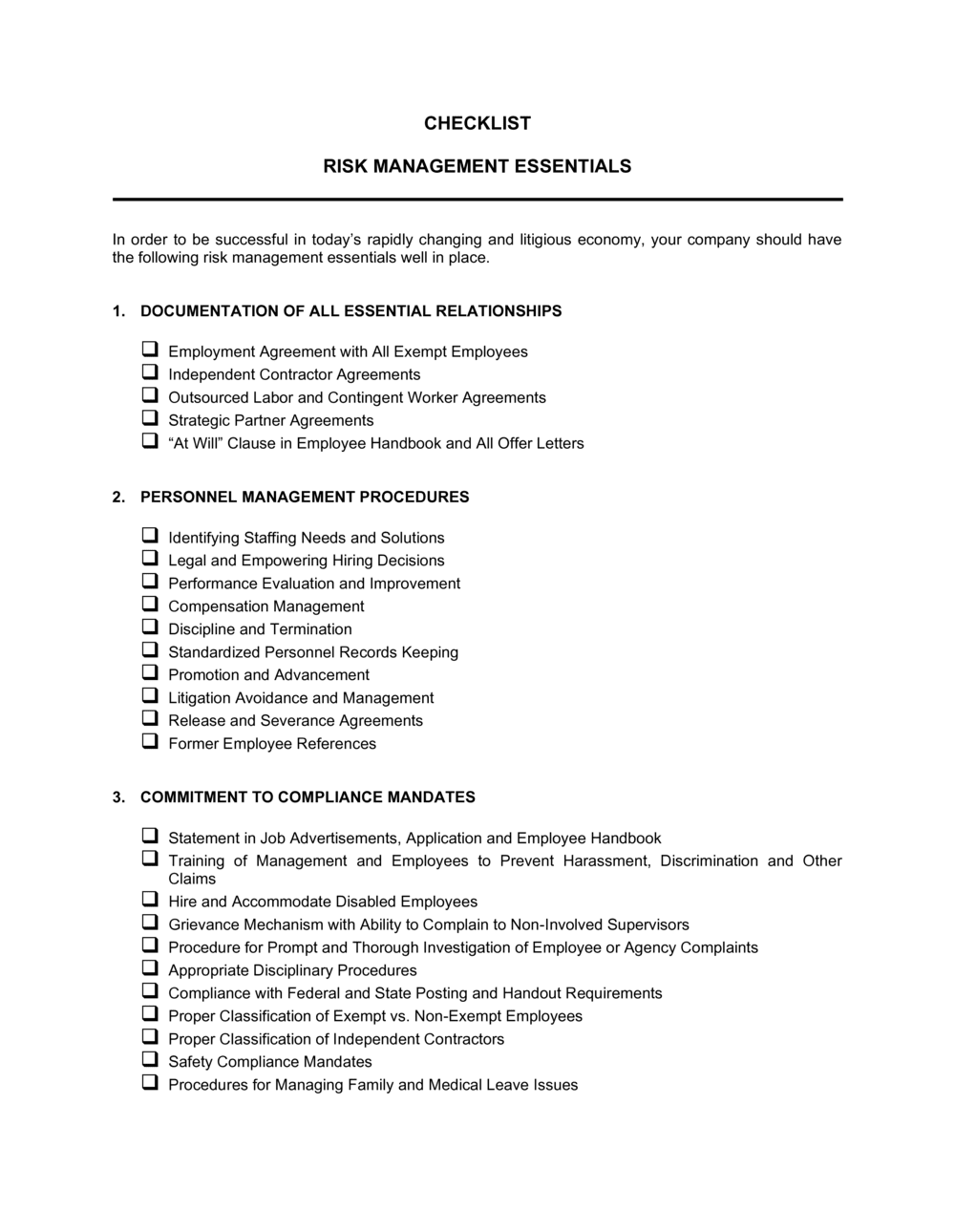
Checklist Risk Management Essentials

Free download β€’ Use as a template β€’ Print or share

2 pagesβ€’20–25 min to useβ€’Difficulty: Standard
Learn more ↓
FreeChecklist Risk Management Essentials Template

At a glance

What it is
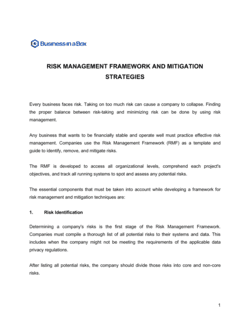
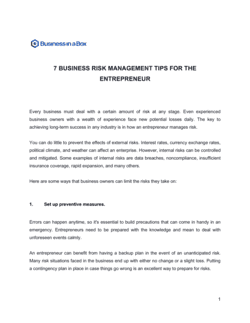
A Risk Management Essentials Checklist is a structured form that guides teams through identifying, rating, and tracking the key risks facing a business or project. This free Word download gives you a ready-to-use table you can edit online and export as PDF to share with stakeholders, auditors, or leadership in minutes.
When you need it
Use it at the start of a new project, during an annual business review, before a major operational change, or any time leadership needs a consolidated view of risk exposure and the controls in place to address it.
What's inside
Risk category, risk description, likelihood and impact ratings, a risk score, assigned owner, current control measures, mitigation action, target resolution date, and status tracking β€” all in a single structured form.

What is a Risk Management Essentials Checklist?

A Risk Management Essentials Checklist is a structured form that guides businesses and project teams through the process of identifying, rating, prioritizing, and tracking the key risks that could affect their objectives. Each risk is captured with a plain-language description, a likelihood and impact score, a calculated risk score, a named owner, existing control measures, a specific mitigation action, and a target resolution date. The result is a single, consolidated document that turns an informal awareness of risk into a prioritized action plan leadership can actually manage.

Why You Need This Document

Operating without a structured risk checklist means risks live in the heads of individual team members β€” invisible to the rest of the organization until they materialize. A single untracked key-person dependency, supplier concentration, or compliance gap can stall operations, trigger unexpected costs, or damage client relationships at the worst possible time. Investors and boards increasingly expect documented evidence of risk awareness before committing capital or approving budgets; showing up with a completed checklist signals operational maturity. This template gives you a ready-to-use form that turns a 90-minute team session into a living risk document β€” one that can be updated quarterly and shared with any stakeholder who needs confidence that the business knows what it is managing against.

Which variant fits your situation?

If your situation is…Use this template
Assessing risks for a specific project rather than the whole businessProject Risk Assessment
Tracking IT and cybersecurity vulnerabilitiesIT Risk Assessment Checklist
Evaluating health and safety hazards in a physical workplaceHealth and Safety Risk Assessment
Performing due diligence risk review before an acquisitionDue Diligence Checklist
Documenting a formal risk register with ongoing version historyRisk Register
Reviewing financial controls as part of an internal auditInternal Audit Checklist

Common mistakes to avoid

❌ Vague risk descriptions

Why it matters: A risk described as 'market risk' or 'IT issues' cannot be owned, scored, or mitigated. It adds no actionable information to the checklist.

Fix: Rewrite every risk as a specific event with a named consequence: '[TRIGGER] occurs, resulting in [SPECIFIC BUSINESS IMPACT].'
❌ Assigning ownership to a department instead of a person

Why it matters: When a team owns a risk, no individual is accountable. In practice, no one monitors it, and no mitigation action is taken until the risk materializes.

Fix: Replace every department-level owner with a named individual and their title. If the right person is unclear, that is an organizational accountability gap to resolve.

❌ Writing 'monitor' as the mitigation action

Why it matters: Monitoring tracks a risk β€” it does not change the likelihood or impact. A checklist full of 'monitor' actions signals that no real mitigation planning has occurred.

Fix: For every risk scoring 8 or above, define at least one action that actively reduces likelihood or impact β€” a new control, a process change, or a contingency plan.

❌ Completing the checklist once and never updating it

Why it matters: A static risk checklist describes the risk landscape at one point in time. New risks emerge and old ones resolve; an outdated checklist creates false confidence.

Fix: Schedule a standing review β€” quarterly at minimum β€” and assign a named facilitator to update status, scores, and actions before each session.

The 10 key fields, explained

Risk category

Risk description

Likelihood rating (1–5)

Impact rating (1–5)

Risk score

Risk owner

Current control measures

Mitigation action

Target resolution date

Status

How to fill it out

  1. 1

    Assemble the right participants

    Gather representatives from each key function β€” finance, operations, sales, IT, and HR β€” for a 60–90 minute risk identification session. Risks missed at this stage don't appear in the checklist until something goes wrong.

    πŸ’‘ Send participants a one-paragraph brief 48 hours in advance asking them to come with two to three risks from their area. Pre-loaded thinking cuts session time significantly.

  2. 2

    List all identifiable risks by category

    Work through each risk category β€” operational, financial, strategic, compliance, reputational, technology β€” and record one risk per row. Aim for 10–20 risks on a first pass; you can consolidate later.

    πŸ’‘ Use a sticky-note round-robin format: each person contributes one risk at a time until the group runs dry. This prevents a single voice from dominating the list.

  3. 3

    Write specific risk descriptions

    For each identified risk, write a one-sentence description naming the trigger event and the business consequence β€” not just a label. 'Key supplier insolvency delays product delivery by 6+ weeks' is useful; 'supply chain risk' is not.

    πŸ’‘ If you cannot describe the consequence in one sentence, the risk is probably too vague to manage. Break it into two separate items.

  4. 4

    Rate likelihood and impact independently

    Have each participant rate likelihood (1–5) and impact (1–5) for each risk independently, then discuss where ratings diverge by more than one point. Calculate the risk score (L Γ— I) after consensus is reached.

    πŸ’‘ Divergent ratings often reveal information asymmetry β€” the person rating impact higher usually knows something others don't. Surface that knowledge before averaging.

  5. 5

    Assign a named owner to each risk

    Assign each risk to a specific individual β€” not a team or department. The owner is responsible for documenting current controls, defining the mitigation action, and updating status at each review cycle.

    πŸ’‘ If no one volunteers to own a risk, that signals either unclear accountability structure or a risk no one wants to surface. Both situations require attention.

  6. 6

    Define mitigation actions and target dates

    For every risk scoring 8 or higher, document at least one concrete mitigation action with a specific target completion date. Risks scoring 1–7 may be documented as accepted within risk appetite.

    πŸ’‘ Limit each risk to one or two primary mitigation actions. Long action lists without owners or dates are as useless as no action list at all.

  7. 7

    Schedule recurring review cycles

    Set a review cadence β€” monthly for high-priority risks, quarterly for medium and low β€” and record the next review date in the checklist. Assign a facilitator to own the update process.

    πŸ’‘ Build the review into an existing management meeting rather than scheduling a standalone session. Risk checklists maintained outside regular routines are almost never updated.

Frequently asked questions

What is a risk management checklist?

A risk management checklist is a structured form that guides a business through identifying, rating, and tracking key risks in a consistent format. Each risk is logged with a description, likelihood and impact scores, an assigned owner, existing controls, a mitigation action, and a target resolution date. It gives leadership a consolidated, prioritized view of risk exposure without requiring a formal risk management system.

What is the difference between a risk checklist and a risk register?

A risk register is a living, version-controlled document that tracks all risks over time with full audit history β€” typically maintained in a dedicated tool or spreadsheet updated continuously. A risk management checklist is a simpler, point-in-time form used to capture and assess risks in a single review session. The checklist is the right starting point for small businesses and projects; a full risk register is appropriate when risk volume or regulatory requirements demand ongoing tracking.

How do I calculate a risk score?

Multiply the likelihood rating (1–5) by the impact rating (1–5) to produce a risk score between 1 and 25. Scores of 15–25 are high priority and require immediate mitigation planning. Scores of 8–14 are medium priority and should have documented actions with target dates. Scores of 1–7 are low priority and may be accepted within the organization's risk appetite without active mitigation.

Who should complete a risk management checklist?

The most useful checklists are completed collaboratively β€” with input from each key function including finance, operations, sales, IT, and HR. A single person completing the checklist alone typically misses risks outside their direct visibility. A senior leader or operations manager should facilitate and assign final ownership for each identified risk.

How often should a risk management checklist be updated?

At minimum, review the checklist quarterly and after any major operational change β€” a new product launch, acquisition, regulatory change, or significant staff departure. High-priority risks (score 15+) should be reviewed monthly. A checklist that is more than six months old without updates is unlikely to reflect the current risk environment.

Does a risk management checklist need to be signed?

No signature is required for an internal risk checklist. For board reporting, audit purposes, or investor disclosure, some organizations have the facilitator and a senior executive acknowledge the document with a date stamp to confirm it represents the organization's current risk view. Adding a review date and the name of the facilitator is good practice regardless of formal signature requirements.

What categories of risk should the checklist cover?

A comprehensive checklist covers at least six categories: operational (process failures, supplier issues, key-person dependency), financial (cash flow, credit exposure, cost overruns), strategic (competitive threats, market shifts), compliance (regulatory changes, licensing obligations), reputational (brand, customer trust, social media), and technology (cybersecurity, system downtime, data loss). Adding an industry-specific category β€” such as clinical or environmental risk β€” is appropriate for regulated sectors.

Can I use this checklist for project risk management?

Yes β€” the same structure applies directly to project risk management. Scope the risk identification to project-specific categories such as schedule, budget, resource availability, and stakeholder alignment. Many project managers complete a risk checklist at kickoff and update it at each project status meeting for the duration of the engagement.

How this compares to alternatives

vs Risk Register

A risk register is a continuously updated, version-controlled log of all organizational risks β€” typically maintained in a spreadsheet or GRC tool over months or years. This checklist is a lighter, session-based form designed for a single review and immediate action planning. Use the checklist to get started; graduate to a risk register when risk volume or reporting requirements demand ongoing history.

vs Due Diligence Checklist

A due diligence checklist is used in the context of a specific transaction β€” M&A, investment, or partnership β€” to verify facts and surface deal-level risks. A risk management checklist covers ongoing operational and strategic risks across the whole business. The two serve different purposes and are typically used together during acquisitions.

vs Business Continuity Plan

A business continuity plan documents the procedures to follow when a high-impact risk materializes β€” it is the response playbook. A risk management checklist is the upstream diagnostic tool that identifies which risks warrant a continuity plan. The checklist feeds the continuity plan; they are used in sequence, not interchangeably.

vs Internal Audit Checklist

An internal audit checklist verifies that specific controls, processes, or compliance requirements are operating as intended. A risk management checklist identifies and prioritizes risks regardless of whether controls exist. Audit checklists test controls; risk checklists identify what needs controlling.

Industry-specific considerations

Professional services

Key-person dependency, client concentration, and professional indemnity exposure are the most commonly logged risks for consulting and advisory firms.

Construction and trades

Health and safety incidents, subcontractor default, material cost escalation, and weather delays require project-level risk tracking on every job.

Technology / SaaS

Cybersecurity breaches, data loss, third-party API dependency, and regulatory compliance (SOC 2, GDPR) are the primary risk categories for software businesses.

Retail and e-commerce

Inventory shortfalls, payment fraud, supplier concentration, and platform dependency (e.g., reliance on a single marketplace) are the most material retail risks.

Template vs pro β€” what fits your needs?

PathBest forCostTime
Use the templateSmall businesses, project teams, and startups conducting their first structured risk reviewFree1–2 hours for a facilitated session plus 30 minutes to complete the form
Template + professional reviewBusinesses preparing risk documentation for board reporting, investor due diligence, or ISO 31000 alignment$300–$1,000 for a risk consultant review session2–5 days
Custom draftedRegulated industries (financial services, healthcare, government contracting) requiring a formal risk management framework$2,000–$10,000+ for a full enterprise risk management engagement2–8 weeks

Glossary

Risk
Any uncertain event or condition that, if it occurs, could have a positive or negative effect on business objectives.
Likelihood
The estimated probability that a specific risk will occur, typically rated on a scale of 1 (rare) to 5 (almost certain).
Impact
The severity of the consequence if a risk materializes, rated on a scale of 1 (negligible) to 5 (critical).
Risk Score
Likelihood multiplied by Impact β€” a single number used to prioritize which risks require immediate attention.
Risk Owner
The named individual or role accountable for monitoring a specific risk and ensuring mitigation actions are executed.
Control Measure
An existing process, policy, or safeguard already in place that reduces the likelihood or impact of a risk.
Mitigation Action
A specific planned step designed to reduce a risk's likelihood or impact to an acceptable level.
Residual Risk
The level of risk that remains after all current control measures and mitigation actions have been applied.
Risk Appetite
The amount and type of risk an organization is willing to accept in pursuit of its business objectives.
Risk Register
A living document that records all identified risks, their ratings, owners, and mitigation status β€” of which this checklist is a simplified entry-point form.

Part of your Business Operating System

This document is one of 3,000+ business & legal templates included in Business in a Box.

  • Fill-in-the-blanks β€” ready in minutes
  • 100% customizable Word document
  • Compatible with all office suites
  • Export to PDF and share electronically

Create your document in 3 simple steps.

From template to signed document β€” all inside one Business Operating System.
1
Download or open template

Access over 3,000+ business and legal templates for any business task, project or initiative.

2
Edit and fill in the blanks with AI

Customize your ready-made business document template and save it in the cloud.

3
Save, Share, Send, Sign

Share your files and folders with your team. Create a space of seamless collaboration.

Save time, save money, and create top-quality documents.

β˜…β˜…β˜…β˜…β˜…

"Fantastic value! I'm not sure how I'd do without it. It's worth its weight in gold and paid back for itself many times."

Managing Director Β· Mall Farm
Robert Whalley
Managing Director, Mall Farm Proprietary Limited
β˜…β˜…β˜…β˜…β˜…

"I have been using Business in a Box for years. It has been the most useful source of templates I have encountered. I recommend it to anyone."

Business Owner Β· 4+ years
Dr Michael John Freestone
Business Owner
β˜…β˜…β˜…β˜…β˜…

"It has been a life saver so many times I have lost count. Business in a Box has saved me so much time and as you know, time is money."

Owner Β· Upstate Web
David G. Moore Jr.
Owner, Upstate Web

Run your business with a system β€” not scattered tools

Stop downloading documents. Start operating with clarity. Business in a Box gives you the Business Operating System used by over 250,000 companies worldwide to structure, run, and grow their business.

Start freeΒ Β·Β No credit card required