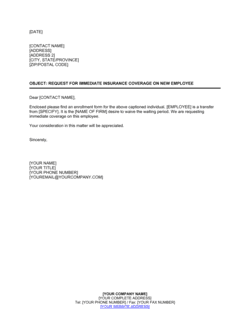
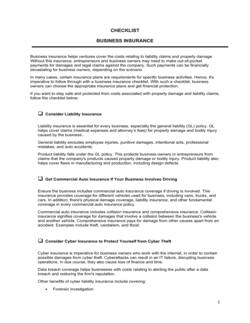
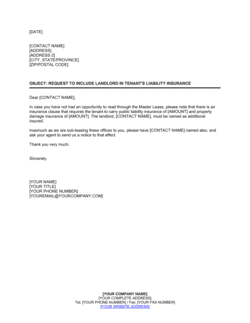
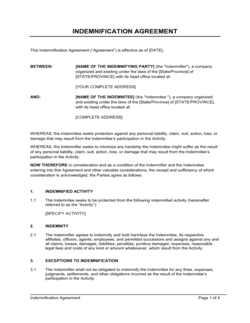
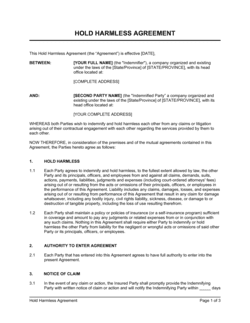
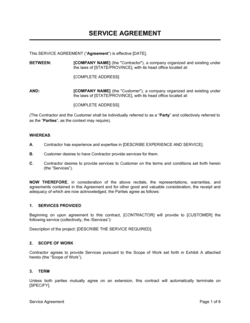
Insurance Agreement Template

Free Word download • Edit online • Save & share with Drive • Export to PDF

4 pages25–35 min to fillDifficulty: ComplexSignature requiredLegal review recommended
Learn more ↓
FreeInsurance Agreement Template

At a glance

What it is
An Insurance Agreement is a legally binding contract between an insurer and an insured party that defines the scope of coverage, premium obligations, exclusions, claims procedures, and conditions under which the insurer will pay out a benefit or indemnify a loss. This free Word download gives you a structured, editable starting point you can customize for general liability, property, professional indemnity, or other commercial coverage types, then export as PDF for execution.
When you need it
Use it when formalizing a commercial insurance arrangement between a business and an insurer, when a client or counterparty requires proof of coverage terms as a condition of a contract, or when establishing a captive or self-insurance arrangement that requires documented policy language.
What's inside
Parties and policy identification, coverage scope and insured events, premium amounts and payment schedule, deductibles and coverage limits, exclusions and conditions, claims notification and settlement procedures, subrogation rights, cancellation and renewal terms, and governing law.

What is an Insurance Agreement?

An Insurance Agreement is a legally binding contract between an insurer and an insured party that defines the full terms under which the insurer will indemnify the insured against specified financial losses in exchange for a premium. It establishes the coverage scope, triggering conditions, coverage limits and sublimits, deductibles, exclusions, claims notification requirements, and the procedures governing dispute resolution and cancellation. Unlike a certificate of insurance — which is a summary evidence document only — the insurance agreement is the authoritative legal instrument that determines whether a claim will be paid, for how much, and under what conditions.

Why You Need This Document

Operating without a properly documented insurance agreement exposes your business to two compounding risks simultaneously: the risk of the underlying insured event occurring, and the risk that an ambiguous or incomplete policy will not actually pay when it does. Insurers deny claims on the basis of late notice, entity name mismatches, excluded loss categories, and waived subrogation rights — all of which are contract interpretation issues that a well-drafted agreement resolves in advance. Businesses that rely on a broker's verbal summary or a certificate of insurance without reviewing the underlying policy routinely discover at the worst possible moment that critical sublimits are inadequate or a key exclusion eliminates their largest exposure. This template gives you a structured, clause-by-clause framework to document, negotiate, and execute commercial insurance coverage with the precision that protects your ability to recover when a covered loss occurs.

Which variant fits your situation?

If your situation is…Use this template
Covering third-party bodily injury and property damage from business operationsGeneral Liability Insurance Agreement
Protecting a business against losses from fire, theft, or natural disasterCommercial Property Insurance Agreement
Covering professionals against claims of negligence or errors in service deliveryProfessional Indemnity Insurance Agreement
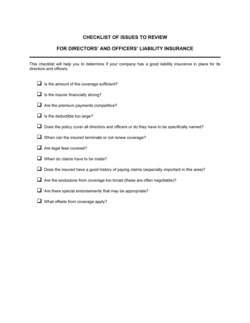
Insuring directors and officers against personal liability claimsDirectors and Officers Insurance Agreement
Covering employees for work-related injuries under statutory requirementsWorkers Compensation Insurance Agreement
Providing excess coverage above the limits of underlying primary policiesUmbrella Insurance Agreement
Requiring a third party to maintain coverage as a condition of a service contractCertificate of Insurance and Hold Harmless Agreement

Common mistakes to avoid

❌ Insured entity name mismatch

Why it matters: If the policy names a holding company but the loss is suffered by an operating subsidiary, the insurer may deny the claim on the grounds that the named insured has no insurable interest in the loss. Courts in the US and UK have upheld such denials.

Fix: Confirm the legal entity that will actually incur the covered losses and name that entity — or all relevant entities — explicitly in the policy, using an additional insured endorsement where needed.

❌ Waiving subrogation without notifying the insurer

Why it matters: Agreeing to a waiver of subrogation in a third-party contract without the insurer's consent can prejudice the insurer's ability to recover paid claims, which is grounds for claim denial under most policy conditions.

Fix: Before signing any contract that contains a waiver-of-subrogation clause, request a blanket subrogation waiver endorsement from the insurer and attach it to the policy before the contract is executed.

❌ Relying on verbal notice to a broker as formal claims notice

Why it matters: Brokers are agents of the insured, not the insurer, in most jurisdictions. Verbal notice to a broker does not constitute notice to the insurer, and late formal notice is one of the leading grounds for commercial claim denial.

Fix: Submit written notice directly to the insurer's claims department within the contractual notice period, with a copy to your broker. Keep the transmission confirmation on file.

❌ Not reviewing sublimits against actual exposure

Why it matters: A policy with a $5M aggregate limit may include a $100K sublimit on business interruption or cyber response costs — the categories most likely to generate your largest single loss. The headline limit is misleading if the relevant sublimit is inadequate.

Fix: Map each sublimit to your top five foreseeable loss scenarios and confirm the sublimit covers at least 80% of the estimated worst-case cost for each category before binding.

❌ Assuming automatic renewal on the same terms

Why it matters: Most commercial insurance agreements are subject to underwriting review at renewal. A significant claim, a change in business activity, or a market hardening can result in coverage restrictions, exclusion additions, or non-renewal — leaving the business uninsured at expiry.

Fix: Start renewal negotiations at least 90 days before expiry, disclose any material changes in operations or risk profile, and obtain the renewal terms in writing before the current policy lapses.

❌ No endorsements for additional insureds required by contracts

Why it matters: Many client contracts, leases, and construction agreements require the other party to be added as an additional insured. Operating under a contract without the required endorsement in place means the counterparty has no coverage, which can trigger a contract breach and personal liability exposure.

Fix: Audit all active contracts at each policy renewal for additional insured requirements, then request the corresponding endorsements from the insurer before the new policy period begins.

The 10 key clauses, explained

Parties and Policy Identification

In plain language: Identifies the insurer and insured by legal name, sets the unique policy number, and establishes the policy period with specific start and end dates.

Sample language
This Insurance Agreement (Policy No. [POLICY NUMBER]) is entered into between [INSURER LEGAL NAME] ('Insurer') and [INSURED LEGAL NAME] ('Insured'), effective from [START DATE] to [END DATE] ('Policy Period').

Common mistake: Using a trade name or DBA instead of the insured's full legal entity name — mismatches between the policy name and operating entity can cause claim denials when the insurer argues the loss was suffered by a different legal person.

Coverage Scope and Insured Events

In plain language: Defines precisely what risks, events, and losses the insurer agrees to cover, including the coverage type (liability, property, professional indemnity, etc.) and the triggering conditions.

Sample language
Subject to the terms and conditions of this Agreement, Insurer agrees to indemnify Insured against [TYPE OF LOSS] arising from [COVERED EVENTS] occurring during the Policy Period, up to the Coverage Limit stated in Schedule A.

Common mistake: Describing coverage in broad, aspirational language without specifying the trigger conditions — vague coverage language is routinely used by insurers to contest whether a specific loss falls within scope.

Coverage Limits and Sublimits

In plain language: States the maximum aggregate and per-occurrence dollar amounts the insurer will pay, and any sublimits that apply to specific categories of loss such as business interruption or data breach.

Sample language
The per-occurrence limit is $[AMOUNT]. The aggregate limit for the Policy Period is $[AMOUNT]. A sublimit of $[AMOUNT] applies to [SUBLIMIT CATEGORY, e.g., 'cyber incident response costs'].

Common mistake: Negotiating only the headline aggregate limit without reviewing sublimits — a $5M policy with a $250K sublimit on business interruption provides almost no protection for the category most likely to produce a large claim.

Deductible and Self-Insured Retention

In plain language: Specifies the amount the insured must pay per claim before the insurer's obligation is triggered, and distinguishes between a standard deductible (insurer pays first, then recoups) and a self-insured retention (insured pays first).

Sample language
Insured shall bear the first $[DEDUCTIBLE AMOUNT] of each covered claim ('Deductible'). The Insurer's obligation to indemnify arises only after the Deductible has been satisfied by Insured.

Common mistake: Treating deductibles and self-insured retentions as interchangeable — with an SIR, the insurer has no duty to defend until the retention is exhausted, which can leave the insured managing litigation alone for months.

Exclusions

In plain language: Lists the specific events, conditions, or categories of loss the policy does not cover, such as intentional acts, contractual liability assumed voluntarily, or losses arising from war or nuclear events.

Sample language
This Agreement does not cover losses arising from: (a) intentional or fraudulent acts of the Insured; (b) liabilities assumed under contract beyond those the Insured would bear at common law; (c) [ADDITIONAL EXCLUSIONS]; or (d) any event excluded by applicable law.

Common mistake: Failing to read the exclusions section before signing — many businesses discover that the specific risk they thought they were covering (e.g., a flood, a cyberattack, or a contractual penalty) is explicitly excluded from standard policy language.

Premium and Payment Schedule

In plain language: States the total annual premium, the installment schedule if applicable, and the consequences of late or missed payments including a grace period before coverage lapses.

Sample language
Insured shall pay an annual premium of $[AMOUNT], payable in [INSTALLMENTS / full] on [DUE DATE(S)]. A grace period of [X] days applies to each payment. Failure to pay within the grace period permits Insurer to suspend or cancel coverage on [X] days' written notice.

Common mistake: Missing a premium payment without realizing coverage lapses automatically after the grace period — any loss occurring during a lapsed period is uninsured, even if the policy is later reinstated.

Claims Notification and Procedure

In plain language: Establishes the timeframe and method for notifying the insurer of a covered event or potential claim, the information required, and the consequences of late or defective notice.

Sample language
Insured shall notify Insurer of any covered event or potential claim as soon as practicable, and in any event within [X] days of first becoming aware of the event. Notice shall be in writing to [CLAIMS CONTACT / ADDRESS] and shall include [REQUIRED INFORMATION].

Common mistake: Providing verbal notice to a broker or agent and assuming the insurer has been formally notified — most policies require written notice to the insurer directly, and late notice is one of the most common grounds for claim denial.

Subrogation

In plain language: Grants the insurer the right to step into the insured's position after paying a claim and pursue the third party responsible for the loss to recover what the insurer paid out.

Sample language
Upon payment of any claim under this Agreement, Insurer shall be subrogated to all rights and remedies of Insured against any third party responsible for the covered loss, to the extent of the payment made. Insured shall cooperate fully in any such recovery action.

Common mistake: Signing a contract with a mutual waiver-of-subrogation clause without notifying the insurer — if the insurer's subrogation rights are waived by contract before a loss occurs, the insurer may deny the claim entirely on the grounds that recovery has been prejudiced.

Cancellation and Renewal

In plain language: Sets out the conditions under which either party may cancel the policy mid-term, the required notice period, the return of unearned premium, and the terms on which the policy may be renewed at expiry.

Sample language
Either party may cancel this Agreement on [X] days' written notice. In the event of cancellation by Insurer, Insurer shall return the pro-rata unearned premium. Renewal of this Agreement is subject to [CONDITIONS / UNDERWRITING REVIEW] and is not guaranteed.

Common mistake: Assuming an insurance agreement renews automatically on the same terms — many commercial policies are subject to underwriting review at renewal, and changes in the business or claims history can result in coverage restrictions or non-renewal without an explicit right to renew.

Governing Law and Dispute Resolution

In plain language: Specifies the jurisdiction whose insurance law governs the agreement and the mechanism for resolving disputes — appraisal, arbitration, or court — including the venue.

Sample language
This Agreement is governed by the laws of [STATE / PROVINCE / COUNTRY]. Any dispute arising under this Agreement that cannot be resolved by negotiation shall be submitted to [ARBITRATION / APPRAISAL] administered by [BODY] in [CITY], except claims for injunctive relief or emergency coverage.

Common mistake: Agreeing to an arbitration clause without reviewing whether the applicable state or provincial insurance regulations restrict mandatory arbitration for insurance disputes — several US states and Canadian provinces limit or prohibit binding pre-dispute arbitration clauses in consumer and small commercial policies.

How to fill it out

  1. 1

    Identify the parties and assign a policy number

    Enter the insurer's full legal name and jurisdiction of incorporation, the insured's registered legal entity name, and a unique policy number. Confirm the insured name matches the entity that will suffer the loss.

    💡 If multiple related entities need coverage, list them separately or use an 'Insured Entities' schedule rather than relying on a general 'affiliates' reference, which courts interpret inconsistently.

  2. 2

    Define the coverage type and triggering events precisely

    Choose the coverage category (general liability, property, professional indemnity, D&O, etc.) and write out the specific triggering conditions — the events that activate the insurer's payment obligation. Avoid relying on the coverage category name alone.

    💡 Cross-reference the coverage definition against the exclusions clause before finalizing — the two clauses are often drafted independently and can leave unintended gaps.

  3. 3

    Set coverage limits, sublimits, and deductibles

    Enter the per-occurrence limit, aggregate limit, and any sublimits for specific loss categories. State the deductible amount and confirm whether it operates as a standard deductible or a self-insured retention.

    💡 Run a scenario analysis: if your single largest foreseeable loss (e.g., a complete facility destruction or a class-action claim) hit today, would the per-occurrence limit and sublimits actually cover it?

  4. 4

    List all exclusions explicitly

    Populate the exclusions clause with the standard exclusions for your coverage type plus any negotiated carve-outs. Each exclusion should be specific enough that a claims adjuster can apply it without judgment calls.

    💡 Ask the insurer for a list of the top ten claims they have denied under similar policies in the past three years — this tells you which exclusions are actively used and which are theoretical.

  5. 5

    Set the premium, payment schedule, and grace period

    Enter the annual premium, installment due dates, and the number of days in the grace period before coverage lapses for non-payment. Confirm that the grace period meets any statutory minimum in the governing jurisdiction.

    💡 Calendar all premium due dates and set reminders 10 business days in advance — a missed payment that lapses coverage on the day of a loss is one of the most costly and avoidable insurance errors.

  6. 6

    Draft the claims notification procedure

    Specify the notice period (e.g., 30 days from first awareness), the method (written, to a named claims contact), and the minimum information required in the notice. Include a backup contact in case the primary is unavailable.

    💡 In claims-made policies, late notice is a coverage-defeating condition — consider setting your internal notice trigger 10 days earlier than the contractual deadline to create a buffer.

  7. 7

    Address subrogation waivers if required by related contracts

    Review any service contracts, leases, or construction agreements that require a mutual waiver of subrogation. If waivers are needed, add an endorsement to the policy before the contract is signed — not after a loss occurs.

    💡 Inform your insurer of any waiver-of-subrogation obligations in writing and get written confirmation that coverage is not affected — verbal assurances from brokers are not binding on the insurer.

  8. 8

    Execute the agreement before the policy period starts

    Both parties should sign before the coverage start date. Attach all schedules (coverage schedule, premium schedule, endorsements) as executed exhibits. Retain the fully executed original in your risk management files.

    💡 Request a certified copy of the executed policy from the insurer within 30 days of signing — disputes about what was agreed often arise when parties are working from different versions of the document.

Frequently asked questions

What is an insurance agreement?

An insurance agreement is a legally binding contract between an insurer and an insured party under which the insurer agrees to indemnify the insured against specified losses in exchange for a premium. It defines the coverage scope, limits, exclusions, deductibles, claims procedures, and the conditions that must be satisfied for the insurer's obligation to pay to arise. Unlike a certificate of insurance, which is a summary document, the insurance agreement is the governing legal instrument.

What is the difference between an insurance agreement and an insurance policy?

In practice, the terms are often used interchangeably. Technically, the insurance policy is the full document package including the declarations page, coverage form, endorsements, and conditions — the insurance agreement is the core contract within that package that creates the insurer's obligation to pay. When drafting or reviewing commercial insurance, treat the entire policy package as the binding agreement and ensure all endorsements are attached and executed.

What must an insurance agreement include to be enforceable?

At minimum: identification of both parties, the policy period, a clear description of the covered risks and triggering events, the coverage limits and deductible, the premium and payment terms, the exclusions, and the claims notification requirements. Most jurisdictions also require that the insurer be licensed to write the coverage type in the applicable jurisdiction. An agreement that omits the exclusions or coverage trigger may be interpreted by courts in favor of the insured under the principle of contra proferentem.

What is the difference between a claims-made and an occurrence policy?

An occurrence policy covers events that happen during the policy period, regardless of when the claim is actually filed — even years later. A claims-made policy covers only claims that are both reported and first made during the active policy period. Claims-made policies are common for professional indemnity and D&O coverage. When switching insurers on a claims-made basis, a retroactive date and tail coverage (extended reporting period) are essential to avoid gaps for past incidents.

Do I need a lawyer to review an insurance agreement?

For standard commercial policies under $1M in premium, a licensed insurance broker with expertise in your industry can typically identify coverage gaps, sublimit issues, and problematic exclusions. Engage a lawyer when the coverage involves complex risk transfer (captives, reinsurance, specialty lines), when the policy is tied to a significant transaction, when a coverage dispute has arisen, or when the insurer is drafting bespoke policy language rather than using a standard form.

What happens if I miss a premium payment?

Most insurance agreements include a grace period — typically 10 to 30 days — after which the insurer may suspend or cancel coverage on written notice. Any loss occurring after the grace period expires but before the policy is reinstated is uninsured. Some jurisdictions require insurers to provide a statutory minimum notice period before cancellation for non-payment; the contractual grace period should meet or exceed that minimum. Reinstated policies may carry a lapse exclusion for the gap period.

What is an additional insured endorsement and when is it required?

An additional insured endorsement adds a third party — typically a client, landlord, lender, or project owner — to the policy, giving them direct rights to make claims under specified conditions. It is commonly required in commercial leases, construction contracts, and professional services agreements. The endorsement must be attached to the policy before a loss occurs; retroactive additions are generally not accepted by insurers and do not bind them to cover losses that have already happened.

Can a business cancel an insurance agreement before it expires?

Yes — most insurance agreements allow either party to cancel on written notice, typically 30 days for the insured or up to 60 days for the insurer (longer for non-payment). If the insured cancels, the return of unearned premium is usually calculated on a short-rate basis (slightly less than pro-rata) rather than a full pro-rata refund. Confirm the cancellation calculation method before cancelling mid-term, and ensure replacement coverage is bound before the cancellation takes effect.

How does subrogation work in an insurance agreement?

After paying a covered claim, the insurer steps into the insured's legal shoes and pursues the third party whose negligence or breach caused the loss. This prevents the insured from recovering twice — once from the insurer and once from the responsible party. The insured is required to cooperate in the insurer's subrogation action and must not do anything that prejudices the insurer's recovery rights, such as signing a release of liability with the responsible party without the insurer's consent.

How this compares to alternatives

vs Hold Harmless Agreement

A hold harmless agreement is a contractual risk-transfer mechanism under which one party agrees to indemnify the other for specified losses — but it does not create an insurance obligation or guarantee that funds will be available to pay a claim. An insurance agreement creates a funded indemnity obligation backed by the insurer's capital. The two documents are often used together: one party assumes the contractual liability, and the insurance agreement backstops the ability to pay.

vs Certificate of Insurance

A certificate of insurance is a one-page summary document that evidences the existence of coverage — it is not the policy and does not modify coverage terms. An insurance agreement is the binding contract. Relying on a certificate without reviewing the underlying policy is a common and costly mistake: the certificate may describe coverage that the policy's exclusions have effectively negated.

vs Indemnification Agreement

An indemnification agreement is a standalone contractual promise by one party to cover another's losses in specified situations. It is only as good as the indemnifying party's financial ability to pay. An insurance agreement shifts the same risk to a regulated, solvent insurer with statutory reserves. The two are complementary: indemnification agreements typically require the indemnifying party to maintain adequate insurance to fund the obligation.

vs Risk Management Policy

A risk management policy is an internal governance document that identifies organizational risks and establishes mitigation procedures — it does not create any external legal obligations or coverage. An insurance agreement is a binding external contract with a licensed insurer. The risk management policy informs what insurance is needed; the insurance agreement is the mechanism that actually transfers the financial risk.

Industry-specific considerations

Construction

General liability and builder's risk coverage are typically required by contract; subcontractors must be named as additional insureds, and wrap-up (OCIP/CCIP) programs consolidate coverage across multiple parties on large projects.

Professional Services

Professional indemnity (errors and omissions) coverage on a claims-made basis is standard; retroactive dates and tail coverage at contract termination are critical to avoid gaps for services already performed.

Technology / SaaS

Cyber liability and technology E&O coverage address data breach response, regulatory fines, and third-party claims arising from software failures; policy sublimits on cyber incident response costs warrant close scrutiny.

Healthcare

Medical malpractice and general liability coverage must align with state licensing requirements; HIPAA breach notification costs should be explicitly covered, and occurrence-based malpractice policies are preferred over claims-made where available.

Manufacturing

Product liability coverage protects against bodily injury and property damage claims arising from manufactured goods; recall coverage and product contamination riders are essential for food, pharmaceutical, and consumer goods manufacturers.

Retail / E-commerce

Commercial property coverage for inventory and premises, combined with cyber liability for payment card data breaches; business interruption sublimits should reflect peak-season revenue exposure, not average monthly revenue.

Jurisdictional notes

United States

Insurance is regulated at the state level — policy forms and rates must be filed with and approved by each state's Department of Insurance before use. Standard policy forms (ISO, AAIS) are widely adopted but may be modified by endorsement. Several states, including California, New York, and Texas, impose specific notice requirements for mid-term cancellation and non-renewal, which must meet or exceed what the policy states. Non-admitted (surplus lines) insurers may be used for unusual risks but are not covered by state guaranty funds.

Canada

Insurance regulation is primarily provincial, with each province maintaining its own Insurance Act governing policy form requirements, cancellation notice periods (typically 15 days for non-payment, 45 days for other reasons), and statutory conditions that are incorporated into every policy by law. Quebec's Civil Code imposes distinct obligations on insurers and insureds, including good-faith disclosure requirements at policy inception. Federal oversight applies to federally regulated financial institutions and certain reinsurance arrangements.

United Kingdom

The Insurance Act 2015 replaced the Marine Insurance Act 1906 as the primary framework for commercial insurance contracts, introducing a duty of fair presentation replacing the prior duty of utmost good faith, proportionate remedies for breach, and restrictions on basis-of-contract clauses. The Financial Conduct Authority regulates insurer conduct and policy terms. Post-Brexit, UK insurers no longer passporte into the EEA, and separate EU placements require EU-authorized carriers. The Consumer Insurance (Disclosure and Representations) Act 2012 applies to non-commercial personal lines policies.

European Union

The Solvency II Directive harmonizes insurer capital requirements and governance across EU member states but does not standardize policy language — contract terms remain subject to the law of the member state where the risk is located. GDPR obligations apply where policy administration involves personal data processing, requiring a lawful basis for each processing activity. Cross-border placements within the EEA are permitted under freedom of services rules, but local mandatory insurance requirements (e.g., motor, employers' liability) must be met by an EU-authorized insurer. France, Germany, and Spain each impose specific statutory conditions on commercial insurance contracts that may not be waived by agreement.

Template vs lawyer — what fits your deal?

PathBest forCostTime
Use the templateSmall businesses placing standard commercial coverage using insurer-provided standard form policiesFree30–60 minutes to review and customize
Template + legal reviewBusinesses with complex operations, multiple entities, or policies above $500K in annual premium$500–$1,500 for a broker or coverage counsel review3–7 business days
Custom draftedLarge commercial placements, bespoke specialty lines, captive insurance arrangements, or coverage tied to M&A transactions$3,000–$15,000+ for specialist insurance counsel2–6 weeks

Glossary

Insured
The individual or entity whose risk of loss is covered under the insurance agreement.
Insurer
The insurance company or underwriter that agrees to pay covered claims in exchange for the premium.
Premium
The amount the insured pays — monthly, quarterly, or annually — to maintain coverage under the policy.
Deductible
The amount the insured must pay out of pocket on each covered claim before the insurer's obligation begins.
Coverage Limit
The maximum dollar amount the insurer will pay for a single covered event or in aggregate over the policy period.
Exclusion
A specific event, condition, or type of loss that the policy explicitly does not cover.
Subrogation
The insurer's right, after paying a claim, to step into the insured's shoes and pursue recovery from the third party responsible for the loss.
Indemnity
The principle that the insured should be restored to the same financial position they were in before the covered loss — no more, no less.
Policy Period
The defined start and end dates during which the insurance agreement is in force and claims can be triggered.
Additional Insured
A third party — such as a client or landlord — added to the policy by endorsement and granted coverage rights under specific conditions.
Claims-Made vs. Occurrence
Two trigger structures: claims-made policies cover claims filed during the policy period; occurrence policies cover events that happen during the policy period regardless of when the claim is filed.
Endorsement
A written amendment to the insurance agreement that modifies, expands, or restricts the standard policy terms.

Part of your Business Operating System

This document is one of 3,000+ business & legal templates included in Business in a Box.

  • Fill-in-the-blanks — ready in minutes
  • 100% customizable Word document
  • Compatible with all office suites
  • Export to PDF and share electronically

Create your document in 3 simple steps.

From template to signed document — all inside one Business Operating System.
1
Download or open template

Access over 3,000+ business and legal templates for any business task, project or initiative.

2
Edit and fill in the blanks with AI

Customize your ready-made business document template and save it in the cloud.

3
Save, Share, Send, Sign

Share your files and folders with your team. Create a space of seamless collaboration.

Save time, save money, and create top-quality documents.

★★★★★

"Fantastic value! I'm not sure how I'd do without it. It's worth its weight in gold and paid back for itself many times."

Managing Director · Mall Farm
Robert Whalley
Managing Director, Mall Farm Proprietary Limited
★★★★★

"I have been using Business in a Box for years. It has been the most useful source of templates I have encountered. I recommend it to anyone."

Business Owner · 4+ years
Dr Michael John Freestone
Business Owner
★★★★★

"It has been a life saver so many times I have lost count. Business in a Box has saved me so much time and as you know, time is money."

Owner · Upstate Web
David G. Moore Jr.
Owner, Upstate Web

Run your business with a system — not scattered tools

Stop downloading documents. Start operating with clarity. Business in a Box gives you the Business Operating System used by over 250,000 companies worldwide to structure, run, and grow their business.

Start free · No credit card required