Checklist Directors and Officers Insurance

Free download β€’ Use as a template β€’ Print or share

1 pageβ€’20–25 min to useβ€’Difficulty: Standard
Learn more ↓
FreeChecklist Directors and Officers Insurance Template

At a glance

What it is
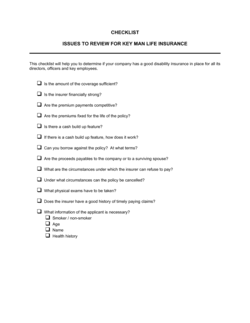
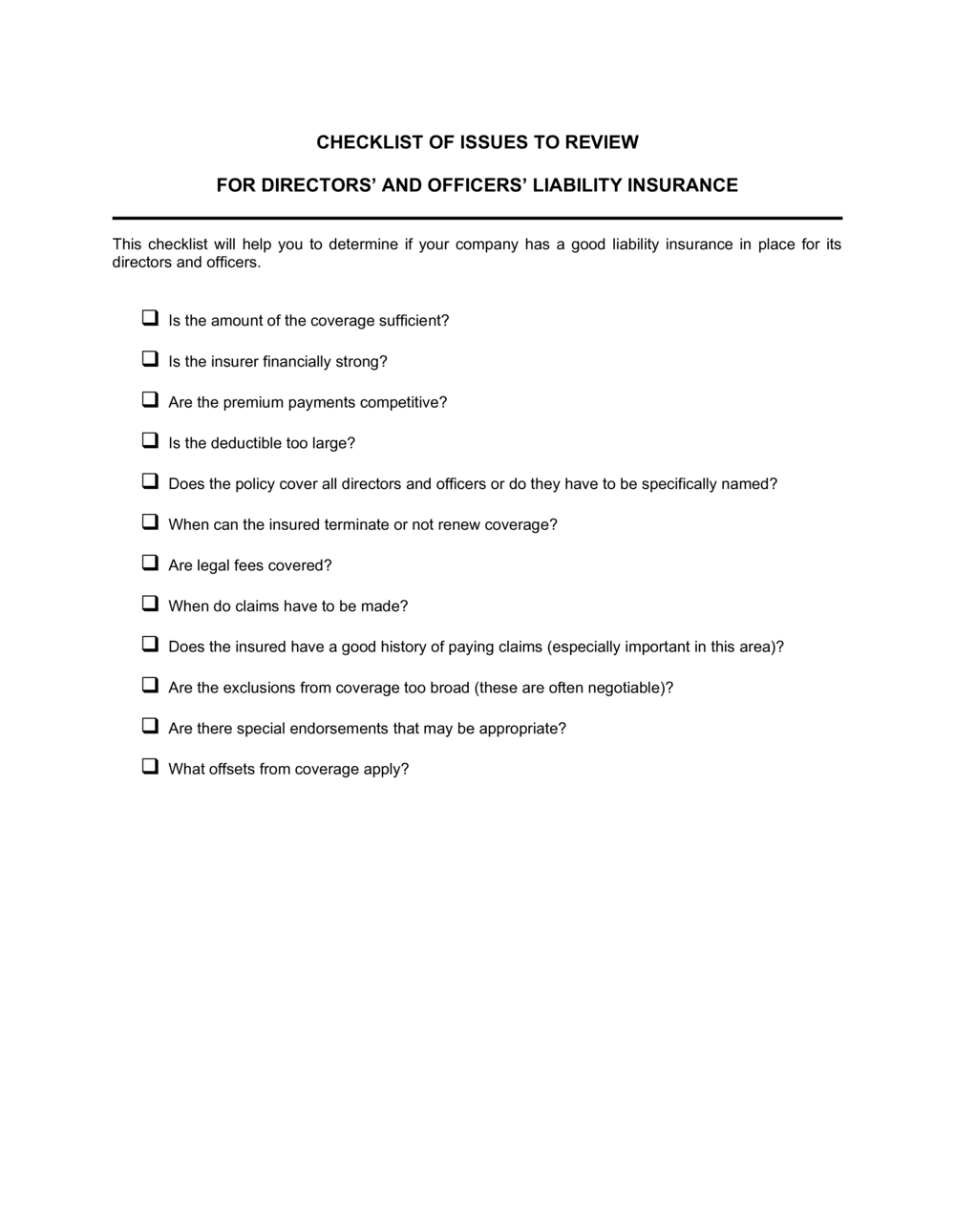
A Directors and Officers Insurance Checklist is a structured form used to evaluate, compare, and track D&O liability coverage for a company's board members and senior executives. This free Word download gives risk managers, CFOs, and governance teams a systematic way to verify policy terms, coverage limits, exclusions, and renewal dates in a single document.
When you need it
Use it when purchasing D&O coverage for the first time, renewing an existing policy, comparing quotes from multiple insurers, or onboarding new board members who need to confirm coverage is in place.
What's inside
Company and policy identification fields, coverage type and limit fields, key exclusion tracking, claims-made versus occurrence basis notation, Side A/B/C coverage breakdown, renewal and premium tracking, and a carrier contact reference section.

What is a Directors and Officers Insurance Checklist?

A Directors and Officers Insurance Checklist is a structured reference form used to record, verify, and track the essential terms of a D&O liability policy β€” including coverage limits, policy period, Side A/B/C breakdown, exclusions, retentions, and renewal deadlines. Rather than requiring board members or governance teams to read a 60-page policy each time a question arises, the checklist extracts the fields that matter most for day-to-day risk management and annual coverage reviews. It is available as a free Word download that can be edited online and exported as a PDF for board packets, audits, or insurer comparisons.

Why You Need This Document

Without a completed D&O insurance checklist, critical policy details β€” the retroactive date on a claims-made policy, which coverage sides are active, the tail coverage exercise window β€” get buried in dense policy language and surface only when a claim makes them urgent. A missed renewal submission deadline can leave directors personally exposed for weeks while a lapsed policy is reinstated. Investors and auditors increasingly request documented evidence that D&O coverage is current and adequate; a completed checklist satisfies that request in minutes rather than hours of policy review. For startups with VC-mandated coverage requirements and nonprofits protecting volunteer board members, this checklist turns a filing-cabinet document into an actionable governance tool.

Which variant fits your situation?

If your situation is…Use this template
Comparing D&O policies from multiple insurers side by sideInsurance Comparison Checklist
Tracking all corporate insurance policies in one placeCorporate Insurance Register
Evaluating errors and omissions coverage for professional services firmsErrors and Omissions Insurance Checklist
Documenting cyber liability insurance coverage detailsCyber Liability Insurance Checklist
Reviewing general liability coverage for a small businessGeneral Liability Insurance Checklist
Preparing an insurance summary for a board governance reportBoard Meeting Agenda

Common mistakes to avoid

❌ Listing the trade name instead of the legal entity name

Why it matters: If the named insured on the checklist and policy doesn't match the company's legal registration, the insurer has grounds to dispute a claim on a technicality.

Fix: Pull the certificate of incorporation or articles of organization and copy the exact legal name into the checklist header before any other fields.
❌ Leaving the retroactive date blank on a claims-made policy

Why it matters: Without tracking the retroactive date, the company may unknowingly lack coverage for wrongful acts committed before the current policy's start β€” a gap that surfaces at the worst possible moment.

Fix: Locate the retroactive date on the declarations page and enter it in the checklist at every renewal. If switching carriers, confirm the new policy matches or precedes the prior retroactive date.

❌ Tracking only the policy expiration date, not the renewal submission deadline

Why it matters: Most D&O carriers require renewal applications 60–90 days before expiry. Missing this window forces a rushed renewal with fewer carrier options and less negotiating leverage on pricing and terms.

Fix: Record the renewal submission deadline as a separate field and add a calendar reminder 90 days before the policy expires.

❌ Not separating Side A and Side B retentions

Why it matters: Applying the wrong retention in a claim calculation leads to budget shortfalls; in a real claim, the company may discover it owes more out of pocket than expected.

Fix: Record each side's retention as its own line item in the checklist and confirm the amounts directly against the policy schedule of retentions.

The 10 key fields, explained

Company and entity information

Policy number and carrier details

Policy period and renewal date

Coverage basis (claims-made vs. occurrence)

Aggregate limit and per-claim limit

Side A / B / C coverage confirmation

Key exclusions log

Retention (deductible) by coverage side

Annual premium and payment schedule

Tail coverage and extended reporting period options

How to fill it out

  1. 1

    Enter company and entity details

    Fill in the insured entity's full legal name, state of incorporation, and entity type in the header section. Cross-reference your corporate registry filing to confirm the exact name matches the policy.

    πŸ’‘ If the company has subsidiaries that are named insureds, list each entity separately rather than using a parent company umbrella entry.

  2. 2

    Record policy number and carrier contact

    Enter the insurer name, policy number, and your broker's direct contact. This section should be updated at every renewal to reflect the current policy number.

    πŸ’‘ Store a scanned copy of the declarations page alongside the completed checklist so both documents are accessible in the same folder.

  3. 3

    Confirm policy period and renewal deadline

    Enter the effective date, expiration date, and the submission deadline for renewal applications β€” typically 60–90 days before expiry.

    πŸ’‘ Set a calendar reminder 90 days before the expiration date. Starting the renewal process late limits your ability to negotiate terms or switch carriers.

  4. 4

    Verify coverage basis and retroactive date

    Check whether the policy is claims-made or occurrence, and if claims-made, record the retroactive date exactly as stated in the declarations page.

    πŸ’‘ When switching carriers, confirm the new carrier will honor the retroactive date from your prior policy to avoid a coverage gap for past acts.

  5. 5

    Record limits, retentions, and Side A/B/C breakdown

    Enter the aggregate and per-claim limits, then confirm which coverage sides are included and note any sublimits. Record the retention for each applicable side separately.

    πŸ’‘ Compare the per-claim limit against the company's current litigation exposure β€” if the company is publicly traded or has recently closed a funding round, standard limits may be insufficient.

  6. 6

    Log key exclusions

    Review the policy's exclusions section and check off each standard exclusion β€” fraud, prior known claims, bodily injury, insured vs. insured β€” in the exclusions log field.

    πŸ’‘ Ask your broker to provide a plain-English exclusions summary if the policy language is unclear. Knowing exclusions before a claim arises is the entire value of this step.

  7. 7

    Note tail coverage options and trigger events

    Record whether tail coverage is available, its estimated cost, and the specific events that would trigger the need for it β€” such as a merger, acquisition, or director departure.

    πŸ’‘ For companies in late-stage fundraising or M&A discussions, price tail coverage now. The option window after a triggering event is short and the cost rises significantly under deadline pressure.

Frequently asked questions

What is a directors and officers insurance checklist?

A directors and officers insurance checklist is a structured form used to record, verify, and track the key terms of a D&O liability policy β€” including coverage limits, policy period, exclusions, retentions, and renewal dates. It helps risk managers, CFOs, and governance officers confirm that coverage is current and adequate without reading the full policy each time.

Who should complete a D&O insurance checklist?

Typically the CFO, risk manager, corporate legal counsel, or board secretary completes it at policy inception and updates it at each annual renewal. Startups and nonprofits often assign this to the founder or executive director. The completed checklist should be shared with the full board so each member can confirm they are named as an insured.

What is the difference between Side A, Side B, and Side C D&O coverage?

Side A covers individual directors and officers directly when the company cannot or will not indemnify them. Side B reimburses the company after it has already advanced defense costs on behalf of a director or officer. Side C, also called entity coverage, protects the company itself against securities claims brought alongside individual director claims. Not all policies include all three sides β€” the checklist confirms which are active.

Do private companies need D&O insurance?

Yes. Private companies face D&O claims from investors, creditors, employees, and regulators β€” not just securities plaintiffs. Venture-backed startups are frequently required by investors to carry D&O coverage as a condition of funding. Nonprofits also need it to protect volunteer board members from personal liability for governance decisions.

What does a claims-made policy mean for a D&O checklist?

A claims-made policy covers claims reported during the active policy period, regardless of when the underlying act occurred β€” subject to the retroactive date. The checklist should record the retroactive date precisely, because any act before that date is excluded. When switching insurers, confirming that the new retroactive date matches the prior one is critical to avoiding a gap in historical coverage.

How often should a D&O insurance checklist be updated?

Update it at every annual renewal, whenever the company adds or removes board members, after any material change in coverage terms, and immediately following a merger, acquisition, or significant funding event. A checklist that is more than 12 months old may not reflect current policy numbers, limits, or carrier contacts.

What is tail coverage and when does the checklist help?

Tail coverage, or an extended reporting period endorsement, allows claims to be reported after a claims-made policy expires β€” typically triggered by a company sale, merger, or non-renewal. The checklist's tail coverage field records availability, estimated cost, and trigger events so the company can act within the short exercise window, which is commonly 30–60 days after the policy ends.

Can I use this checklist for multiple D&O policies across subsidiaries?

Yes. Complete a separate checklist for each named insured entity β€” parent and each subsidiary with its own policy β€” then store them together in a master insurance binder. Using one checklist for multiple entities with different policy numbers and limits creates confusion during a claim and makes annual audits harder to complete accurately.

How this compares to alternatives

vs Full D&O Insurance Policy

A full D&O policy is a 40–80 page legal contract issued by the insurer. The checklist is a one-page summary that extracts only the fields a governance team needs to monitor day-to-day. The checklist does not replace the policy β€” it is a reference tool that points you to the right section of the policy when a question arises.

vs Certificate of Insurance

A certificate of insurance is a standardized one-page document issued by the broker to prove coverage exists; it does not capture exclusions, retentions, or Side A/B/C breakdowns. The D&O checklist goes deeper, recording the details that matter for governance decisions and claim preparedness rather than just confirming that a policy is in force.

vs Corporate Insurance Register

A corporate insurance register tracks all policies β€” general liability, property, cyber, D&O, E&O β€” at a high level in one spreadsheet. The D&O checklist focuses exclusively on directors and officers coverage with the granular fields (retroactive date, Side A/B/C, tail coverage) that a single-line register row cannot accommodate.

vs Board Meeting Agenda

A board meeting agenda governs the structure of a governance session; it does not capture insurance details. The D&O checklist is typically attached as an exhibit to the agenda when insurance renewal or coverage confirmation appears as a board agenda item, providing members with the specific policy data they need to vote on coverage decisions.

Industry-specific considerations

Technology / SaaS

Venture-backed startups are commonly required by lead investors to show active D&O coverage with specific minimum limits before a funding round closes.

Financial Services

Regulated entities must track D&O policy terms alongside FINRA and SEC compliance records; regulators and auditors may request evidence of current coverage.

Nonprofit Organizations

Volunteer board members often serve without reading the full policy; the checklist gives them a plain-English summary of the coverage protecting them personally.

Healthcare

Hospital boards and health system governance teams track D&O coverage alongside professional liability policies to ensure no gap exists between executive and clinical liability.

Template vs pro β€” what fits your needs?

PathBest forCostTime
Use the templateCFOs, risk managers, and governance teams performing annual D&O policy reviews at any company sizeFree30–60 minutes per policy
Template + professional reviewCompanies with complex multi-entity structures or policies with unusual exclusions and sublimits$200–$500 for a broker or risk consultant review1–2 days
Custom draftedPublic companies, heavily regulated financial institutions, or organizations with active D&O litigation requiring counsel-supervised coverage analysis$1,000–$3,000+ for legal or specialist risk advisory1–2 weeks

Glossary

Directors and Officers (D&O) Insurance
A liability policy that pays for defense costs and damages when directors or officers are personally sued for alleged wrongful acts in managing the company.
Side A Coverage
The portion of a D&O policy that covers individual directors and officers directly when the company cannot or will not indemnify them.
Side B Coverage
The portion that reimburses the company when it has already advanced defense costs or indemnified a director or officer.
Side C Coverage
Also called entity coverage, this protects the company itself against securities claims brought alongside claims against individual directors.
Claims-Made Policy
A policy structure where coverage applies only to claims reported during the active policy period, regardless of when the alleged wrongful act occurred.
Occurrence Policy
A policy structure where coverage applies to any wrongful act that occurred during the policy period, even if the claim is filed after the policy expires.
Retroactive Date
The earliest date from which alleged wrongful acts are covered under a claims-made D&O policy β€” acts before this date are excluded.
Retention (Deductible)
The amount the company or individual must pay out of pocket before the D&O insurer begins covering costs on a given claim.
Aggregate Limit
The maximum total amount the insurer will pay for all covered claims during a single policy period.
Tail Coverage (Extended Reporting Period)
An optional endorsement that extends the reporting window for claims after a claims-made policy expires or is cancelled, typically used when a company is sold or a board member retires.

Part of your Business Operating System

This document is one of 3,000+ business & legal templates included in Business in a Box.

  • Fill-in-the-blanks β€” ready in minutes
  • 100% customizable Word document
  • Compatible with all office suites
  • Export to PDF and share electronically

Create your document in 3 simple steps.

From template to signed document β€” all inside one Business Operating System.
1
Download or open template

Access over 3,000+ business and legal templates for any business task, project or initiative.

2
Edit and fill in the blanks with AI

Customize your ready-made business document template and save it in the cloud.

3
Save, Share, Send, Sign

Share your files and folders with your team. Create a space of seamless collaboration.

Save time, save money, and create top-quality documents.

β˜…β˜…β˜…β˜…β˜…

"Fantastic value! I'm not sure how I'd do without it. It's worth its weight in gold and paid back for itself many times."

Managing Director Β· Mall Farm
Robert Whalley
Managing Director, Mall Farm Proprietary Limited
β˜…β˜…β˜…β˜…β˜…

"I have been using Business in a Box for years. It has been the most useful source of templates I have encountered. I recommend it to anyone."

Business Owner Β· 4+ years
Dr Michael John Freestone
Business Owner
β˜…β˜…β˜…β˜…β˜…

"It has been a life saver so many times I have lost count. Business in a Box has saved me so much time and as you know, time is money."

Owner Β· Upstate Web
David G. Moore Jr.
Owner, Upstate Web

Run your business with a system β€” not scattered tools

Stop downloading documents. Start operating with clarity. Business in a Box gives you the Business Operating System used by over 250,000 companies worldwide to structure, run, and grow their business.

Free Forever PlanΒ Β·Β No credit card required