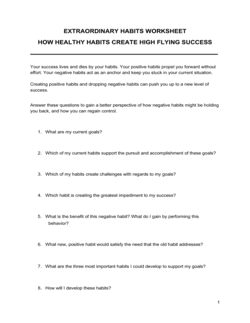
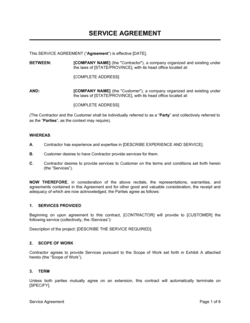
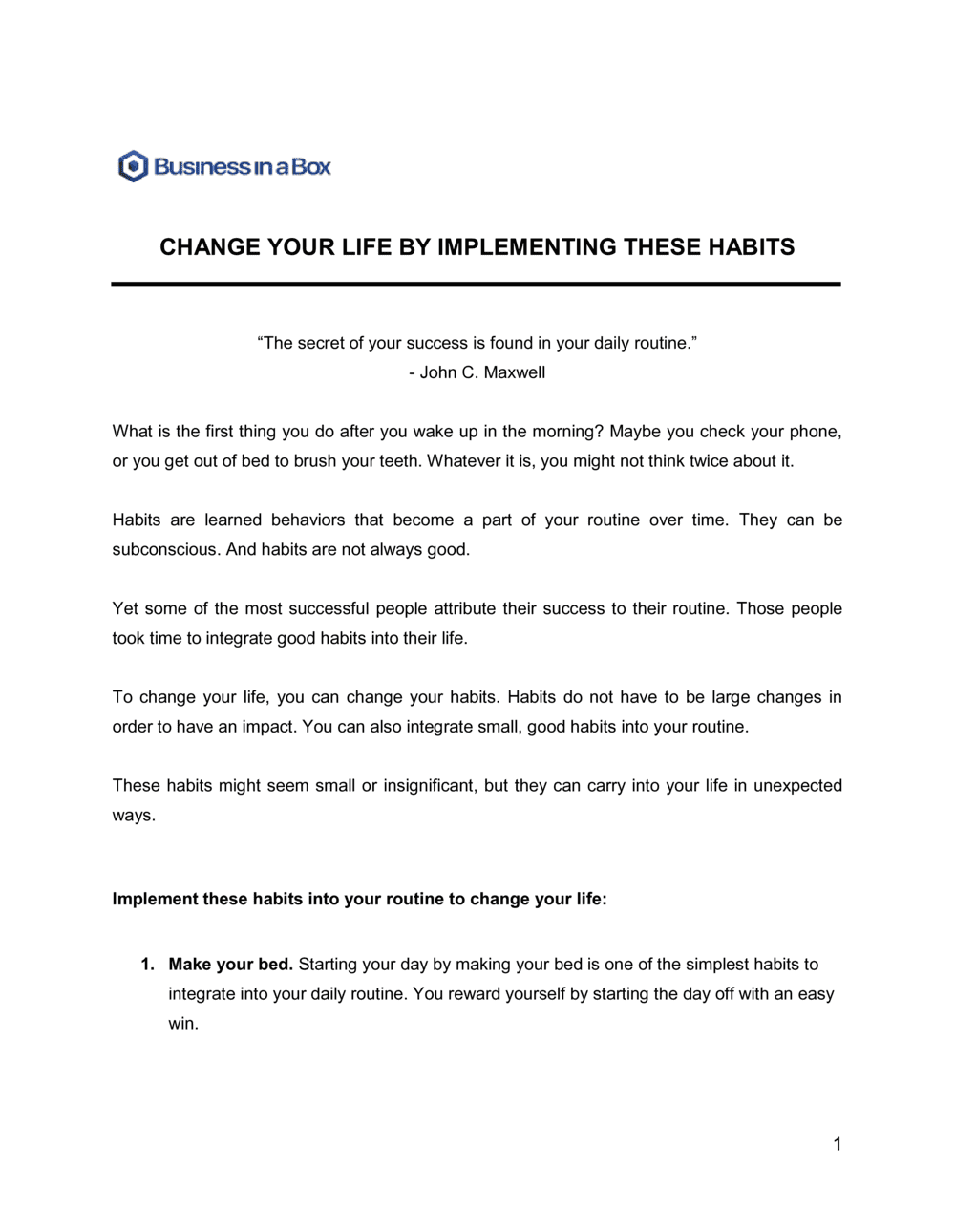
Change Your Life By Implementing These Habits Template

Free Word download β€’ Edit online β€’ Save & share with Drive β€’ Export to PDF

3 pagesβ€’20–30 min to fillβ€’Difficulty: Standardβ€’Signature requiredβ€’Legal review recommended
Learn more ↓
FreeChange Your Life By Implementing These Habits Template

At a glance

What it is
A Personal Habits Commitment Agreement is a written, signed document in which one or more parties formally commit to adopting, maintaining, or discontinuing specific behaviors over a defined period. This free Word download lets you set measurable habit targets, define an accountability structure, and establish review milestones β€” all in a single document you can edit online and export as PDF.
When you need it
Use it when you want a structured, enforceable framework for a personal development goal β€” such as a wellness program, executive coaching engagement, or peer accountability partnership β€” where informal promises have previously failed to produce lasting change.
What's inside
Defined habit goals with measurable benchmarks, a review and check-in schedule, accountability partner obligations, consequences for non-compliance, a modification procedure, and a governing terms clause covering confidentiality and dispute resolution.

What is a Personal Habits Commitment Agreement?

A Personal Habits Commitment Agreement is a signed, written document in which one party β€” the committed party β€” formally agrees to adopt, maintain, or discontinue specific behaviors over a defined period, with a named accountability partner designated to monitor progress and conduct regular reviews. Unlike an informal goal-setting conversation or a self-directed worksheet, this agreement sets measurable benchmarks for each habit, establishes a scheduled review cadence, and defines consequences for non-compliance β€” transforming personal intentions into documented, bilateral obligations. Coaches, HR professionals, wellness practitioners, and peer accountability partners use this format when informal promises have consistently failed to produce lasting behavior change.

Why You Need This Document

Without a written commitment agreement, personal development goals collapse into good intentions β€” there is no benchmark to assess, no review date to prepare for, and no consequence when momentum stalls. Research on behavior change consistently shows that people who sign a written commitment with a named accountability partner are significantly more likely to follow through than those who set goals verbally or in private. For coaches and wellness professionals, the absence of a documented commitment creates disputes about what was agreed to, exposes the practitioner to claims that they failed to support the client, and leaves sensitive personal information unprotected by any confidentiality obligation. This template gives every habit goal a measurable standard, every review period a fixed date, and every accountability relationship a clear scope β€” so that when a goal is missed, both parties know exactly what happens next, and when a goal is met, there is a written record to prove it.

Which variant fits your situation?

If your situation is…Use this template
Two peers holding each other mutually accountable for habit goalsMutual Accountability Agreement
Coaching engagement where habits are tied to paid deliverablesLife Coaching Services Agreement
Employee wellness program with employer-sponsored incentivesEmployee Wellness Agreement
Group or cohort setting with multiple participants and shared goalsGroup Commitment Agreement
Short-term 30-day challenge with defined start and end date30-Day Challenge Commitment Form
Parent and child agreeing on behavior change goals togetherFamily Behavior Agreement
Recovery or sobriety program requiring formal behavioral commitmentsRecovery Support Agreement

Common mistakes to avoid

❌ Vague habit goals without measurable benchmarks

Why it matters: Goals like 'sleep better' or 'be more productive' cannot be objectively assessed at review. Both parties end up arguing about whether the standard was met, which erodes trust and defeats the purpose of the agreement.

Fix: Rewrite every goal in the format: '[SPECIFIC BEHAVIOR] at least [FREQUENCY / QUANTITY] per [PERIOD].' Every goal should pass the question: could a third party determine with certainty whether it was met?

❌ No scheduled review dates in the document

Why it matters: Without fixed review dates, check-ins become informal and irregular, progress reports stop being submitted, and the agreement becomes meaningless within two to four weeks of signing.

Fix: Enter specific calendar dates for every review in the agreement and schedule them immediately at signing. Treat review dates as binding appointments with the same weight as the habit goals themselves.

❌ Consequence clause set too high to enforce

Why it matters: A disproportionate penalty β€” $1,000 for missing a single workout β€” will be quietly ignored by both parties, destroying the agreement's credibility as a commitment mechanism.

Fix: Set consequences that sting without being catastrophic: a $25–$100 charitable donation per missed benchmark is motivating and consistently enforced in practice.

❌ No confidentiality clause covering the accountability partner

Why it matters: Personal habit goals often involve sensitive health, financial, or relationship information. A partner who shares this casually β€” even without malicious intent β€” causes real harm and potential liability.

Fix: Include an explicit confidentiality clause that names the categories of information covered and survives termination of the agreement by at least two years.

The 10 key clauses, explained

Parties and Recitals

In plain language: Identifies the committed party and the accountability partner by full legal name, describes the purpose of the agreement, and records the effective date.

Sample language
This Personal Habits Commitment Agreement ('Agreement') is entered into as of [DATE] between [COMMITTED PARTY FULL NAME] ('Committed Party') and [ACCOUNTABILITY PARTNER FULL NAME] ('Accountability Partner').

Common mistake: Using nicknames or informal names instead of legal names. If a consequence clause ever needs to be enforced, ambiguous party identification weakens the document's standing.

Habit Goals and Measurable Benchmarks

In plain language: Lists each specific habit the committed party agrees to adopt or discontinue, with a quantifiable benchmark for each and the frequency at which it must be met.

Sample language
Committed Party agrees to: (a) exercise for a minimum of [X] minutes at least [Y] days per week; (b) limit social media use to no more than [Z] minutes per day; (c) complete [ACTIVITY] each morning before [TIME].

Common mistake: Defining habits in vague terms like 'exercise more' or 'eat healthier.' Goals without specific, measurable benchmarks cannot be objectively assessed during a review period.

Term and Review Schedule

In plain language: Sets the agreement's start and end dates and establishes the cadence of check-ins β€” weekly, monthly, or quarterly β€” at which progress is formally reviewed.

Sample language
This Agreement commences on [START DATE] and expires on [END DATE], unless extended by mutual written consent. The parties shall conduct formal reviews on [DAY/FREQUENCY], with Committed Party submitting a progress report no later than [X] hours before each review.

Common mistake: Omitting a specific review schedule and leaving check-ins informal. Without documented review dates, accountability partners and committed parties drift into inconsistent follow-up, undermining the agreement's purpose.

Accountability Partner Obligations

In plain language: Defines what the accountability partner is expected to do β€” attend check-ins, review submitted progress reports, provide feedback β€” and limits their liability for the committed party's outcomes.

Sample language
Accountability Partner agrees to: (a) attend all scheduled reviews; (b) review progress reports within [X] business days of receipt; (c) provide written feedback at each review. Accountability Partner is not responsible for Committed Party's failure to meet any Habit Goal.

Common mistake: Leaving the accountability partner's role undefined. Vague expectations cause disputes about whether the partner fulfilled their obligations when the committed party fails to meet goals.

Consequence and Incentive Clause

In plain language: Specifies the agreed consequence for missing benchmarks β€” such as a financial penalty, forfeited deposit, or charitable donation β€” and any positive incentive for consistent compliance.

Sample language
If Committed Party fails to meet [X] or more Habit Goals in any Review Period, Committed Party shall [pay $[AMOUNT] to [BENEFICIARY] / forfeit [DEPOSIT AMOUNT] / donate $[AMOUNT] to [CHARITY]] within [Y] days of that review.

Common mistake: Setting consequences so severe that neither party enforces them. A $5,000 penalty for missing one gym session is unrealistic and will be ignored; calibrate consequences to the seriousness of the goal.

Confidentiality

In plain language: Prohibits the accountability partner from disclosing the committed party's personal goals, progress data, setbacks, or personal information to any third party without written consent.

Sample language
Accountability Partner shall keep all information relating to Committed Party's Habit Goals, progress, and personal circumstances strictly confidential and shall not disclose such information to any third party without prior written consent from Committed Party.

Common mistake: Omitting confidentiality entirely. Accountability partnerships involve sensitive personal information β€” health status, financial behavior, relationship issues β€” that the committed party has a reasonable expectation of privacy around.

Modification Procedure

In plain language: Establishes how the habit goals or review schedule may be changed during the term β€” typically requiring a signed written amendment from both parties.

Sample language
Any modification to the Habit Goals, Review Schedule, or Consequence Clause must be made in writing and signed by both parties. Oral modifications are not valid and shall have no effect on this Agreement.

Common mistake: Allowing informal modifications by text or email without a formal amendment process. Undocumented changes create disputes about what was actually agreed to at any given point during the term.

Force Majeure and Suspension

In plain language: Excuses the committed party's non-compliance when a qualifying event β€” serious illness, bereavement, or other circumstances outside their reasonable control β€” makes compliance impossible.

Sample language
Committed Party's obligations shall be suspended during any period in which performance is prevented by [SERIOUS ILLNESS / BEREAVEMENT / NATURAL DISASTER / OTHER QUALIFYING EVENT], provided Committed Party notifies Accountability Partner in writing within [X] days of the qualifying event.

Common mistake: Defining force majeure too broadly, such that any inconvenience qualifies. A well-drawn clause covers genuine incapacity, not missed goals due to poor time management.

Term, Termination, and Early Exit

In plain language: States the conditions under which either party may end the agreement before the scheduled expiry β€” typically by written notice β€” and what happens to any financial deposits or consequences upon early termination.

Sample language
Either party may terminate this Agreement with [X] days' written notice. Upon termination, any forfeited deposit or consequence amounts accrued to the termination date shall be settled within [Y] days.

Common mistake: No early termination provision at all. When a coaching relationship or accountability partnership breaks down mid-term, the absence of an exit mechanism creates confusion about outstanding obligations.

Governing Law and Dispute Resolution

In plain language: Identifies the jurisdiction whose law governs the agreement and the method β€” negotiation, mediation, or arbitration β€” for resolving disputes before resorting to litigation.

Sample language
This Agreement is governed by the laws of [STATE / PROVINCE / COUNTRY]. Any dispute shall first be addressed through good-faith negotiation. If unresolved within [X] days, the parties agree to submit to [MEDIATION / BINDING ARBITRATION] in [CITY].

Common mistake: Omitting a dispute resolution clause entirely. Without one, minor disagreements about whether a benchmark was met have no structured resolution path and default to expensive litigation.

How to fill it out

  1. 1

    Identify and name both parties

    Enter the full legal names of the committed party and the accountability partner in the parties clause. If the accountability partner is a professional coach or employer, include their business entity name as well.

    πŸ’‘ Confirm the correct legal name by checking a government-issued ID or business registration β€” nicknames create enforceability ambiguity.

  2. 2

    Define each habit goal with a specific, measurable benchmark

    List every habit the committed party is committing to, with a number, frequency, and observable outcome for each. Avoid adjectives β€” use quantities.

    πŸ’‘ Limit the initial list to three to five habits. Agreements covering ten or more goals simultaneously produce low completion rates and diffuse accountability.

  3. 3

    Set the agreement term and review schedule

    Enter the start and end dates and choose a review cadence β€” weekly check-ins work for high-frequency habits; monthly suits longer-term behavior change goals.

    πŸ’‘ Block review dates on both parties' calendars the day the agreement is signed. Pre-scheduled reviews are three times more likely to occur than open-ended ones.

  4. 4

    Define the accountability partner's specific obligations

    List exactly what the accountability partner will do at each review: read the progress report, attend the call, provide written feedback within a set number of days.

    πŸ’‘ If the accountability partner is a paid professional, cross-reference their obligations in this agreement with the scope of work in the services contract.

  5. 5

    Calibrate the consequence and incentive clause

    Choose a consequence that is meaningful enough to motivate compliance but realistic enough that both parties will actually enforce it. Common options include a fixed cash penalty, a charitable donation, or forfeiture of a pre-paid deposit.

    πŸ’‘ Have the committed party name the charity or beneficiary personally β€” self-identified stakes produce higher follow-through than generic penalties.

  6. 6

    Add the confidentiality and modification clauses

    Confirm the confidentiality obligation covers all personal information the committed party shares during check-ins, and specify that modifications require a signed written amendment.

    πŸ’‘ If either party expects to share progress data with a third party β€” such as an employer or sponsor β€” add an explicit carve-out with the committed party's written consent.

  7. 7

    Select governing law and dispute resolution method

    Choose the jurisdiction where both parties primarily operate and a dispute resolution method proportionate to the financial stakes β€” negotiation for low-stakes agreements, mediation for those involving deposits over $500.

    πŸ’‘ For cross-border accountability partnerships, choose the jurisdiction where the committed party is located, as that is typically where any enforcement action would be needed.

  8. 8

    Execute before the start date

    Both parties must sign the agreement before the first review period begins. Post-start signatures create ambiguity about which review periods fall under the agreement's terms.

    πŸ’‘ Use a timestamped eSignature tool to record the exact execution date and store the fully signed copy in a shared location accessible to both parties.

Frequently asked questions

What is a personal habits commitment agreement?

A personal habits commitment agreement is a written, signed document in which one party formally commits to adopting, maintaining, or discontinuing specific behaviors over a defined period, with an accountability partner designated to monitor progress and enforce review check-ins. It transforms informal intentions into structured, documented obligations with defined consequences for non-compliance. Coaches, HR professionals, and wellness practitioners commonly use this format to give personal development goals the same rigor as a professional contract.

Is a personal habits commitment agreement legally binding?

A personal habits commitment agreement can be generally enforceable as a contract when it contains the standard elements of a valid agreement β€” offer, acceptance, consideration, and mutual intent β€” and is signed by both parties. However, enforceability of consequence clauses (particularly financial penalties) varies by jurisdiction and the nature of the obligation. In most cases, the primary value of the document is behavioral rather than litigious β€” the act of signing increases follow-through significantly even without court enforcement. Consider consulting a lawyer if financial stakes exceed $500 or if the agreement is tied to a professional services engagement.

Who should be named as an accountability partner?

An accountability partner can be a professional coach, a trusted peer, a manager in an employer-sponsored wellness program, or any person both parties agree is suitable. The key requirements are availability for all scheduled reviews, genuine commitment to providing honest feedback, and willingness to enforce the consequence clause if benchmarks are missed. Professional coaches acting as accountability partners should also be covered by a separate services agreement defining their compensation and scope of work.

What happens if the committed party misses a habit goal?

The agreement's consequence clause governs what occurs when a benchmark is missed during a review period. Typical consequences include a fixed cash payment to a named charity, forfeiture of a pre-paid deposit, or a defined additional obligation for the following period. The consequence should be documented, agreed upon before signing, and applied consistently β€” selective enforcement undermines the entire accountability framework.

Can the habit goals be changed after the agreement is signed?

Yes, but only through the modification procedure defined in the agreement β€” typically a written amendment signed by both parties. Oral changes or informal text-message agreements are not valid under a well-drafted modification clause and will not be recognized if a dispute arises. Changes to goals are reasonable when circumstances change materially, such as a health event that makes a specific habit physically impossible.

What if illness or an emergency prevents the committed party from complying?

A force majeure clause suspends the committed party's obligations during a qualifying event β€” serious illness, bereavement, or comparable circumstances beyond their reasonable control. The committed party typically must notify the accountability partner in writing within a defined number of days. The suspension period does not count toward the agreement's term, effectively pausing the clock until normal circumstances resume.

How is this different from a life coaching services agreement?

A life coaching services agreement governs the commercial relationship between a coach and a client β€” fees, deliverables, cancellation policy, and liability. A personal habits commitment agreement documents the specific behavioral goals the client commits to within that engagement. Both documents can coexist: the coaching agreement sets the professional framework; the habits agreement captures the client's personal commitments in enforceable written form.

Should this agreement be notarized?

Notarization is not typically required for a personal habits commitment agreement. Signatures from both parties, a clear date of execution, and a stored copy accessible to both parties are sufficient in most circumstances. Notarization may be worth considering if the agreement involves significant financial deposits β€” generally above $1,000 β€” or if either party anticipates the other might dispute the authenticity of their signature.

How long should the agreement term be?

Most habit research supports a 60-to-90-day initial term β€” long enough for behavioral patterns to consolidate, short enough to maintain urgency. After the first term, the parties can extend with updated goals or graduated benchmarks. Agreements running longer than six months without a mid-term review tend to lose momentum; build in at least one formal milestone review at the halfway point for any term exceeding 90 days.

How this compares to alternatives

vs Life Coaching Services Agreement

A life coaching services agreement defines the commercial terms of a coaching engagement β€” session fees, deliverables, cancellation policy, and liability. A personal habits commitment agreement documents the specific behavioral goals the client commits to during that engagement. They serve different functions and can coexist in the same coaching relationship; the services agreement governs the professional framework while the habits agreement captures the client's personal obligations.

vs Employee Wellness Agreement

An employee wellness agreement is issued by an employer as part of a workplace wellness program, typically with employer-sponsored incentives and HR oversight. A personal habits commitment agreement is a bilateral document between any two consenting parties β€” it does not require an employment relationship. Use the employee wellness format when employer obligations and incentive structures are involved; use the personal habits agreement for independent coaching or peer accountability arrangements.

vs Behavioral Health Treatment Agreement

A behavioral health treatment agreement is used in clinical settings β€” therapy, addiction recovery, psychiatric care β€” and carries specific regulatory and professional licensing implications. A personal habits commitment agreement is a non-clinical document for general personal development goals. Anyone dealing with diagnosed mental health conditions or substance use disorders should use a clinical treatment agreement prepared with qualified professional guidance rather than a general habits template.

vs Goal-Setting Worksheet

A goal-setting worksheet is an internal planning tool β€” no signatures, no accountability partner, no consequence clauses. It is useful for individual reflection but creates no enforceable obligations. A personal habits commitment agreement is a bilateral signed document with defined review dates and real consequences for non-compliance. Research consistently shows that signed commitments with accountability structures produce significantly higher follow-through than self-directed worksheets.

Industry-specific considerations

Professional Coaching

Coaches use this agreement to formalize client commitments between sessions, creating a written record that reinforces verbal goal-setting and supports progress reporting at each coaching touchpoint.

Human Resources / Corporate Wellness

HR teams embed this format into structured wellness or leadership development programs, linking habit commitments to measurable performance outcomes and employer-sponsored incentive structures.

Healthcare and Allied Health

Allied health practitioners β€” physiotherapists, dietitians, psychologists β€” use commitment agreements to document patient behavior-change plans, reinforcing clinical recommendations between appointments.

Education and Training

Training programs and academic institutions use habit commitment agreements to structure student accountability during intensive learning cohorts, tying study behaviors to measurable academic milestones.

Jurisdictional notes

United States

Personal commitment agreements are generally enforceable as contracts under common law when supported by consideration β€” typically the mutual exchange of obligations between parties. Consequence clauses involving financial penalties may be scrutinized as liquidated damages; courts in most states will uphold them if the amount is a reasonable estimate of actual harm rather than a punitive figure. California and New York have specific rules on personal services contracts that may affect professional coaching arrangements where this agreement accompanies a services contract.

Canada

Canadian contract law requires offer, acceptance, and consideration for enforceability. Mutual habit commitments between peers typically satisfy the consideration requirement. Financial penalty clauses are assessed under the penalty-versus-liquidated-damages distinction β€” Canadian courts, particularly in Ontario and British Columbia, will void penalty clauses found to be punitive rather than compensatory. Quebec's civil law framework under the Civil Code of Quebec applies different interpretive rules; agreements involving Quebec residents should include a French version for clarity.

United Kingdom

Under English and Welsh contract law, a personal habits commitment agreement requires consideration to be binding β€” nominal consideration (a small payment or mutual exchange of promises) is generally sufficient. Financial consequence clauses are subject to the rule against penalties established in Cavendish Square v. Makdessi (2015); clauses must represent a legitimate interest proportionate to the breach. Scottish law follows similar common-law principles but with some distinct procedural differences in enforcement.

European Union

Enforceability of personal commitment agreements across EU member states varies significantly β€” Germany, France, and the Netherlands each apply their own civil code frameworks. GDPR is particularly relevant: any accountability partner who records, stores, or processes the committed party's personal progress data β€” health metrics, behavioral records β€” may be acting as a data controller under GDPR and must comply with lawful basis, data minimization, and subject-access requirements. Including a brief data processing acknowledgment within the confidentiality clause is advisable for EU-based parties.

Template vs lawyer β€” what fits your deal?

PathBest forCostTime
Use the templateIndividuals, coaches, and HR teams establishing personal or peer accountability frameworks with no financial stakes above $500Free20–30 minutes
Template + legal reviewCoaching professionals whose accountability obligations are tied to a paid services contract, or programs involving financial deposits$200–$500 for a one-hour lawyer review1–3 days
Custom draftedCorporate wellness programs with employer-funded incentives, clinical settings, or agreements involving financial stakes above $2,000$800–$2,5001–2 weeks

Glossary

Committed Party
The individual who formally agrees to adopt, maintain, or discontinue specific habits under the terms of the agreement.
Accountability Partner
A person designated in the agreement to monitor progress, receive check-in reports, and enforce the agreed review schedule.
Habit Goal
A specific, measurable behavioral objective β€” such as exercising four times per week or limiting screen time to two hours per day β€” defined in the agreement.
Review Period
A defined interval β€” weekly, monthly, or quarterly β€” at which the parties assess progress against the habit goals and document outcomes.
Measurable Benchmark
A quantifiable indicator used to determine whether a habit goal has been met during a review period.
Consequence Clause
A provision specifying what occurs if the committed party fails to meet the agreed benchmarks β€” such as a financial penalty, forfeited deposit, or program suspension.
Modification Procedure
The agreed process for amending habit goals or review terms during the agreement's term, typically requiring written consent from both parties.
Confidentiality Obligation
A clause requiring the accountability partner not to disclose the committed party's personal goals, progress data, or setbacks to third parties.
Force Majeure
A provision excusing a party's non-performance when compliance is prevented by circumstances outside their reasonable control, such as serious illness or bereavement.
Term and Termination
The start and end dates of the agreement and the conditions under which either party may end the arrangement early.
Integration Clause
A provision stating that the written agreement is the complete and final record of the parties' commitments, superseding any prior verbal or written understandings.

Part of your Business Operating System

This document is one of 3,000+ business & legal templates included in Business in a Box.

  • Fill-in-the-blanks β€” ready in minutes
  • 100% customizable Word document
  • Compatible with all office suites
  • Export to PDF and share electronically

Create your document in 3 simple steps.

From template to signed document β€” all inside one Business Operating System.
1
Download or open template

Access over 3,000+ business and legal templates for any business task, project or initiative.

2
Edit and fill in the blanks with AI

Customize your ready-made business document template and save it in the cloud.

3
Save, Share, Send, Sign

Share your files and folders with your team. Create a space of seamless collaboration.

Save time, save money, and create top-quality documents.

β˜…β˜…β˜…β˜…β˜…

"Fantastic value! I'm not sure how I'd do without it. It's worth its weight in gold and paid back for itself many times."

Managing Director Β· Mall Farm
Robert Whalley
Managing Director, Mall Farm Proprietary Limited
β˜…β˜…β˜…β˜…β˜…

"I have been using Business in a Box for years. It has been the most useful source of templates I have encountered. I recommend it to anyone."

Business Owner Β· 4+ years
Dr Michael John Freestone
Business Owner
β˜…β˜…β˜…β˜…β˜…

"It has been a life saver so many times I have lost count. Business in a Box has saved me so much time and as you know, time is money."

Owner Β· Upstate Web
David G. Moore Jr.
Owner, Upstate Web

Run your business with a system β€” not scattered tools

Stop downloading documents. Start operating with clarity. Business in a Box gives you the Business Operating System used by over 250,000 companies worldwide to structure, run, and grow their business.

Start freeΒ Β·Β No credit card required